Education 9 min read
Cannabis During Pregnancy and Breastfeeding in Canada
Canada-aware guide on cannabis during pregnancy and breastfeeding, including risks, CBD, nausea, provider questions, and safer support steps.
Short answer: Canadian public-health guidance is clear that the safest choice is not to use cannabis during pregnancy or breastfeeding. That includes THC products, CBD products, edibles, oils, vapes, flower, concentrates, and medical cannabis unless a qualified health care provider is actively helping you weigh alternatives.
This guide is for adults in Canada who are trying to sort through confusing advice without being judged or sold to. Cannabis is legal for adults, but legal access does not mean every situation is low risk. Pregnancy, planning a pregnancy, and breastfeeding are situations where the stakes are different because substances can reach a fetus or infant, and because symptoms such as nausea, anxiety, sleep disruption, and pain deserve real care rather than guesswork.
The Weed Journal is not a medical provider. Use this as a plain-language preparation guide for a conversation with your doctor, midwife, nurse practitioner, pharmacist, public-health nurse, or another licensed clinician who knows your health history.
| Situation | Canada-aware takeaway | Best next step |
|---|---|---|
| Trying to conceive | Health Canada says cannabis use while trying to conceive carries risks and should be avoided. | Tell your provider what you use, how often, and why, including partner use if relevant. |
| Pregnant | There is no known safe amount of cannabis use during pregnancy. | Ask about safer ways to manage nausea, sleep, pain, stress, or appetite. |
| Breastfeeding | THC can pass into breast milk, and Health Canada advises avoiding cannabis while breastfeeding. | Discuss feeding plans and symptom support with a clinician before using any cannabis product. |
| Using medical cannabis | Medical cannabis is still cannabis, and pregnancy/breastfeeding changes the risk conversation. | Do not stop or switch prescribed care alone. Ask for a pregnancy-safe treatment review. |
| Using CBD | CBD products may contain THC, and the effects of CBD during pregnancy are not well understood. | Bring the exact product label or bottle to a pharmacist or prenatal-care appointment. |
Why legal cannabis is not the same as pregnancy-safe cannabis
Canada legalized adult-use cannabis so adults could access a regulated market instead of an illegal one. That policy change did not turn cannabis into a risk-free product. The federal cannabis framework still carries health warnings, age restrictions, impaired-driving rules, child-resistant packaging requirements, and product limits because cannabis can cause harm in certain situations.
Pregnancy and breastfeeding are among the clearest examples. Health Canada states that cannabis use while trying to conceive, while pregnant, or while breastfeeding carries risks and should be avoided. Public Health Agency of Canada guidance also says there is no known safe amount of cannabis use during pregnancy, and that the safest option is not to use cannabis during pregnancy.
That message can feel blunt, especially if someone has used cannabis for nausea, sleep, pain, anxiety, appetite, or trauma symptoms. The point is not to shame people. The point is that this is a situation where internet advice, product marketing, or a friend’s experience is not enough. A provider can help separate the symptom you are trying to manage from the substance you are using to manage it.
What may reach the fetus or baby?
THC is the intoxicating cannabinoid in cannabis. During pregnancy, chemicals in cannabis can move through the mother’s blood to the fetus. After birth, cannabis substances can pass into breast milk. Health Canada notes that cannabis use during pregnancy has been associated with lower birth weight and with longer-term developmental concerns such as memory, attention, reasoning, behaviour, and future substance-use risk.
Those statements need careful wording. They do not mean every exposure causes the same outcome, and they do not replace individual medical assessment. Pregnancy research is complicated because many factors can affect birth and child development outcomes. But when a credible public-health agency says there is no known safe amount, that is a strong reason to avoid experimenting on your own.
Breastfeeding deserves the same caution. Health Canada notes that THC has been found in breast milk after cannabis smoking, and that cannabinoids are stored in fat and released slowly. That matters because timing use around a feed is not as simple as waiting until the feeling of being high has passed.
CBD is not a loophole
CBD does not usually create the same intoxicating effect as THC, so it is often marketed as the “gentler” cannabinoid. During pregnancy or breastfeeding, that is not enough to make it safe. Public-health guidance says the effects of CBD during pregnancy are not well understood, and CBD products can contain trace amounts of THC.
There is also a practical label issue. In Canada, legal cannabis products list cannabinoid amounts, but people may still misread total THC, total CBD, activation language, serving size, or package totals. Unregulated CBD products are even more uncertain because label accuracy, contaminants, and THC content may not be reliable. If you are pregnant, planning pregnancy, or breastfeeding, bring any CBD product to a pharmacist or health care provider instead of relying on a package claim.
For label basics outside pregnancy-specific decisions, The Weed Journal’s guide to reading cannabis labels in Canada explains THC, CBD, warning symbols, lot information, and package details. In pregnancy and breastfeeding, though, label literacy is only the first step. The main recommendation remains avoidance unless your clinician is directly advising you.
Morning sickness, appetite, sleep, and anxiety need real support
One of the most common reasons people search this topic is nausea. Some adults hear that cannabis can help with nausea in other contexts and wonder whether it might help morning sickness. Health Canada says using cannabis to treat nausea or vomiting during pregnancy is not recommended, and encourages people to ask a health care provider about safer alternatives.
That does not mean symptoms should be dismissed. Nausea, vomiting, appetite loss, insomnia, anxiety, pain, and stress can be serious, especially if they interfere with hydration, nutrition, daily functioning, or prenatal care. The safer path is to name the symptom clearly and ask for options that fit pregnancy or breastfeeding.
- If nausea is the issue, ask what non-cannabis strategies and pregnancy-compatible treatments are appropriate for your situation.
- If sleep is the issue, ask whether the problem is pain, anxiety, reflux, schedule disruption, medication, or another cause.
- If anxiety or mood is the issue, ask about mental-health support, counselling, peer support, medication review, and urgent care signs.
- If pain is the issue, ask what has changed, what should be assessed, and what treatment options are safer during pregnancy or breastfeeding.
- If appetite is the issue, ask when reduced intake becomes a medical concern and what nutrition support is available.
Honesty helps. A clinician cannot give useful advice about cannabis if they do not know what is being used. That includes product type, THC/CBD amount, frequency, route of use, whether tobacco or alcohol is involved, and whether cannabis is being used to replace another medication.
Smoking and vaping add separate concerns
Route of use matters. Smoking cannabis exposes the user to smoke, and CAMH notes that cannabis smoke contains chemicals found in cigarette smoke that are dangerous to a fetus. Vaping avoids combustion, but that does not make it pregnancy-safe. Vape oils, high-THC concentrates, additives, hardware, and dose escalation can introduce separate risks.
Outside pregnancy and breastfeeding, The Weed Journal covers inhalation tradeoffs in its vaping vs smoking cannabis guide and vape cartridge safety checklist. During pregnancy or breastfeeding, those harm-reduction comparisons should not be misread as permission to switch formats and continue using cannabis. The Canada-aware guidance is still to avoid cannabis and talk with a provider if stopping is difficult.
What if you already used cannabis before knowing you were pregnant?
Many pregnancies are not recognized immediately. If you used cannabis before you knew you were pregnant, the most useful next step is not panic. It is disclosure and planning. Tell your prenatal-care provider what happened, what product type was used, how often, and whether you are still using.
It is also worth asking what to monitor and what support is available. A provider may ask about other substances, medications, nutrition, mental health, sleep, nausea, housing stress, partner support, or safety at home. Those questions are not moral tests. They help identify practical supports that can reduce risk going forward.
If you are using cannabis daily or feel unable to stop, say that plainly. Dependence and withdrawal can happen, and pregnancy can be a hard time to manage symptoms alone. Ask for a plan that is realistic, confidential, and connected to prenatal care.
A provider conversation checklist
Before an appointment, write down the basics. You do not need perfect language. The goal is to make the conversation specific enough that your provider can help.
- What product are you using: flower, vape, edible, oil, capsule, concentrate, topical, CBD, or multiple formats?
- How often do you use it, and when was the last use?
- What THC and CBD amounts are listed on the label?
- Why are you using it: nausea, sleep, pain, appetite, anxiety, mood, trauma symptoms, recreation, or something else?
- Are you also using tobacco, nicotine vapes, alcohol, sedatives, opioids, or other substances?
- Are you taking prescription or over-the-counter medications?
- Are you pregnant, trying to conceive, postpartum, breastfeeding, pumping, combo feeding, or planning to breastfeed?
- What support would make stopping or reducing easier?
If you feel judged by one provider, try another route: a pharmacist, midwife, family doctor, nurse practitioner, public-health unit, or pregnancy clinic. The important thing is not to manage a high-stakes question alone because cannabis feels less formal than prescription medication.
How to make the home safer if cannabis is present
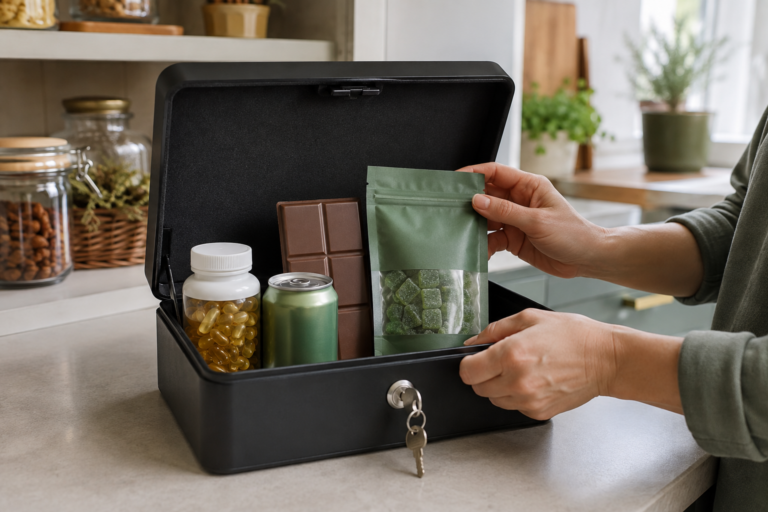
Even if the pregnant or breastfeeding person is avoiding cannabis, products may still be in the home. This is especially important with edibles, beverages, capsules, and oils because they can look like ordinary food or supplements. Store all cannabis in original packaging, locked away, and out of sight and reach of children, teens, visitors, and pets.
Do not leave edibles in purses, bedside drawers, cars, diaper bags, kitchen counters, or unmarked containers. Do not use cannabis while responsible for infant care if it affects alertness, coordination, judgment, or waking response. If another adult in the home uses cannabis, make a clear plan for storage, smoke/vapour exposure, driving, and caregiving duties.
For general safer-use context, our guide on beginner cannabis mistakes in Canada covers overconsumption, storage, and “too much too soon” patterns. This pregnancy and breastfeeding guide is narrower: when a fetus or infant may be exposed, the safest cannabis decision is avoidance plus clinical support.
Bottom line
If you are pregnant, trying to become pregnant, or breastfeeding, do not treat cannabis as a harmless wellness product. Health Canada and Canadian public-health guidance advise avoiding cannabis in these situations, including THC and CBD products. If you are using cannabis for symptoms, medical reasons, or dependence, the next step is a health-care conversation, not silence.
Bring the product label, be honest about frequency and reasons for use, and ask for safer alternatives that fit your pregnancy, postpartum, or breastfeeding plan. Good care should reduce shame and increase support. That is the reader-first version of harm reduction here.
Sources
Explore the beginner’s guide, or learn how we source and edit our stories.