Blog

  • How to Store Cannabis Edibles in Canada

    How to Store Cannabis Edibles in Canada

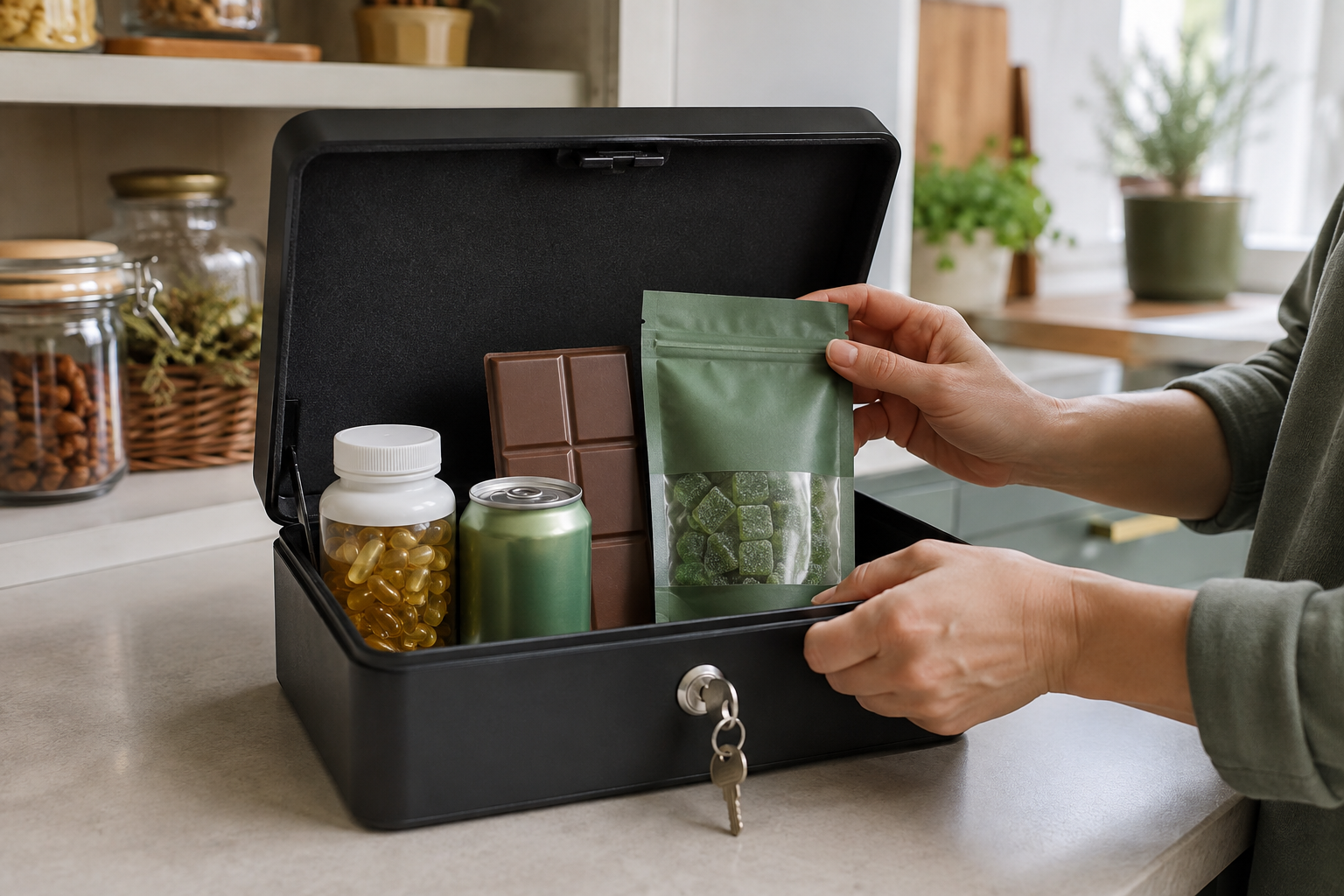
    Cannabis edibles are easy to mis-store because they look and behave like ordinary food. Gummies can sweat or stick together, chocolate can soften or bloom, drinks may be forgotten in the fridge, and capsules can end up beside vitamins if you are not careful. In a Canadian home, the safest storage habit is simple: keep every edible in its original cannabis package, put that package in a locked container, and store it separately from regular snacks.

    This guide is for adults who have legal cannabis gummies, chocolates, beverages, baked goods, oils, or capsules at home and want a practical system for freshness, label tracking, and household safety. It is not medical advice. If cannabis is being used for a health reason, or if you have questions about medications, pregnancy, mental health, or substance use, speak with a qualified health professional.

    The short version

    • Keep cannabis edibles in their original child-resistant package whenever possible.
    • Put the original package inside a locked box, pouch, or cabinet.
    • Store edibles away from ordinary food, candy, baking supplies, and kids’ lunch items.
    • Keep the product label, THC/CBD amount, lot number, package date, and warning information with the product.
    • Use cool, dark, dry storage unless the product label gives a more specific instruction.
    • Do not combine leftover pieces from different products in one bag or jar.
    • Throw away anything with mould, broken seals, odd odours, leakage, or unclear identity.

    Why edible storage deserves its own routine

    Edibles create two overlapping storage questions. The first is freshness: heat, moisture, air, and time can affect flavour, texture, and quality. The second is safety: edible cannabis can be mistaken for regular food, especially when it looks like candy, chocolate, cookies, or drinks. Health Canada advises adults to keep cannabis out of sight and reach of children and pets and to store cannabis in its original child-resistant packaging. That advice matters even more with edible products.

    Original packaging is useful because it carries information you may need later: total THC and CBD, unit size, lot number, package date, expiry or best-before details when provided, warning messages, and the producer’s identity. If you move a gummy, chocolate square, or capsule into an unmarked container, you may lose the information that helps you dose cautiously, check a recall, or explain what was consumed in an accidental exposure.

    For dose planning, pair this storage routine with The Weed Journal’s edibles dosing guide for Canada. Storage keeps the product organized; dosing habits decide whether the session stays manageable.

    Storage by edible format

    FormatMain storage riskBest everyday setupWhen to discard
    Gummies and candiesHeat, stickiness, accidental snack confusionKeep sealed in the original pouch, then place the pouch in a locked box away from regular candyDiscard if pieces are melted into an unclear mass, smell off, show mould, or cannot be matched to the label
    ChocolateMelting, fat bloom, moisture, portion confusionStore cool, dark, and dry; keep the labelled wrapper or package around any remaining piecesDiscard if it smells rancid, has mould, was left hot for a long period, or no longer has clear serving information
    DrinksBeing mistaken for regular beverages or forgotten after openingKeep unopened cans or bottles in a labelled locked container; follow the label after openingDiscard if opened beyond label guidance, leaking, swollen, sour-smelling, or unidentifiable
    Baked goodsFood spoilage and unclear THC distributionFollow the package directions closely; keep servings separated and labelled inside locked storageDiscard if stale beyond comfort, mouldy, unlabelled, or stored with regular baked goods
    Capsules and softgelsConfusion with vitamins or medicationKeep in the original cannabis bottle or blister pack, separate from medicines and supplements, inside locked storageDiscard if the bottle is unlabelled, capsules leak, or the product cannot be identified
    Use the product label first. This table is a household organization aid, not a replacement for package directions.

    Keep edibles in the original package

    It can be tempting to move edibles into a nicer jar, a snack container, or a fridge bin. Avoid that unless the original package is damaged and you have no safer option. Legal Canadian cannabis packaging is designed to identify the product as cannabis and to include required warnings and product information. A plain kitchen container does the opposite: it makes the product look like food.

    If the original package is awkward, place the whole package inside a second locked container. For example, put the cannabis gummy pouch into a lockbox instead of pouring gummies loose into a jar. Put the chocolate wrapper and all remaining pieces into a sealed bag, then place that bag inside the locked box. The goal is not decorative storage. The goal is that any adult who finds the item can immediately tell what it is.

    For product-specific label details, see TWJ’s guides to cannabis gummies in Canada, cannabis beverages, and cannabis capsules and softgels.

    Separate cannabis from ordinary snacks

    A cannabis chocolate bar does not belong in the regular chocolate stash. A THC drink should not sit loose beside sparkling water. A gummy pouch should not live in the same basket as candy, fruit snacks, or school treats. Physical separation is one of the easiest ways to reduce confusion.

    Pick one location for cannabis edibles and make it boring, adult-only, and locked. A small lockbox on a high shelf is better than a drawer everyone uses. A locked cabinet is better than a fridge door bin. If you need to refrigerate a product because the label says so, use a locked fridge box or another clearly marked locked container rather than leaving it loose.

    Do not rely only on height. Children climb, visitors browse cupboards, and pets can chew through packaging. A lock adds a second layer when attention fails.

    Use cool, dark, and dry as the default

    Most cannabis edibles do best away from heat, sunlight, and humidity. A stable cupboard or pantry is usually more predictable than a sunny counter, a hot car, a bathroom, or a windowsill. Heat can soften gummies and chocolate. Moisture can damage packaging or encourage spoilage in food-based products. Sunlight and air can reduce quality over time.

    There is one important exception: follow the product label. Some beverages or food-style products may have instructions for refrigeration after opening. If the label gives a specific direction, that direction wins. The storage system should still stay locked and clearly separate from normal food.

    If you are wondering whether an older package is still usable, read TWJ’s guide to whether cannabis edibles expire in Canada. Do not try to rescue a questionable edible by baking it, freezing it after contamination, or mixing it into other food.

    Do not split servings without preserving the label

    Some edibles come in multiple pieces, and some adults cut chocolate or baked goods into smaller portions. If you divide a product, keep the remaining pieces with the package and a clear note about what was changed. A tiny unlabelled square wrapped in foil may be obvious to you today and confusing to someone else next week.

    The safest routine is to decide on a serving only when you are ready to use it, then return the rest to the original package and locked container immediately. Avoid leaving partial servings on counters, side tables, bedside tables, or bags. Edibles often take longer than inhaled cannabis to feel noticeable, so it is easy for someone to set one down, forget it, and create a household hazard.

    Build a two-minute home checklist

    • Package: Is every edible still in its original labelled cannabis package?
    • Lock: Is the product inside a locked box, pouch, or cabinet?
    • Separation: Is it away from regular snacks, drinks, vitamins, and medication?
    • Condition: Is the seal intact, the product dry where it should be dry, and the smell normal?
    • Label: Can you still read the THC/CBD amount, lot number, and package details?
    • After use: Did the package go back into locked storage before the session moved on?

    If kids, pets, roommates, guests, or tradespeople are in the home, do the checklist before they arrive. If you travel with edibles, do it again when you return. For a broader household routine, use TWJ’s safe cannabis storage checklist for Canada.

    What to do after a spill, leak, or mystery package

    If a drink leaks, a package tears, or a gummy bag loses its label, do not guess. Cannabis products should be identifiable. If you cannot tell the product, amount, or age, discard it in a way that prevents accidental consumption. Do not leave loose edibles in household garbage where a child, pet, or visitor could access them.

    If you think a child, pet, or another adult has accidentally consumed cannabis, treat it seriously. Call local poison control or emergency services as appropriate, especially if the person is very drowsy, confused, having trouble breathing, or cannot explain what was taken. Keep the package available if you have it; the label can help responders understand the product.

    Common mistakes to avoid

    The biggest edible storage mistake is treating cannabis like a normal treat. The second is separating the product from the label. The third is assuming “hidden” means secure. A bag at the back of a cupboard may be hidden from you, but not from a curious child or a houseguest looking for snacks.

    Another mistake is mixing formats in the same container. Gummies, chocolate, beverages, and capsules have different labels, serving sizes, package dates, and storage needs. Keeping them together loosely makes dose tracking harder and can create confusion later.

    Finally, avoid using storage as a way to stretch a product indefinitely. Cannabis edibles are still edible products. If the food base has spoiled, the package is damaged, or the product seems wrong, freshness is no longer the main issue. Safety is.

    Bottom line

    A good cannabis edible storage system is simple enough to repeat: original package, locked container, separate from regular food, cool and dry unless the label says otherwise, and checked before guests, kids, or pets are around. That routine protects the label information you need, helps preserve quality, and lowers the chance that an edible is mistaken for an ordinary snack.

    For most households, the best upgrade is not a fancy storage gadget. It is one boring locked box and the habit of using it every time.
    Sources

  • Cannabis in a Car in Canada: Carrying and Storage Checklist

    Cannabis in a Car in Canada: Carrying and Storage Checklist

    Quick answer: in Canada, adults can generally transport legal cannabis, but the safer habit is simple: keep it sealed, out of reach, away from the driver area, and never consume it in a vehicle that is being driven or could be driven. Provincial details matter, so treat the federal 30 gram public possession limit as the starting point, then check the rules where you are.

    A car makes cannabis rules feel confusing because several issues overlap at once: public possession, open products, passengers, impairment, smoking and vaping bans, storage, and travel between provinces. This guide is not legal advice. It is a practical checklist for adults who want to avoid the common mistakes that turn a legal purchase into a risky ride.

    The safest default

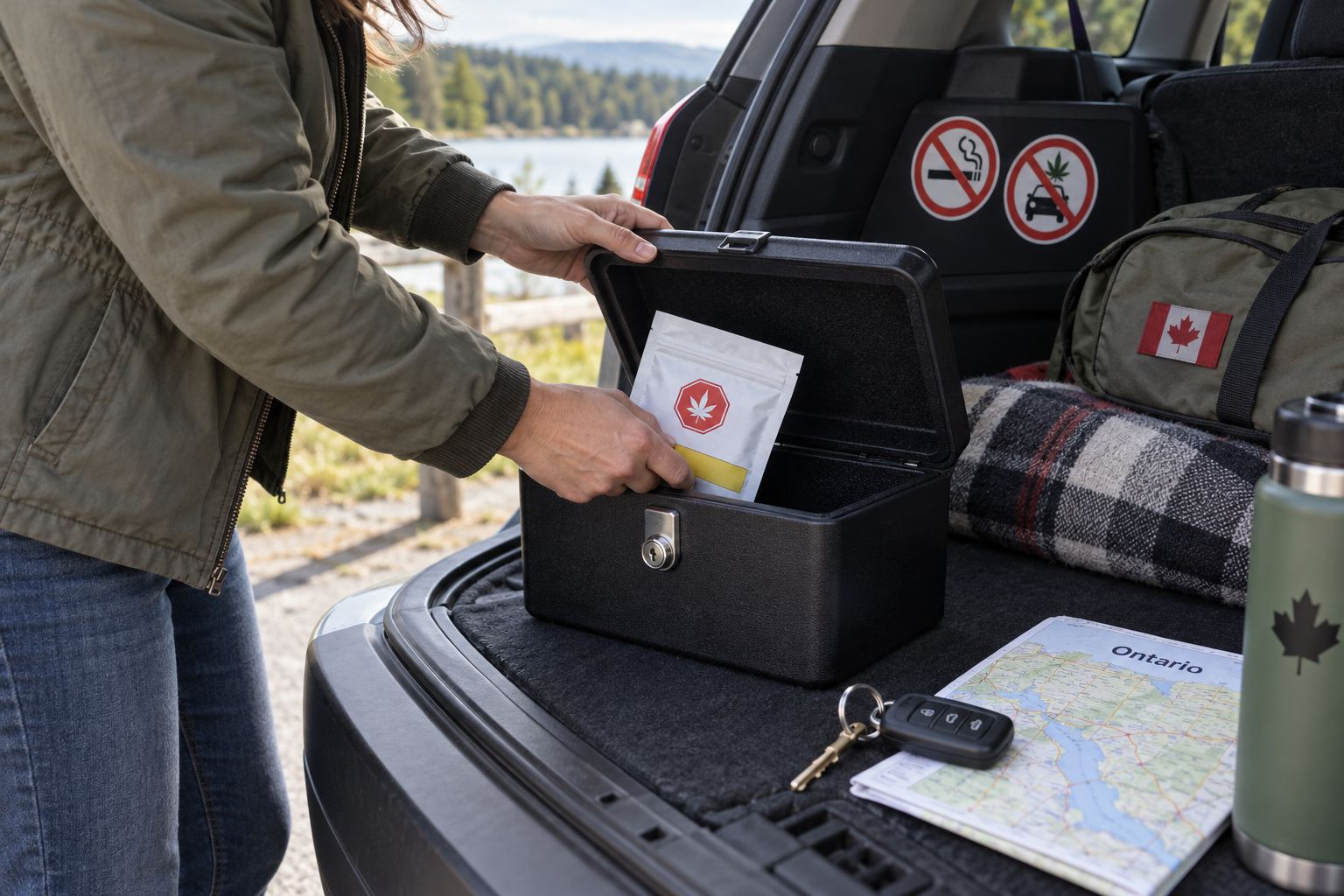
    If you only remember one rule, make it this: cannabis belongs packed away, not handled in the cabin. Put legal cannabis in its original packaging when possible, close the container, place it in a bag or lockbox, and keep it in the trunk or another area that is not within easy reach of the driver. That habit helps with odour, prevents accidental access by passengers, and keeps the situation clear if you are stopped.

    The same logic applies whether you bought dried flower, pre-rolls, vapes, oils, beverages, or edibles. A sealed package in a locked box says “transport.” A loose product, open edible, active vape, or recently used pipe inside the cabin creates a very different impression.

    Car cannabis checklist

    SituationSafer choiceWhy it matters
    Driving home from a legal storeKeep cannabis in the original sealed package and put it away before starting the trip.It supports a clear story: you are transporting a legal product, not using it.
    Carrying flower or pre-rollsUse a closed container, then place it in the trunk, hatch area, or a zipped bag away from the driver.Loose cannabis creates odour and access problems.
    Carrying edibles or beveragesDo not open them in the vehicle. Keep them labelled and away from children, pets, and passengers.Edibles can be mistaken for regular food and are easy to overconsume.
    Passengers want to smoke or vapeDo not allow smoking, vaping, or edible use in the vehicle.In Ontario, cannabis consumption is not allowed in a vehicle or boat being driven or at risk of being put into motion.
    Crossing a borderDo not bring cannabis across Canada’s international border in either direction.Federal travel guidance warns that cannabis remains illegal to move across the border, even when it is legal on both sides.

    How much can be in the car?

    For non-medical cannabis, the federal public possession limit for adults is up to 30 grams of legal dried cannabis, or the equivalent in other product forms. Health Canada’s possession calculator is the cleanest official tool for equivalents because oils, solids, concentrates, fresh cannabis, seeds, and dried flower are not counted the same way.

    That limit does not mean every car trip with 30 grams is automatically low-risk. The product still needs to be legal, the adult still needs to meet the local legal age, and the cannabis should be stored in a way that does not invite use while driving. For more detail on equivalents, use our Canadian cannabis possession limits guide as the companion article.

    Can a passenger use cannabis in the car?

    Do not treat the passenger seat as a loophole. Ontario’s cannabis laws say that a person cannot consume cannabis in a vehicle or boat that is being driven or will be driven. The province’s smoke-free guidance also says no one in a motor vehicle or boat being driven, or at risk of being put into motion, can consume cannabis in any manner, including smoking, vaping, or eating, with limited medical-use exceptions.

    Even outside Ontario, the practical answer is the same for most adults: keep the vehicle cannabis-free during the trip. A passenger’s smoke, vape, open edible, or visible product can create odour, distraction, impairment concerns, and confusion if police stop the vehicle. If someone wants to use cannabis, park legally, leave the vehicle, and follow the local public-use rules for that place.

    Driving after cannabis is different from carrying cannabis

    Transporting a legal product is not the same thing as being fit to drive. Health Canada warns that cannabis can impair judgment, reaction time, coordination, attention, and decision-making. The federal impairment guidance also notes that some effects, such as drowsiness, can last up to 24 hours after use, depending on the person, product, dose, and method of consumption.

    That is why “I feel fine” is not a reliable driving test. There is no universal waiting time that works for every adult after cannabis use. If you used cannabis recently, plan a different ride, wait longer, or do not drive. Our cannabis and driving in Canada guide covers impairment rules in more detail, and our night-before-driving checklist is useful for next-morning planning.

    Where should cannabis go in the vehicle?

    Use the least ambiguous storage spot available. In a sedan, that usually means the trunk. In a hatchback, wagon, SUV, or van, use a zipped bag, cargo area, or locked case in the back rather than the console, cupholder, glove box, or door pocket. If you are carrying cannabis for a longer trip, choose a hard-sided container that closes fully and does not leak odour.

    Odour control is not only about being polite. Strong smell can draw attention, make other passengers uncomfortable, and make it harder to show that the product is simply being transported. Our smell-proof cannabis storage checklist explains practical container choices without pretending any pouch makes cannabis invisible to law enforcement.

    If you are stopped

    Good storage also makes an ordinary traffic stop less confusing. Keep your licence, ownership, and insurance separate from cannabis so you do not need to reach into the same bag or container. If an officer asks about cannabis, be calm and factual: it is legal cannabis, it is closed, and it is stored away from the driver. Do not open packages, hand products around, or argue roadside legal details. If you receive a ticket or charge, save the paperwork and get legal advice from a qualified professional.

    The goal is not to hide cannabis. The goal is to avoid mixed signals: open products, strong odour, recent use, loose edibles, or cannabis sitting beside the driver. A boring, closed container in the back of the vehicle is usually the clearest setup.

    Special caution for edibles, drinks, and vapes

    Edibles and beverages deserve extra caution in vehicles because they can look ordinary. Keep gummies, chocolates, baked goods, capsules, oils, and drinks in original packaging whenever possible. Do not transfer them into regular snack bags, water bottles, or unlabelled containers. If children or pets are travelling with you, put the products in a locked bag or box before anyone gets into the car.

    Vapes are different but still need discipline. A cartridge or disposable vape should be turned off, capped if possible, and packed away. Do not pass it around in the car. Do not leave batteries in direct heat, and do not toss a vape into a hot glove box for hours. For more on product handling, see our vape cartridge safety checklist.

    Road trips and borders

    Driving between provinces can add another layer of rules. Legal age, retail systems, public-use restrictions, and local enforcement can vary. Before a road trip, check the provincial or territorial page for where you are going, especially if you plan to buy cannabis there or stay in rental housing, hotels, parks, campgrounds, or event areas.

    The international border is simpler: do not cross it with cannabis. Government of Canada travel guidance warns that taking cannabis across Canada’s border is illegal, whether you are entering or leaving Canada and even if cannabis is legal at your destination. If a route may cross into the United States or another country, remove cannabis from your bags and vehicle before the trip. Our travel with cannabis in Canada guide covers the broader trip-planning picture.

    A practical pre-drive routine

    • Confirm the product came from a legal source and is labelled.
    • Check that the package is closed and not being used by anyone in the vehicle.
    • Keep the amount within the adult public possession limit or equivalent.
    • Place cannabis in the trunk, cargo area, or a locked container away from the driver.
    • Keep edibles and beverages away from children, pets, and regular snacks.
    • Do not drive if you have used cannabis recently or feel affected in any way.
    • Remove cannabis before any international border crossing.

    Bottom line

    A car is for transporting cannabis, not using it. Keep legal products closed, labelled, and packed away; keep the driver unimpaired; and check local rules before you travel. Those habits will not answer every legal edge case, but they will help adults avoid the most common problems: open products in the cabin, passenger use, odour, over-the-limit possession, impaired driving, and accidental border mistakes.

    Sources

  • Cannabis at a House Party in Canada: Host Checklist

    Cannabis at a House Party in Canada: Host Checklist

    A house party is not a dispensary, a medical clinic, or a test of anyone’s tolerance. If cannabis is present, the safest host is the boring one: products are labelled, edibles are separated from regular food, smoking rules are clear, and nobody is nudged toward using more than they planned.

    This Canada-aware checklist is for adult hosts who want to keep a gathering relaxed without turning cannabis into a problem. Laws vary by province, landlord, venue, and municipality, so treat this as a practical planning guide, not legal advice. The common thread is simple: adults only, legal products only, locked storage when not in active use, and no impaired driving.

    The quick host rule

    If you are hosting, decide before people arrive whether cannabis is part of the event. A casual “people can bring whatever” approach creates confusion around edibles, smoke, pets, kids, neighbours, and rides home. You do not need to police every adult, but you do need a visible house standard.

    A good standard sounds like this: cannabis is for adults of legal age, products stay in original or clearly labelled packaging, edibles do not go near shared snacks, smoking or vaping follows local and building rules, and anyone who uses cannabis plans not to drive. That is not stiff. It is just easier than trying to solve a preventable issue at midnight.

    House party cannabis checklist

    Host decisionWhy it mattersPractical move
    Adults only around cannabisProvincial rules restrict possession, use, and distribution by age.Do not leave cannabis where younger guests, children, or passersby can access it.
    Keep original labelsTHC amount, package date, lot details, and warnings are easier to verify.Avoid unlabelled homemade-looking items unless everyone clearly knows what they are.
    Separate edibles from foodEdibles can be mistaken for regular snacks and may take longer to feel.Use a labelled container away from the snack table; do not serve cannabis edibles buffet-style.
    Lock products between usesSafe storage lowers the risk of accidental ingestion.Use a cupboard, lockbox, or host-controlled storage spot.
    Set smoking and vaping rulesOntario and many other places restrict smoking or vaping in enclosed public places, workplaces, patios, vehicles, and other areas.Follow building, lease, condo, municipal, and provincial rules before allowing smoking or vaping.
    Plan rides before useCannabis can impair attention, reaction time, and coordination.Put ride-share, transit, walking, taxi, or overnight plans ahead of consumption.

    Keep edibles boring and obvious

    Edibles are the easiest party format to mishandle because they look like food and do not feel immediate. Someone who would never accidentally smoke a joint could still grab a brownie, gummy, or drink from the wrong bowl. A host should never rely on vague warnings like “those are the special ones” when people are distracted, drinking, or arriving late.

    Keep cannabis edibles in their legal packaging until the person using them is ready. If they are placed in another container, label that container plainly and keep it away from regular snacks. Do not put infused items beside chips, cookies, fruit, drinks, or anything guests are expected to share freely.

    For adult guests who are newer to cannabis, point them toward basic timing information before they use anything. The Weed Journal’s guide to edibles dosing in Canada explains why “start low and go slow” matters and why taking more too soon is a common mistake. The host’s job is not to prescribe a dose. It is to create a setting where nobody is pressured into guessing.

    Do not mix party pressure with cannabis

    At parties, people often copy the room. That can be risky with cannabis because tolerance, body size, recent food, sleep, mood, medication use, alcohol use, and product strength all change how a person responds. Health Canada warns that frequent use, high-THC products, cannabis smoke, and impaired driving all carry risks. A host should make it socially easy to skip cannabis, stop early, or choose a lower-intensity option.

    A simple line helps: “No pressure either way; keep your night manageable.” That sounds small, but it changes the room. Avoid games, dares, competitive hits, “finish this,” or jokes at the expense of someone who is taking less. If someone seems uncomfortable, anxious, very sleepy, confused, or more intoxicated than they expected, move them somewhere calm, offer water, keep them away from more cannabis or alcohol, and encourage medical help if symptoms seem serious or unusual.

    Alcohol deserves special attention. Government of Canada impairment guidance notes that mixing cannabis with alcohol can increase impairment. If alcohol is also present, keep the cannabis plan even more conservative. Our cannabis and alcohol mixing guide is a useful internal reference for this part of the conversation.

    Guests bringing their own cannabis

    The easiest time to set boundaries is before people arrive with bags and pockets full of unknown products. If guests may bring cannabis, ask them to keep it in the original package or in a clearly labelled container. Loose edibles, unmarked drinks, shared jars, and “try this, I made it” items are harder to manage because nobody can quickly verify strength, ingredients, or whether the item is cannabis at all.

    Do not let guests leave cannabis on the snack table, bathroom counter, couch, balcony rail, or entry table. If someone brings more than they plan to use, ask them to keep it closed and stored with their belongings or in the host-controlled storage spot. That is especially important in apartments, shared houses, and parties where people are moving between rooms.

    It is also reasonable to say no to certain formats. A host can allow sealed legal edibles but not homemade infused food, or allow adults to possess cannabis while still banning indoor smoking and vaping. Clear limits are easier to enforce than vague tolerance.

    Smoking, vaping, and neighbour rules

    Do not assume that a private home means anything goes. Condos, apartment buildings, leases, short-term rentals, house rules, patios, balconies, and local bylaws can all matter. In Ontario, provincial pages explain that smoking cannabis and vaping are restricted in many places, and that cannabis cannot be consumed in a vehicle or boat that is being driven or may be driven. Other provinces have their own rules, and a building can be stricter than the baseline law.

    If smoking or vaping is allowed at all, decide where it happens before the party starts. Avoid hallways, elevators, shared entrances, enclosed common areas, and anywhere smoke or vapour will drift into neighbours’ units. If the answer is “there is no suitable place,” make that the rule. It is better to be clear than to have a guest wander into a prohibited area with a vape or joint.

    Storage during the party

    Safe storage is not only a family-home issue. It matters at parties because guests move around, bags get opened, snacks get mixed, pets get curious, and people forget what they brought. Health Canada’s lower-risk information specifically advises storing cannabis out of reach and locked away, especially because accidental ingestion can be serious for children.

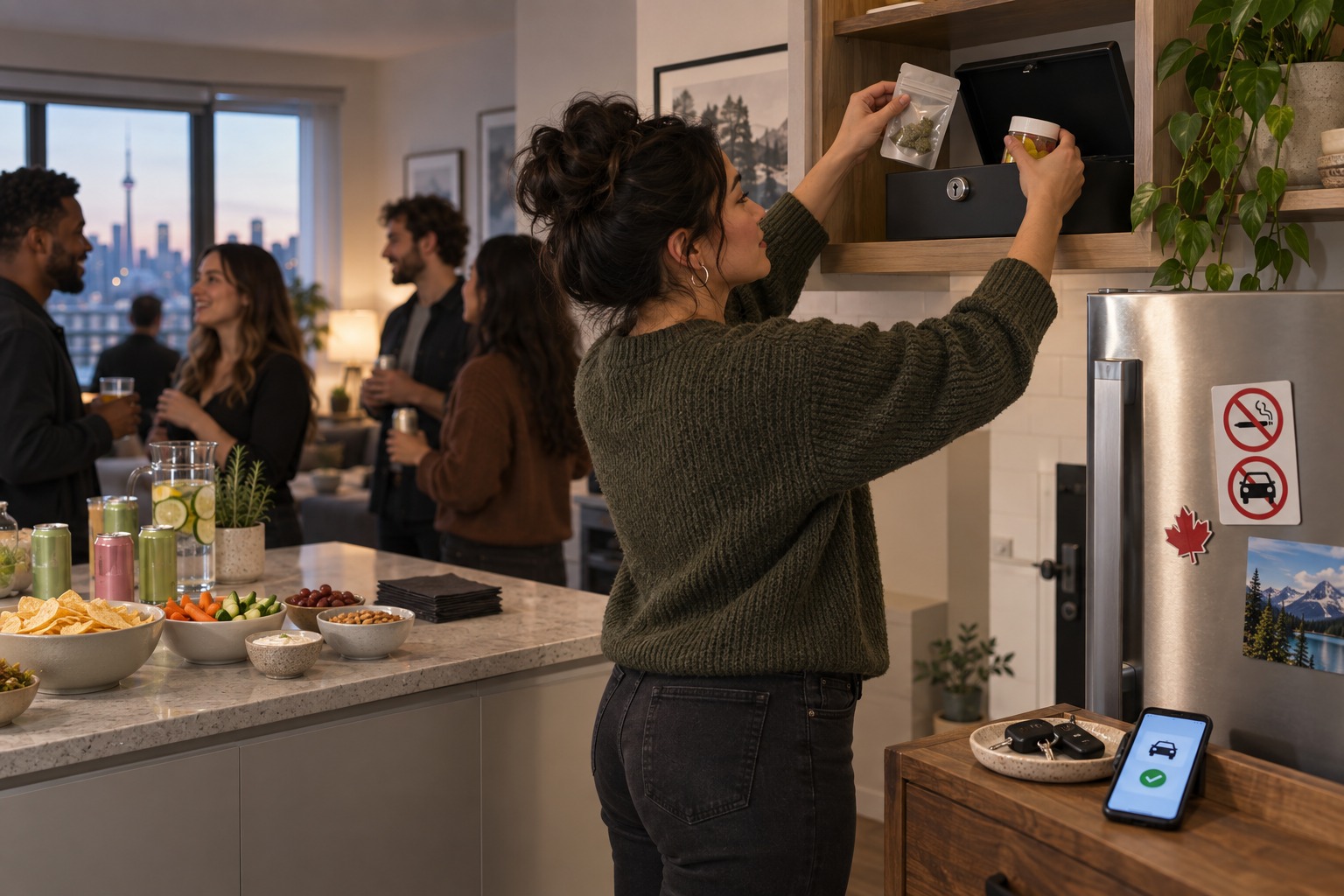
    The cleanest host system is one controlled storage spot: a lockbox, high cabinet, or closed room where cannabis stays when it is not being actively used by an adult. Keep packaging with the product. Do not leave grinders, loose flower, open edibles, infused beverages, vape carts, or concentrates on coffee tables. If the party includes pets, children arriving later, roommates, or overnight guests, be stricter. The site already has a deeper home cannabis storage checklist for that scenario.

    Driving and the end of the night

    Do not make ride planning the last conversation. By then, people may be tired, impaired, embarrassed, or too optimistic about how they feel. Cannabis can impair reaction time, attention, and coordination. Impaired driving is illegal, and the safer host move is to make non-driving plans ordinary: ride-share, transit, taxi, designated sober driver, walking with a sober friend where appropriate, or staying over.

    Keep car keys visible only as a reminder, not as an invitation. If someone used cannabis, especially with alcohol, the answer should be no driving. For the morning-after question, use extra caution too; effects and sleepiness can carry over for some people. The Weed Journal’s guide to cannabis the night before driving in Canada covers that planning angle in more detail.

    A pre-party script hosts can use

    • “Cannabis is adults-only here, and no one has to use it.”
    • “Please keep anything cannabis-related labelled and away from the food table.”
    • “No smoking or vaping inside; building and local rules still apply.”
    • “If you use cannabis tonight, plan not to drive.”
    • “If you feel uncomfortable, tell me early. You will not be judged.”

    That script is plain on purpose. It avoids lecturing, but it sets expectations before cannabis becomes part of the room.

    Canada-aware hosting bottom line

    A responsible cannabis house party is not about making the event cannabis-themed. It is about reducing avoidable confusion. Keep products legal and labelled, separate edibles from snacks, store everything securely, follow smoking and vaping rules, avoid pressure, be careful with alcohol, and sort out rides before anyone uses cannabis.

    For the legal baseline, start with the general legal cannabis in Canada guide, then check your province, municipality, building, lease, and event setting. The more public or shared the space is, the less you should improvise.

    Sources

  • Cannabis on Public Transit in Canada: Carry, Odour, and Courtesy Checklist

    Cannabis on Public Transit in Canada: Carry, Odour, and Courtesy Checklist

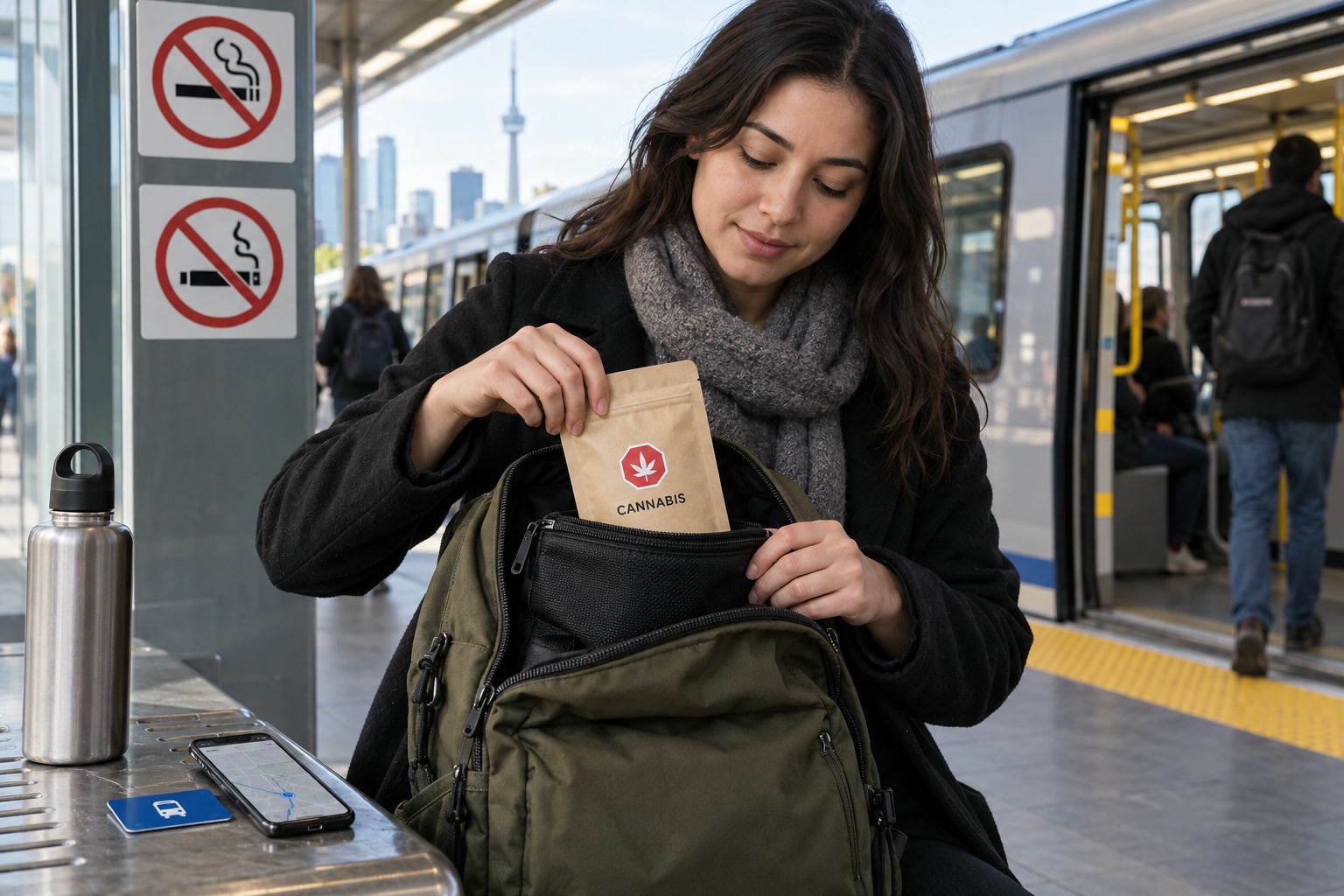
    Taking legal cannabis home by bus, subway, commuter rail, or ferry sounds simple until you are standing on a platform with a paper bag, a crowded vehicle, and ten different local rules in the back of your mind. The safest approach is also the least dramatic: keep the product sealed, keep it put away, do not smoke or vape anywhere transit rules forbid it, and plan the rest of your trip as if other riders should not have to notice what you bought.

    This guide is for adults in Canada who are carrying legal cannabis as a passenger on public transit. It is not legal advice, and local rules can change, but it gives you a practical checklist for the situations people actually run into: odour, open packages, transfers, long rides, storing products around kids or pets after you get home, and avoiding impaired driving after the transit leg ends.

    The quick answer

    In most everyday cases, an adult can carry legal cannabis on public transit in Canada if they are within the legal possession limit, the product is not being used on transit property, and local smoking, vaping, alcohol, conduct, and safety rules are followed. The federal public possession limit for adults is generally 30 grams of dried cannabis or its equivalent, but provinces, territories, municipalities, transit agencies, campuses, workplaces, landlords, and event venues can add rules about where cannabis can be used or how people may behave on their property.

    Think of transit as a carry-only environment. A sealed package in a bag is one thing. Lighting up, vaping, eating an edible in a way that leaves you too impaired to navigate safely, opening strong-smelling flower beside other riders, or arguing with staff about posted rules is another.

    Public transit cannabis checklist

    Transit moment Better choice Why it matters
    Leaving a legal store Keep cannabis in its original sealed package and put it inside a bag or pouch. It reduces odour, keeps labels with the product, and avoids drawing attention on the ride.
    Waiting at a stop or platform Follow posted no-smoking and no-vaping rules, including outdoor station areas where they apply. Transit agencies often treat stations, shelters, platforms, vehicles, and property as smoke-free or vape-free spaces.
    Riding in a crowded vehicle Keep the package closed, zipped away, and out of the aisle. Other riders should not have to deal with odour, spills, loose items, or blocked space.
    Carrying edibles or drinks Keep them clearly separate from regular snacks and drinks. Edibles can be mistaken for regular food, especially once you get home around guests, kids, or pets.
    Ending the trip Store cannabis securely as soon as you arrive. Health Canada recommends keeping cannabis out of reach of children, teens, and pets.

    Can you smoke or vape cannabis at a bus stop, station, or platform?

    Do not assume you can. Smoking and vaping rules are usually stricter on transit property than they are in a generic public outdoor space. Ontario, for example, has provincial rules about where people cannot smoke or vape, and transit agencies can also set their own conduct rules. The TTC’s By-law No. 1 prohibits smoking in or on TTC property and carrying lighted smoking equipment there. TransLink’s rider etiquette page says smoking and vaping are prohibited on TransLink property and vehicles and reminds riders to follow cannabis, tobacco, vaping, and municipal rules.

    The practical rule is simple: if you are on a vehicle, in a station, in a shelter, on a platform, in a paid fare zone, or near posted no-smoking/no-vaping signs, do not smoke or vape. If you are outside the transit system entirely, check the local smoking and vaping rules for that place. Cannabis being legal does not mean every public spot is a consumption spot.

    Should cannabis stay sealed?

    Yes, whenever possible. Keeping cannabis in its original retail packaging helps preserve the label details and makes the product less likely to spill, smell, or be confused with ordinary food. This matters most for edibles, beverages, capsules, oils, and concentrates, but it is also useful for flower and pre-rolls.

    If the package is already open, put it inside a secondary container or pouch before you board. This is not about hiding illegal activity. It is about being a low-friction passenger: no loose flower in a pocket, no open edible bag beside regular snacks, no leaking vape cartridge in the front pouch of a backpack, and no strong odour escaping into a packed vehicle.

    For buying basics before the transit trip, The Weed Journal’s legal cannabis retailer checklist explains why legal source, labels, excise stamps, and package information matter.

    What about possession limits?

    The common federal adult public possession limit is 30 grams of dried cannabis or equivalent. Equivalents matter because extracts, edibles, beverages, seeds, and other product forms do not map one-to-one against dried flower weight. If you are carrying multiple formats, use the product labels and official equivalency rules rather than guessing by package size.

    For a plain-language refresher, see The Weed Journal’s guide to cannabis possession limits in Canada. The key point for transit is that a legal ride home can become a problem if you are carrying more than the allowed public amount, crossing into a place with stricter property rules, or mixing legal adult possession with unsafe behaviour.

    Odour is a courtesy issue, not just a storage issue

    Cannabis odour can be strong even when nobody is consuming it. In a crowded bus or train, that can become a courtesy issue quickly. Some riders may dislike the smell; others may have asthma, migraine triggers, sensory sensitivities, workplace uniform concerns, or children with them. You do not need to make cannabis invisible, but you should make the trip uneventful for everyone else.

    Use a simple system: original package first, then a zippered pouch, then your bag. Keep the pouch closed. Do not open jars or bags to show a friend what you bought. Do not grind flower, roll anything, reload a device, or inspect a sticky concentrate in a moving vehicle. If a package has leaked or smells unusually strong, step away from the crowd, re-secure it, and deal with it properly when you are home.

    The same habits apply after the ride. The Weed Journal’s home safe-storage checklist covers locked storage, separation from ordinary food, and practical household routines.

    Edibles, drinks, and long rides

    Edibles and cannabis beverages deserve extra caution on transit because they can look ordinary and their effects can take time. If you take an edible before or during a long ride, the strongest effects may arrive later, possibly during a transfer, a walk home, a pickup by someone else, or a situation where you need to respond quickly. Health Canada warns that cannabis can impair attention, coordination, reaction time, and decision-making; the timing depends on the product, the person, dose, food, tolerance, and other substances.

    For transit, the safer default is to wait until you are at your destination, especially if you are unfamiliar with the product, the route, or the dose. If you already consumed cannabis before boarding, avoid driving after the transit portion, avoid mixing with alcohol, and consider whether you have a simple route home that does not require complex decisions.

    If your trip ends with a car, read The Weed Journal’s guide to cannabis and driving in Canada before making assumptions about timing.

    Carry plan by product type

    Product type Transit carry risk Practical carry plan
    Dried flower Odour, loose material, crushed buds Keep the retail package closed, then place it in a zippered pouch or inner backpack pocket.
    Pre-rolls Odour, bent tubes, temptation to light one near a stop Leave tubes sealed and do not open them on transit property.
    Edibles Confusion with regular snacks Keep child-resistant packaging intact and separate from food, especially if travelling home to a shared space.
    Beverages Leaking, mistaken identity, delayed effects Keep cans or bottles closed, upright, and away from regular drinks.
    Vapes Leaking, heat, accidental activation, prohibited use Store upright if possible, protect from damage, and do not use on transit vehicles or property.
    Oils, capsules, sprays Leaks, dosing confusion Keep caps tight, labels visible, and products separate from toiletries or supplements.

    What if you are crossing provincial or municipal lines?

    Transit trips often blur boundaries. A commuter train can cross municipalities. A bus can cross from one province into another in the Ottawa-Gatineau region. A ferry can connect places with different local rules. The federal possession framework is only one layer. Provinces and territories set age, retail, possession, home growing, public use, and enforcement details, while municipalities and transit operators can add property-specific rules.

    If the trip is local and routine, the low-risk approach is usually enough: legal source, legal amount, sealed storage, no use on transit property, and secure storage at home. If the trip crosses a border, involves an event, school, workplace, hospital, airport, ferry terminal, or campus, check the destination rules before you travel. The Government of Canada warns travellers not to take cannabis across Canada’s international border, even if cannabis is legal where they are going.

    Do not make staff guess what you are doing

    Most transit staff are trying to keep vehicles moving, maintain safety, and respond to obvious conduct issues. Make their job easy. Keep cannabis out of sight unless there is a legitimate reason to show the package. Follow posted signs. Keep bags out of doorways and aisles. If a staff member asks you to stop smoking, move away from a restricted area, put something away, or follow a property rule, do it calmly and sort out questions later through the agency’s customer service channel.

    This is also where odour-control habits help. A closed pouch in a backpack does not create the same situation as an open jar, a freshly lit joint, or a vape cloud near a platform entrance.

    After you get home

    The trip does not end when you leave the vehicle. Put cannabis away before you unpack everything else, especially if you live with children, teens, pets, roommates, guests, or anyone who should not accidentally handle it. Health Canada recommends storing cannabis securely and out of reach. That means high, locked, labelled, and separate from regular food where practical.

    If odour is the concern, use storage habits that respect other people in the home instead of trying to mask the smell with heavy fragrances. The Weed Journal’s smell-proof cannabis storage guide has a practical home, car, and travel checklist.

    A simple public-transit carry routine

    1. Buy from a legal source and keep the receipt if you want extra context for the trip home.
    2. Confirm you are within the legal public possession amount for the products you carry.
    3. Leave products sealed in original packaging.
    4. Put cannabis inside a zippered pouch, then inside your bag.
    5. Do not smoke, vape, roll, grind, open, eat, or share cannabis on vehicles, platforms, shelters, or other transit property where rules prohibit it.
    6. Keep edibles and beverages separate from regular snacks and drinks.
    7. Plan a non-driving route if you have consumed cannabis or may consume soon after arriving.
    8. Store products securely as soon as you get home.

    Bottom line

    Carrying cannabis on public transit in Canada is mostly about restraint and preparation. Keep it legal, closed, labelled, zipped away, and unused until you are somewhere it is allowed. That protects you from avoidable rule problems and protects other riders from odour, smoke, vape aerosol, spills, and awkward confusion. Good cannabis etiquette is boring in the best way: nobody on the bus, train, or ferry has to think about your purchase at all.

    Sources

  • Cannabis and Medications in Canada: What to Ask Before You Mix

    Cannabis and Medications in Canada: What to Ask Before You Mix

    If you use cannabis and also take prescription or over-the-counter medication, the safest answer is not a blanket yes or no. It is a better question: what exactly am I taking, how often, and who has checked the combination?

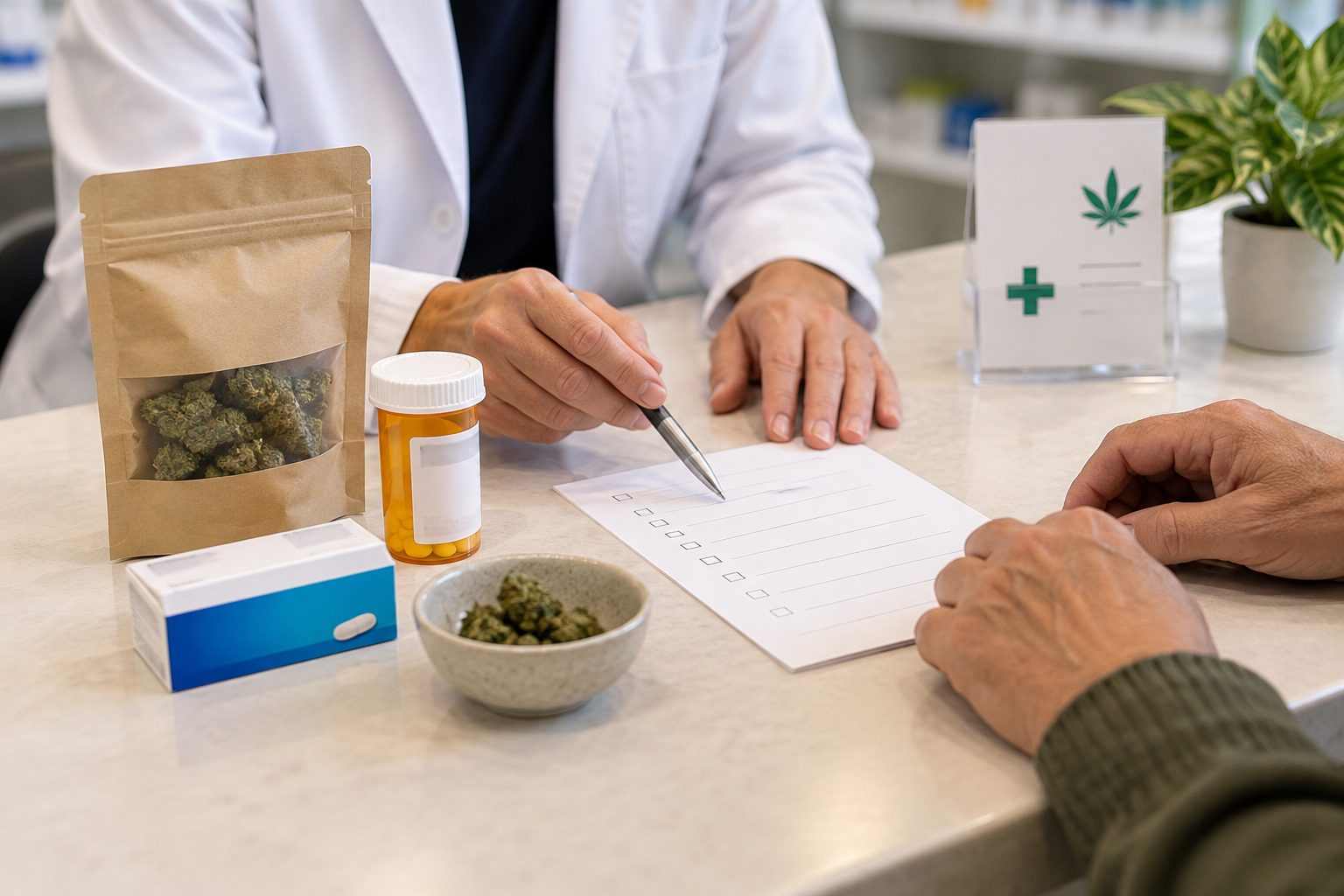
    Cannabis products can vary widely in THC, CBD, route of use, onset, duration, and strength. Medications vary too. A once-a-day blood pressure pill, a sleep aid, an antidepressant, an opioid pain medication, an allergy tablet, and an over-the-counter pain reliever do not raise the same questions. That is why this guide focuses on the practical part: how Canadian adults can prepare for a safer conversation with a pharmacist, prescriber, or other qualified health professional.

    This is general education, not medical advice. Do not stop, start, or change prescribed medication because of an article. If cannabis is already part of your routine, bring it into the same medication review you would use for alcohol, supplements, or new prescriptions.

    Why cannabis belongs in a medication review

    Health Canada’s information for health care professionals notes that cannabis and cannabinoids are complex substances, and that product differences, route of administration, dose, individual factors, and possible interactions all matter. That is the core idea for consumers: “cannabis” is not one predictable product.

    THC is the main intoxicating cannabinoid. CBD is not generally used for intoxication, but it can still matter in medication discussions, especially at higher doses or when used regularly. Edibles, oils, capsules, sprays, vapes, flower, concentrates, and high-CBD products can all behave differently in the body. A person who uses a low-THC product once a month is not in the same situation as someone taking daily CBD oil while also taking several prescriptions.

    The Canadian Centre on Substance Use and Addiction has a public resource specifically about cannabis and medications, describing the issue as one that can involve both prescription and off-the-shelf drugs. The Canadian Pharmacists Association also emphasizes pharmacists’ medication expertise, including their role in helping identify harmful drug interactions and contraindications.

    Medication groups that deserve extra caution

    The goal is not to memorize a giant interaction list. The useful move is to know which categories should trigger a conversation before you combine them with cannabis, especially THC-rich products or frequent use.

    Medication or product type Why it is worth asking about Practical question to ask
    Sleep aids, sedatives, benzodiazepines, some anxiety medications THC can cause drowsiness and slowed reaction time, and other sedating products may add to that effect. “Could cannabis make me too drowsy or unsafe to drive, work, or care for someone?”
    Opioid pain medications and other strong pain medicines Combining central nervous system depressants can increase safety concerns, especially around sedation and impairment. “Is this combination risky for breathing, alertness, falls, or overdose safety?”
    Antidepressants, antipsychotics, mood stabilizers, ADHD medications Cannabis may affect mood, anxiety, attention, and side effects differently from person to person. “What changes in mood, sleep, anxiety, or side effects should I watch for?”
    Blood thinners, seizure medications, transplant medications, and narrow-therapeutic-index drugs Some medications require stable levels; interaction concerns may be more serious when small changes matter. “Does THC or CBD affect the level or monitoring plan for this medication?”
    Alcohol, OTC sleep products, antihistamines, cough/cold products These are easy to forget because they may not feel like “medications,” but they can still add sedation or impairment. “Should I avoid cannabis on days I use this product?”
    A medication review works best when it includes prescriptions, over-the-counter drugs, alcohol, supplements, and cannabis products.

    Be especially careful with products marketed as “just CBD.” CBD is not the same as THC, but that does not make it interaction-free. A pharmacist or clinician will care about dose, frequency, the medication list, and whether the product is legal and labelled clearly enough to understand what is in it.

    What to bring to the pharmacy or clinic

    A useful cannabis-medication conversation is easier when you bring specifics. “I use gummies sometimes” is harder to assess than “I use one 2.5 mg THC gummy on Friday nights, and I take these three prescriptions every day.” You do not need to give a speech. You just need enough detail for the professional to spot obvious risks and ask better follow-up questions.

    • Your full medication list: prescriptions, over-the-counter products, vitamins, supplements, sleep aids, allergy medication, pain relievers, and any products you take only sometimes.
    • Your cannabis product details: THC and CBD amounts, product type, brand if you know it, whether it is legal Canadian cannabis, and how often you use it.
    • Your timing: morning, evening, before bed, before driving, after alcohol, with meals, or only on weekends.
    • Your reason for using cannabis: recreation, sleep, appetite, pain, anxiety, or another reason. Keep it plain and factual.
    • Recent changes: a new prescription, higher cannabis dose, stronger product, new edible format, or a new side effect.

    If you are embarrassed, remember that pharmacists and clinicians hear practical safety questions all day. You are not asking for permission to be judged; you are asking for a medication safety check.

    Timing matters more than people think

    Many interaction problems are not about cannabis being “bad” in isolation. They are about timing, stacking, and the activity planned afterward.

    For example, an edible can take longer to feel than inhaled cannabis and may last longer. If someone adds a sleep aid because the edible “is not working yet,” the combined effect can become stronger than expected later in the evening. If someone drinks alcohol, uses THC, and takes an antihistamine, the issue may be less about any single product and more about the combined impairment.

    Driving deserves its own caution. Health Canada advises that cannabis can impair judgment and reaction time, and that some effects, such as drowsiness, can last up to 24 hours. There is no universal safe waiting period for driving after cannabis. If there is any doubt, plan another way home or avoid driving entirely.

    For more detail on timing, read The Weed Journal’s guides to how long edibles take to kick in, how long a cannabis high lasts, and cannabis the night before driving in Canada.

    Questions to ask before mixing cannabis and medication

    Bring these questions to a pharmacist, doctor, nurse practitioner, or clinic that knows your health history. You do not need every question every time, but this list can prevent the common mistake of asking only, “Is cannabis okay?”

    1. Could cannabis increase drowsiness, dizziness, confusion, anxiety, or fall risk with this medication?
    2. Does THC or CBD affect how this medication is processed or monitored?
    3. Should I avoid cannabis completely while taking this medication, or only avoid certain product types or doses?
    4. Are edibles, oils, capsules, vapes, or flower different for my situation?
    5. Should I avoid alcohol or other sedating products if cannabis is in the picture?
    6. What warning signs mean I should seek medical help?
    7. Would changing the timing of cannabis use reduce risk, or is the combination still a concern?
    8. Should this discussion be added to my medication record?

    For people using medical cannabis or higher-dose CBD, ask whether any lab monitoring, medication-level checks, or prescriber follow-up is appropriate. That question is especially important for medications where blood levels, bleeding risk, seizure control, transplant safety, or heart rhythm concerns are part of the care plan.

    Red flags: when not to “wait and see”

    Some situations call for immediate caution rather than experimentation. Get professional advice before mixing cannabis with medication if you are taking multiple prescriptions, have a history of fainting or falls, are pregnant or breastfeeding, have a heart condition, liver disease, seizure disorder, psychosis history, or have been told not to use alcohol or sedating substances with a medication.

    Seek urgent help if someone has severe confusion, chest pain, trouble breathing, repeated vomiting, loss of consciousness, severe panic that does not settle, or symptoms that feel dangerous or unusual. If a child or pet consumes cannabis or cannabis edibles, treat it as urgent and contact poison control, emergency services, or a veterinarian as appropriate.

    Legal Canadian products make the review easier

    A pharmacist cannot evaluate a mystery product well. Legal Canadian cannabis has standardized packaging and clearer THC/CBD information than unregulated products. That does not make every legal product low risk, but it gives the person doing the medication review something concrete to work with.

    Bring the package or a photo of the label if you can. Look for total THC, total CBD, package size, unit dose, lot number, and product type. If the label is confusing, The Weed Journal’s guides on reading cannabis labels in Canada and CBD:THC ratios can help you prepare better questions before the appointment.

    A safer-use checklist for adults

    • Keep an updated medication list on your phone.
    • Tell your pharmacist or prescriber about cannabis use, including CBD-only products.
    • Avoid mixing cannabis with alcohol or sedating products unless a qualified professional has said it is acceptable for your situation.
    • Do not drive or do safety-sensitive work after using cannabis.
    • Be extra cautious with edibles because delayed effects can lead to accidental stacking.
    • Use legal, clearly labelled products so dose and contents are easier to discuss.
    • Store cannabis away from children, pets, guests, and anyone who could mistake it for regular food or medication.
    • Report worrying side effects or suspected adverse reactions to a health professional.

    The bottom line

    Cannabis and medications can be a simple conversation, but it should not be a guess. The responsible move is to treat cannabis like any other substance that can affect alertness, side effects, and medication safety. Bring the product details, be honest about frequency and dose, and ask a pharmacist or prescriber to check the combination against your real medication list.

    The best outcome is not fear. It is clarity: what to avoid, what to monitor, when to pause, and when to get help.

    Sources

  • Cannabis the Night Before Driving in Canada

    Cannabis the Night Before Driving in Canada

    Using cannabis at night and driving the next morning can feel like a grey area. You may not feel “high” anymore. You may have slept. You may have work, school, childcare, or errands waiting. But cannabis impairment is not something to solve with confidence alone, especially when edibles, alcohol, fatigue, higher THC products, or a short sleep window are involved.

    This guide is for adults in Canada who want a practical way to plan before they use cannabis, not a loophole after the fact. It does not give a universal waiting time, because Canadian public guidance is clear that the science does not support a simple number that applies to every person and every product. The safer habit is to decide your driving plan before using cannabis, keep an alternative ready, and skip the drive if there is any doubt.

    If you are hosting, a host checklist for cannabis and rides home can make the no-driving expectation clear before anyone uses cannabis.

    The Short Answer

    If you used cannabis the night before and feel impaired, foggy, slowed down, unusually tired, anxious, dizzy, or unsure, do not drive. If you used an edible, mixed cannabis with alcohol, took more than planned, slept poorly, or have an early drive, treat the next morning as a higher-risk situation and arrange another way to get where you need to go.

    Canada treats cannabis-impaired driving as a serious road-safety issue. Health Canada says cannabis can affect judgment, reaction time, coordination, concentration, and attention. Justice Canada also notes that there is no general rule for how much cannabis someone can use before driving or how long they should wait afterward. That uncertainty is the point: plan conservatively.

    Why the Next Morning Can Still Be Risky

    Many people picture impaired driving as someone driving immediately after smoking or vaping. That is one risk, but it is not the only one. The next morning can still be a problem because cannabis effects vary by product type, THC amount, route of use, tolerance, body size, food, sleep, and whether alcohol or other substances were involved.

    Edibles deserve special caution because their onset and duration are often longer than inhaled cannabis. A person who takes an edible late at night may still be dealing with lingering impairment or fatigue the next morning, especially if they re-dose because the first serving did not seem to work quickly enough. If you need a refresher on timing, see our guide on how long edibles take to kick in and our broader article on how long a cannabis high can last.

    Feeling awake is not the same as being unimpaired. Coffee, a shower, breakfast, or a short nap may make you feel more functional, but they do not prove your reaction time, attention, and judgment are back to normal. That is especially important for highway driving, winter roads, night driving, long commutes, and any job that involves operating a vehicle or machinery.

    A Practical Planning Table

    Use this table before you consume, not after you are already trying to decide whether to leave.

    Night-before situation Why it raises concern Safer planning move
    Late-night edible or capsule Oral cannabis can take longer to peak and can last longer than expected. Do not schedule an early drive. Arrange transit, rideshare, a pickup, or a later start.
    Any cannabis plus alcohol Health Canada warns that combining cannabis and alcohol can further reduce driving skills. Do not drive that night or the next morning if there is any lingering effect, poor sleep, or uncertainty.
    Higher-THC product than usual Higher THC can increase the chance of stronger or longer-lasting impairment for some people. Keep the next morning free from driving until you are clearly sober and rested.
    Re-dosing because effects felt delayed Stacked servings can turn into more THC than intended once the delayed effects arrive. Set a no-driving plan before using and avoid making a morning decision under pressure.
    Poor sleep after cannabis use Fatigue can compound impairment and slow attention even if the obvious high has faded. Treat the drive as unsafe if you feel groggy, foggy, or slowed down.
    Work vehicle, machinery, or safety-sensitive shift The consequences of residual impairment are higher when other people depend on your performance. Follow workplace rules and choose a no-cannabis window before safety-sensitive work.
    There is no universal clock that makes cannabis and driving safe. Product type, dose, timing, sleep, alcohol, tolerance, and the drive itself all matter.

    Do Not Use Feelings as the Only Test

    A common mistake is to ask, “Do I feel high?” That question is too narrow. A better set of questions is: can I focus normally, react quickly, track the road, handle a surprise, stay awake, and make calm decisions for the whole trip? If you hesitate, do not drive.

    Self-checks are imperfect because cannabis can affect the same judgment you are using to judge yourself. That does not mean every adult who used cannabis last night is automatically impaired the next morning. It means you should not use confidence as evidence. A responsible plan leaves room for uncertainty.

    Watch for practical warning signs: heavy eyes, time distortion, trouble following a conversation, clumsy movement, delayed responses, anxiety spikes, nausea, dizziness, unusual irritability, or the sense that ordinary tasks take extra effort. Those signs are enough to call the drive off.

    Read the Product Before You Plan the Night

    Canadian cannabis labels are there for a reason. Before using a product at night, check the product type, Total THC, Total CBD, serving size, number of units, warning statements, and storage directions. If you are using edibles, drinks, capsules, oils, or sublingual products, pay special attention to whether the label describes THC per unit, THC per activation, or total THC in the package.

    For label basics, use our Canadian cannabis label guide. For product-format planning, our guide to choosing cannabis product types in Canada can help you compare inhaled products, edibles, oils, capsules, topicals, and beverages without treating them as interchangeable.

    The goal is not to calculate a guaranteed safe driving time from the label. The goal is to notice when a product is more likely to create a long or unpredictable window, then avoid putting a morning drive inside that window.

    The Night-Before Driving Checklist

    Before using cannabis on a night when you may need to drive the next day, run this checklist:

    • Confirm whether you actually need to drive in the morning.
    • Move the drive, switch to transit, book a ride, arrange a pickup, or work from home if possible.
    • Check the product type and THC amount before using it.
    • Avoid re-dosing because an edible, drink, capsule, oil, or sublingual product feels slow.
    • Do not mix cannabis with alcohol if there is any chance of driving later.
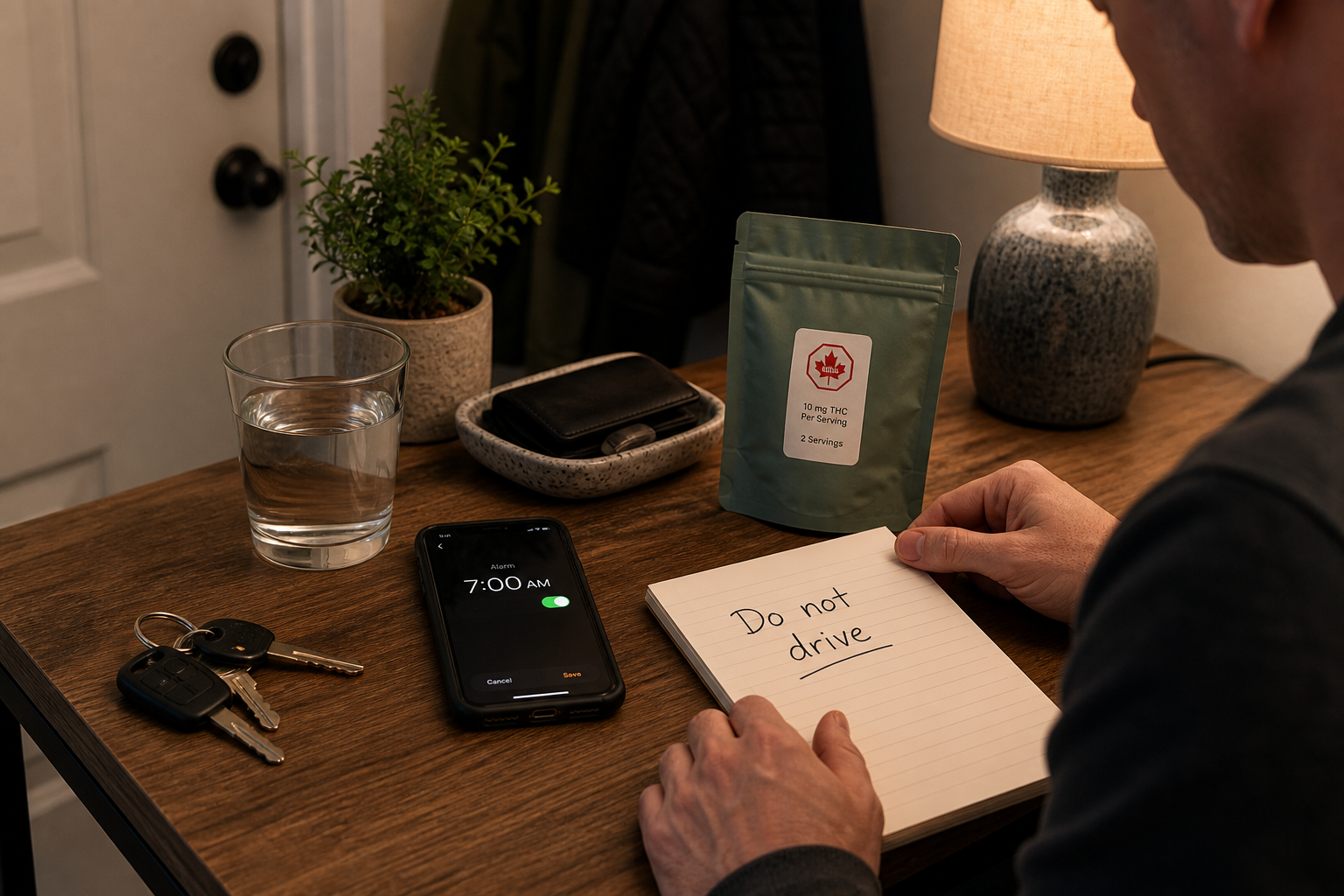
    • Set a reminder that says not to drive if you wake up impaired, foggy, or uncertain.
    • Put keys away before using cannabis so the decision is not made casually later.
    • Tell a trusted adult your plan if you are worried you may rationalize driving.
    • Follow workplace, school, court, probation, or medical instructions that apply to you.
    • If you are unsure in the morning, do not drive.

    This checklist is intentionally conservative. It is easier to explain a changed plan than to undo a crash, charge, license consequence, workplace incident, or injury.

    What Canadian Law Adds to the Decision

    Driving while impaired by cannabis is illegal in Canada. The criminal law includes drug-impaired driving offences and blood-drug concentration offences for THC. Provinces and territories can also have their own roadside, license, vehicle, novice-driver, commercial-driver, and zero-tolerance rules. Ontario, for example, states that driving while impaired by cannabis is illegal and dangerous, and its rules apply beyond ordinary cars to vehicles such as trucks, boats, snowmobiles, and off-road vehicles.

    Do not treat this article as legal advice. Laws, penalties, roadside procedures, license consequences, and workplace rules can vary by province, driver class, age, license stage, and facts. The reader-first rule is simpler: if cannabis may still be affecting you, do not drive.

    What About CBD Products?

    CBD products still deserve careful reading. A product marketed around CBD may contain THC, and the label matters more than the front-facing wellness language. Health Canada advises that cannabis products can have health and safety risks, and legal cannabis labels should help you identify THC and CBD amounts.

    If a product contains no intoxicating amount of THC, the driving concern may be different, but you still need to think about drowsiness, other ingredients, prescription medication, alcohol, and your own reaction. If you feel impaired, sleepy, dizzy, distracted, or unlike yourself, do not drive. If you use cannabis for a medical reason, follow advice from a qualified health professional and any rules connected to your license or workplace.

    Morning Decision Rules That Are Easier to Follow

    Morning decisions are easier when the rule is made the night before. Try one of these simple rules:

    • If I use an edible after dinner, I do not drive early the next morning.
    • If I mix cannabis with alcohol, I do not drive until I have slept well and feel clearly sober later, with no pressure deadline.
    • If I take more cannabis than planned, I cancel the morning drive.
    • If I wake up foggy, anxious, slowed down, or unsure, I do not drive.
    • If someone else says I seem off, I take that seriously and do not argue myself onto the road.

    These rules are not perfect science. They are practical guardrails for real life, where people often make driving decisions while tired, late, embarrassed, or trying not to inconvenience someone else.

    FAQ

    How long should I wait to drive after cannabis?

    There is no universal waiting time that applies to every person, product, and situation. Justice Canada’s public FAQ says existing scientific evidence does not provide general guidance about how much cannabis someone can consume before it is unsafe to drive or how long they should wait. If you feel impaired or uncertain, do not drive.

    Can coffee make me safe to drive after cannabis?

    No. Coffee may make someone feel more awake, but it does not prove that cannabis-related impairment has cleared. It also does not solve the added risk from alcohol, lack of sleep, or a late edible.

    Is the next morning safer than the same night?

    It may be lower risk for some situations, but it is not automatically safe. Product type, amount, timing, alcohol, sleep, tolerance, and lingering effects all matter. Morning driving should be cancelled if you feel impaired, foggy, unusually tired, or unsure.

    Bottom Line

    Cannabis and driving should be planned around before you use, not negotiated afterward. If you may need to drive the next morning, choose a product and timing plan that does not put you under pressure, avoid mixing with alcohol, read the THC label, and keep another transportation option ready. If the morning comes and the answer is not clearly safe, do not drive.

    Sources

  • Cannabis and Caffeine in Canada: Coffee, Energy Drinks, and Safer Timing

    Cannabis and Caffeine in Canada: Coffee, Energy Drinks, and Safer Timing

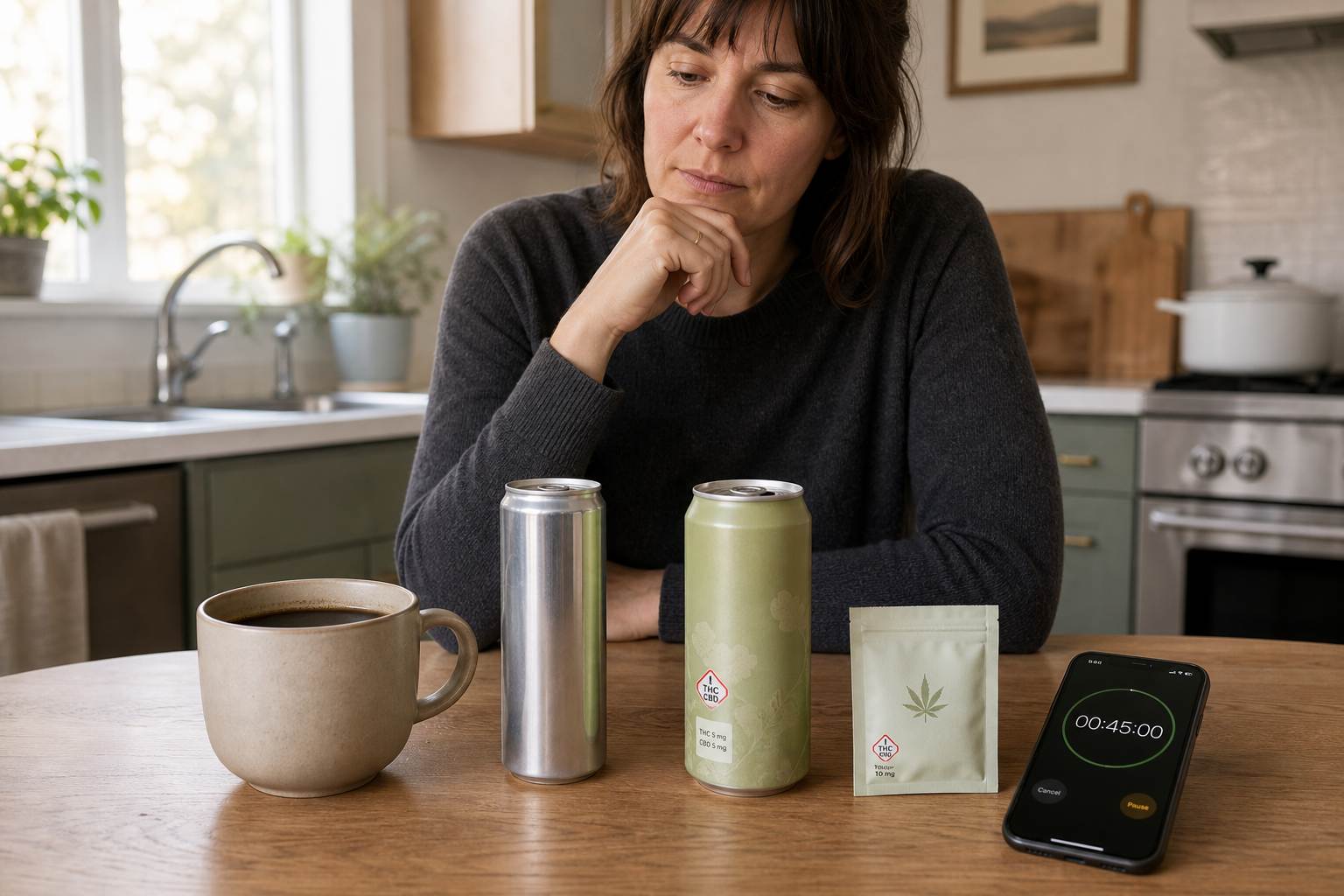
    Coffee and cannabis are both common in adult routines, but they do not always make a tidy pair. A morning coffee before a low-dose edible, an energy drink before a vape, or a THC beverage at a social event where everyone is also having cold brew can make the experience harder to read. The issue is not that caffeine and cannabis are automatically dangerous together for every adult. The more practical problem is that caffeine can make the body feel more alert, restless, or keyed up while THC can change perception, timing, coordination, and anxiety. When those signals overlap, it becomes easier to misjudge dose, timing, and impairment.

    This guide is for adults in Canada who want a cautious, real-world way to think about cannabis and caffeine. It is not medical advice, and it cannot predict how a specific person will feel. Tolerance, product type, THC amount, caffeine amount, sleep, food, stress, and medications can all matter. The safest default is simple: try one variable at a time, keep the THC dose modest, avoid driving, and do not use caffeine as a tool to “cancel out” cannabis impairment.

    The Short Answer

    Cannabis and caffeine can be used on the same day by some adults, but combining them closely together can make the experience less predictable. Caffeine may add jitters, faster heartbeat, anxiety, stomach upset, or sleep disruption for sensitive people. THC may add impairment, slower reaction time, altered perception, dry mouth, anxiety, or a stronger-than-expected high, especially with edibles and beverages. Together, they can make it harder to tell whether the problem is too much caffeine, too much THC, bad timing, or all three.

    Health Canada lists a recommended maximum daily caffeine intake of 400 mg for most healthy adults, and lower limits for people who are pregnant, planning pregnancy, or breastfeeding. That number is not a cannabis-mixing guideline; it is a caffeine guideline. If cannabis is also in the picture, the smarter move is to stay comfortably below personal caffeine limits and avoid stacking several stimulating drinks around THC.

    Why the Combination Can Feel Confusing

    Caffeine is a stimulant. Many adults use it because it can increase alertness and reduce sleepiness for a while. That can feel helpful, but it can also bring the familiar downsides: shakiness, racing thoughts, a faster-feeling pulse, stomach discomfort, irritability, or trouble sleeping. A 2024 meta-analysis on caffeine and anxiety found that caffeine intake may increase anxiety risk, especially at higher doses, though individual response varies and study designs differ.

    THC is different. It can make some people feel relaxed, social, or absorbed, but it can also make others feel anxious, foggy, overly aware of body sensations, or uncomfortable. Health Canada’s cannabis risk guidance emphasizes starting with lower-risk choices, avoiding frequent heavy use, and being careful with products that can impair judgment. With edibles and beverages, timing adds another layer because effects can take longer to appear than inhaled cannabis.

    The overlap is where people get tripped up. A person may drink coffee because an edible “hasn’t kicked in,” then feel both the delayed THC and the caffeine at once. Someone may use cannabis after an energy drink and mistake stimulation for cannabis anxiety. Another adult may feel fine in the moment but sleep poorly, then use more caffeine the next day and repeat the cycle.

    Coffee, Energy Drinks, and Cannabis Beverages Are Not the Same Situation

    The cannabis-caffeine question changes depending on the format. A small coffee earlier in the day is not the same as a large energy drink next to a high-THC edible. A cannabis beverage is not the same as coffee with a joint because oral cannabis timing can stretch the experience.

    SituationMain timing issueSafer-use check
    Coffee before cannabisCaffeine may still be active when THC effects rise.Use a lower THC amount than usual if you are already jittery, underslept, or anxious.
    Energy drink plus cannabisHigher caffeine servings can make body sensations louder.Read the caffeine amount and serving instructions; avoid stacking multiple caffeinated products.
    THC edible after caffeineDelayed onset can lead to impatience and extra dosing.Wait long enough for the edible before adding more THC or more caffeine.
    THC beverage at a social eventDrinks are easy to sip quickly while distracted.Track the THC per container and treat it like a cannabis product, not a regular soda.
    Late-day cannabis and caffeineBoth can interfere with a clear read on sleep and next-day grogginess.Leave a buffer before bedtime and avoid using caffeine to push through impairment.

    Do Not Use Coffee to Sober Up From Cannabis

    A common myth is that coffee makes a person sober enough to drive, work, or handle a risky task after cannabis. That is not a safe assumption. Caffeine can make someone feel more awake without removing THC-related impairment. The person may feel more alert but still have slower reaction time, altered judgment, or poor coordination. For Canadian readers, the practical rule is clear: if cannabis may be affecting you, do not drive. Time, rest, food, water, and a calm setting are more realistic supports than trying to outsmart impairment with another substance.

    If you are already too high, caffeine may not be the best next move. For some people it can make anxiety, a racing-feeling heart, or looping thoughts worse. A better first step is to lower stimulation: sit somewhere safe, pause extra THC, sip water, eat a simple snack if that feels comfortable, and remind yourself that the unpleasant peak usually passes. TWJ’s separate guide on how to sober up from being too high walks through that situation in more detail.

    The Anxiety Angle

    Caffeine and THC can both be uncomfortable for people who are prone to anxiety. That does not mean every anxious reaction is the same. Caffeine can feel like physical activation: alertness, restless energy, a tense stomach, or a faster heartbeat. THC anxiety can feel more perceptual: worries feel sticky, time feels stretched, ordinary sensations feel too important, or a person becomes concerned that something is wrong. Combined closely, those two patterns can reinforce each other.

    If cannabis has made you anxious before, mixing it with a strong coffee or energy drink is a poor testing ground. Start with a calm day, familiar setting, low THC amount, and no pressure to perform. If anxiety, panic symptoms, chest pain, fainting, severe confusion, or other alarming symptoms show up, seek medical help rather than trying to self-manage with more cannabis, alcohol, or stimulants. For prevention-focused advice, read TWJ’s guide to weed anxiety and safer-use tips.

    What the Research Can and Cannot Tell Us

    There is not enough human research to give a simple universal rule for every cannabis-and-caffeine combination. Some evidence comes from animal or laboratory work, and some studies focus on specific outcomes such as memory, mood, or cardiovascular markers rather than everyday adult use. A paper on THC and caffeine interactions in memory-related tasks, for example, is useful as a caution that the combination is biologically plausible and not fully settled, but it should not be treated as a direct household dosing guide.

    That uncertainty matters. When the evidence is incomplete, the responsible advice is not to make a dramatic claim. It is to reduce variables. Know how much caffeine you have had. Know how much THC is in the product. Avoid mixing several product types in one session. Give oral cannabis enough time before redosing. Do not test the combination before driving, work, exercise, childcare, or any situation where impairment would create real risk.

    A Practical Timing Plan

    If you still plan to use cannabis and caffeine on the same day, make it boring and trackable. Boring is good here. Use a product and dose you already understand, not a new high-THC edible beside a new energy drink. Keep the caffeine familiar too. A known morning coffee is easier to interpret than a large can with multiple stimulants and serving instructions you have not read.

    • Check caffeine first: count coffee, tea, cola, energy drinks, pre-workout products, and caffeine tablets.
    • Check THC second: read the total THC per package and the THC per unit or serving.
    • Separate timing when possible: avoid taking THC right when caffeine is peaking if you are sensitive to jitters.
    • Use a lower THC amount when caffeine, stress, or poor sleep is already in the mix.
    • Set a phone timer before redosing edibles or cannabis beverages.
    • Do not add alcohol as a third variable.
    • Do not drive, bike in traffic, operate tools, or take on caregiving tasks while impaired.

    For edible timing specifically, see TWJ’s guide to how long edibles take to kick in. For the broader duration question, the guide on how long a cannabis high lasts is a useful companion.

    Energy Drink Labels Deserve Extra Attention

    Energy drinks are easy to underestimate because they look like ordinary beverages. In Canada, caffeinated products can carry label directions and warnings that matter. Read the amount per serving, the number of servings in the container, and any directions about maximum daily intake or groups for whom the product is not recommended. If a drink also contains other stimulating ingredients, do not treat it as just another cup of coffee.

    Pair that label reading with cannabis label reading. A THC beverage, gummy, capsule, or oil should be checked for total THC, THC per serving, CBD amount, package date, storage instructions, and whether the product came from a legal source. A legal product label is not a guarantee that the combination will suit you, but it gives you the basic information needed to make a less chaotic decision.

    Who Should Be More Cautious?

    Some adults should be especially careful or avoid the combination unless they have spoken with a qualified health professional. That includes people who are pregnant, planning pregnancy, breastfeeding, sensitive to caffeine, prone to panic, living with heart rhythm concerns, taking medications that affect alertness or heart rate, or using cannabis for a health-related reason. Young people should avoid cannabis, and caffeine guidance is also stricter for children and adolescents. This article is written for adults, not youth.

    People with low tolerance should also slow down. A person who rarely uses cannabis may not have a reliable sense of how THC feels with or without caffeine. A person returning after a break may be surprised by a dose that used to feel ordinary. A low-dose THC product with no added pressure is a better test than a high-THC edible, strong coffee, and a busy social setting.

    Bottom Line

    Cannabis and caffeine are not a clean on/off switch. Caffeine does not erase cannabis impairment, and THC does not make high caffeine intake harmless. If you use both, keep the session simple: legal cannabis, known dose, known caffeine amount, enough time between products, no driving, no alcohol, and no pressure to keep adding more because the first effect was not what you expected.

    The most reader-safe advice is also the least flashy: change one thing at a time. If you want to understand how cannabis affects you, do not bury the signal under an energy drink. If you want coffee, enjoy coffee without assuming it will fix a cannabis session that went too far. Clear timing beats guesswork.

    Sources

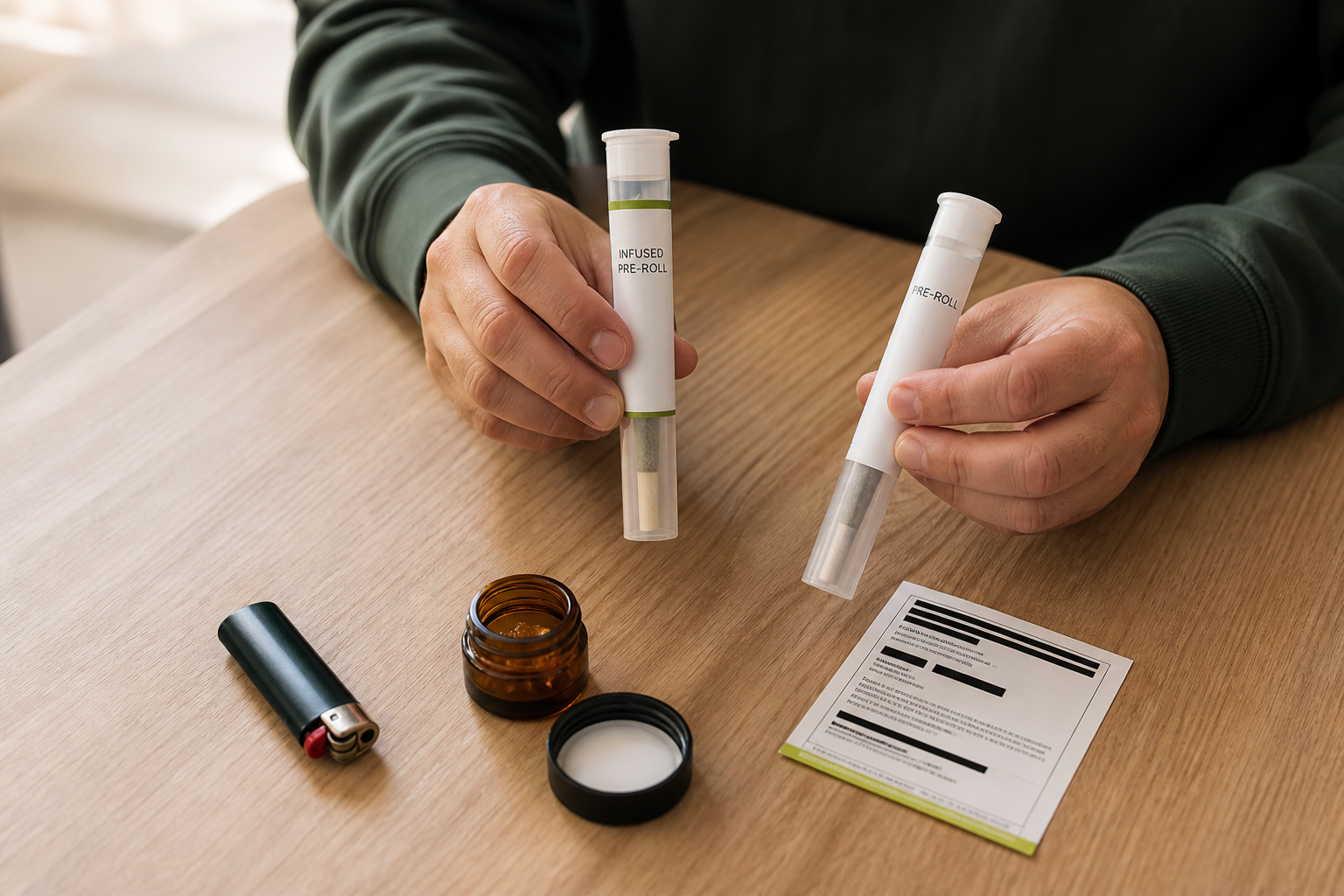
  • Infused Pre-Rolls in Canada: Labels, THC, and Safer Checks

    Infused Pre-Rolls in Canada: Labels, THC, and Safer Checks

    Infused pre-rolls can look simple: a ready-made joint with something extra added. The buying decision is not always simple, though. In Canada, an infused pre-roll may combine dried cannabis with kief, hash, resin, distillate, or another cannabis extract. That can change strength, burn, smell, price, and the chance that a casual session becomes stronger than expected.

    This guide is for adults comparing infused pre-rolls in the legal Canadian market. It explains what to check on the package, how infused options differ from regular pre-rolls, and why the safest choice is usually the one you understand before you light it.

    What Is an Infused Pre-Roll?

    A standard pre-roll is usually ground dried cannabis flower rolled in paper, often with a filter. An infused pre-roll adds a cannabis extract or concentrated cannabis material to that flower. The added material might be inside the roll, coated on the outside, mixed through the flower, or paired with kief or hash-style material.

    The exact format matters because “infused” is not one product type. A kief-coated pre-roll, a hash-infused pre-roll, and a distillate-infused pre-roll can feel very different in strength and burn behaviour. If the package only makes the product sound exciting but does not make the format clear, slow down and compare another option.

    If you are still learning the basics, start with The Weed Journal’s cannabis pre-roll buying checklist before moving into infused formats. Infused products are usually a second-step choice, not the easiest beginner option.

    Regular vs Infused Pre-Rolls: Quick Comparison

    Buying checkRegular pre-rollInfused pre-rollReader takeaway
    Main cannabis materialDried flowerFlower plus kief, hash, resin, distillate, or another extractFind out what was added, not just that it is “infused.”
    THC expectationsOften easier to compare against flower THC rangesCan be much stronger because concentrated material is addedCheck total THC and package size before assuming serving strength.
    Burn and handlingUsually more familiarMay burn unevenly, feel harsher, or need slower pacingDo not rush through it just because it is pre-rolled.
    Best fitAdults who want a simple smoked formatAdults with more cannabis experience who understand potency labelsInfused does not automatically mean better; it means more variables.

    The Label Checks That Matter Most

    Canadian cannabis labels can include a lot of small numbers and required warnings. For infused pre-rolls, the most useful checks are product format, net weight, number of units, THC and CBD amounts, lot number, package date, and storage instructions. Health Canada’s consumer label guidance is a good baseline for understanding those pieces before comparing products.

    Do not stop at the biggest THC percentage on the front of a package. Look for how much cannabis is in each pre-roll, how many pre-rolls are in the pack, whether the label gives “total THC” information, and whether the infused material is identified clearly. The Canadian cannabis label guide explains the broader label math if THC, CBD, and package units feel confusing.

    A useful label should help you answer five practical questions: What is the base flower? What was added? How strong is the product? How much is in the package? Is this something you can store and use responsibly at home?

    THC Strength: Why Infused Can Surprise People

    Infused pre-rolls can create a false sense of familiarity. They look like a smoked flower product, but the added extract can move the experience closer to the concentrates category. Health Canada warns that cannabis with higher THC levels can increase risks, including anxiety, impaired attention, and dependence-related concerns. That does not mean every adult will respond the same way, but it does mean high-THC inhaled products deserve more caution than a casual label glance.

    For a practical comparison, think in terms of variables. A regular pre-roll may already be stronger than a beginner expects. An infused pre-roll adds at least one more variable: concentrated cannabis material. If the product is also large, shared loosely, used quickly, or mixed with alcohol, the experience becomes harder to predict.

    If you want a deeper explanation of extracts, read the cannabis concentrates guide. The main point here is simple: when a pre-roll contains concentrate, judge it partly like an inhaled concentrate product, not only like flower.

    A Safer Buying Checklist for Infused Pre-Rolls

    • Confirm the product is from a legal Canadian source with sealed, regulated packaging.
    • Check the exact infused material: kief, hash, resin, distillate, or another extract.
    • Read total THC and CBD information, not just a marketing name or strain label.
    • Compare package size, number of pre-rolls, and net weight before judging value.
    • Avoid treating an infused pre-roll as a beginner “try one and see” product.
    • Plan the setting: no driving, no work obligations, no pressure to finish the whole item.
    • Avoid mixing with alcohol or other substances, especially with high-THC products.
    • Store leftovers, unused pre-rolls, and packaging away from children, pets, and visitors.

    How to Think About “One Pre-Roll”

    One pre-roll is not always one sensible serving. Legal packages may contain single large pre-rolls, slim multi-packs, or products intended to be shared. Infusion can make that more important because total product strength is not always obvious from the name.

    Before buying, ask whether you would be comfortable using only part of the product and stopping. If the answer is no, choose a simpler or lower-strength format. The best harm-reduction move is often made before purchase, when you still have the option to choose a less complicated product.

    Inhaled cannabis usually has a faster onset than swallowed edibles, but that does not mean you can perfectly judge the final effect after one or two pulls. Pace matters. So does setting. The guide to how long a cannabis high lasts can help you separate onset, peak, duration, and next-day caution.

    Storage and Home Safety

    Infused pre-rolls should be stored like a cannabis product first and a smoked product second. Keep the original package where possible, since it carries the lot number, THC/CBD information, warnings, and child-resistant features. Keep products dry, sealed, and away from heat or direct sunlight, and avoid leaving them loose in a drawer, bag, car, or shared living space.

    Added extracts can make smell, stickiness, and residue more noticeable. If the pre-roll is damaged, leaking, unusually sticky, or missing clear package information, do not try to rescue the purchase by guessing. Use the retailer or producer information on the package and check recall notices if something seems wrong.

    For household basics, use the safe cannabis storage checklist. This matters even more with infused products because other adults may not realize they are stronger than a regular pre-roll.

    Who Should Be Extra Cautious?

    Some adults should be especially careful with high-THC inhaled products: people new to cannabis, people who have had cannabis-related anxiety or panic, people taking medications that affect alertness, people with a personal or family history of psychosis, and anyone who needs to drive, work, supervise children, or make important decisions soon after use. This is not personal medical advice. It is a reason to choose lower-risk settings and talk to a qualified health professional when health conditions or medications are involved.

    Infused pre-rolls are also a poor fit for “prove it” sessions where someone feels pushed to keep up. The format can be hard to split into predictable amounts, and social pacing can override common sense. If you are not sure, do less, wait, or choose a clearer format.

    If the Label Feels Unclear

    Confusing labels are a reason to pause, not a puzzle the buyer has to solve on the spot. Look for the producer name, product class, net weight, THC and CBD details, warning panel, lot number, and package date. If those pieces are hard to find, ask the retailer for clarification or choose a simpler product with clearer information.

    This is especially important when a product uses familiar strain names or bold flavour language. Names can help you remember what you bought, but they should never replace basic label checks.

    Bottom Line

    An infused pre-roll is not just a regular pre-roll with better marketing. It is a flower product plus concentrated cannabis material, and that combination can change strength, burn, and risk. A careful buyer checks what was added, reads the THC and CBD details, compares package size, plans a low-pressure setting, and stores the product safely afterward.

    If the product label makes the added extract and total strength easy to understand, you can compare it calmly. If the label is vague or the purchase depends on hype, choose something simpler.

    FAQ

    Are infused pre-rolls legal in Canada?

    Legal cannabis products can include dried cannabis, extracts, edibles, topicals, and other regulated classes, but the practical answer depends on whether the product comes from an authorized legal source and follows Canadian packaging and labelling rules. Avoid unregulated products, especially when the strength or infused material is unclear.

    Are infused pre-rolls stronger than regular pre-rolls?

    They often can be, because they add concentrated cannabis material to flower. The exact strength depends on the flower, extract type, total THC, package size, and how the product is used. Read the label instead of relying on the word “infused.”

    Are infused pre-rolls good for beginners?

    Usually, beginners are better served by simpler, lower-THC products with clearer pacing. Infused pre-rolls add potency and format variables that can make the experience harder to judge.

    Sources

  • Cannabis Decarboxylation in Canada: Labels, Edibles, and Flower

    Cannabis Decarboxylation in Canada: Labels, Edibles, and Flower

    Decarboxylation is one of those cannabis words that sounds more technical than the reader question behind it. Most adults are really asking: why does heating cannabis change what it does, why do Canadian labels say Total THC, and why does dried flower behave differently from an edible, oil, capsule, or drink?

    The short answer: decarboxylation is a heat-linked chemical change that can convert acidic cannabinoids such as THCA into neutral cannabinoids such as THC. That matters when you read a cannabis label, compare product types, cook with dried flower, or try to understand why raw flower is not the same as a ready-to-eat edible. This guide keeps the chemistry practical and Canada-aware, without pretending that a kitchen can control cannabis potency like a licensed lab.

    Quick Answer

    Cannabis decarboxylation is the process where acidic cannabinoids lose a carboxyl group and shift toward their neutral forms. In plain language, heat can help change THCA into THC and CBDA into CBD. Smoking, vaping, baking, extraction, processing, and long storage conditions can all play a role, but they do not produce perfect conversion every time.

    In Canada, this is why labels often emphasize Total THC and Total CBD. Health Canada’s label guidance says the front of a cannabis label must display total THC and total CBD amounts or concentrations. Federal cannabis regulations also describe Total THC as the quantity or concentration that could yield THC when the potential conversion of THCA into THC is taken into account.

    Why Decarboxylation Matters On Canadian Labels

    If you are looking at dried flower, the label may show more than one cannabinoid number. THC can mean the THC already present in the product before use. Total THC is the number that accounts for potential conversion from THCA. That does not mean every person will experience the number exactly, but it is a better label clue than raw THC alone when flower will be heated.

    This is closely connected to our THCA guide for Canada and our broader Canadian cannabis label guide. The practical habit is simple: for flower and other heat-used products, compare Total THC and Total CBD first, then use the rest of the label to understand product type, package date, lot number, terpenes, and storage instructions.

    Label or product detailWhat decarboxylation changesReader takeaway
    THCA on flowerSome THCA can convert toward THC when heated.Raw THC alone may understate the potential effect of heated flower.
    Total THCAccounts for potential THC yield after conversion.Use it as a comparison clue, not a personal dose guarantee.
    Edible THC in mgThe product is already manufactured for oral use.Do not apply flower-style assumptions to a gummy, drink, capsule, or chocolate.
    Storage conditionsHeat, time, and light can affect cannabinoid stability.Keep products sealed, labelled, and stored as directed.
    Homemade infusionKitchen heat may change cannabinoids unevenly.A homemade edible is harder to dose than a labelled legal edible.
    Use decarboxylation as a label-reading concept, not as a promise of exact potency.

    Flower, Vapes, Edibles, and Oils Are Not The Same

    Decarboxylation shows up differently depending on the product. Dried flower is often heated by the consumer through smoking, dry herb vaping, or cooking. A vape cartridge or extract has already gone through processing steps before it reaches the shelf. An edible, beverage, capsule, or oil is a finished product with THC and CBD amounts listed in a format meant for that product category.

    That is why product type matters as much as cannabinoid chemistry. If you are still comparing categories, start with our guide to choosing cannabis product types in Canada. A person who wants quick feedback, a person avoiding inhalation, and a person trying to read a flower label are solving different problems.

    Can You Decarb Cannabis At Home?

    Adults in Canada may encounter decarboxylation when making a homemade infusion, cooking with dried flower, or trying to understand online recipes. The important caution is that a home kitchen is not a testing lab. Oven temperatures fluctuate. Flower pieces vary in size, moisture, age, and cannabinoid content. Heat may not reach every piece evenly. Some cannabinoids and terpenes can also degrade or evaporate under heat, time, air, and light.

    That does not mean the concept is useless. It means readers should avoid fake precision. A recipe that promises an exact THC result from flower without lab testing is guessing. If you use legal dried flower at home, keep the original package, note the Total THC, avoid mixing product lots, label any infused food clearly, and assume the finished result may be uneven. For many adults, a legal edible or oil with a measured label is a simpler choice than homemade cannabis food.

    A Safer Home-Decarb Checklist

    • Start with a legal cannabis product in its original packaging.
    • Read Total THC, Total CBD, net weight, package date, lot number, and storage instructions before using it.
    • Do not combine multiple lots or unknown leftovers if you want a predictable result.
    • Keep cannabis and cannabis-prepared foods away from children, pets, visitors, and anyone who may mistake them for ordinary food.
    • Use clear labels on any homemade infused food, including a warning that it contains cannabis.
    • Avoid driving, work, tools, caregiving duties, or alcohol when trying a new homemade product.
    • Treat any homemade edible as delayed-onset and hard to measure.

    The last point is the one that prevents the most trouble. Homemade edible effects can arrive slowly, feel stronger than expected, and last longer than a quick inhaled session. Health Canada’s “start low, go slow” advice is especially relevant when dose is uncertain. Pair this guide with our edibles dosing guide and edibles onset guide before making decisions about timing or serving size.

    What Decarboxylation Does Not Tell You

    Decarboxylation explains an important chemical change, but it does not tell the whole story of a cannabis experience. It does not tell you your tolerance, your impairment level, your personal response, whether a product is a good fit for your plans, or whether homemade food has mixed evenly. It also does not turn CBD into THC, remove impairment risk, or make a high-THC product automatically better.

    It also does not replace legal sourcing. Canada’s legal cannabis system includes packaging, labelling, licensed production, and provincial or territorial retail rules. A homemade process cannot add those safeguards to unlabelled cannabis from an unknown source. When a product has no reliable label, you lose the best starting point for comparing potency and risk.

    How Heat, Time, And Storage Fit Together

    Scientific reviews of acidic cannabinoid decarboxylation describe conversion as affected by factors such as temperature, time, and the structure of the cannabinoid involved. For readers, the useful point is not to memorize a single universal oven setting. The useful point is that heat and time change cannabis chemistry, and uncontrolled heat and time can also reduce product quality.

    Storage is the everyday version of the same lesson. Cannabis should be kept away from excess heat, light, air, and moisture, and it should stay in a secure place. If your concern is freshness rather than cooking, use our cannabis storage guide and flower freshness checklist. You are trying to preserve the product, not accidentally “improve” it through poor storage.

    How To Use This When Buying Cannabis

    Decarboxylation is most useful before you buy or prepare cannabis, not after something feels too strong. When comparing dried flower, check Total THC rather than chasing the biggest raw THC number. When comparing edibles, drinks, oils, capsules, or sprays, look at milligrams per unit or container and remember that the product has already been formulated for that route of use. When comparing homemade cannabis food with a legal edible, admit the difference: one has a regulated label, the other depends on your materials and method.

    If a retailer, package, or recipe makes the chemistry sound too easy, slow down. Good cannabis education should make uncertainty visible. Total THC is useful. Legal labels are useful. Published chemistry is useful. But no label or article can tell you exactly how a homemade edible will affect you at a specific moment.

    FAQ

    Does raw cannabis flower already contain THC?

    It can contain some THC, but dried flower often contains a meaningful amount of THCA. That is why Canadian labels use Total THC to help show potential THC after conversion from THCA.

    Is decarboxylation the same as making cannabis stronger?

    No. Decarboxylation can change acidic cannabinoids into neutral forms, but heat can also degrade some compounds. “Stronger” depends on product, amount, route of use, tolerance, and how evenly the product is prepared.

    Do legal edibles need to be decarbed at home?

    No. A legal edible is a finished cannabis product. Read the THC and CBD amount per unit or container, follow the label, and avoid adding more before effects are clear.

    Can decarboxylation make homemade edibles predictable?

    It can make the preparation more informed, but it cannot make a home kitchen as predictable as a tested legal product. Uneven mixing, oven variation, flower differences, and serving size all matter.

    Sources

  • How to Read Terpene Labels in Canada

    How to Read Terpene Labels in Canada

    Terpene labels can make cannabis shopping feel more precise than it really is. A package might list myrcene, limonene, caryophyllene, pinene, linalool, or total terpene percentage, but that does not mean the label can predict exactly how you will feel. It can, however, give you useful clues about aroma, freshness, product consistency, and whether two products are genuinely different.

    This Canadian guide explains how to read terpene information without turning it into a promise. Use it beside the basics: THC and CBD amount, package date, lot number, product type, your tolerance, and whether the product comes from a legal source with regulated packaging.

    What terpenes are

    Terpenes are aromatic compounds found in cannabis and many other plants. They help shape how a product smells: citrus, pine, pepper, floral, earthy, fuel-like, herbal, or fruity. In cannabis retail, terpenes are often presented as part of a product’s “profile” alongside cannabinoid information.

    The important beginner point is simple: terpene labels are best used as aroma and comparison clues, not as a medical or mood guarantee. A product high in a certain terpene may smell familiar from past products you liked, but effects still vary by THC amount, CBD amount, dose, route of consumption, setting, tolerance, sleep, food, and individual sensitivity.

    Where terpene information appears in Canada

    Canadian cannabis packages must follow federal packaging and labelling rules. Required information focuses on things like standardized cannabis symbols, THC and CBD amounts, warning statements, lot numbers, net weight, and responsible-use details. Terpene information may appear on the package, a producer’s website, a retailer listing, or a certificate-style lab summary, but it is not always presented the same way from product to product.

    That means terpene labels are useful only when you read them in context. If a package has no terpene profile, that does not automatically mean the product is poor. If a package has a detailed profile, that does not automatically mean it is better. The value is in how the information helps you compare one product with another.

    How to read a terpene panel

    Start with the unit. Some labels show individual terpenes as percentages. Others show milligrams per gram, total terpene percentage, or a ranked list of the top terpenes. Do not compare two products until you know whether the numbers are using the same unit.

    Label item What it can tell you What it cannot tell you
    Total terpenes Whether the product may have a stronger or lighter aroma profile compared with similar products. Whether the product will feel stronger than another product with more THC.
    Top terpene list The dominant aroma direction, such as citrus, pine, herbal, floral, spicy, or earthy. A guaranteed effect such as sleep, focus, anxiety relief, or pain relief.
    Batch or lot result Whether the listed profile belongs to a specific lot or a broad product description. Whether every future package of the same strain will match exactly.
    Package date How long the product has been sealed since packaging, which can matter for aroma quality. The exact freshness or storage history before you bought it.
    THC and CBD beside terpenes The potency context you need before judging whether a product suits your tolerance. A complete prediction of your personal experience.

    A practical way to use the panel is to compare like with like. Compare dried flower with dried flower, pre-rolls with pre-rolls, and vapes with vapes. A terpene percentage on a dried flower label does not mean the same thing as a flavour-forward vape description, especially when the product format and ingredients are different.

    Common terpene names and aroma clues

    You do not need to memorize every terpene. Start with the names that appear most often and connect them to smell, not promised effects.

    Terpene Common aroma clue How to use that clue while shopping
    Myrcene Earthy, herbal, musky, sometimes clove-like Look for it if you tend to enjoy heavier, earthier flower aromas.
    Limonene Citrus peel, lemon, orange Use it as a signpost for brighter citrus aroma, not as a promise of mood.
    Beta-caryophyllene Pepper, spice, woody notes Helpful when comparing products that smell more peppery or savoury.
    Pinene Pine, resin, fresh herbs Useful if you prefer crisp, forest-like aroma notes.
    Linalool Floral, lavender-like Use it to identify softer floral profiles, especially in lower-aroma products.
    Humulene Hoppy, herbal, woody Can help distinguish herbal profiles from sweet or fruit-forward ones.

    Do terpenes predict effects?

    They should not be treated as an effects guarantee. Cannabis research continues to explore how cannabinoids, terpenes, dose, and individual biology interact, but retail shorthand often gets ahead of the evidence. A label that lists limonene does not prove the product will be energizing. A label that lists myrcene does not prove the product will be sedating. Those claims are too tidy for how cannabis actually behaves from person to person.

    A more careful approach is to track your own experience. If two legal products have similar THC amounts but one repeatedly feels better suited to you, compare their terpene panels, package dates, product types, and CBD content. Over time, patterns may emerge. Treat those patterns as personal notes, not universal rules.

    How terpene labels fit with THC and CBD

    Many shopping mistakes happen when people treat terpenes as a workaround for potency. They are not. A high-THC product with a terpene profile you like can still be too strong. A balanced CBD:THC product with fewer terpene details may still be a better fit for a cautious beginner.

    If you are new, start by reading the THC and CBD values first. Health Canada emphasizes that cannabis products vary in strength and that THC can have intoxicating effects. Once you know the potency range, terpene details can help you choose between products in the same general strength band.

    For a broader potency primer, The Weed Journal’s guide to CBD:THC ratios in Canada explains how to read balanced products without treating one number as the whole story. If you are still choosing between product formats, start with how to choose cannabis product types in Canada before using terpene details as a finer filter.

    Freshness, storage, and package dates matter

    Terpene labels are most useful when the product still smells and handles like the profile suggests. Poor storage, old package dates, damaged seals, and dried-out flower can make a labelled aroma profile less meaningful in real life.

    When buying dried flower or pre-rolls, check the package date, lot number, seal, and product condition. A terpene panel from the original batch is not a magic shield against stale handling. If aroma quality matters to you, pair terpene reading with the freshness checks in our Canadian flower buying checklist and our guide to storing cannabis at home.

    A simple terpene-label checklist

    • Confirm the product type before comparing numbers.
    • Check whether the label shows total terpenes, top terpenes, or both.
    • Look at the units: percentage, mg/g, or a ranked list.
    • Read THC and CBD values before giving terpenes too much weight.
    • Check package date, lot number, and seal condition.
    • Use aroma words as clues, not medical or mood claims.
    • Keep notes on products you personally tolerate well.
    • Be cautious with very high-THC products, even when the terpene profile sounds appealing.

    Red flags when terpene information is overused

    Be careful when product copy turns a terpene into a certainty. Phrases that promise anxiety relief, sleep, pain control, focus, or other health outcomes deserve skepticism unless they are properly supported and legally appropriate. Cannabis can affect people differently, and health-adjacent claims should not be reduced to a terpene name on a package.

    Also be wary of comparisons that ignore format. A dried flower profile, an infused pre-roll, a vape cartridge, and an edible may all use terpene language, but they do not deliver cannabis in the same way. Inhaled products usually have a faster onset than oral products; oral cannabis can take longer and last longer. Terpenes do not erase those format differences.

    When a terpene profile is most useful

    Terpene information is most useful when you already know your preferred format and potency range. For example, an adult who likes moderate-THC dried flower and wants a brighter aroma can compare two products with similar THC values, package dates, and price, then use limonene or pinene as aroma clues. Another reader who dislikes sharp citrus aromas may use the same panel to avoid a product, not chase a promised effect.

    It is also useful for repeat buying. If you liked a product last month but the next package feels different, compare lot numbers, package dates, THC/CBD values, and terpene totals. Cannabis is an agricultural product, so variation is normal. The label gives you a paper trail for noticing those changes.

    Bottom line

    Terpene labels are worth reading, but they work best as part of a bigger label-reading habit. Start with legal packaging, THC and CBD amount, product type, package date, and lot number. Then use terpene names and totals to understand aroma direction and compare similar products.

    The careful shopper’s rule is this: terpenes can help you ask better questions, but they should not make the decision for you. If a product sounds too strong, too old, poorly labelled, or wrapped in health promises, the terpene list is not enough to fix that.

    Sources

    FAQ

    Are terpenes required on every Canadian cannabis label?

    No. Canadian cannabis labels must include required federal information, but terpene details are not presented consistently across every product. You may see them on a package, retailer listing, producer page, or lab-style summary.

    Is a higher terpene percentage always better?

    No. Higher terpene totals may suggest a more noticeable aroma, but they do not automatically mean better quality, better effects, or better fit for your tolerance.

    Can I use terpenes to choose cannabis for sleep or anxiety?

    Use caution. Terpene names are often marketed with effect claims, but they should not be treated as medical advice or a guaranteed outcome. Talk to a healthcare professional for health-specific questions.