Education 7 min read
Cannabis Sublinguals in Canada: Strips, Lozenges, Oils
A practical Canada-aware guide to cannabis sublingual strips, lozenges, and oils: label checks, onset expectations, dosing caution, and when to treat a product like an edible.
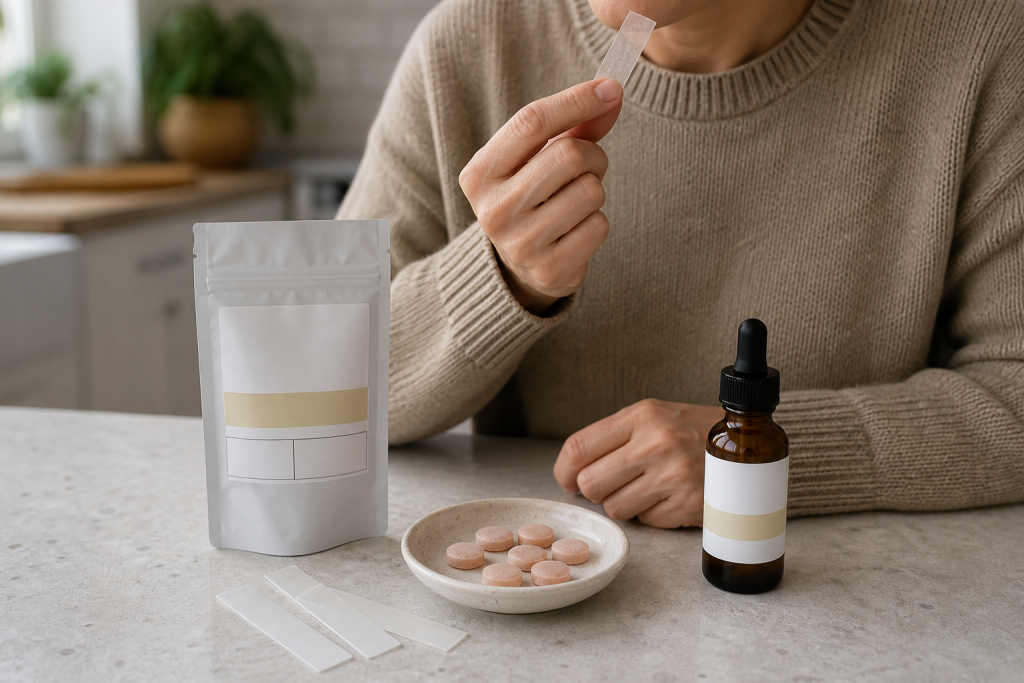
Cannabis sublingual products can sound more precise than they really are. A strip that dissolves under the tongue, a lozenge held in the mouth, and an oil dropped under the tongue may all be marketed around faster absorption, but Canadian shoppers still need to read the label, understand the product class, and plan the dose cautiously.
This guide explains how to compare cannabis strips, lozenges, oils, and other mouth-held products in Canada without assuming every product behaves the same way. It is not medical advice. The useful question is simpler: what does the package say, how much THC or CBD is in each unit or activation, and what happens if you swallow some or all of it?
What “sublingual” means
Sublingual means “under the tongue.” In cannabis shopping, people often use the word loosely for products meant to sit in the mouth before swallowing: oils, oral sprays, dissolvable strips, tablets, lozenges, and sometimes hard candies. That loose language matters because the same package may involve both mouth absorption and ordinary digestion.
If a product is held under the tongue or against the cheek, some cannabinoids may be absorbed through oral tissue. If it is swallowed quickly, it behaves more like an edible or ingestible oil. Many real-world uses land somewhere in the middle, especially with lozenges and strips that dissolve over time. For background on related formats, see our guides to cannabis oil vs tincture labels, cannabis oral sprays, and capsules and softgels.
The comparison that actually helps
| Product style | How people use it | What to check first | Main caution |
|---|---|---|---|
| Dissolvable strip | Held under tongue or against cheek until it dissolves | THC/CBD per strip, total THC/CBD per package, ingredients | Easy to take a second strip too soon if effects feel subtle |
| Lozenge or tablet | Held in the mouth, sometimes swallowed after partial dissolving | THC/CBD per unit, whether it is treated as edible cannabis, allergens or sweeteners | Can behave partly like an edible if swallowed |
| Oil or tincture-style dropper | Dosed by mL or drops, often held briefly before swallowing | THC/CBD per mL or per activation, carrier oil, dropper markings | Drop size can vary; measure instead of guessing |
| Oral spray | Sprayed into the mouth using a metered pump | THC/CBD per spray, total sprays per bottle, directions | Repeated sprays can add up quickly |
Read the front label before the format claims
Health Canada explains that the front of a cannabis label must display THC and CBD amounts, including total THC and total CBD. That label information is more useful than a package claim such as “fast acting,” “sublingual,” or “rapid.” Start with the numbers, then read the directions.
For a strip, tablet, lozenge, or spray, look for the amount per discrete unit or activation. For oils, look for the amount per mL and the total amount in the bottle. If the product only makes sense after a math step, do the math before opening it. A “low-dose” product can still become a high-dose session if several units are used close together.
Onset: why timing can be confusing
People often buy mouth-held cannabis products because they want something that feels easier to manage than smoking and potentially quicker than a swallowed edible. The catch is that onset is not guaranteed. It can depend on how long the product is held in the mouth, how much is swallowed, the amount of THC, recent meals, tolerance, and individual sensitivity.
A cautious practical rule is to avoid treating sublingual timing as permission to keep redosing. If the product is swallowed, part of the experience may follow edible-like timing. Our edibles onset guide explains why waiting matters, especially for newer consumers.
Label checklist for strips, lozenges, and oils
- THC per unit or activation: Check the amount in each strip, lozenge, tablet, spray, mL, or measured serving.
- Total THC per container: Know the package total so you do not accidentally treat a multi-unit package like one serving.
- CBD amount: CBD does not erase THC impairment, but it is still important for comparing products.
- Product class: Confirm whether the package is sold as edible cannabis, a cannabis extract, or another class. Rules and label details can differ.
- Ingredients and allergens: Lozenges and strips may include sweeteners, flavours, colour ingredients, or allergens that matter for some readers.
- Directions: Read whether the product is meant to dissolve, be sprayed, be held briefly, or be swallowed.
- Lot number and packaging date: Keep these in case of quality questions or recalls.
- Storage instructions: Some products can be affected by heat, humidity, or light. Keep all cannabis away from children, pets, and anyone who might mistake it for ordinary candy or medicine.
Do Canadian THC limits change by product type?
Yes, product class can matter. Edible cannabis is generally limited to 10 mg of THC per immediate container. Cannabis extracts have different limits and packaging rules; federal regulations set a 1,000 mg THC maximum per immediate container for a cannabis extract or topical product, accounting for potential THCA conversion. That difference is one reason shoppers should not assume that every mouth-held product is “just an edible” or “just an oil.”
For readers, the practical point is not to memorize regulatory categories. It is to treat the label as the source of truth. If a lozenge, strip, spray, or oil has more THC available across the package than you expected, slow down and plan around the exact unit size.
Who should be extra cautious?
Be especially cautious if you are new to THC, returning after a long break, using other substances, caring for children or pets, or need to drive, work, study, or make decisions later. Health Canada warns that cannabis can impair attention, reaction time, and judgment. Mouth-held products may look small and controlled, but impairment can still happen.
People who are pregnant, breastfeeding, have a history of cannabis-related anxiety, or have a medical condition or medication concern should avoid relying on a product page or blog post for personal guidance. Speak with a qualified health professional if cannabis use intersects with health decisions.
How to compare two products in a store
If two products look similar, compare them in this order: unit dose, total package dose, directions, ingredients, and timing expectations. A low-dose strip with clear per-unit labelling may be easier to plan than a bottle that requires measuring a fraction of a mL. A spray can be convenient if each pump is clearly labelled. A lozenge can be discreet, but it may also be easier to confuse with ordinary candy if stored carelessly.
Also check whether the product fits your setting. A product that takes time to dissolve may not be ideal if you are in a rush. A product that is easy to redose may not be ideal for a first try. If you are testing a new format, choose a calm day, avoid mixing with alcohol, and do not stack it with other THC products.
A simple first-use plan
- Read the THC and CBD amount per unit before opening the package.
- Choose one measured unit or a clearly measured partial serving only if the product directions allow it.
- Use it in a safe, familiar place with no driving or important obligations planned.
- Wait longer than your first instinct before considering more, especially if any portion was swallowed.
- Write down what you used and how long it took to feel noticeable. That note is more useful than relying on memory next time.
Bottom line
Cannabis sublingual strips, lozenges, oils, and sprays can be useful formats for adults who want measured, smoke-free options. They are not automatically mild, instant, or risk-free. In Canada, the smartest comparison starts with the legal label: THC per unit, total THC, CBD amount, product class, directions, and storage instructions.
If the label is confusing, choose the simpler product or wait until you can ask a licensed retailer a specific question. The best cannabis product is not the one with the cleverest format. It is the one you can understand before you use it.
FAQ
Are cannabis strips and lozenges the same as edibles?
Not always. Some products are intended to dissolve in the mouth, while others may be swallowed partly or fully. Check the label and product class instead of relying on the format name.
Do sublingual cannabis products work instantly?
No. Some people may notice effects sooner than with swallowed edibles, but timing varies. If part of the product is swallowed, edible-like timing may still matter.
What number matters most on the label?
Start with THC per unit or activation, then total THC in the package. CBD amount, ingredients, directions, and storage instructions also matter.
Can I drive after using a small cannabis strip or lozenge?
No one should drive while impaired. Small products can still contain THC, and impairment can vary by person, timing, and dose.
Sources
- Health Canada: How to read and understand a cannabis product label
- Health Canada: Packaging and labelling guide for cannabis products
- Justice Laws Website: Cannabis Regulations, packaging and extracts
- Health Canada: Cannabis health effects
Explore the beginner’s guide, or learn how we source and edit our stories.