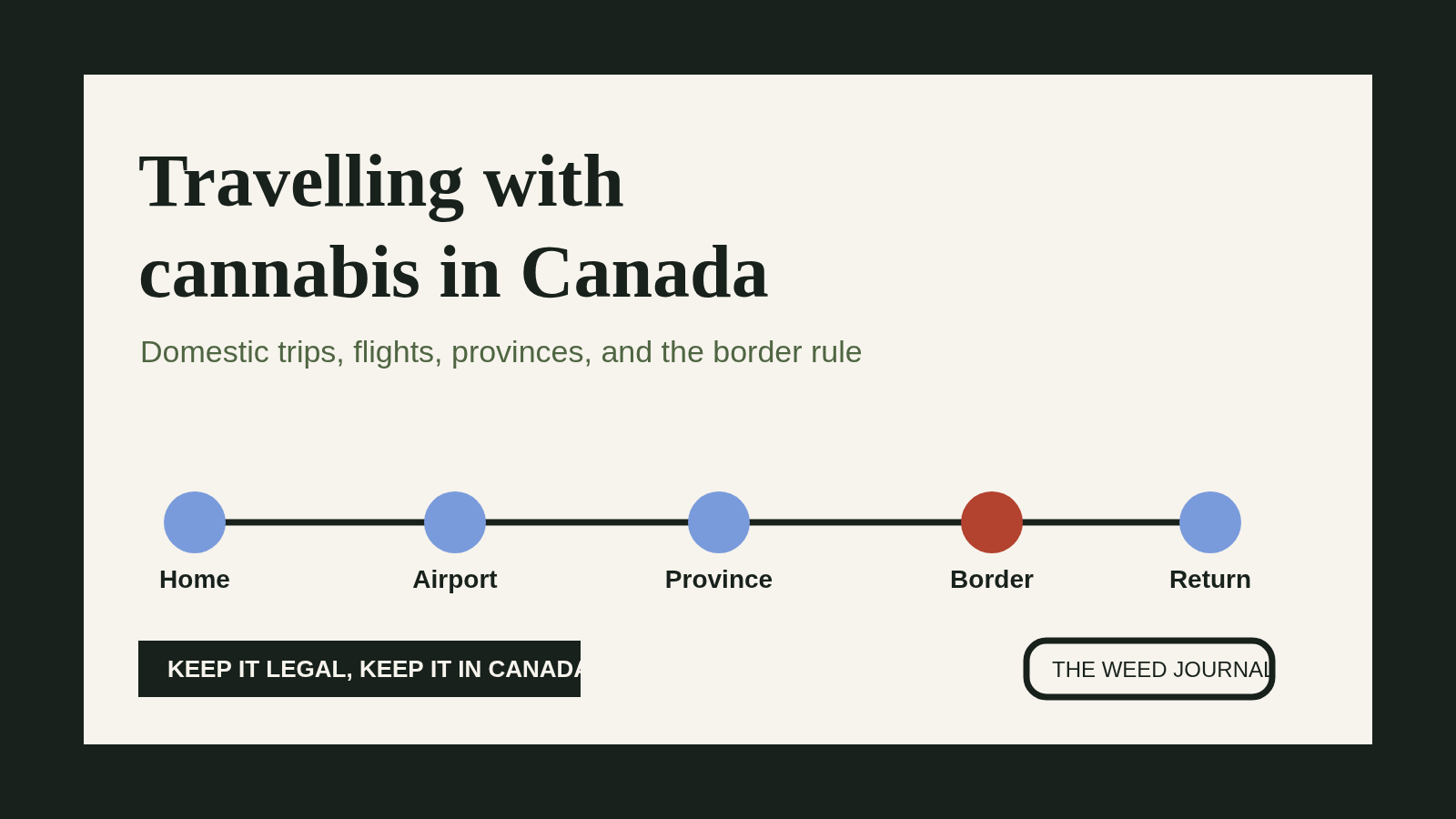
Travelling with cannabis in Canada is legal in some situations and a serious problem in others. The simple version is this: adults can usually travel domestically with a legal personal amount, but they are responsible for the rules in the province or territory they are visiting, and they should never take cannabis across an international border.
This guide is for adults who already choose to use cannabis and want a practical, Canada-aware travel checklist. It covers domestic flights, road trips, province rules, packing, hotel etiquette, medical cannabis cautions, and the border rule. It is legal information for general education, not legal advice.
Quick answer
You may travel within Canada with cannabis if you are of legal age, the product is legal, and the amount is within the applicable possession limit. For most provinces and territories, Health Canada lists the public possession limit as 30 grams of dried cannabis or equivalent for adults. Quebec sets the legal age at 21, while most provinces and territories list 19 and Alberta lists 18.
Domestic flights are different from international flights. CATSA says passengers are responsible for knowing the laws at their destination within Canada. CBSA is much stricter at the border: taking cannabis into or out of Canada without a Health Canada permit or exemption remains a serious criminal offence, even if the cannabis is legal where you bought it or legal where you are going.
Domestic travel vs crossing a border
| Travel situation | What to check first | Reader-first rule |
|---|---|---|
| Driving within one province | Legal age, possession amount, open-container/storage rules, public-use rules. | Keep products sealed or stored away from the driver and never consume before driving. |
| Travelling between provinces | The rules where you start, pass through, and arrive. | Do not assume your home-province rules apply at the destination. |
| Domestic flight inside Canada | CATSA screening rules, liquid limits, destination laws, airline baggage rules. | Keep legal products clearly packaged and avoid packing anything questionable. |
| International flight or land border | CBSA and destination-country rules. | Do not bring cannabis across the border in any amount or form unless you hold a valid permit or exemption. |
| Cruise, ferry, or mixed itinerary | Whether the trip enters another country or crosses customs jurisdiction. | Treat border exposure as a stop sign, not a grey area. |
The 30 gram rule is not the only rule
Adults often hear that they can possess up to 30 grams of dried cannabis or equivalent in public. That is a useful starting point, but it is not the whole travel checklist. Health Canada notes that provinces and territories are responsible for cannabis sale and distribution in their jurisdictions, and that they can add restrictions such as changing legal age, lowering possession limits, or restricting where cannabis may be used in public.
For travellers, the practical takeaway is straightforward: check the province or territory you are visiting before packing cannabis. A trip from Ontario to Quebec, for example, is not just a change of scenery. Quebec’s listed legal age is 21, while Ontario’s is 19. Public consumption, lodging rules, rental-car rules, campsite rules, and municipal bylaws can also affect what is allowed.
If you are buying before a trip, use legal retailers only. Our legal retailer checklist for buying cannabis in Canada explains how to spot authorized sellers and avoid sketchy delivery sites.
Can you fly domestically with cannabis?
For domestic air travel, CATSA’s public guidance says recreational cannabis passengers are responsible for knowing the laws and regulations at their destination within Canada. It also notes that liquid and topical cannabis products are subject to liquid, aerosol, and gel restrictions in carry-on baggage and must fit with other liquids in the clear one-litre bag.
That does not mean every cannabis product is a good idea for a flight. Airport screening is stressful enough without loose flower, unlabeled containers, mixed products, or liquids that look confusing. Keep legal products in original packaging when possible. Make sure labels are readable. Do not pack more than a legal personal amount. Do not consume cannabis before flying if it could make the airport process harder, and never consume in restricted airport or aircraft settings.
If the product format is confusing, start with our Cannabis 101 product type guide. Oils, edibles, vapes, dried flower, capsules, topicals, and concentrates can create different packing questions.
Do not cross the Canadian border with cannabis
The border rule is the safest part of this article to remember because it has very little room for interpretation: do not bring cannabis into Canada and do not take cannabis out of Canada unless you have a Health Canada permit or exemption. CBSA says transporting cannabis across the border in any form, including oils containing THC or CBD, without that authorization remains a serious criminal offence.
CBSA also says this applies regardless of the amount, whether you have a medical document, or whether you are travelling from an area where cannabis is legal or decriminalized. That means “it is legal in Canada” is not a defence for crossing a border with it. “It is legal in the destination state” is not a defence either.
This includes small amounts, gifts, edibles, CBD oils, vape cartridges, and products purchased legally in Canada. If your trip involves customs, international airspace, a land border, or a country outside Canada, leave cannabis at home.
Packing checklist for domestic trips
- Confirm the legal age and possession limit where you are going.
- Buy from an authorized retailer and keep the product in original packaging when possible.
- Check the excise stamp and label if you are unsure whether the product is legal.
- Do not pack more than a personal legal amount.
- Keep liquids and topicals within carry-on liquid rules for domestic flights.
- Store cannabis away from children, pets, and anyone who has not consented to use it.
- Do not drive, cycle, boat, operate equipment, or do safety-sensitive work after using cannabis.
- Do not consume in hotels, rentals, vehicles, parks, campuses, workplaces, or public spaces unless you have confirmed it is allowed.
- Do not bring cannabis on any trip that crosses an international border.
What about edibles?
Edibles deserve extra caution when travelling because they can look like ordinary food, start slowly, and last longer than expected. If you bring edibles on a domestic trip, keep them in child-resistant legal packaging and do not mix them with regular snacks. Travelling with unlabeled edibles creates avoidable risk for roommates, family members, cleaners, hotel staff, and children.
On timing, do not treat edibles like a quick pre-flight relaxer. Delayed onset can overlap with airport security, boarding, turbulence, customs-style questioning on unusual itineraries, or ground transportation after landing. If you need a refresher on timing, read how long edibles take to kick in before deciding whether they belong in your travel plan.
What about vape cartridges?
Vape cartridges add two sets of questions: cannabis rules and battery rules. For cannabis, confirm the product is legal, labelled, and within the possession limit. For the device, check airline and airport guidance for batteries and cartridges before flying. Do not assume a vape is discreet enough to use anywhere; many places that restrict smoking also restrict vaping.
For product-quality checks, use our vape cartridge safety checklist. Legal packaging, clear labels, and source traceability matter more when you are away from home and cannot easily fix a bad purchase.
Hotel, rental, and campground etiquette
Legal possession does not automatically mean legal use in every space. Hotels, short-term rentals, campgrounds, condos, and campuses can set their own smoke-free or cannabis-free rules. A balcony is not always a permitted consumption area. A campsite may be governed by park rules, municipal rules, or the operator’s own policy.
Be practical: read the house rules before you consume, avoid smoke or vapour that affects other guests, store products securely, and do not leave cannabis waste behind. If the only available option would bother other people or violate the property’s rules, do not use it there.
Medical cannabis still needs planning
Medical authorization does not make border travel simple. CBSA specifically says the border prohibition applies regardless of whether a traveller holds a medical document authorizing cannabis use. CATSA has separate guidance for cannabis oil used for medical purposes, including that larger quantities may need to be presented to the screening officer.
If you use cannabis for medical purposes, plan earlier than a recreational traveller would. Check Health Canada guidance, carrier rules, destination rules, documentation needs, and storage requirements before travel. If your trip leaves Canada, speak with a qualified professional and do not assume you can carry cannabis with you.
Common mistakes to avoid
- Assuming “legal in Canada” means legal everywhere on your itinerary.
- Bringing cannabis to the airport for an international connection.
- Packing CBD oil for a border crossing because it “doesn’t get you high.”
- Using cannabis before driving a rental car after arrival.
- Carrying loose, unlabeled flower or homemade edibles.
- Forgetting that Quebec’s legal age is listed as 21.
- Ignoring hotel, campground, condo, or municipal consumption rules.
Bottom line
Travelling with cannabis in Canada is manageable when the trip is domestic, the product is legal, the amount is personal, and you have checked the rules where you are going. It becomes much riskier when you guess, repack products, carry unlabeled edibles, ignore local rules, or involve an international border.
The safest travel habit is to make the decision before you leave home: Is this a domestic trip only? Am I of legal age at the destination? Is the product legal and labelled? Is the amount clearly within the limit? Do I know where I can and cannot use it? If any answer is unclear, leave it behind or check the official rule before packing.