Education 9 min read
Cannabis the Night Before Driving in Canada
A practical Canadian guide to planning around cannabis use before a next-day drive, with timing cautions, legal reminders, and safer alternatives.
Using cannabis at night and driving the next morning can feel like a grey area. You may not feel “high” anymore. You may have slept. You may have work, school, childcare, or errands waiting. But cannabis impairment is not something to solve with confidence alone, especially when edibles, alcohol, fatigue, higher THC products, or a short sleep window are involved.
This guide is for adults in Canada who want a practical way to plan before they use cannabis, not a loophole after the fact. It does not give a universal waiting time, because Canadian public guidance is clear that the science does not support a simple number that applies to every person and every product. The safer habit is to decide your driving plan before using cannabis, keep an alternative ready, and skip the drive if there is any doubt.
If you are hosting, a host checklist for cannabis and rides home can make the no-driving expectation clear before anyone uses cannabis.
The Short Answer
If you used cannabis the night before and feel impaired, foggy, slowed down, unusually tired, anxious, dizzy, or unsure, do not drive. If you used an edible, mixed cannabis with alcohol, took more than planned, slept poorly, or have an early drive, treat the next morning as a higher-risk situation and arrange another way to get where you need to go.
Canada treats cannabis-impaired driving as a serious road-safety issue. Health Canada says cannabis can affect judgment, reaction time, coordination, concentration, and attention. Justice Canada also notes that there is no general rule for how much cannabis someone can use before driving or how long they should wait afterward. That uncertainty is the point: plan conservatively.
Why the Next Morning Can Still Be Risky
Many people picture impaired driving as someone driving immediately after smoking or vaping. That is one risk, but it is not the only one. The next morning can still be a problem because cannabis effects vary by product type, THC amount, route of use, tolerance, body size, food, sleep, and whether alcohol or other substances were involved.
Edibles deserve special caution because their onset and duration are often longer than inhaled cannabis. A person who takes an edible late at night may still be dealing with lingering impairment or fatigue the next morning, especially if they re-dose because the first serving did not seem to work quickly enough. If you need a refresher on timing, see our guide on how long edibles take to kick in and our broader article on how long a cannabis high can last.
Feeling awake is not the same as being unimpaired. Coffee, a shower, breakfast, or a short nap may make you feel more functional, but they do not prove your reaction time, attention, and judgment are back to normal. That is especially important for highway driving, winter roads, night driving, long commutes, and any job that involves operating a vehicle or machinery.
A Practical Planning Table
Use this table before you consume, not after you are already trying to decide whether to leave.
| Night-before situation | Why it raises concern | Safer planning move |
|---|---|---|
| Late-night edible or capsule | Oral cannabis can take longer to peak and can last longer than expected. | Do not schedule an early drive. Arrange transit, rideshare, a pickup, or a later start. |
| Any cannabis plus alcohol | Health Canada warns that combining cannabis and alcohol can further reduce driving skills. | Do not drive that night or the next morning if there is any lingering effect, poor sleep, or uncertainty. |
| Higher-THC product than usual | Higher THC can increase the chance of stronger or longer-lasting impairment for some people. | Keep the next morning free from driving until you are clearly sober and rested. |
| Re-dosing because effects felt delayed | Stacked servings can turn into more THC than intended once the delayed effects arrive. | Set a no-driving plan before using and avoid making a morning decision under pressure. |
| Poor sleep after cannabis use | Fatigue can compound impairment and slow attention even if the obvious high has faded. | Treat the drive as unsafe if you feel groggy, foggy, or slowed down. |
| Work vehicle, machinery, or safety-sensitive shift | The consequences of residual impairment are higher when other people depend on your performance. | Follow workplace rules and choose a no-cannabis window before safety-sensitive work. |
Do Not Use Feelings as the Only Test
A common mistake is to ask, “Do I feel high?” That question is too narrow. A better set of questions is: can I focus normally, react quickly, track the road, handle a surprise, stay awake, and make calm decisions for the whole trip? If you hesitate, do not drive.
Self-checks are imperfect because cannabis can affect the same judgment you are using to judge yourself. That does not mean every adult who used cannabis last night is automatically impaired the next morning. It means you should not use confidence as evidence. A responsible plan leaves room for uncertainty.
Watch for practical warning signs: heavy eyes, time distortion, trouble following a conversation, clumsy movement, delayed responses, anxiety spikes, nausea, dizziness, unusual irritability, or the sense that ordinary tasks take extra effort. Those signs are enough to call the drive off.
Read the Product Before You Plan the Night
Canadian cannabis labels are there for a reason. Before using a product at night, check the product type, Total THC, Total CBD, serving size, number of units, warning statements, and storage directions. If you are using edibles, drinks, capsules, oils, or sublingual products, pay special attention to whether the label describes THC per unit, THC per activation, or total THC in the package.
For label basics, use our Canadian cannabis label guide. For product-format planning, our guide to choosing cannabis product types in Canada can help you compare inhaled products, edibles, oils, capsules, topicals, and beverages without treating them as interchangeable.
The goal is not to calculate a guaranteed safe driving time from the label. The goal is to notice when a product is more likely to create a long or unpredictable window, then avoid putting a morning drive inside that window.
The Night-Before Driving Checklist
Before using cannabis on a night when you may need to drive the next day, run this checklist:
- Confirm whether you actually need to drive in the morning.
- Move the drive, switch to transit, book a ride, arrange a pickup, or work from home if possible.
- Check the product type and THC amount before using it.
- Avoid re-dosing because an edible, drink, capsule, oil, or sublingual product feels slow.
- Do not mix cannabis with alcohol if there is any chance of driving later.
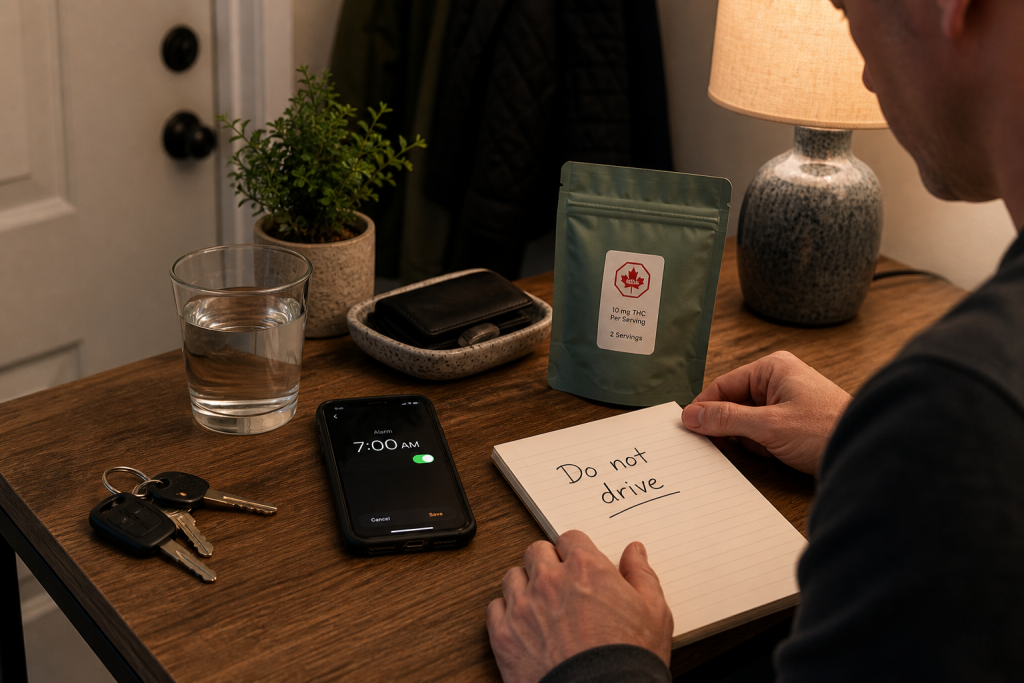
- Set a reminder that says not to drive if you wake up impaired, foggy, or uncertain.
- Put keys away before using cannabis so the decision is not made casually later.
- Tell a trusted adult your plan if you are worried you may rationalize driving.
- Follow workplace, school, court, probation, or medical instructions that apply to you.
- If you are unsure in the morning, do not drive.
This checklist is intentionally conservative. It is easier to explain a changed plan than to undo a crash, charge, license consequence, workplace incident, or injury.
What Canadian Law Adds to the Decision
Driving while impaired by cannabis is illegal in Canada. The criminal law includes drug-impaired driving offences and blood-drug concentration offences for THC. Provinces and territories can also have their own roadside, license, vehicle, novice-driver, commercial-driver, and zero-tolerance rules. Ontario, for example, states that driving while impaired by cannabis is illegal and dangerous, and its rules apply beyond ordinary cars to vehicles such as trucks, boats, snowmobiles, and off-road vehicles.
Do not treat this article as legal advice. Laws, penalties, roadside procedures, license consequences, and workplace rules can vary by province, driver class, age, license stage, and facts. The reader-first rule is simpler: if cannabis may still be affecting you, do not drive.
What About CBD Products?
CBD products still deserve careful reading. A product marketed around CBD may contain THC, and the label matters more than the front-facing wellness language. Health Canada advises that cannabis products can have health and safety risks, and legal cannabis labels should help you identify THC and CBD amounts.
If a product contains no intoxicating amount of THC, the driving concern may be different, but you still need to think about drowsiness, other ingredients, prescription medication, alcohol, and your own reaction. If you feel impaired, sleepy, dizzy, distracted, or unlike yourself, do not drive. If you use cannabis for a medical reason, follow advice from a qualified health professional and any rules connected to your license or workplace.
Morning Decision Rules That Are Easier to Follow
Morning decisions are easier when the rule is made the night before. Try one of these simple rules:
- If I use an edible after dinner, I do not drive early the next morning.
- If I mix cannabis with alcohol, I do not drive until I have slept well and feel clearly sober later, with no pressure deadline.
- If I take more cannabis than planned, I cancel the morning drive.
- If I wake up foggy, anxious, slowed down, or unsure, I do not drive.
- If someone else says I seem off, I take that seriously and do not argue myself onto the road.
These rules are not perfect science. They are practical guardrails for real life, where people often make driving decisions while tired, late, embarrassed, or trying not to inconvenience someone else.
FAQ
How long should I wait to drive after cannabis?
There is no universal waiting time that applies to every person, product, and situation. Justice Canada’s public FAQ says existing scientific evidence does not provide general guidance about how much cannabis someone can consume before it is unsafe to drive or how long they should wait. If you feel impaired or uncertain, do not drive.
Can coffee make me safe to drive after cannabis?
No. Coffee may make someone feel more awake, but it does not prove that cannabis-related impairment has cleared. It also does not solve the added risk from alcohol, lack of sleep, or a late edible.
Is the next morning safer than the same night?
It may be lower risk for some situations, but it is not automatically safe. Product type, amount, timing, alcohol, sleep, tolerance, and lingering effects all matter. Morning driving should be cancelled if you feel impaired, foggy, unusually tired, or unsure.
Bottom Line
Cannabis and driving should be planned around before you use, not negotiated afterward. If you may need to drive the next morning, choose a product and timing plan that does not put you under pressure, avoid mixing with alcohol, read the THC label, and keep another transportation option ready. If the morning comes and the answer is not clearly safe, do not drive.
Sources
- Health Canada: Cannabis impairment
- Justice Canada: Impaired driving laws
- Justice Canada: Drug-impaired driving laws FAQ
- Ontario: Cannabis and driving
- Health Canada: Cannabis health effects
- Health Canada: How to read and understand a cannabis product label
Explore the beginner’s guide, or learn how we source and edit our stories.