Education 9 min read
Cannabis and Driving in Canada: What Adults Should Know
A practical Canadian guide to cannabis impairment, driving laws, wait-time myths, edibles, high THC, Ontario rules, and safer transportation plans.
Legal cannabis does not make driving after cannabis legal. That is the simplest rule for adults in Canada, and it is the one worth remembering before any timing chart, THC percentage, or “I feel fine” guesswork. Cannabis can affect attention, reaction time, coordination, and judgment, and the safest driving plan is to separate cannabis use from driving entirely.
This guide explains cannabis and driving in Canada in practical terms: what impairment means, why timing is hard to predict, how edibles and inhaled products differ, what Ontario drivers should know, and how to plan a lower-risk ride home. It is not legal advice, and it does not replace provincial or territorial rules.
Quick answer
Do not drive after using cannabis. In Canada, police can investigate drug-impaired driving, and drivers can face consequences including fines, criminal charges, licence suspensions, vehicle impoundment, or jail depending on the situation and jurisdiction. Cannabis effects vary by person, dose, format, tolerance, food, sleep, alcohol, and other drugs, so there is no reliable universal wait time that makes driving safe for everyone.
If you have used cannabis and need to go somewhere, use a sober driver, transit, rideshare, taxi, walking plan, or overnight plan. If you are unsure whether you are impaired, treat that uncertainty as the answer: do not drive.
Cannabis and driving at a glance
| Situation | Why it matters | Lower-risk choice |
|---|---|---|
| Smoked or vaped cannabis | Effects can be felt quickly, but impairment can outlast the first noticeable peak. | Do not drive. Plan transport before using. |
| Edibles, capsules, oils, or drinks | Onset can be delayed and effects can last longer than expected. | Do not drive the same outing; avoid redosing because “nothing happened yet.” |
| High-THC product or concentrate | Higher THC can increase impairment and unwanted effects. | Choose lower THC when possible and keep driving off the schedule. |
| Cannabis plus alcohol | Combining substances can worsen impairment and judgment. | Do not drive; arrange a sober ride. |
| Young, novice, or commercial driver in Ontario | Ontario applies zero-tolerance rules for cannabis detected in these driver groups. | Do not use cannabis before driving; check current provincial rules. |
Legal does not mean drive-ready
Canada legalized and regulates adult-use cannabis, but impaired driving remains illegal. Canada.ca warns that driving impaired by cannabis or other drugs can lead to serious consequences, including fines, criminal charges, or jail. The fact that a product was purchased legally does not protect a driver who is impaired behind the wheel.
This distinction matters because cannabis marketing can make products feel ordinary. A legal edible, vape cartridge, dried flower product, oil, or beverage may be sold through a regulated retailer, labelled correctly, and still be completely incompatible with driving. Legal source helps with product safety and labelling; it does not make impairment safe.
For source checks, use our legal cannabis buying checklist for Canada. For driving, use a stricter rule: if cannabis is part of the plan, driving should not be.
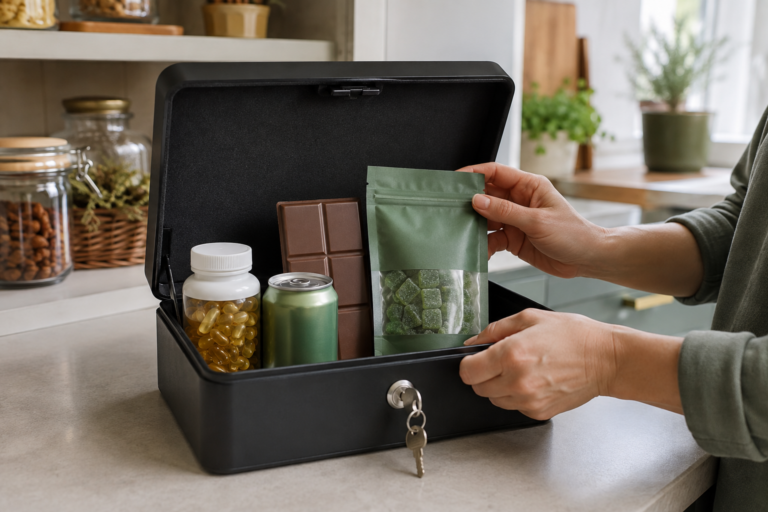
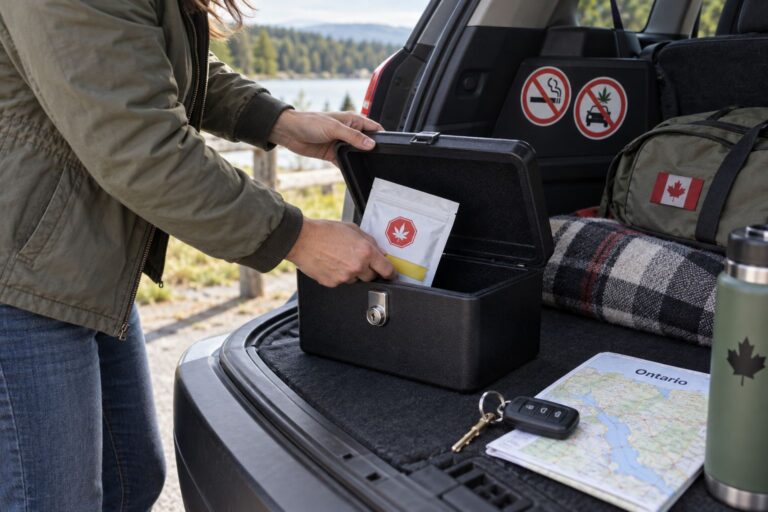
For carrying cannabis in a vehicle before or after a legal purchase, our smell-proof storage guide explains why sealed, labelled, out-of-reach storage is useful but never a workaround for impaired-driving rules. For a vehicle-specific checklist, see our guide to carrying cannabis in a car in Canada.
How cannabis can affect driving
Health Canada says cannabis can affect concentration, attention, coordination, and reaction time. Those are not abstract risks. They are exactly the skills drivers rely on when a pedestrian steps off a curb, traffic stops suddenly, weather changes, or another driver makes a mistake.
Cannabis impairment is also easy to misread. Someone may feel relaxed, familiar with the route, or less “high” than they did earlier, but still be slower to respond. Confidence is not a driving test. Familiarity with cannabis is not the same as being safe to operate a vehicle.
The risk is not limited to heavy use. A small amount can affect a new or occasional user more than expected. A higher-THC product can be too much for someone who normally uses lower-strength cannabis. A tolerance break can make a familiar dose feel stronger than it used to.
Why wait-time rules are unreliable
Readers often want a neat answer: “How many hours after cannabis can I drive?” The problem is that cannabis does not work on a universal clock. Inhaled products can be felt within minutes, while edibles and drinks may take much longer to show full effects. Body size, tolerance, THC amount, CBD amount, food, sleep, stress, and product type all change the experience.
Health Canada’s lower-risk material notes that edible effects may be felt within 30 minutes to 2 hours and can take up to 4 hours to feel fully. Inhaled products can be felt in seconds to minutes and may take up to 30 minutes to feel the full effects. That timing difference is one reason edible redosing is risky, and it is also why driving plans should be made before using.
For timing basics, see our guides on how long THC lasts in Canada and how long edibles take to kick in. For driving, the practical answer remains conservative: do not use cannabis when driving may be needed.
Edibles and drinks deserve extra caution
Edibles, capsules, oils, and cannabis drinks can be especially tricky because the delay can make people think they are not impaired yet, or not impaired anymore. A person may eat an edible at dinner, feel little at first, take more, then be much more impaired later when they expected to be going home.
The risk is not only the first hour. Ingested cannabis can last long enough to affect the rest of the evening, and sometimes the next morning if the dose was high, the person slept poorly, or they are still feeling groggy. That does not mean every person is impaired the same way for the same length of time. It means a driving plan based on hope is weak planning.
If you choose edibles or drinks, decide on transportation first. Keep the package so you can read the THC amount, avoid taking more too soon, and do not combine cannabis with alcohol because it can make impairment harder to judge.
High THC and concentrates raise the stakes
THC is the main intoxicating cannabinoid in cannabis. Higher THC does not automatically mean a better product, but it can mean stronger impairment. Health Canada’s lower-risk advice encourages lower-THC choices when possible and warns that certain extracts such as hash, kief, wax, or shatter can contain high THC concentrations.
This matters for drivers because a small-looking amount can still be strong. A concentrate, high-THC vape, potent dried flower product, or large edible dose can be more than the person expected, especially if they are new, tired, stressed, or returning after a break. A product that feels efficient at home can be a poor choice before errands, work, school pickup, or any trip that might involve driving.
If you want to understand potency without treating it as a quality score, read why THC percentage is not everything in Canada.
Ontario: zero tolerance for some drivers
Rules differ by province and territory, so drivers should check the rules where they live and travel. In Ontario, the provincial cannabis-and-driving page says there is zero tolerance for young, novice, and commercial drivers. Ontario explains this as cannabis detected in the system for those driver groups, similar in practical seriousness to alcohol rules for restricted drivers.
That is important for G1, G2, M1, M2, young drivers, and commercial drivers. “I do not feel high” is not a reliable defence strategy, and it is not a safety strategy. If your licence class or job puts you under a stricter standard, keep cannabis and driving completely separate.
Other provinces and territories may set different administrative rules, roadside processes, or sanctions. When in doubt, check the current official provincial or territorial page before relying on something a friend, forum, or seller told you.
What about medical cannabis?
Medical authorization does not create permission to drive impaired. A person using cannabis for medical reasons still has to consider impairment, product type, dose, timing, workplace rules, licence class, and safety-sensitive duties. If a health professional is involved in your cannabis use, ask direct questions about driving, work, medication interactions, and next-day impairment.
Do not assume CBD-heavy products are automatically drive-safe either. CBD does not produce the same intoxication as THC, but products can still contain THC, affect people differently, or interact with other substances. Read the label, understand the product, and avoid driving if you feel altered, sleepy, slowed, dizzy, anxious, or unsure.
A practical no-driving plan
- Decide before using. If cannabis is part of the plan, choose a sober ride before the package is opened.
- Keep your keys out of the decision. Leave the vehicle at home when possible.
- Use one transport backup. Taxi, rideshare, transit, walking route, sober friend, or overnight stay.
- Avoid alcohol mixing. Combining alcohol and cannabis can make impairment harder to judge.
- Read the THC amount. Know the dose or concentration before you use anything.
- Do not chase edibles. Wait long enough; do not take more because effects are delayed.
- Watch the next morning. Grogginess, poor sleep, or lingering effects mean no driving.
- Protect other people. Do not let an impaired friend talk themselves into driving.
If someone is too high and planned to drive
Do not debate whether they are “fine.” Move the conversation to options: take their keys if you can do so safely, call a sober ride, stay with them, get food and water nearby, or help them wait somewhere calm. If they are panicking, vomiting repeatedly, having chest pain, losing consciousness, behaving dangerously, or you are worried about their safety, seek urgent medical help.
For non-emergency overconsumption support, our guide on what to do when you are too high gives practical steps. The driving rule is simpler: the person does not drive today.
How common is driving after cannabis use?
Health Canada’s 2024 cannabis survey key findings reported that 18% of people in Canada who consumed cannabis in the past year said they drove after cannabis use. That was lower than 2018 but higher than 2023. The same report said 16% reported driving within 2 hours of smoking or vaporizing cannabis, and 10% reported driving within 4 hours of ingesting cannabis.
Those numbers are a useful reminder that this is not a niche issue. Plenty of adults understand cannabis can impair driving in theory, yet still make risky choices when timing, convenience, confidence, or social pressure gets involved. The fix is not a better self-test. The fix is a better plan before using.
Bottom line
Cannabis and driving should be kept separate. Legal cannabis can still impair attention, coordination, reaction time, and judgment. Effects vary too much for a universal wait-time promise, and edibles, drinks, high-THC products, concentrates, alcohol mixing, and fatigue can make the situation harder to judge.
If you use cannabis, make transportation part of the purchase and consumption plan. Read the label, choose lower-risk products when possible, avoid mixing substances, and do not drive when you have used cannabis or when you are unsure. The safest driving decision is the one made before impairment has a vote.
Sources
- Canada.ca: Cannabis impairment
- Canada.ca: Cannabis health effects
- Health Canada: Cannabis: lower your risks
- Health Canada: Key findings, cannabis use in Canada
- Ontario.ca: Cannabis and driving
- Health Canada: How to read and understand a cannabis product label
Explore the beginner’s guide, or learn how we source and edit our stories.