Education 8 min read
Cannabis Beverages in Canada: THC Drinks, Labels, and Timing
Learn how Canadian adults can compare THC drinks, read labels, plan onset timing, and avoid common cannabis beverage mistakes.
Cannabis beverages can feel casual because they look like drinks people already recognize. That is exactly why adults in Canada should read them more carefully, not less. A THC drink is still a cannabis product, and the most important details are on the label, not in the flavour name or the social setting where it is served.
This guide explains how to compare cannabis beverages in Canada, how timing differs from sipping an ordinary drink, what label details matter, and where beverages fit beside edibles, oils, capsules, and other smoke-free formats. If you are still choosing between product types, start with our Cannabis 101 product-types guide first.
Quick answer
A cannabis beverage is usually an edible cannabis product in drink form. That means you should treat it like an ingestible product: read the Total THC and Total CBD, check the amount per container, plan for delayed onset, avoid stacking servings, and keep it away from children, pets, and anyone who might mistake it for a regular drink.
Health Canada’s edible cannabis classification guidance says edible cannabis products are intended to be consumed in the same manner as food and can look or taste familiar, which increases accidental and over-consumption risk. That is the central reader takeaway: cannabis drinks may feel familiar, but the dosing and storage rules are not the same as an ordinary beverage.
What to check on a cannabis beverage label
| Label detail | What it tells you | Why it matters |
|---|---|---|
| Total THC per container | The maximum THC amount declared for the package. | Edibles are limited differently than extracts, and the container amount is the key comparison point. |
| Total CBD per container | Whether CBD is present and in what amount. | CBD does not erase THC impairment risk or make the drink risk-free. |
| Number of units | Whether the drink is one container or part of a multi-pack. | Do not assume one flavour equals one serving unless the label supports it. |
| Ingredients and allergens | What else is in the drink. | Sweeteners, caffeine-like expectations, or allergens can matter for some adults. |
| Packaging date and lot number | The product traceability details. | Useful if taste, carbonation, seal, recall, or freshness questions come up. |
| Storage instructions | How to store the product before and after opening. | Beverages can be mistaken for regular drinks if they are left in a fridge or cooler. |
Timing: do not sip your way into a second dose
The biggest beverage mistake is impatience. A drink may feel lighter than a gummy or brownie, but it can still be an ingestible cannabis product with delayed effects. The exact timing depends on the product, your body, food, dose, and tolerance. Use the label and your own experience conservatively rather than treating the drink like a fast feedback loop.
If you are planning an evening, pair this article with our edibles onset guide and edibles dose chart. Those guides explain why people often get into trouble when they take more before the first serving has peaked.
Beverages versus gummies, capsules, and oils
Cannabis beverages are part of the wider smoke-free category, but they are not identical to other smoke-free products. A capsule may make dose counting simple. An oil or spray may require measuring. A gummy may look like candy and raise storage risk. A beverage may be easy to sip quickly and easy to confuse with non-cannabis drinks.
| Format | Main comparison point | Common mistake |
|---|---|---|
| Beverage | Total THC per container and timing plan | Drinking too quickly because it feels familiar |
| Gummy or edible | Mg per piece and pieces per package | Eating another piece before onset is clear |
| Capsule or softgel | Mg per unit and number of units | Expecting fast feedback from an oral product |
| Oil or oral spray | Mg per ml or activation | Confusing dropper volume with THC amount |
Buying checklist for THC drinks
- Buy only through a legal source for your province or territory.
- Confirm the product is cannabis and not a hemp-themed or grey-market beverage.
- Read Total THC, Total CBD, container size, and number of units before price.
- Plan one serving window and avoid topping up just because the drink tastes mild.
- Do not mix with alcohol or other substances when you are trying to judge effects.
- Keep the package and lot number until the product is finished.
- Store it away from children, pets, visitors, and ordinary drinks.
Household storage is a bigger deal with drinks
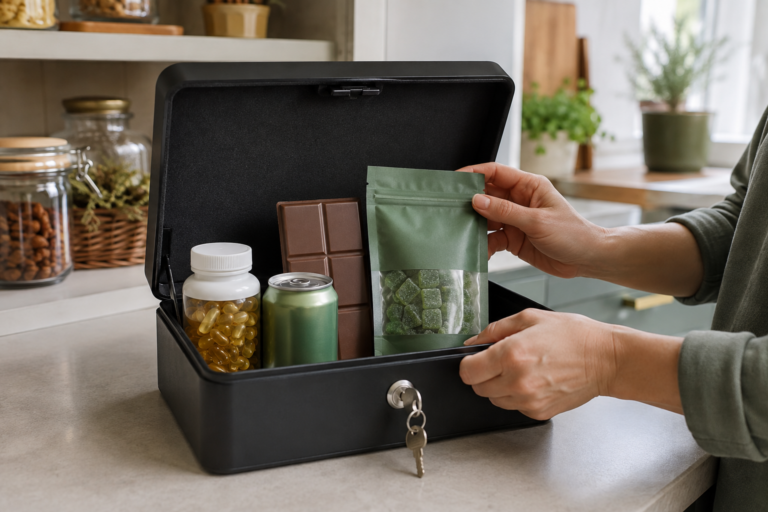
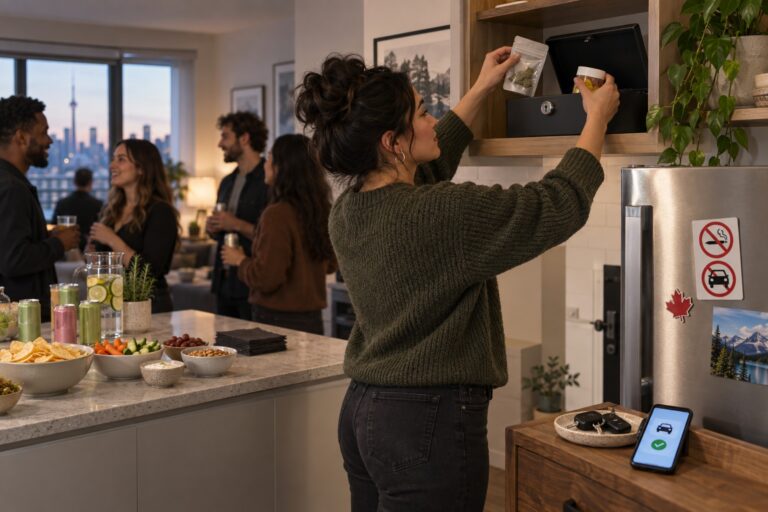
A cannabis beverage may end up in a refrigerator, cooler, backpack, or party setting. That creates a practical risk: someone else may not realize it contains cannabis. Keep it in the original package, separate it from regular drinks, and do not leave unfinished product where another person could take it by mistake.
For more household guidance, use our safe storage checklist and our cannabis and pets storage guide. Beverage packaging does not remove the need for locked or controlled storage.
How to plan a cannabis beverage window
A beverage works best when it has a clear window. Decide where you will be, what you need to do later, whether you are driving, and whether you have already used cannabis that day. A cannabis drink is not a background refreshment if you still need to make important decisions, supervise children, drive, work, or handle tools. Keep the plan simple: one product, one labelled amount, enough time to understand the effect, and no pressure from another person to finish it quickly.
Avoid pairing a new cannabis beverage with alcohol. Mixing substances makes it harder to understand what is causing an effect and can increase impairment. If you want to compare a new product, compare it on a quiet day with food, water, and a realistic end time. That is less exciting than a party setting, but it gives you better information and lowers the chance of accidentally overdoing it.
How to compare price without ignoring dose
Price comparisons can be misleading with beverages. A larger can may not be a better value if you do not want the whole container. A multi-pack may be poor fit if you are still testing tolerance. Compare the legal source, total THC, CBD amount, container size, number of units, and storage needs before calculating price per milligram. The cheapest option is not useful if it encourages you to consume more than you intended.
Also think about waste and storage. If a product should be consumed after opening, or if it is awkward to secure once opened, that affects whether it fits your household. A smoke-free product is not automatically low-maintenance. The best product for a beginner is often the one that makes the next responsible step obvious.
What to do if the label is confusing
If the beverage label leaves you unsure about THC, CBD, number of servings, product class, or storage, do not guess. Use the retailer or producer contact path, compare the product against Health Canada label guidance, or choose a clearer product. Confusion is a real buying signal. A legal cannabis product should make the basic details easy enough for an adult consumer to check before use.
Keep the receipt and package if you decide to try it. If the drink tastes unusual, the seal seems damaged, the carbonation is off, or the effects feel very different from the label expectation, those records make it easier to ask a precise question or check official recall sources.
Reader checklist before you use the product
Before using any new cannabis product, pause long enough to answer five practical questions. Did you buy it from a legal source? Can you read the THC and CBD amount without guessing? Do you know how long the product may take to affect you? Is the rest of your day compatible with impairment? Can the package be stored where no child, pet, visitor, or roommate will confuse it for something else? If any answer is unclear, the safer move is to slow down.
Also check whether the advice you are following comes from the product label, an official public-health or regulator source, or a seller trying to close a sale. Those are not equal. The label and official sources should anchor the decision; marketing copy can help describe a product, but it should not override dose, age, legal-source, impairment, or storage cautions.
This checklist is intentionally plain. Most cannabis problems do not start because someone failed to understand advanced chemistry. They start because a product looked familiar, the label was skimmed, the dose was repeated too soon, or the package was left somewhere careless. Legal cannabis still requires adult judgment after purchase.
- Choose a calm setting for first use, especially with a new format or potency.
- Avoid mixing with alcohol or other substances when judging a product.
- Keep the original package and receipt until the product is finished.
- Write down the amount used if you are comparing products over time.
- Stop and seek qualified help if effects feel severe, unusual, or unsafe.
The goal is not to make cannabis feel complicated. The goal is to make the next step obvious. A reader-worthy product choice should survive basic questions about source, label, dose, timing, storage, and what to do if something seems wrong.
Bottom line
Cannabis beverages are not just drinks with a cannabis flavour story. Treat them as ingestible cannabis products: verify the legal source, read the full label, plan for delayed effects, avoid stacking servings, and store them where they cannot be confused with ordinary beverages.
FAQ
Are cannabis beverages legal in Canada?
Legal cannabis beverages can be sold through authorized channels when they comply with the Cannabis Act and Cannabis Regulations. Adults should still verify the seller and province-specific rules before buying.
Can a THC drink affect me faster than a gummy?
Some products may be marketed for different onset experiences, but you should not assume rapid feedback. Plan cautiously and follow the label rather than stacking servings.
Should I keep the empty package?
Keeping the package until the product is finished helps preserve the lot number, packaging date, ingredients, and cannabinoid details if you need to check a recall or ask a question.
Sources
- Health Canada: Classification of edible cannabis products
- Health Canada: How to read and understand a cannabis product label
- Health Canada: Reduce your risk by choosing legal cannabis
- Ontario: Buying recreational cannabis
Explore the beginner’s guide, or learn how we source and edit our stories.