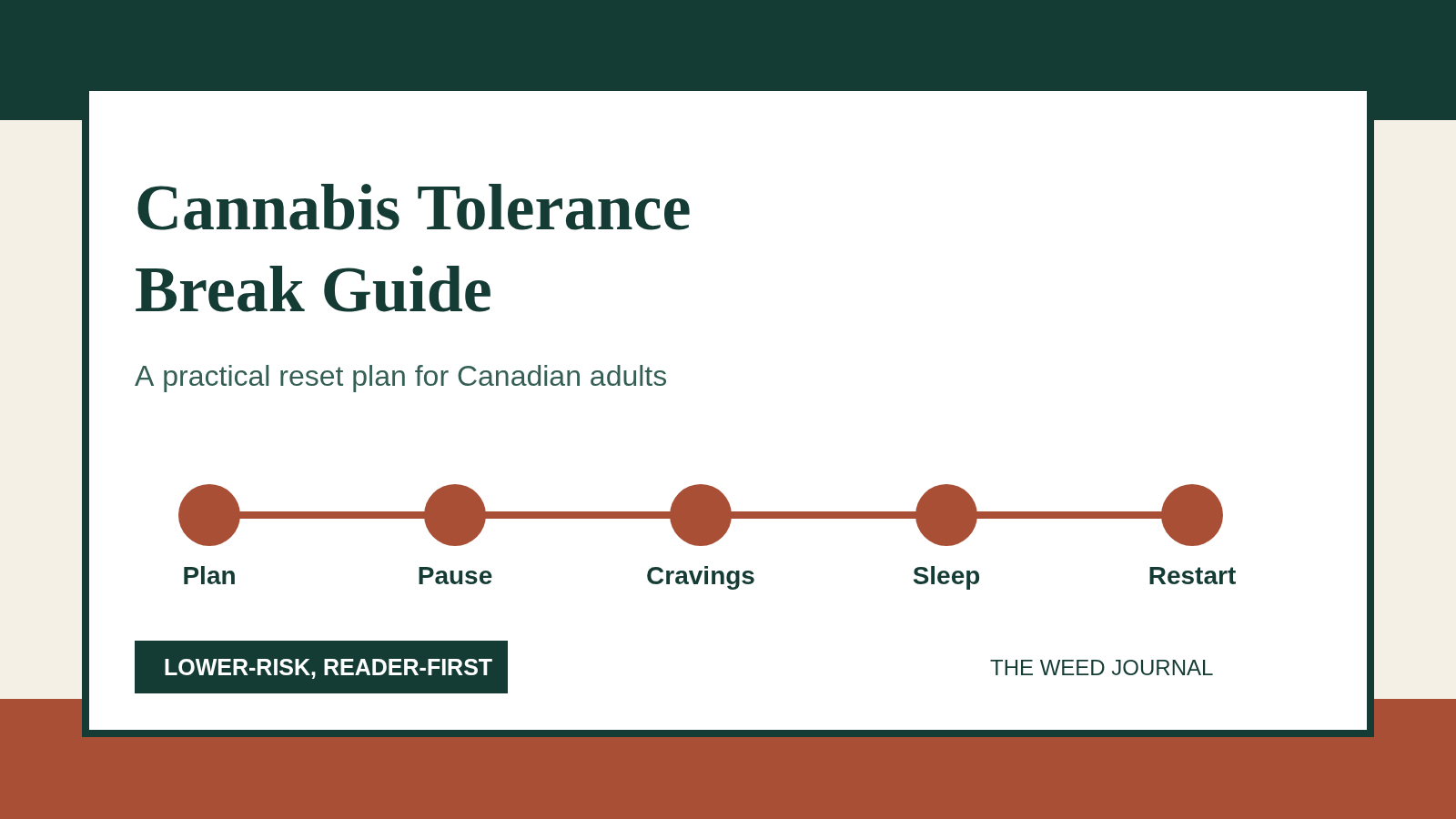
If cannabis has started feeling less predictable, more expensive, or more automatic than intentional, a tolerance break can be a useful reset. For some adults, that means a weekend without cannabis. For others, it means several weeks away from THC so they can notice habits, sleep patterns, cravings, spending, and the dose they actually need.
This guide is written for adults in Canada who legally choose to use cannabis. It is not medical advice, treatment advice, or a promise that a break will solve anxiety, sleep, pain, or dependence. It is a practical harm-reduction plan: how to decide whether a break makes sense, what withdrawal can feel like, how to make the first week easier, and how to restart more cautiously if you use cannabis again.
Quick answer
A cannabis tolerance break is an intentional pause from cannabis, usually taken because regular use no longer feels as effective, affordable, enjoyable, or easy to control. Some people take a short break of a few days. People who use cannabis most days often plan a longer break, sometimes around two to four weeks, because daily use can build tolerance and can make stopping feel uncomfortable.
Health Canada says tolerance can develop when someone needs larger amounts to get the same effects. It also notes that some people can develop dependence, cravings, and restlessness, mood changes, anxiety, or other symptoms when they are not using cannabis. If stopping feels unmanageable, or cannabis is affecting work, school, relationships, mental health, driving, or finances, it is worth speaking with a qualified health professional.
A tolerance break at a glance
| Decision | A practical default | Why it helps |
|---|---|---|
| Goal | Pause, reduce, or reassess | A clear goal prevents the break from becoming vague. |
| Length | Pick a date range before you start | Open-ended plans are easier to abandon. |
| Product rule | Avoid THC during the break | THC is the main driver of intoxication and tolerance. |
| Environment | Remove or lock away products | Fewer cues means fewer automatic decisions. |
| Support | Tell one trusted person if useful | Accountability helps during cravings or low mood. |
| Replacement | Plan sleep, meals, movement, and evenings | The habit gap is often harder than the rule itself. |
| Restart | Use less than before, if you restart | Tolerance may be lower after a break. |
Signs a tolerance break may be worth trying
A tolerance break is not only for people who feel out of control. It can also be a routine check-in for adults who use cannabis and want to keep it intentional.
Consider a break if you are using more THC to get the same effect, reaching for cannabis earlier in the day than you meant to, spending more than planned, feeling foggy the next morning, or choosing high-THC products by default. A break can also help if cannabis has become the only way you relax, sleep, eat, watch a movie, socialize, or handle boredom.
Another sign is irritation when cannabis is unavailable. Health Canada lists craving, thinking a lot about cannabis, finding it hard to stop or reduce use, increased tolerance, and feeling restless, moody, or anxious when not using as possible signs of dependence. That does not mean every frequent user has cannabis use disorder, but it does mean the pattern deserves attention.
If you use cannabis for a medical reason, talk to your clinician before making a major change. If you use cannabis to cope with anxiety, depression, trauma, insomnia, or another health issue, a break may bring those symptoms forward. Support is planning.
Pick the right kind of break
The best break is the one you can actually complete. A three-day reset may be realistic for someone who uses cannabis occasionally. A person using THC every evening may need a clearer two-week plan. A daily or near-daily user may choose a longer break, especially if the goal is to notice sleep, appetite, cravings, and baseline mood without cannabis.
Some university harm-reduction resources describe a 21-day break as a useful structure for regular users. Treat that as a planning template, not a medical rule. The right length depends on frequency, product strength, reason for use, mental health, social setting, and whether you are trying to pause, cut down, or stop.
Write the goal in plain language: I want to see whether I can sleep without THC; I want to lower my dose and spending; I want to stop using cannabis before workdays; I want a month away from vapes and concentrates; or I want to understand whether cannabis is helping or covering a problem.
Once the goal is written, choose a start date and an end date. Then decide what counts as breaking the break. For most tolerance breaks, that means no THC products: no flower, edibles, vapes, oils, concentrates, infused drinks, or shared joints. If you plan to use CBD, keep it separate from the tolerance-break goal and make sure the product is legal, clearly labelled, and low or non-intoxicating.
Prepare before day one
Do not start a tolerance break with a house full of open products and no evening plan. That makes the break harder than it needs to be.
Before day one, move cannabis out of sight or lock it away. If you do not want cannabis in the home, dispose of it according to local guidance and keep it away from children, pets, and guests. Put accessories away too: grinders, rolling papers, batteries, dab tools, lighters, ashtrays, and edible packaging. Habit cues matter.
Plan the first three evenings. Those are often the hours when autopilot shows up. Pick low-friction replacements: a walk, a shower, a meal that takes your hands, a call, a game, a book, a gym session, a movie with snacks, or an earlier bedtime. Avoid building the whole plan around willpower.
If you usually use cannabis before sleep, lower the difficulty where you can. Caffeine earlier in the day, screens late at night, irregular meals, and no wind-down routine can make the first nights feel worse. A tolerance break is not a perfect wellness challenge. It is a practical pause, and practical supports count.
What withdrawal can feel like
Not everyone gets withdrawal symptoms, and symptoms vary. People who use cannabis daily or near daily, especially higher-THC products, are more likely to notice discomfort when they stop.
Health Canada describes possible dependence symptoms such as cravings, difficulty stopping or reducing, feeling like you need cannabis, increased tolerance, and restlessness, moodiness, or anxiety when not using. Other clinical and public-health resources commonly describe sleep disruption, vivid dreams, irritability, reduced appetite, headaches, sweating, low mood, and strong urges to use again.
For many people, symptoms are unpleasant rather than dangerous. But unpleasant can still be serious if it affects safety, mental health, work, driving, caregiving, or the ability to function. If symptoms feel severe, if you have thoughts of harming yourself, if anxiety or depression spikes, or if you are using other substances heavily, seek professional help quickly.
The first week is usually the hardest because the habit is fresh and the body is adjusting. That is why the first week should be planned, not improvised.
A seven-day starter plan
| Day | Focus | Useful move |
|---|---|---|
| 1 | Remove cues | Put products and accessories away; tell one person if helpful. |
| 2 | Protect sleep | Keep caffeine early, eat dinner, and expect sleep to be imperfect. |
| 3 | Handle cravings | Delay for 20 minutes, change rooms, walk, shower, or call someone. |
| 4 | Notice triggers | Write down when urges show up: boredom, stress, meals, screens, pain, or social cues. |
| 5 | Replace the ritual | Keep the same break-time ritual but swap the cannabis part out. |
| 6 | Check mood | If anxiety, depression, anger, or insomnia is intense, get support. |
| 7 | Review | Decide whether to continue, reduce, or seek help before restarting. |
How to handle cravings without making it dramatic
Cravings tend to rise, peak, and fall. They can feel like commands, but they are signals. The trick is to create time between the signal and the action.
Use a short delay: I can decide in 20 minutes. During that time, change the setting. Go outside. Wash dishes. Take a shower. Stretch. Put your phone in another room. Drink water. Eat something simple if you have not eaten. Message someone. The replacement does not need to be inspiring; it only needs to interrupt the loop.
It also helps to name the trigger without arguing with it. For example: this is the after-dinner craving, this is the stress craving, this is the sleep craving, this is the boredom craving. Once the pattern has a name, it becomes easier to plan around.
If the craving is tied to a real issue such as pain, panic, grief, insomnia, or alcohol use, treat the underlying issue seriously. Cannabis may have become the tool you reach for, but a tolerance break can reveal that another form of support is needed.
Avoid the most common break mistakes
The biggest mistake is replacing cannabis with heavier alcohol use. Health Canada’s lower-risk cannabis guidance warns against combining cannabis with alcohol because impairment can increase. During a break, alcohol can also weaken sleep, mood, impulse control, and the next day’s motivation.
Another mistake is keeping high-THC products in the easiest possible place. If the vape is on the desk, the break now requires dozens of decisions a day. Move it. Lock it. Make the healthy choice less heroic.
A third mistake is restarting at the old dose. If the break lowers tolerance, the amount that felt normal before may feel stronger after. That matters with edibles, vapes, concentrates, and high-THC flower.
Restarting after a tolerance break
If you decide to use cannabis again, restart like a cautious beginner. Use less than you used before the break. Choose lower THC. Avoid mixing with alcohol. Read the label. Do not drive. Give edibles several hours before considering more. If vaping or smoking, take one small inhalation and wait.
This is where a break can turn into a better long-term pattern. Instead of going straight back to the strongest product or the same nightly routine, decide what you learned. Maybe weekends only works better. Maybe lower-THC flower is enough. Maybe edibles are too unpredictable. Maybe vapes are too easy to overuse. Maybe microdosing is more aligned with your goals than chasing a strong high.
Our guide to how to microdose cannabis in Canada can help you think about smaller amounts, and our article on why THC percentage is not everything explains why the highest number is not always the smartest choice.
When a tolerance break is not enough
A tolerance break is a tool, not a diagnosis and not a treatment plan. If you repeatedly plan breaks and cannot start, cannot finish, or quickly return to a pattern that causes harm, it may be time for more support.
Talk to a doctor, nurse practitioner, pharmacist, counsellor, addiction service, or local health line if cannabis is affecting mental health, family life, money, work, school, driving, or responsibilities. This is especially important if you are pregnant, under 25, using cannabis with other substances, have a personal or family history of psychosis, or are using cannabis to manage anxiety or depression without clinical support.
Health Canada’s mental-health guidance warns that daily or near-daily cannabis use over time can increase risks for some mental-health problems and dependence. Reducing or stopping may help some people, but the transition can be uncomfortable. Get help early if the break makes life feel unsafe or unmanageable.
Bottom line
A cannabis tolerance break works best when it is specific: a clear goal, clear dates, fewer cues, planned evenings, and a cautious restart. It does not need to be dramatic. It needs to be honest.
If cannabis is still useful in your life, a break can help you use less and choose better. If cannabis is creating problems, a break can help you see the pattern clearly. And if stopping feels much harder than expected, that is useful information too. You do not have to handle it alone.
For more beginner context, start with The Weed Journal’s Start Here guide and our guide to how long THC lasts in Canada.