Education 8 min read
How to Microdose Cannabis in Canada: A Practical Low-Dose Guide
A practical Canada-aware guide to low-dose cannabis, THC labels, edibles, inhalation timing, safety checks, and when microdosing is the wrong fit.
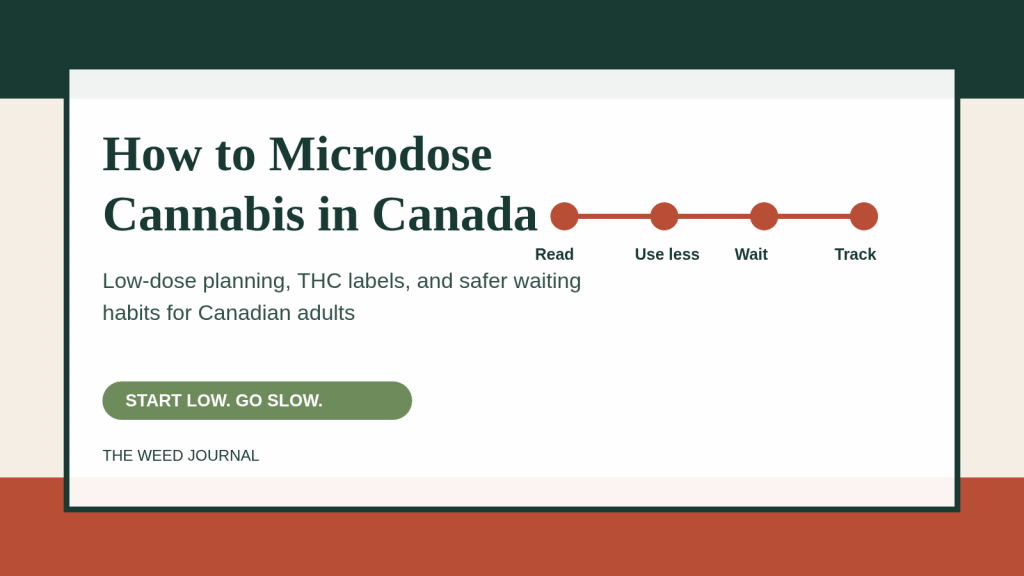
Microdosing cannabis sounds precise, but the useful version is simple: use less THC than you think you need, give it enough time, and pay attention to whether the amount actually fits your day. It is not a hack, a medical treatment, or a promise that cannabis will improve your mood, sleep, creativity, pain, anxiety, or focus.
For edible-specific planning, storage, and waiting windows, pair this low-dose article with our edibles dosing and safety hub.
For Canadian adults who already choose to use cannabis, microdosing is best understood as a lower-dose planning habit. It can help reduce the chance of taking too much, especially with edibles, oils, beverages, vapes, or high-THC flower. The goal is not to feel nothing at all. The goal is to avoid accidentally turning a small experiment into a long, uncomfortable, impairing experience.
This guide explains how to think about low-dose cannabis in Canada, how to read THC labels, what to track, when to wait, and when microdosing is the wrong fit. It is educational only and not medical advice.
Quick answer
Microdosing cannabis usually means choosing a deliberately low THC amount and increasing only slowly, if at all. In Canada, Health Canada’s lower-risk advice says to start low and go slow, choose low-THC products, and wait to feel the effects before taking more. For edibles, Health Canada points readers toward products with 2.5 mg THC or less and notes that full effects can take up to 4 hours. For inhaled cannabis, it suggests 1 or 2 puffs from products with 10% THC or less and waiting because full effects can take up to 30 minutes.
Those numbers are planning references, not personal guarantees. Your response can change based on product type, THC amount, CBD amount, tolerance, food, sleep, stress, alcohol, medication, and setting.
Microdosing at a glance
| Choice | Lower-dose starting idea | Why it matters |
|---|---|---|
| Edibles, capsules, oils, beverages | Look for 2.5 mg THC or less per unit when available | Edibles can take hours to fully show themselves, so dose stacking is a common mistake. |
| Smoking or vaping flower | 1 or 2 small puffs from a low-THC product | Inhaled cannabis acts faster, but repeated puffs can still add up. |
| Vape cartridges and concentrates | Use extra caution or avoid if new or occasional | Extracts can be highly concentrated and easy to overuse. |
| Product balance | Consider products with equal or higher CBD than THC | CBD may reduce some THC effects, but it does not erase impairment. |
| Tracking | Record product, THC amount, time, setting, and effects | A short log helps you avoid repeating uncomfortable mistakes. |
What microdosing is, and what it is not
Microdosing is a dose strategy. It is not proof that cannabis is safe for you, and it is not a way to make driving, work, childcare, or safety-sensitive tasks compatible with cannabis use.
A useful microdose should be small enough that you can clearly observe the effect without chasing intensity. Some people may feel relaxed, sleepy, hungry, social, distracted, anxious, or nothing obvious. A low dose can still impair judgment, attention, coordination, and reaction time, especially if you are sensitive to THC or combine cannabis with alcohol or other substances.
If you are new to product formats, start with our broader guide to cannabis product types in Canada. Microdosing is easier to understand once you know the difference between flower, edibles, oils, vapes, beverages, and extracts.
Why Canada’s legal labels matter
Legal Canadian cannabis products are packaged with required information such as THC, CBD, warning labels, lot or packaging details, and product-specific instructions. That does not make every product suitable, but it gives you a clearer starting point than an unlabelled edible or informal-market vape.
For microdosing, the key label question is not “how strong is the package?” It is “how much THC is in the amount I am about to use?” A package may contain multiple units. A bottle of oil may list THC per activation, per gram, per millilitre, or total package amount. A flower label may use percent THC or mg/g. If the label makes you unsure, pause before using it.
Our guide to reading cannabis labels in Canada explains how to check THC, CBD, terpenes, package dates, and storage details.
Step-by-step: a cautious microdosing approach
- Pick one product format. Do not test a new edible, vape, oil, and flower on the same day.
- Choose a low-THC product. If you are inexperienced, avoid high-THC concentrates and strong cartridges.
- Read the serving amount. Find THC per unit or per measured amount, not just total package THC.
- Use it in a safe setting. Stay somewhere familiar, with no driving or important tasks planned.
- Take one small amount. Do not chase an immediate result.
- Wait based on the format. Inhaled cannabis can build over minutes; edibles can take hours.
- Write down what happened. Record product name, THC amount, CBD amount, time, food, setting, and effects.
- Change only one thing next time. If you adjust, change the amount, product, or setting separately so you learn something useful.
This is intentionally boring. Boring is good when the alternative is accidentally taking too much THC.
Edibles: the microdosing format that needs the most patience
Edibles are where many low-dose plans go wrong. A person takes a small amount, feels little after 45 minutes, takes more, and then both amounts arrive later. Health Canada warns that edible effects can take time to appear and that full effects can take up to 4 hours. The BC edible safety fact sheet also points to 2.5 mg THC as a low-dose way to learn individual response and advises waiting before taking another amount.
If your edible is 10 mg THC and you are aiming low, one whole unit may not be a microdose for you. Check whether the product is scored, whether the label describes one unit or the whole package, and whether dividing it is practical. Homemade edibles are especially poor microdosing tools because the THC can be unevenly distributed and the actual amount may be unclear.
For timing details, read How Long Do Edibles Take to Kick In? before treating an edible as “not working.”
Inhaled cannabis: faster does not mean risk-free
Smoking and vaping usually act faster than edibles, which can make small adjustments feel easier. But puff size, inhalation depth, product potency, device temperature, cartridge strength, and tolerance can all change the experience. A low-dose plan can become a high-dose session if you keep taking small puffs without waiting.
Health Canada’s lower-risk guidance suggests starting with 1 or 2 puffs of a vape or joint with 10% THC or less, then waiting. It also cautions new or occasional users to avoid high-concentration extracts such as hash, kief, wax, or shatter because higher THC can increase impairment and adverse effects.
If you are choosing between inhaled formats, read our comparison of vaping vs smoking cannabis in Canada.
What to track in a simple cannabis log
A short note after each low-dose experiment can prevent repeat mistakes. You do not need a complicated spreadsheet. Track the basics:
- Product name and legal source
- Format: edible, oil, beverage, flower, vape, or other
- THC amount and CBD amount
- Time used and time effects became noticeable
- Food, alcohol, caffeine, medication, sleep, and stress context
- Effects you liked, disliked, or found surprising
- Whether you felt impaired longer than expected
- Whether you would repeat, lower, skip, or change the format next time
This turns microdosing from guessing into learning. It also helps you notice if cannabis is becoming more frequent, less intentional, or harder to skip.
When microdosing is the wrong fit
A lower dose is not always a good idea. Skip cannabis, or talk with a qualified professional first, if you are pregnant, breastfeeding, under the legal age, using cannabis because of a health condition, taking medication that could interact, dealing with a history of psychosis or serious mental health symptoms, or responsible for driving, tools, patients, children, or safety-sensitive work.
Microdosing is also the wrong frame if you are trying to stay “technically functional” while impaired. Cannabis can affect attention, memory, coordination, reaction time, and decision-making. Low dose does not mean no impairment.
If you notice you need cannabis more often to get the same effect, feel irritable when you skip it, use more than planned, or keep using despite problems, that is not a microdosing issue. That is a signal to step back and consider support.
Common mistakes
- Starting with a product that is too strong for the plan.
- Reading total package THC instead of THC per serving.
- Taking more edible cannabis before the first amount has peaked.
- Using high-THC vapes or concentrates as if they are beginner products.
- Mixing cannabis with alcohol and then blaming the cannabis dose alone.
- Testing cannabis before driving, work, childcare, or social pressure.
- Changing product, dose, meal, and setting all at once.
- Treating CBD as a guarantee against impairment.
Bottom line
Microdosing cannabis is not magic. It is a cautious way to use less THC, wait longer, and learn how a product affects you before making bigger decisions. In Canada, the practical starting point is to use legal labelled products, choose low THC, consider CBD balance, avoid high-potency extracts if you are new or occasional, and never use a countdown as permission to drive.
The best microdose may be no cannabis at all on days when you have responsibilities, uncertainty, or a bad setting. When you do choose to use cannabis, keep the experiment small, slow, and honest.
Sources
- Health Canada: Cannabis: lower your risks
- Health Canada: Cannabis health effects
- Canada’s Lower-Risk Cannabis Use Guidelines
- BC Cannabis Secretariat: Edible Cannabis Affects People Differently
Explore the beginner’s guide, or learn how we source and edit our stories.