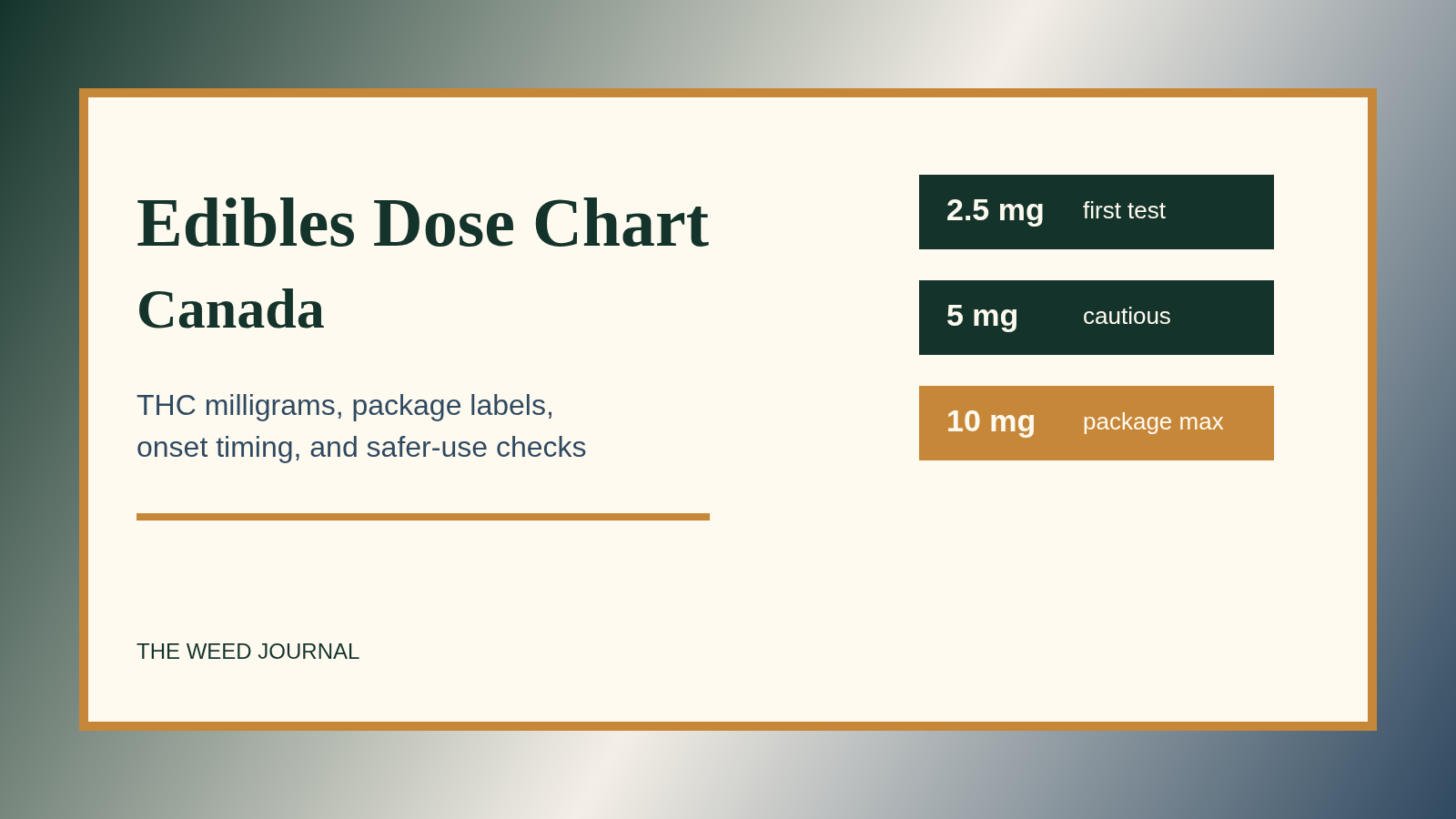
Edibles are easy to underestimate because they do not feel like smoking or vaping. A gummy, chocolate square, capsule, oil, or infused drink can look familiar, taste mild, and still contain enough THC to make the next several hours uncomfortable if the serving is too high or taken too quickly.
This Canadian edibles dose chart is not medical advice and it is not a challenge to work upward. It is a practical reading tool for adults who want to understand THC milligrams, legal package limits, delayed onset, and safer-use habits before deciding whether an edible makes sense at all.
Quick answer
For legal edible cannabis in Canada, Health Canada says the maximum THC amount is 10 mg per container, no matter how many pieces are inside. A four-piece package labelled 2.5 mg Total THC per unit still equals 10 mg Total THC in the full package. For a new or low-tolerance consumer, 10 mg can be far too much.
The cautious approach is to start with a very small amount, wait long enough to understand the effect, and avoid taking more just because nothing has happened yet. Edibles can take hours to peak and may last much longer than expected.
Edibles dose chart for Canadian adults
| THC amount | Best understood as | Why it matters | Safer-use note |
|---|---|---|---|
| 0 mg THC | No intoxicating THC dose | CBD-only products can still have cautions, but they should not feel like a THC edible | Check the label carefully; “CBD” on the front does not replace Total THC |
| 1 mg THC | A very small test amount | Useful for highly cautious adults or people unsure about sensitivity | Do not stack servings quickly; track timing and next-day grogginess |
| 2.5 mg THC | A common beginner test range | Often enough for a first meaningful read without jumping to a full package | Wait several hours before considering more |
| 5 mg THC | A moderate low dose for some adults | May be too strong for new, occasional, smaller, or sensitive consumers | Choose a quiet night with no driving or responsibilities |
| 10 mg THC | The Canadian legal edible package maximum | Not a beginner target; one legal package can still be a lot | Avoid treating one package as one serving unless you know your response |
| More than 10 mg THC | Not allowed in one legal edible cannabis container | Products presented as higher-dose edibles may be illegal, misclassified, or riskier | Use the legal-source and label checks before buying |
Why the package limit is not a serving suggestion
Canada’s 10 mg THC limit for edible cannabis is a product rule, not a personal dose recommendation. It tells you the maximum amount allowed in one legal edible cannabis container. It does not tell you that 10 mg is right for your body, your tolerance, your plans, or your next morning.
This distinction matters because packaging can be confusing. One package may contain one piece with 10 mg THC, two pieces with 5 mg each, four pieces with 2.5 mg each, or another split that still adds up to 10 mg. If you eat the whole package, you consume the whole package’s Total THC.
Health Canada’s label guidance explains that Total THC can be shown by unit and by package. Before you open anything, find both numbers. If a product has multiple pieces, ask: “How much THC is in one piece, and how much is in the full container?”
How long edibles can take
The main dosing mistake with edibles is impatience. Ingested cannabis can take longer to feel because it has to move through digestion and metabolism. Health Canada’s lower-risk guidance notes that edible cannabis avoids inhalation-related risks, but delayed psychoactive effects can lead people to use higher doses than intended.
A person may feel little at 30 minutes, stronger effects at two hours, and a peak later than expected. Food, product type, metabolism, tolerance, sleep, alcohol, and other substances can all change the timeline. That is why taking a second serving too soon is one of the easiest ways to overdo it.
For a deeper timing guide, read how long edibles take to kick in. If you are comparing edibles with inhaled products, The Weed Journal’s Cannabis 101 product type guide explains why format changes onset and duration.
What “start low and go slow” means in practice
“Start low and go slow” is useful, but it can become vague if nobody defines the behaviour. For edibles, it means choosing a small THC amount, using it on a low-risk day, waiting long enough for delayed effects, and avoiding the common urge to add more before the first amount has fully declared itself.
It also means building in a stop rule before you consume. For example: “Tonight is only a 2.5 mg test,” or “I am not taking any more for the rest of the evening.” A stop rule is easier to respect when it is made before THC changes judgment.
If your goal is to use less rather than more, our guide on how to microdose cannabis in Canada covers the same cautious mindset from a lower-dose angle.
A label-reading checklist before any edible
- Confirm the product is from a legal Canadian source authorized in your province or territory.
- Find Total THC for the full container.
- Find Total THC per unit or per piece.
- Check whether CBD is present, but do not assume CBD cancels THC impairment.
- Read the serving count and do the math before eating anything.
- Look for the lot number, packaging date, expiry date if present, and required warnings.
- Check ingredients and allergens, especially with chocolates, baked goods, and beverages.
- Store the product locked away from children, pets, roommates, and visitors.
This checklist is part of a broader buying habit. The Weed Journal also has a practical guide to reading cannabis labels in Canada if you want to compare THC, CBD, terpenes, lot dates, and product details more carefully.
When even a low dose may be a bad idea
Some situations are not solved by choosing a smaller edible. Avoid cannabis if you are under the legal age, pregnant or breastfeeding, driving, operating equipment, on call for safety-sensitive work, responsible for urgent childcare, combining with alcohol, or taking medications that warn about sedation or impairment unless a qualified clinician has advised otherwise.
Edibles can also be a poor fit if cannabis has previously caused panic, paranoia, faintness, confusion, vomiting, or next-day impairment. Health Canada warns that cannabis can impair thinking, concentration, memory, decision-making, coordination, and reaction time. Those effects matter even if the product is legally purchased and carefully labelled.
People with a personal or family history of psychosis or certain mental-health concerns should be especially cautious and seek medical guidance before using THC products. This article cannot judge those risks for an individual.
What to do if you took too much
If an edible feels too strong, do not take more cannabis, alcohol, or other substances to try to change the experience. Move to a calm setting, stay with a trusted sober adult if possible, sip water, and remind yourself that edible effects can take time to pass.
Get urgent help if someone has trouble breathing, chest pain, severe confusion, repeated vomiting, loss of consciousness, injury, or symptoms that feel dangerous. If a child or pet may have consumed cannabis, treat it as urgent and contact poison control, emergency services, or a veterinarian as appropriate.
For adult overconsumption planning, The Weed Journal’s guide to beginner cannabis mistakes explains the “too much too soon” pattern and how to avoid repeating it.
How to compare legal edibles without chasing strength
Strength is only one product detail. A more useful comparison includes THC per piece, total package THC, CBD amount, format, expected onset, ingredients, freshness, legal source, storage needs, price per serving, and whether the product fits the context in which you plan to use it.
Be skeptical of products that make medical-style promises, hide the THC math, imitate popular candy too closely, or appear to exceed legal edible limits. Health Canada specifically points to legal products as a way to reduce risk because regulated products must follow rules for THC limits, packaging, warnings, and quality controls.
Bottom line
The safest edibles dose chart is not a ladder. It is a brake. In Canada, a legal edible container can contain up to 10 mg THC, but that full amount is not automatically a wise serving for a beginner, an occasional consumer, or anyone with a low tolerance.
Start with the label, not the marketing. Read Total THC, understand the number of pieces, choose a low-risk setting, wait long enough, and keep the product away from children and pets. If the label math is unclear or the product source looks questionable, skip it.