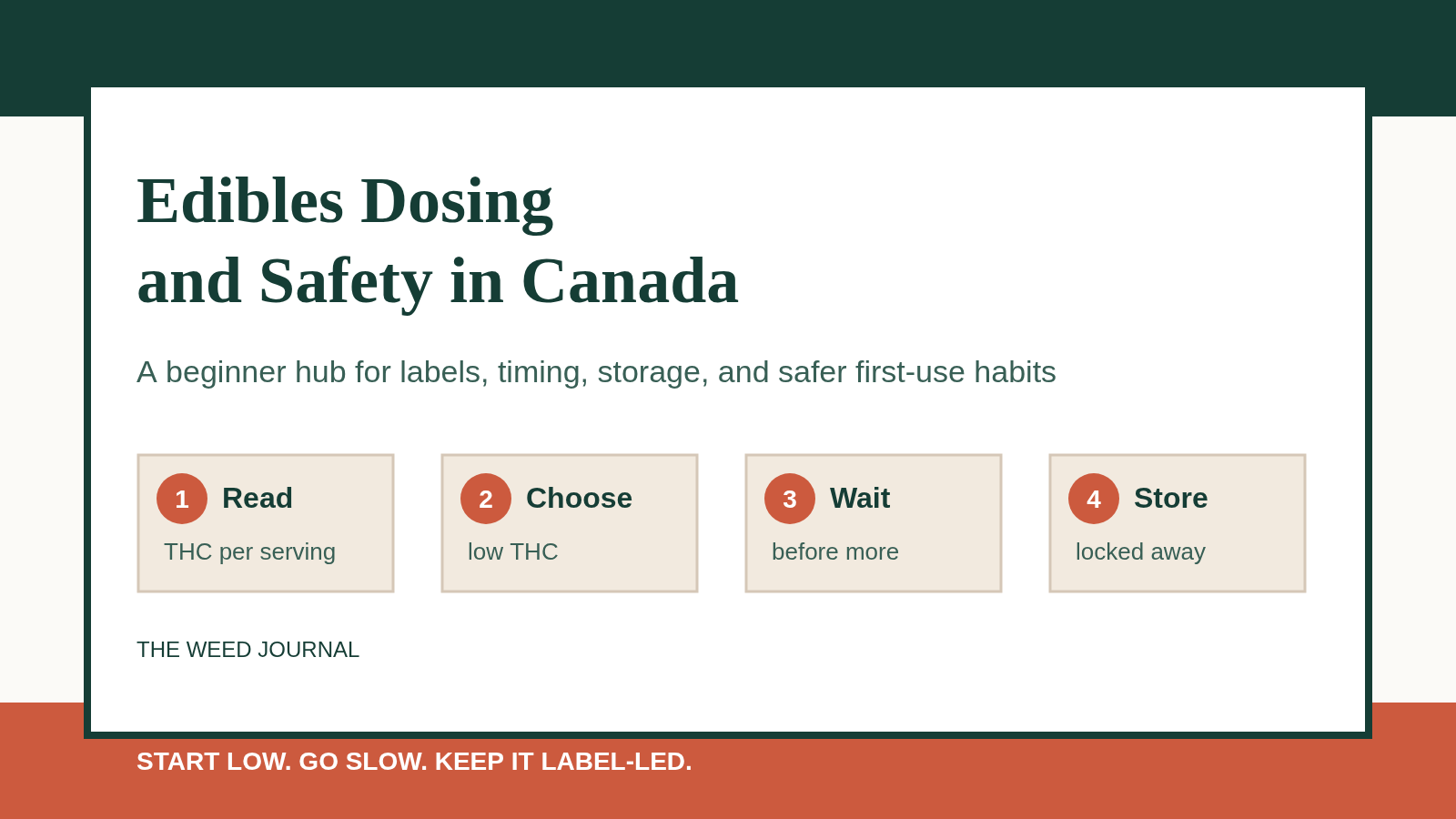
Edibles hub
Edibles require patience, label reading, and storage planning.
A Canada-focused hub for edible onset, duration, low-dose habits, serving math, storage, and common mistakes.
Use this hub for
- Timing and onset expectations.
- Low-dose planning without medical claims.
- Storage and label-reading habits.
Edible safety map
Dose chart
Compare THC milligrams, package limits, onset timing, and label checks before choosing any serving.
Do not overdo it
Use a slower dose-planning checklist before taking more, especially when an edible feels delayed.
Timing
Edibles can take longer than inhaled formats. Waiting matters before taking more.
Duration
Compare how long effects can last across inhaled cannabis, edibles, drinks, oils, capsules, and residual impairment windows.
Caffeine timing
Separate edible, drink, coffee, and energy drink timing so stimulation does not hide delayed THC effects.
Low dose
Start with low-dose planning and avoid treating package precision as a guarantee.
Tolerance breaks
If edibles or THC products feel less predictable, use a planned reset instead of simply taking more.
Labels
Check THC/CBD per package and per serving, warnings, and product type before use.
Storage
Keep edibles away from children, pets, and anyone who might mistake them for regular food.
Original hub notes
Edibles are one of the easiest cannabis formats to misunderstand. They look familiar, they do not involve smoke, and the package may feel more precise than flower or vape products. But for adults in Canada, edible cannabis still needs careful label reading, patience, and secure storage.
This hub brings The Weed Journal’s edibles coverage into one practical place. Use it as a starting point for low-dose planning, timing, serving math, storage, and common mistakes. It is education only, not medical advice, and it does not recommend cannabis for any health condition.
If you are still choosing between product types, start with our broader Cannabis 101 product type guide. If you already have an edible, drink, capsule, oil, or spray in front of you, slow down and read the label before deciding how much to use.
Quick answer
For most beginners, the safest edibles habit is simple: choose a legal labelled product, start with a low amount of THC, wait long enough to understand the first amount, and store the rest where children, pets, guests, and roommates cannot access it.
Health Canada advises people to start low and go slow, avoid mixing cannabis with alcohol or other substances, avoid driving or safety-sensitive tasks after cannabis use, and choose products with lower THC. For edible cannabis, Health Canada points to 2.5 mg THC or less as a lower-risk starting point and notes that effects may be felt within 30 minutes to 2 hours, with full effects taking up to 4 hours.
Edibles safety map
| Step | What to check | Why it matters |
|---|---|---|
| 1. Confirm the product | Legal source, sealed package, THC/CBD label, package date, ingredients, and warnings. | Unlabelled or homemade products make dose planning much harder. |
| 2. Read the serving math | THC per unit, THC per package, number of pieces, and whether the product is meant to be split. | One package can contain multiple servings, and the total package number is not always one serving. |
| 3. Plan the timing | Time taken, food, alcohol, other cannabis, driving, childcare, work, and sleep plans. | Delayed effects are a common reason people take more too soon. |
| 4. Wait before more | Give the first amount enough time before considering another amount. | Full edible effects can take hours to become clear. |
| 5. Store securely | Locked container, original package, away from children, pets, and ordinary snacks. | Edibles can look like regular food or candy. |
What counts as an edible?
Edible cannabis is cannabis meant to be eaten or drunk. Common legal formats include gummies, chocolates, baked goods, beverages, capsules, and other infused foods. Some people also group oils, drops, and oral sprays with edibles because they are smoke-free and may be swallowed. Labels may classify those products differently, but the planning question is similar: how much THC and CBD are in the amount you are about to use?
For a format-by-format comparison, see our guide to tinctures vs edibles in Canada. It explains why oils, sprays, capsules, beverages, and gummies can differ in label math and timing.
How to read THC and CBD before using an edible
Do not rely on package size, flavour, or product name. Read the cannabis facts panel and any product directions. The most important distinction is whether the THC number applies to one piece, one activation, one millilitre, one serving, or the entire package.
- THC per unit: the amount in one gummy, capsule, chocolate square, drink serving, or other single unit.
- Total THC per package: the amount in the full package. This is not the same as one serving if the package has multiple pieces.
- CBD per unit or package: useful context, but CBD does not cancel THC impairment or make driving safe.
- Ingredients and allergens: especially important for foods, beverages, and anyone avoiding certain ingredients.
- Storage instructions: follow the package and keep the product in its original child-resistant container when possible.
Our guide to reading cannabis labels in Canada walks through THC, CBD, terpenes, lot details, and package information in more depth.
Beginner dosing basics without fake precision
No article can tell every adult the right personal amount. Body size, recent food, tolerance, product type, sleep, alcohol, medications, and individual sensitivity can all change the experience. The more useful habit is to make the first test small, controlled, and easy to repeat or avoid later.
Health Canada recommends starting low and going slow. In practical terms, that means picking a low-THC amount, using one cannabis format at a time, avoiding alcohol, and writing down what happened. If the first experience was too strong, do not treat that as a challenge to repeat. Choose less next time or skip the format.
For a more detailed dose-planning article, use our edible dosing guide for Canada. For very small amount planning, see how to microdose cannabis in Canada.
Timing: why edibles catch people off guard
The most common edible mistake is taking more before the first amount has peaked. With inhaled cannabis, effects usually appear quickly. With swallowed edible cannabis, effects take longer because the product moves through digestion and metabolism first.
Health Canada says edible cannabis effects may be felt within 30 minutes to 2 hours and may take up to 4 hours to reach full effect. Public-health guidance from British Columbia also cautions that edible effects can last for hours, and some residual effects may last longer.
That is why a calendar matters as much as the package. Do not use edibles before driving, work, tools, childcare, school, or any safety-sensitive task. If you are new or returning after a break, choose a day with no pressure to go anywhere and no reason to make quick decisions.
For a deeper timing breakdown, read how long edibles take to kick in. For the broader effects window across product types, see how long THC can last.
First-use checklist
- Use a legal, labelled cannabis product so the THC and CBD amounts are clear.
- Choose one format only. Do not combine an edible with a new oil, vape, flower, or alcohol.
- Check whether the THC number is per piece, per serving, per activation, or per package.
- Pick a low-THC amount, especially if you are new, returning, tired, or unsure of your tolerance.
- Eat in a familiar place with water, snacks, and no driving or obligations planned.
- Wait long enough before considering more. Do not chase the effect in the first hour.
- Write down the product, amount, time, food, effects, and duration.
- Store the rest in the original package, locked away from children, pets, and anyone who might mistake it for ordinary food.
What to avoid
- Using an edible with no visible THC amount.
- Assuming one package means one serving.
- Mixing cannabis with alcohol to “see what happens.”
- Taking more because nothing has happened yet.
- Switching brands, doses, and formats all on the same day.
- Leaving gummies, chocolates, baked goods, or drinks in a shared fridge or snack drawer.
- Driving the same day because the effect feels mild at first.
Storage and household safety
Edibles deserve more storage caution than many adults expect. A chocolate, gummy, cookie, or beverage can look ordinary to someone else. Keep products in their original package, keep the label visible, and store them in a locked or otherwise secure place. Do not transfer edibles into regular candy bags, jars, or snack containers.
If a child, pet, or non-consenting adult may have accessed cannabis, treat it seriously and contact local poison control, a health professional, or emergency services as appropriate. This page is not a substitute for medical or emergency advice.
Where this hub fits on The Weed Journal
This page is the top-level edibles and ingestibles hub. Use it to move into the specific article that matches your next question:
- Edible dosing in Canada for dose-planning habits.
- How not to overdo edibles in Canada for a practical serving plan before taking more.
- How long edibles take to kick in for onset, peak, and waiting windows.
- Microdosing cannabis in Canada for low-dose planning.
- Tinctures vs edibles in Canada for oils, sprays, capsules, beverages, and gummies.
- How to read cannabis labels for label math and package details.
Who should be extra cautious?
Some adults should be more conservative than a generic guide can describe. Be extra cautious if you are new to cannabis, returning after a long break, using a product with unclear serving sizes, using other substances, feeling unwell, or responsible for driving, childcare, tools, cooking, work, or another safety-sensitive task later in the day. If you take prescription medication, have a health condition, are pregnant or breastfeeding, or are unsure whether cannabis is appropriate for you, speak with a qualified health professional rather than relying on a website checklist.
Bottom line
Edibles are not automatically safer because they are smoke-free, and they are not automatically risky when handled carefully. The practical middle ground is to keep the experience label-led, low-dose, patient, and securely stored.
Read the product, choose less than you think you need, wait longer than impatience wants you to, and keep the rest away from anyone who did not choose to use cannabis.
Sources
Related TWJ guides
- Cannabis beverages in Canada – A drink-format guide for edible timing, labels, and storage.
- Cannabis gummies in Canada – A gummy-specific dose, label, and storage checklist.
- Edibles dosing in Canada: how not to overdo it – A serving plan for avoiding the most common edible mistake.