Education 10 min read
Cannabis Packaging Symbols in Canada: What Labels Mean
Learn what Canadian cannabis package symbols, warning labels, THC/CBD amounts, excise stamps, lot numbers, and dates mean before you buy.
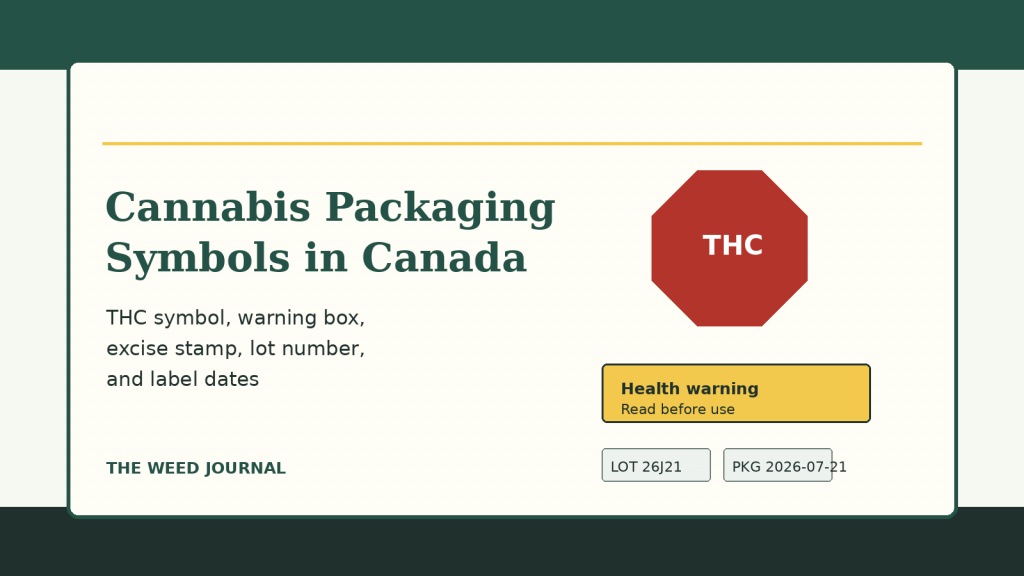
Canadian cannabis packages can look plain, but they carry a lot of important information. The red THC symbol, yellow warning box, excise stamp, lot number, THC and CBD values, and packaging date all help answer the same practical question: what exactly is this product, and how should an adult read it before using it?
This guide is for adults who want to make sense of legal cannabis packaging in Canada without turning a label into a chemistry exam. It explains the main symbols and label sections, what they can tell you, what they cannot prove, and which details deserve a second look before you buy.
Start With the Big Three
If you only have ten seconds in a store or on a provincial retailer site, check three things first: the red THC symbol, the THC/CBD line, and the product class. Those three details tell you whether the product contains meaningful THC, how the label expresses potency, and whether you are comparing flower, edibles, extracts, drinks, topicals, or another format.
Health Canada says the standardized cannabis symbol is used to warn consumers that a product contains THC. On most THC-containing legal products, it appears as a red octagon with a white cannabis leaf and “THC.” Health Canada’s consumer label guide says the symbol is required on the front of cannabis products that contain more than 10 micrograms per gram of THC.
The THC and CBD line matters because different formats use different units. A dried flower label may show milligrams per gram. An edible may show total THC per unit and total THC for the whole package. A spray may show THC per activation. If you compare those numbers as if they were the same unit, you can misjudge strength quickly.
The product class matters because the experience, onset, storage needs, and legal packaging limits differ by format. For example, an edible, a vape cartridge, a dried flower jar, a topical, and an oral oil should not be compared by THC number alone. For a broader label walkthrough, start with The Weed Journal’s Canadian cannabis label guide.
Quick Label Decoder
| Label item | What it usually means | What to check before buying |
|---|---|---|
| Red THC symbol | The product contains THC above the symbol threshold or the producer has used the symbol voluntarily. | Do not stop at the symbol. Read the THC amount, unit, and product format. |
| Yellow health warning | A required warning message about potential risks and effects of cannabis use. | Treat it as safety information, especially for new users, edibles, high-THC products, and anyone with health concerns. |
| Excise stamp | A sign that the product came through the legal regulated supply chain, with provincial or territorial stamp colour differences. | Match the stamp to the market where the product is sold and be cautious with missing, altered, or suspicious packaging. |
| Total THC / Total CBD | The amount or concentration of THC and CBD the product can yield, depending on format. | Check whether the unit is mg, mg/g, per unit, per activation, or total package. |
| Lot number | A traceability code tied to production records and possible recall identification. | Keep it if you report a product issue or compare two packages from different batches. |
| Packaging date | The date the product was packaged, not necessarily the harvest or production date. | For flower, freshness still depends on storage, seal quality, aroma, texture, and package condition. |
What the Red THC Symbol Does and Does Not Tell You
The red THC symbol is a warning sign, not a complete potency guide. Its job is to make THC-containing cannabis products easy to identify at a glance. That is useful, especially in homes where adults want to avoid mix-ups with non-cannabis products or keep cannabis away from children, guests, and pets.
But the symbol does not tell you how strong the product will feel for you. A 2.5 mg THC edible, a 25% THC dried flower, a balanced THC/CBD oil, and a high-THC vape cartridge can all involve THC, but they are not interchangeable. Your tolerance, dose, route of use, timing, recent food intake, and setting all affect the experience.
For beginners, the better question is not “Does it have the symbol?” but “How much THC is in the amount I might actually use?” That is why edible labels deserve special care. A package may show total THC per unit and total THC for the entire package. If you need a separate dosing reference, use the edibles dose chart for Canada before assuming one piece, sip, or activation is right for you.
How to Read THC and CBD Units Without Getting Lost
Canadian labels commonly show “Total THC” and “Total CBD,” but the unit changes with the product. That unit is the detail many shoppers miss.
For dried flower, THC and CBD may be shown as milligrams per gram. Some shoppers mentally convert that to a percentage. For example, 200 mg/g is roughly 20% by weight. Even then, THC percentage is not the whole story. Freshness, aroma, terpene profile, moisture level, grind, device, dose size, and tolerance all matter. The Weed Journal’s guide to why THC percentage is not everything explains that problem in more detail.
For edibles and drinks, look for per-unit and total-package information. If one edible unit says 2.5 mg THC and the package contains four pieces, the total package may contain 10 mg THC. That does not mean one piece is 10 mg. It also does not mean a beginner should automatically take the full package.
For sprays and some extracts, the label may show THC per activation. In plain language, that means the amount dispensed per spray, pump, or measured use. Check the number of activations in the package if you are trying to understand the total amount available.
For topicals, reading THC and CBD can be more confusing because the product is used on the skin and is not meant to be eaten or inhaled. Labels still matter, but you should avoid treating a topical THC number as if it predicts the same experience as smoking, vaping, or eating cannabis. For that format specifically, see The Weed Journal’s cannabis topicals guide.
The Yellow Warning Box Is Not Decoration
Legal cannabis labels include a health warning message in a yellow box. Health Canada’s packaging guidance says health warning messages are displayed on the principal display panel and are intended to inform consumers about potential health risks and effects. Health Canada’s consumer label page also notes that its health warning messages were updated in early 2025.
For readers, the practical takeaway is simple: do not tune out the warning because you have seen similar boxes before. The warning is part of the label’s safety system. It is especially worth reading when you are trying a new format, choosing a stronger product than usual, using edibles, mixing cannabis with alcohol or other substances, or shopping for someone else’s household where storage risks matter.
Warnings also help counter the “plain package means low risk” assumption. Legal packaging is designed to reduce youth appeal and communicate risk; it does not mean cannabis is risk-free. Cannabis can impair attention, coordination, reaction time, and judgment, and effects can vary from person to person.
What the Excise Stamp Means
The excise stamp is one of the easiest ways to distinguish legal regulated cannabis from suspicious packaging. Health Canada’s consumer label guide says the excise stamp tells you the product came from a Health Canada licence holder. It also notes that certain low-THC products and prescription cannabis products may not need excise stamps, and that each province and territory has a different coloured stamp.
That makes the stamp a useful legal-source signal, but it should not be treated as the only check. Buy from authorized retailers, keep an eye out for packaging that looks altered or reused, and be skeptical of products that copy regulated packaging cues while avoiding the required information. Ontario readers can cross-check legal buying basics with Ontario’s own recreational cannabis guidance, while broader Canadian readers can use Health Canada’s advice to reduce risk by choosing legal cannabis.
If the product is being sold outside a legal retailer system, the label may not mean what it appears to mean. A convincing-looking package can still be unregulated. For a fuller safety screen, The Weed Journal’s legal retailer checklist for buying cannabis in Canada is the better starting point.
Lot Numbers, Packaging Dates, and Freshness
The lot number is not exciting, but it matters. Health Canada’s label guide explains that product labels contain the lot number and the date when the product was packaged. A lot number can help identify a specific batch if there is a product issue, recall, complaint, or quality question.
The packaging date is useful, but it does not tell the whole freshness story. A flower jar packaged recently can still be dry if storage was poor or the seal failed. A product with an older packaging date may still be acceptable if it was sealed, stored well, and appropriate for the format. Packaging date is a clue, not a verdict.
For dried flower, combine the date with a freshness check: intact seal, normal aroma for the product, no visible mould, reasonable texture, and no strange moisture or dustiness. After purchase, storage matters too. Keep cannabis sealed, labelled, away from children and pets, and stored according to the package directions. For practical storage steps, use the guide to storing cannabis in Canada.
Plain Packaging and Youth Appeal Rules
Canadian cannabis packaging is intentionally restricted. Health Canada’s packaging and labelling guide says the Cannabis Act and regulations require plain packaging and labelling, child-resistant containers for most cannabis products, mandatory warning messages, the standardized cannabis symbol where applicable, and specific product information such as brand name, class, THC/CBD information, and licence holder information.
This is why legal cannabis packaging often looks calmer than alcohol, candy, snack, or supplement packaging. The plainness is a policy choice. It is meant to reduce youth appeal, reduce misleading presentation, and make key safety details easier to find.
That plainness can also make labels feel dense. A shopper may see the same colours, warning blocks, and symbols across many products and stop reading closely. That is a mistake. The common packaging system gives you a consistent place to look; the product-specific details still change.
A Two-Minute Package Check Before You Buy
- Confirm the source. Buy from an authorized retailer or provincial legal channel. Treat suspicious private-market packaging as unverified, even if it imitates legal design.
- Find the product class. Flower, edible, extract, topical, drink, vape, and oil labels should not be compared as if they work the same way.
- Read the THC unit. Look for mg/g, mg per unit, total package, or per activation. The unit changes the meaning of the number.
- Check CBD too. CBD does not produce a high like THC, but it can still have effects and may matter for product fit.
- Read the warning box. Pay closer attention if the product is new to you, higher in THC, edible, or likely to be stored around other people.
- Check lot and date details. Save the package if you need to report a quality issue or compare products later.
- Plan storage before opening. Keep original packaging when possible because it preserves warnings, lot details, and child-resistant features.
Common Label Mistakes to Avoid
The first mistake is comparing every cannabis product by the biggest THC number on the front. That can push adults toward stronger products without answering whether the format, dose, timing, or experience is actually a good fit.
The second mistake is ignoring “per unit” language. Per-unit information is there to help you avoid confusing one serving, one piece, one activation, or one container with another. This matters most with edibles, drinks, sprays, and multi-unit packages.
The third mistake is treating legal packaging as a quality guarantee for your personal preferences. Legal cannabis is regulated, but that does not mean every product will match your tolerance, taste, budget, or desired experience. Labels help you screen products; they do not replace careful use.
The fourth mistake is throwing away the package immediately. The package contains the lot number, warnings, cannabinoid information, storage instructions, and legal-source signals. If you transfer cannabis to another container, keep the original label information somewhere safe and inaccessible to children.
Bottom Line
Canadian cannabis labels are built to do more than satisfy regulations. They give adult consumers a repeatable way to check legal source, THC and CBD amounts, product class, warning information, traceability, and storage details. The trick is to read the unit, not just the number.
Start with the red THC symbol, THC/CBD line, product class, warning box, excise stamp, lot number, and packaging date. Then connect those details to the product format and your own tolerance. That small pause can prevent many of the most common buying and dosing mistakes.
Sources
- Health Canada: How to read and understand a cannabis product label
- Health Canada: Packaging and labelling guide for cannabis products
- Health Canada: Reduce your risk by choosing legal cannabis
- Ontario: Buying recreational cannabis
Explore the beginner’s guide, or learn how we source and edit our stories.