Education 8 min read
Cannabis Topicals in Canada: Creams, Balms, and Labels
A beginner-friendly Canadian guide to cannabis topicals, including creams, balms, CBD labels, legal buying checks, storage, and safety boundaries.

Cannabis topicals can look familiar at first glance: creams, balms, lotions, oils, bath products, and similar formats meant for the skin. That familiar packaging is exactly why adults in Canada should slow down before buying one. A topical is still a regulated cannabis product, not an ordinary cosmetic with a cannabis-themed label.
This guide explains what cannabis topicals are in Canada, how to read the label, what they can and cannot promise, and how to choose a product without treating it like a medical shortcut. It is written for adults who want the plain-language version before they add a topical to their routine.
What counts as a cannabis topical?
In Canada, cannabis topicals are one of the classes of cannabis that may be sold legally under the federal framework. Health Canada describes topicals as products that include cannabis as an ingredient and are intended for external body surfaces such as skin, hair, or nails. On a retail menu, that can include lotions, creams, balms, bath bombs, body oils, and similar products.
The important boundary is use. A topical is not an edible, not a tincture, not a vape product, and not dried flower. It should be used only as directed on the package. If the product is meant for external use, do not eat it, smoke it, vape it, or use it in a way the label does not describe.
If you are still learning the bigger product landscape, start with our Cannabis 101 guide to product types in Canada. Topicals make more sense once you can separate inhaled, ingested, oral, and external-use formats.
If you are comparing creams and balms with adhesive formats, use our cannabis patches in Canada label checklist as a separate read. Patches can raise different questions about wear time, placement, ingredient disclosure, and whether the product is being described clearly enough for adult use.
Topicals are regulated cannabis, not casual CBD skincare
One common mistake is assuming that a CBD cream is automatically outside cannabis rules because it feels like skincare. That is not how CBD is regulated in Canada. Health Canada says CBD and products containing CBD are subject to the rules and requirements that apply to cannabis under the Cannabis Act and its regulations. CBD products are legal only when sold in compliance with that system.
That matters because unregulated topical products may use vague wellness language, unclear CBD or THC numbers, imported branding, or non-cannabis retail channels that do not match Canadian rules. A legal product should have regulated packaging, a product class on the label, THC and CBD information, required warnings, storage instructions, and a legal purchase channel.
For Ontario readers, the baseline is simple: adults must be 19 or older to buy, possess, and use recreational cannabis. Legal shopping should go through the Ontario Cannabis Store or authorized retailers. If a topical is being sold through a random wellness shop, social account, or grey-market site with no clear cannabis authorization trail, treat that as a red flag.
What topicals can and cannot tell you
A legal topical label can help you understand the product. It is not a guarantee that the product will deliver a specific effect for your body. Cannabis affects people differently, and topical products are especially easy to overinterpret because the packaging can borrow the language of skincare, sports recovery, and wellness.
| Label detail | What it helps you check | Reader-first caution |
|---|---|---|
| Product class | Confirms whether the product is a cannabis topical rather than an extract, edible, or cosmetic-style item. | Use it only in the way the product class and directions support. |
| Total THC and Total CBD | Shows the cannabinoid amount or concentration declared for the product. | Do not assume more THC or CBD means better results. |
| Net weight, volume, and units | Helps compare package size, pumps, bath products, or single-use formats. | A larger container can still have a different concentration than a smaller one. |
| Directions for use | Shows where, how much, and how often the product is intended to be used. | Avoid broken skin, eyes, mucous membranes, or other use unless the label specifically supports it. |
| Storage conditions | Explains temperature, light, and handling instructions for product quality. | Keep cannabis products secured away from children and pets. |
| Authorized source and excise details | Helps separate legal cannabis from suspicious products. | An attractive brand or review page does not prove legal status. |
Health Canada’s label guidance is useful here because it reminds shoppers to check the product class, THC and CBD amount, health warning, net weight or volume, number of units, and storage conditions. If you cannot find those basics, the product is not giving you enough information to compare it responsibly.
Will a cannabis topical get you high?
Many people ask this because topicals may contain THC. The cautious answer is that a topical should not be treated like an edible, vape, or smokeable product. It is intended for external use, and the way cannabinoids interact with the body depends on the product, formulation, amount used, skin condition, and use pattern.
That does not mean the label can be ignored. You should still read the THC and CBD amounts, follow the directions, and avoid using more than directed because “it is only a cream.” You should also wash your hands after use unless the product is meant for the hands, and you should avoid accidentally transferring product to your eyes, mouth, food, or another person.
If you are comparing THC strength across product types, our guide on why THC percentage is not everything is a helpful companion. Topicals are another example of why product format and directions matter as much as the cannabinoid number.
A practical buying checklist
Use this checklist before buying a cannabis topical in Canada:
- Confirm the seller is legal for your province or territory.
- Check that the label identifies the product as a cannabis topical.
- Read the Total THC and Total CBD information instead of relying on front-label marketing language.
- Compare concentration, net amount, and number of uses rather than package size alone.
- Look for clear directions, including where the product should and should not be applied.
- Check storage instructions and keep the product away from children, pets, and visitors.
- Avoid products that make strong pain, inflammation, sleep, anxiety, or healing claims without a regulated medical context.
- Do not use a cannabis topical on irritated or broken skin unless a qualified health professional has advised you and the product directions fit that use.
This is also where legal-source checks matter. Health Canada notes that legal cannabis products are subject to rules for quality, packaging, labelling, promotion, and recall. Legal does not mean risk-free, but it does give you a clearer trail than an unverified marketplace product.
How to compare creams, balms, oils, and bath products
Topicals are not all designed for the same use. A cream may spread differently than a thick balm. A bath product may be used once, while a lotion may be applied in smaller amounts over time. A roll-on may be convenient but harder to compare if you do not know how much product comes out with each use.
When comparing products, start with format and directions before price. Ask: where is this meant to be used, how much does the label suggest, how many uses does the package realistically contain, and how strong is the cannabinoid concentration per amount used? Those questions are more useful than chasing the highest CBD number on the shelf.
For broader shopping habits, see our legal retailer checklist for buying cannabis in Canada. The same principle applies here: verify the seller first, then compare the product.
What claims should make you pause?
Be careful with products or pages that promise quick relief, guaranteed recovery, anti-inflammatory results, sleep improvement, anxiety control, or treatment for a specific condition. That kind of claim changes the stakes for readers. A general retail cannabis product should not be treated as medical advice.
It is reasonable to be curious. It is not reasonable for a seller to push certainty where the evidence, your health situation, and the product label do not support it. If you have a medical condition, take prescription medication, have sensitive skin, are pregnant or breastfeeding, or are buying for someone else, speak with a qualified health professional rather than relying on a product page.
Storage and household safety
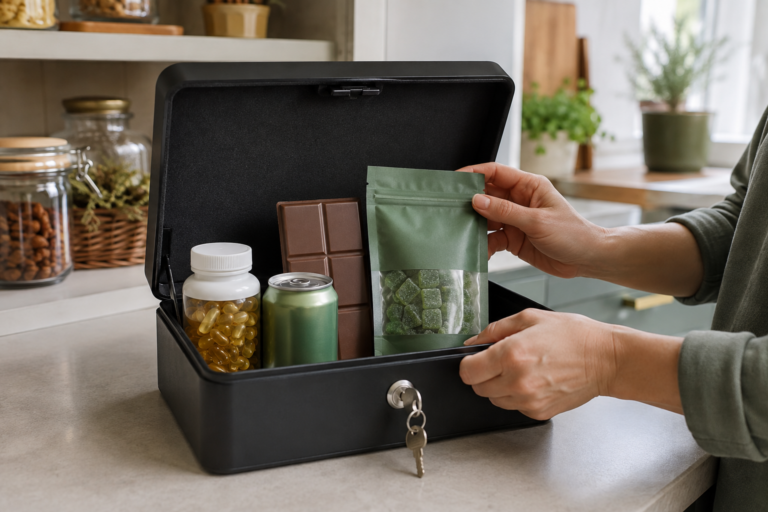
Topicals can be especially risky around children and pets because they may resemble ordinary lotions, balms, bath products, or cosmetics. Keep them in the original child-resistant package when practical, follow the storage directions, and do not leave them in a bathroom, bag, or bedside drawer where someone may mistake them for a regular product.
Also pay attention to heat and light. Creams, oils, and balms can change texture or separate if stored poorly. The label should provide recommended storage conditions. If the smell, texture, colour, packaging, or seal looks off, do not try to rescue the product. Dispose of it according to local guidance and replace it through a legal source if needed.
For a deeper storage primer, read our guide to storing cannabis in Canada.
Bottom line
Cannabis topicals are easiest to understand when you treat them as their own category. They are external-use cannabis products, not edibles, not extracts to ingest, and not ordinary skincare. Read the label, verify the legal source, avoid medical-claim marketing, follow the directions, and store the product securely.
If a topical cannot answer the basic questions of what it is, how it is meant to be used, how much THC and CBD it contains, where it came from, and how to store it, choose a clearer product or skip it.
Sources
- Health Canada: Guide on composition requirements for cannabis products
- Health Canada: Cannabis topicals data and definition
- Health Canada: How to read and understand a cannabis product label
- Health Canada: Cannabidiol (CBD)
- Health Canada: Reduce your risk by choosing legal cannabis
- Ontario: Cannabis laws
Explore the beginner’s guide, or learn how we source and edit our stories.