Education 8 min read
CBD Oil in Canada: What Adults Should Know Before Buying
A Canada-first guide to buying CBD oil legally, reading CBD and THC labels, checking carrier oils, and avoiding unsupported health claims.
CBD oil is one of the easiest cannabis products to misunderstand. It can look wellness-adjacent, it is often sold in small bottles, and the label may list several numbers that sound similar. In Canada, though, CBD oil is still a cannabis product. Adults should treat it like cannabis first: buy from a legal source, read the label, understand the THC content, and avoid medical assumptions that the package does not prove.
This guide is for adults comparing legal CBD oils in Canada. It is not medical advice, and it does not tell anyone to use CBD for a health condition. The goal is practical: understand what you are buying before a bottle ends up in your cart or on your counter.
Quick answer
In Canada, CBD oil should be bought through legal recreational retailers or, for registered medical cannabis patients, through the proper medical cannabis channel. The most useful label checks are CBD per activation or per mL, total THC, bottle size, carrier oil, ingredients, lot number, packaging date, expiry date if provided, and the excise stamp for the province or territory where it is sold.
CBD is not the same as “non-intoxicating no matter what.” Many CBD oils contain some THC, and cannabis can affect people differently depending on dose, product type, body chemistry, other substances, and timing. If you are comparing CBD with other cannabinoids, start with our THC vs CBD vs CBN guide, then use the label-focused checks below.
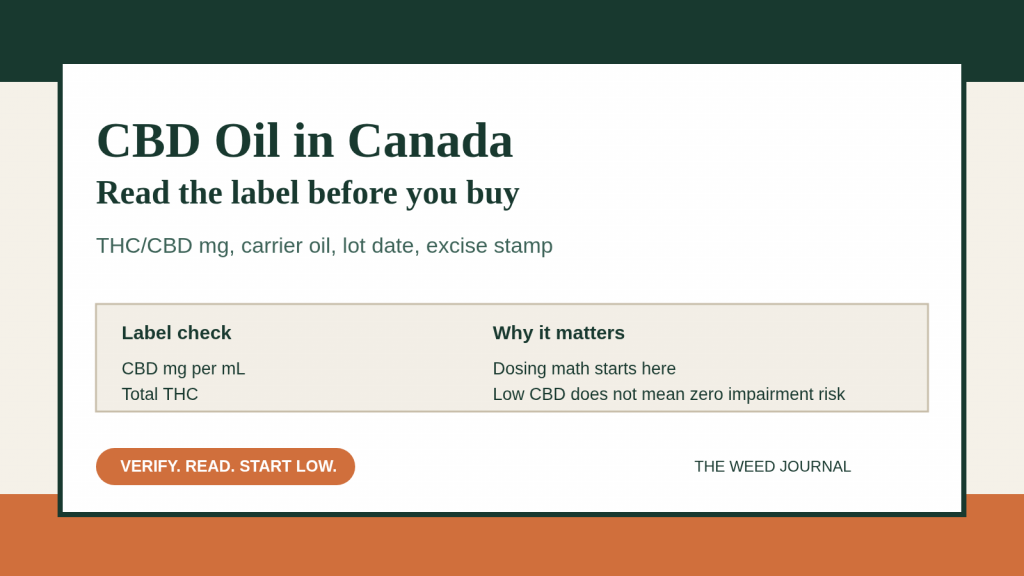
CBD oil label checks at a glance
| Label item | What to check | Why it matters |
|---|---|---|
| CBD amount | CBD per mL, per activation, or total bottle amount. | This is the number you need for basic serving math. |
| Total THC | THC per mL and total THC in the bottle. | CBD-forward oils may still contain THC. |
| Carrier oil | MCT, sunflower, olive, or another listed carrier. | Useful for allergies, preference, and digestion comfort. |
| Package and lot details | Lot number, packaging date, and expiry date if provided. | Helps with freshness, recalls, and product tracking. |
| Excise stamp | Province or territory stamp on legal cannabis packaging. | Signals legal-duty-paid product in the intended market. |
| Directions and warnings | Use instructions, storage notes, and cannabis warnings. | Legal cannabis packaging is designed to slow down impulsive use. |
What CBD oil is in the Canadian retail context
CBD oil usually means a cannabis extract diluted into a carrier oil and sold with a dropper or measured activation format. The bottle may be CBD-dominant, balanced with THC, or formulated with other cannabinoids. The exact profile matters more than the front-of-package phrase.
Health Canada explains that cannabis contains many chemical substances, including cannabinoids such as THC and CBD. THC is the main intoxicating cannabinoid. CBD is not intoxicating in the same way, but that does not turn every CBD product into a risk-free wellness item. The product still needs legal packaging, responsible storage, and careful label reading.
If the front label says “CBD oil,” do not stop there. Turn the bottle or product page into a simple question: how much CBD, how much THC, how many millilitres, and how is one serving measured?
Buy legal first
Before comparing strengths or prices, confirm the seller is legal. Health Canada points consumers to provincial and territorial systems for legal recreational cannabis sales. In Ontario, the official online store is the Ontario Cannabis Store, while private retail stores are licensed by the Alcohol and Gaming Commission of Ontario. Other provinces use different models.
That matters for CBD oil because illegal sellers may lean heavily on wellness language, imported-looking packaging, or “hemp oil” confusion. A legal Canadian cannabis oil should come through a legal cannabis channel and carry the required cannabis packaging information. If you are unsure how to verify a retailer, use our buying cannabis in Canada checklist before comparing products.
Read CBD and THC together
A CBD-forward product can still contain THC. Sometimes the THC amount is small; sometimes the product is intentionally balanced. Either way, the practical question is not “is this CBD?” but “what is the CBD-to-THC profile per measured amount?” If the label gives both cannabinoids but the relationship is unclear, use our CBD:THC ratio guide to compare common product profiles before choosing.
Look for both the amount of CBD and the amount of THC. If a product lists total bottle amounts only, divide by the bottle volume to estimate mg per mL. If it lists mg per activation, confirm what one activation means. A dropper, spray, capsule, and beverage all create different serving expectations.
For a deeper walkthrough of package numbers, see our Canadian cannabis label guide.
Do not treat CBD as medical advice from the shelf
CBD is often discussed online in the context of sleep, pain, stress, inflammation, and anxiety. Some of that conversation comes from early research, some comes from personal experience, and some comes from marketing. A retail cannabis label is not a diagnosis, prescription, or proof that the product will do what a social post claims.
Health Canada warns that cannabis can affect mental and physical health and that effects vary by person and product. If someone is pregnant, breastfeeding, taking medication, has a health condition, or is using cannabis for symptom management, that is a health-professional conversation rather than a blog-post decision. The safest editorial stance is to separate label literacy from treatment claims.
Start low, especially with oils
Oils are easy to underestimate because they do not look like smoking, vaping, or a strong edible. But swallowed cannabis oils can behave more like edible cannabis than inhaled cannabis. Onset may be delayed, effects may last longer, and taking more too soon can make the experience uncomfortable.
Health Canada’s lower-risk cannabis use guidance recommends starting with a low amount and going slowly when using cannabis. That advice is especially useful when a CBD oil contains THC or when a person is new to cannabis oils. If you are trying to understand timing, our edibles onset guide explains why swallowed cannabis can take longer to feel than inhaled formats.
Watch the carrier oil and ingredients
CBD oil is not only cannabinoids. It also includes a carrier oil and sometimes flavouring or other ingredients. Common carriers can include MCT oil, sunflower oil, olive oil, or other food-grade oils. For many adults this is a preference issue, but for some it can matter because of allergies, digestion, diet, or personal tolerance.
If a product page hides the ingredient list, that is a reason to slow down. Legal cannabis products should not require guesswork about what is in the bottle. The ingredient list also helps distinguish CBD oil from dried flower, capsules, beverages, and topical products, which all have different use patterns.
Check age, storage, and household safety
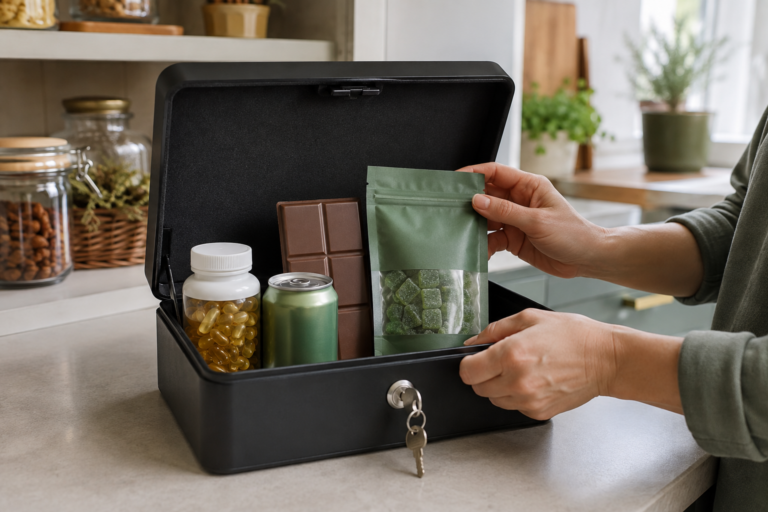
CBD oil bottles are small and easy to misplace. Keep them in the original child-resistant packaging, away from children and pets, and follow storage directions on the label. Health Canada consumer information repeatedly emphasizes keeping cannabis away from young people and storing products securely.
Do not transfer CBD oil into an unlabelled dropper, supplement bottle, or kitchen container. That creates avoidable confusion, especially in shared households. The original package keeps the THC/CBD numbers, lot details, warning statements, and purchase context attached to the product.
Price comparisons: compare mg, not bottle hype
CBD oil prices are easier to compare when you convert the label into rough cost per mg of CBD, while still accounting for THC, bottle size, carrier oil, legal retailer trust, and product freshness. A larger bottle is not automatically a better deal if the CBD concentration is low, and a high-CBD bottle is not automatically the right fit if the THC amount or carrier oil does not suit you.
Keep the comparison simple: total CBD in the bottle, total THC in the bottle, bottle volume, price before tax, and whether the retailer is legal. That small spreadsheet-style check prevents the front label from doing all the thinking for you.
It also helps to write down how you expect to use the product before buying it. A bottle meant for occasional low-dose use is a different purchase from a bottle someone expects to use daily. That planning step can keep price, potency, and storage life in proportion.
When CBD oil may not be the right product
CBD oil may not be the right choice if you need precise no-THC assurance, dislike oil-based products, cannot wait for swallowed cannabis timing, are avoiding cannabis for work or driving reasons, or are trying to self-treat a condition without professional guidance. For some adults, a lower-risk decision is to skip the product entirely.
It is also worth remembering that cannabis impairment and workplace or roadside testing are not the same thing as how a product feels in the moment. If the label shows THC, plan around driving, work, caregiving, and other responsibilities before using it.
Bottom line
CBD oil in Canada is best approached as a legal cannabis product, not a vague wellness shortcut. Buy from a verified legal source, read CBD and THC together, check the carrier oil and package details, store it securely, and be cautious about health claims that outrun the evidence.
The best CBD oil decision is usually quiet and practical: legal source, clear label, low-and-slow approach, and no assumptions.
Sources
- Health Canada: Health effects of cannabis
- Health Canada: Lower-risk cannabis use guidelines
- Health Canada: Packaging and labelling guide for cannabis products
- Health Canada: Authorized cannabis retailers in the provinces and territories
- Justice Laws Website: Cannabis Regulations
Explore the beginner’s guide, or learn how we source and edit our stories.