Education 8 min read
CBD:THC Ratios in Canada: What They Mean
Learn how to read CBD:THC ratios like 1:1, 2:1, and 10:1 on Canadian cannabis labels without confusing ratio with dose.
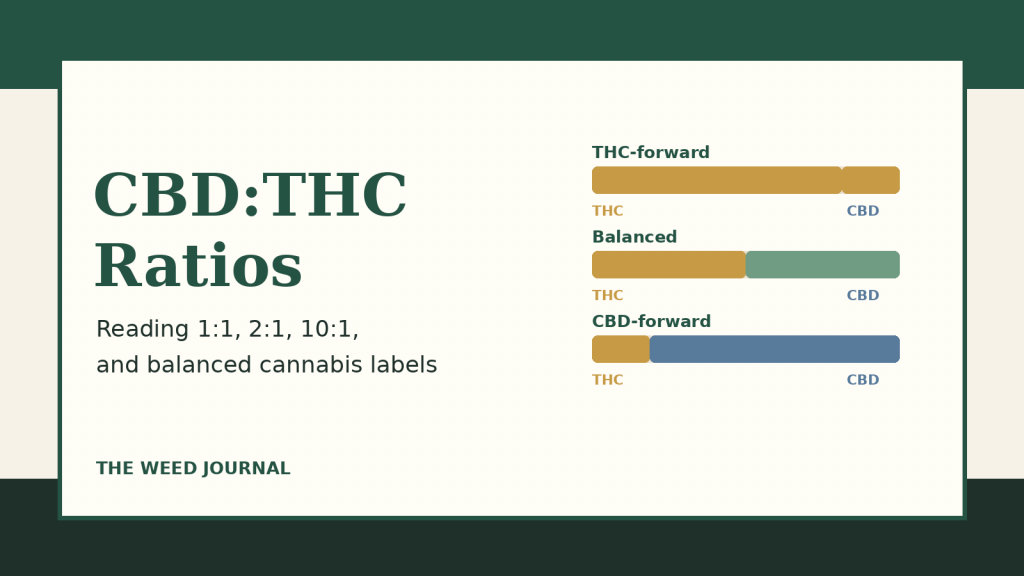
CBD:THC ratios look simple until you are standing in front of a Canadian cannabis menu trying to compare oils, capsules, drinks, flower, pre-rolls, vapes, and edibles. A product might say 1:1, 2:1, 10:1, or “balanced.” Another label might list milligrams per gram, milligrams per package, or milligrams per activation. The ratio is useful, but only if you know what it can and cannot tell you.
This guide is for adults who want a practical, Canada-aware way to read CBD:THC ratios without treating them like medical promises. The short version: the ratio compares the amount of CBD to THC, but the actual dose, product format, your tolerance, timing, and legal label details still matter.
Quick answer
A CBD:THC ratio compares how much cannabidiol (CBD) is present relative to delta-9-tetrahydrocannabinol (THC). A 1:1 product has roughly equal CBD and THC. A 2:1 product has about twice as much CBD as THC. A 10:1 product is CBD-forward. A 1:2 product is THC-forward. In Canada, read the front label for Total THC and Total CBD, then check the serving size or amount per activation before deciding whether the product fits your tolerance.
Ratios are not effect guarantees. Health Canada notes that higher THC content is linked with a higher chance of adverse effects and impairment, and that CBD is known to reduce some effects of THC. That does not mean CBD cancels THC or makes a product non-impairing. A balanced edible can still be too strong if the THC milligrams are high for you.
Common CBD:THC ratios at a glance
| Label ratio | Plain meaning | What to check before use |
|---|---|---|
| 1:1 | Roughly equal CBD and THC. | The actual THC amount per serving; equal does not mean mild. |
| 2:1 or 5:1 | CBD-forward with some THC. | Whether the THC amount is still enough to impair you. |
| 10:1 or 20:1 | Strongly CBD-forward. | Whether there is any THC, and how much is in the full dose. |
| 1:2 or 1:5 | THC-forward with some CBD. | Your tolerance, setting, timing, and need to avoid driving. |
| CBD-only style | CBD-dominant, often with very little THC. | The label may still show trace THC; check Total THC, not just the name. |
Ratio is not the same as dose
The most common mistake is reading a ratio and forgetting the actual amount. A 1:1 product with 2.5 mg THC and 2.5 mg CBD per serving is very different from a 1:1 product with 10 mg THC and 10 mg CBD per serving. The ratio is the same. The dose is not.
That difference matters most with ingestible products such as oils, capsules, softgels, edibles, and drinks. Inhaled products can be titrated more gradually by some adults because effects are usually felt sooner, but that does not make them risk-free. Edibles and oils can take longer, last longer, and catch people off guard when they stack doses too quickly.
If you are new, returning after a break, or switching formats, our microdosing guide for Canadians and edibles dose chart are better starting points than ratio shopping alone.
How Canadian labels show THC and CBD
Health Canada’s label guidance says cannabis product labels must show Total THC and Total CBD. These are the practical numbers most adult consumers should use when comparing potency. Depending on the product, the amount may be shown as milligrams per package, milligrams per unit, milligrams per gram, or a concentration.
For dried flower, you may see THC and Total THC. The same pattern can appear for CBD and Total CBD. The “Total” value estimates what is available after activation, which is why it is usually more useful for a buyer than the inactive-acid number alone. Our Canadian cannabis label guide walks through that label math in more detail.
For oils and ingestibles, check the amount per activation or serving. A bottle might look CBD-forward overall, but the dropper size or activation amount determines what you actually consume. If the label is confusing, slow down and ask the legal retailer to explain the serving math before buying.
What CBD may change about a THC experience
CBD and THC are both cannabinoids, but they do not feel the same for most adults. THC is the main intoxicating compound associated with the cannabis high. CBD is not usually described as intoxicating in the same way, and Health Canada says CBD is known to reduce some effects of THC.
That is useful, but it should be interpreted carefully. CBD does not make THC disappear. It does not make impaired driving safe. It does not guarantee a calm experience, prevent anxiety, or turn a high-dose edible into a beginner product. The National Academies review is also a reminder that cannabis evidence varies by condition and outcome; many claims are supported by limited or insufficient evidence, not certainty.
The practical takeaway is modest: CBD-forward or balanced products may be worth comparing if THC-heavy products feel too intense for you, but the safer-use decision still comes back to dose, timing, setting, and avoiding risky activities.
When a 1:1 product makes sense to consider
A 1:1 product is often marketed as “balanced” because it has similar CBD and THC amounts. That can be helpful language, but balanced does not mean neutral. A balanced product can still be intoxicating, especially if the THC dose is high, the format is an edible, or your tolerance is low.
Consider a 1:1 product only after checking the THC amount in the actual serving. For example, a legal edible with 10 mg THC and 10 mg CBD in the package may be 1:1, but 10 mg THC can be too much for some adults, especially beginners. A product with 2.5 mg THC and 2.5 mg CBD per serving is a very different starting point.
If THC percentage or milligrams are becoming the whole decision, read why THC percentage is not everything. Ratio is another useful clue, not a replacement for judgment.
When CBD-forward products may be the better comparison set
CBD-forward ratios such as 2:1, 5:1, 10:1, or 20:1 are often chosen by adults who want to avoid a strongly THC-forward experience. They can be a reasonable comparison set for people who find high-THC products unpleasant, but the label still needs attention.
First, check whether the product contains THC at all. Some CBD-dominant products contain a small amount of THC. Second, calculate the THC in the serving you plan to use. Third, remember that impairment risk is not only about how the product is marketed. Timing, alcohol, other drugs, fatigue, and your own sensitivity can all change the experience.
For CBD oil specifically, our CBD oil buying guide for Canada covers legal-source checks, label reading, and product-format questions in more detail.
When THC-forward products deserve extra caution
THC-forward ratios such as 1:2 or 1:5 mean there is more THC than CBD. Some adults prefer that. The caution is that higher THC products are more likely to create impairment and adverse effects, especially for inexperienced consumers or people using large servings.
Use extra caution with concentrates, high-THC vapes, infused pre-rolls, and edibles. The label may look familiar, but the dose can be much stronger than an older consumer expects from traditional flower. If anxiety, panic, racing thoughts, dizziness, or discomfort are common for you, a THC-forward product is not the place to prove a point.
Do not drive after using cannabis. Do not mix cannabis with alcohol to test a ratio. Do not use a ratio label as permission to take more before the first dose has fully arrived.
A simple way to compare products
- Confirm the product is from a legal Canadian source.
- Find Total THC and Total CBD on the label.
- Convert the label into the amount you will actually consume per serving.
- Use the ratio to decide whether the product is THC-forward, balanced, or CBD-forward.
- Choose the smallest practical amount when trying a new product.
- Wait long enough for the format before considering more.
- Avoid driving, work, childcare, water activities, or machinery after use.
Questions to ask before checkout
Before buying a ratio product, ask what you are trying to avoid. If the answer is “too much THC,” look at the THC amount first, then the ratio. If the answer is “confusing label math,” choose a product with clear serving information instead of a larger bottle or stronger package. If the answer is “I want CBD but no noticeable high,” check whether the product contains any THC and whether the retailer can explain the Total THC number plainly.
It also helps to compare products inside the same format. A CBD-forward oil, a balanced edible, and a balanced vape are not interchangeable just because the ratio looks similar. Onset, duration, serving control, and how quickly effects are felt can change the risk of taking too much.
Bottom line
CBD:THC ratios are helpful when they stop you from shopping by strain name or THC number alone. They are not enough by themselves. A careful Canadian buyer reads Total THC and Total CBD, checks the serving size, respects the product format, and treats CBD as a possible moderator of some THC effects, not a safety shield.
If you want the simplest buying rule, use this: ratio first, dose second, format third, tolerance always. That order keeps the label useful without pretending cannabis effects can be predicted from one number.
Sources
- Health Canada: How to read and understand a cannabis product label
- Health Canada: Cannabis health effects
- Health Canada: Canada’s lower-risk cannabis use guidelines
- National Academies via NCBI Bookshelf: The Health Effects of Cannabis and Cannabinoids
Explore the beginner’s guide, or learn how we source and edit our stories.