Tag: Canada

  • How Long Does a Cannabis High Last in Canada?

    How Long Does a Cannabis High Last in Canada?

    A cannabis high does not end on a timer. Two people can use the same product and feel different timing because dose, product type, tolerance, food, sleep, alcohol, and setting all matter. That is why a single answer like “two hours” can be misleading, especially for edibles and other swallowed products.

    For adults in Canada, the practical answer is this: inhaled cannabis usually feels faster and fades sooner, while edible cannabis can take much longer to start and may last much longer. Impairment can also outlast the moment when someone feels obviously high, which matters for driving, work, childcare, cooking, and other decisions that require coordination and judgment.

    This guide explains realistic timing ranges by product type, why duration varies, and how to make safer plans without turning cannabis timing into fake precision. It is educational information, not medical or legal advice.

    Quick answer

    A cannabis high can last from a couple of hours to most of a day depending on the product and dose. Inhaled cannabis often starts within minutes, peaks sooner, and commonly fades within a few hours. Edibles and other swallowed products can take 30 minutes to 2 hours or more to feel noticeable, can peak later, and can last 6 to 12 hours for some people, especially at higher THC amounts.

    The safer rule is to plan around the longest reasonable window, not the shortest one. Do not drive, operate equipment, mix with alcohol, or take more THC just because you do not feel much yet. If the product is edible, swallowed oil, capsule, drink, or another oral format, waiting is part of the dose.

    Cannabis high duration by product type

    Product type Common onset Common peak window How long effects may last Planning note
    Smoking or dry herb vaping Within minutes Often within the first hour Often a few hours, but impairment can vary Fast feedback makes overuse easier if you keep inhaling without pausing
    Vape cartridges Within minutes Often within the first hour Often a few hours, depending on strength and session size Small puffs can add up quickly because cartridges can be potent and convenient
    Edibles Often 30 minutes to 2 hours or longer Can peak several hours after use Often 6 to 12 hours, sometimes longer at high doses Do not re-dose early because the first dose may still be building
    Capsules and softgels Often similar to edibles Can be delayed and gradual Often similar to edibles or oils Label milligrams matter more than unit size or brand familiarity
    Oils and tinctures Variable; swallowed oil behaves more like an edible Depends on product, use, and food Can last several hours Read the label carefully and do not assume every dropper is one dose
    Drinks Variable by formulation and stomach contents Can feel faster than some foods but still may be delayed Several hours is possible Treat THC drinks like cannabis first, not like ordinary beverages
    These are planning ranges, not promises. Dose, tolerance, food, body size, product chemistry, and recent substance use can shift the experience.

    Why duration varies so much

    The biggest factor is route of use. Inhaled cannabis reaches the bloodstream quickly through the lungs, so the feedback loop is fast. Swallowed THC moves through digestion and liver metabolism, which is why edible timing can be delayed, stronger than expected, or longer-lasting for some people.

    Dose matters too. A 2.5 mg THC edible and a 20 mg THC edible are not the same experience, even if both are sold legally. The same is true with inhaled products: a single small puff is not the same as a long session, and a high-THC concentrate is not the same as lower-THC dried flower.

    Tolerance changes expectations. Someone who uses THC often may feel a shorter or less intense high than a newer user at the same dose. But tolerance is not a safety shield. It can also encourage larger doses, more frequent re-dosing, or underestimating impairment.

    Food and alcohol can complicate timing. A full meal may delay or change how an edible feels. Alcohol can increase impairment and make decision-making worse. Sleep deprivation, stress, dehydration, and unfamiliar settings can also make a cannabis experience feel more intense or uncomfortable.

    Effects versus impairment

    One of the most important distinctions is between “I feel less high” and “I am unimpaired.” Those are not always the same thing. Health Canada warns that cannabis can affect attention, coordination, reaction time, decision-making, and the ability to drive or operate equipment.

    This is why timing matters beyond comfort. If you use cannabis in the evening, especially edibles, you may still feel groggy or slowed later than expected. If you need to drive, supervise children, use tools, work, or make important decisions, plan a larger buffer than the average onset-and-duration chart suggests.

    For a deeper legal and safety discussion, see The Weed Journal’s guide to cannabis and driving in Canada. The short version is simple: do not drive high, and do not use a personal timing guess as a legal or safety clearance.

    Why edibles surprise people

    Edibles are the most common source of timing mistakes because the delay feels like nothing is happening. A person eats one serving, waits 45 minutes, decides it was too weak, then takes more. The first dose is still moving through the body, and the second dose stacks on top.

    That is why a low-and-slow approach is still useful, even for adults who have used cannabis before. Start with a small THC amount, give the product enough time, and avoid turning impatience into a second dose. The label should tell you milligrams of THC and CBD per unit or package. If it does not, treat that as a red flag rather than a puzzle to solve by experimenting.

    The Weed Journal’s edible onset guide and edibles dose chart explain edible timing and THC milligrams in more detail.

    How to plan around a cannabis high

    • Choose the product type before choosing the dose. A fast-onset product and a delayed oral product need different plans.
    • Read the THC and CBD label carefully, including serving size and total package amount.
    • Use cannabis when you have enough time for the full experience, not when you are rushing between responsibilities.
    • Avoid alcohol and other impairing substances, especially when trying a new product or dose.
    • Do not re-dose edibles, oils, capsules, or drinks early because delayed effects are normal.
    • Keep products locked away before, during, and after use so children, pets, guests, and housemates do not access them.
    • Write down what you used, how much, when it started, when it peaked, and when it faded if you are trying to understand your own pattern.

    A simple note in your phone can prevent repeat mistakes. Record the product type, THC amount, time used, food or alcohol context, and how you felt later. Over time, that teaches you more than a brand name or strain label ever will.

    What if the high lasts too long?

    A long-lasting high can be uncomfortable, especially when it is stronger than intended. If you are anxious or overwhelmed, move to a calm place, avoid more cannabis or alcohol, sip water, eat something light if you can, and remind yourself that edible effects can take time to fade. Staying with a trusted sober person can help.

    Do not try to “fix” a strong cannabis high by adding another substance. If symptoms are severe, unusual, or worrying, seek medical help. That includes chest pain, fainting, trouble breathing, severe confusion, persistent vomiting, suspected poisoning, or concern that a child, pet, or another adult consumed cannabis unintentionally.

    For practical steps during an uncomfortable experience, read How to Sober Up From Being Too High. It focuses on harm reduction rather than quick-fix myths.

    How labels help you estimate duration

    Labels cannot tell you exactly how long a cannabis high will last, but they do give useful clues. Look for total THC, total CBD, THC per serving, package amount, product class, lot number, packaging date, and warning information. For dried flower and some inhaled products, THC percentage can help compare potency, but it does not predict the whole experience by itself.

    For edibles, drinks, capsules, and oils, milligrams are the key unit. A small candy, capsule, or beverage can still contain enough THC to produce long-lasting effects. Do not estimate strength by package size, flavour, price, or how familiar the product looks.

    If the label is confusing, our Canadian cannabis label guide is the better next read.

    Timing mistakes to avoid

    Mistake Why it causes problems Better move
    Taking more edibles after 30 to 60 minutes The first dose may not have peaked yet Wait longer and plan edible use when you have no urgent obligations
    Using cannabis before driving later Impairment can outlast obvious intoxication Separate cannabis from driving entirely
    Mixing cannabis with alcohol Combined impairment can be stronger and less predictable Use one substance or neither, especially with unfamiliar products
    Ignoring serving size A package may contain multiple servings Check THC milligrams per unit and per package
    Assuming tolerance means no risk Frequent users can still be impaired or overdo it Use the lowest amount that meets your goal and keep buffers
    The most preventable timing problems usually come from impatience, unclear labels, or combining substances.

    Bottom line

    A cannabis high can last a short evening or stretch much longer, depending on what you used and how much. Inhaled products usually give faster feedback and often fade sooner. Edibles, capsules, oils, and drinks can be delayed, stronger later, and longer-lasting.

    The reader-first rule is boring but useful: read the label, start lower with unfamiliar THC products, wait longer with oral formats, avoid alcohol, and do not drive or take on safety-sensitive tasks. Planning for the long end of the range is safer than hoping for the short one.

    FAQ

    Can a cannabis high last into the next day?

    Yes, especially after higher-dose edibles, capsules, oils, drinks, or a late-night session. Some people may feel groggy, slowed, or mentally foggy the next morning. Do not treat sleep as a guaranteed reset.

    Why did an edible hit me after I thought it was not working?

    Swallowed THC can take time to move through digestion and metabolism. Food, dose, product type, and personal differences can delay the noticeable effects, which is why early re-dosing is a common mistake.

    Does CBD make a cannabis high end faster?

    CBD may change how some people experience THC, but it should not be treated as a reliable way to end impairment. Avoid quick-fix claims and focus on time, rest, hydration, a calm setting, and medical help when symptoms are concerning.

    How long should I wait before taking more edibles?

    There is no universal safe re-dose time, but the cautious approach is to wait several hours and avoid taking more during the same session when you are unsure. If you are new or returning after a break, choose a lower THC amount next time instead of stacking doses.

    Do stronger THC products always last longer?

    Not always, but higher THC amounts can make effects stronger, less predictable, and harder to manage. Product type, dose, tolerance, food, and mixing with alcohol or other substances all affect duration.
    Sources

  • Cannabis Recalls in Canada: How to Check a Product

    Cannabis Recalls in Canada: How to Check a Product

    A cannabis recall is easy to miss if the product is already in your drawer, lockbox, or fridge. Most people do not check recall notices after every purchase. They buy from a legal store, put the package away, and assume the product is still fine unless the retailer contacts them directly.

    That is not a great system for adults who want to use cannabis carefully. Recalls can involve a specific brand, product size, lot number, packaging date, province, or sales channel. A product on your shelf may be unaffected, while a similar-looking product from the same brand may be part of a notice. The only way to know is to match the details.

    This Canada-aware guide explains how to check cannabis recalls, what label details to compare, what to do if a product matches, and when to report a side effect or product concern. It is educational information, not legal or medical advice.

    Quick answer

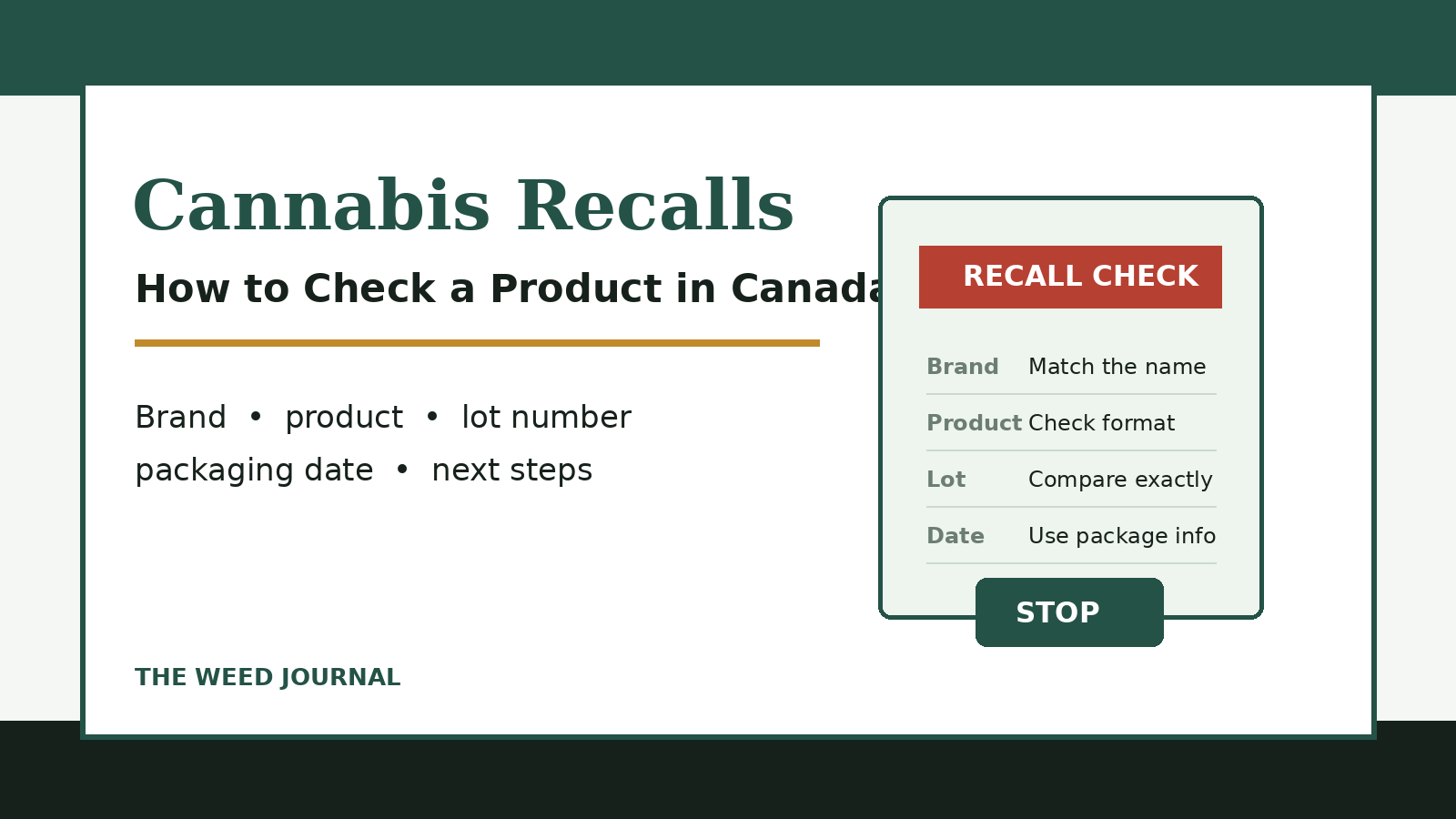
    To check a cannabis recall in Canada, use Health Canada’s cannabis recalls and reporting page or the federal recalls and safety alerts site, then compare the notice against your package. Match the brand, product name, product size, lot number, packaging date, province or sales channel, and any printed potency or label details listed in the notice. If your product appears to match, stop using it, keep the package, follow the recall instructions, and contact the retailer, licence holder, or Health Canada reporting channel listed in the notice.

    If you or someone else has a concerning reaction after using a cannabis product, seek medical help when needed and report the suspected side effect through Health Canada’s cannabis adverse reaction reporting process. If the concern is about suspected illegal sales, misleading products, packaging, promotion, or another cannabis compliance issue, use the appropriate concern-reporting path rather than guessing.

    What to match before assuming a recall applies

    Recall detail Where to look Why it matters
    Brand and product name Front label, receipt, retailer listing Similar names can exist across formats, sizes, and product lines
    Product class Label and recall notice Dried flower, pre-rolls, edibles, extracts, topicals, seeds, and drinks are not interchangeable
    Package size Net weight, volume, unit count, or serving count A recall may cover one size but not another
    Lot number Package label, outer container, peel-back label, or receipt details This is often the most important match point
    Packaging date Package label Helps separate affected batches from unaffected stock
    Where it was sold Recall notice and purchase record Some recalls are limited to certain provinces, territories, medical channels, or retailers
    Printed vs actual values Recall notice and label Some recalls involve incorrect THC, CBD, warning, or product information
    Do not rely on the brand name alone. A careful recall check compares the lot and package details against the official notice.

    Where to check cannabis recalls in Canada

    Health Canada maintains a cannabis recalls, adverse reactions, and reporting page that points readers to recall searches, side-effect reporting, and cannabis concern reporting. The broader Government of Canada recalls and safety alerts site also lets people search recall notices and subscribe to alerts.

    For most adults, the simplest habit is to bookmark the federal cannabis recalls page and search the broader recalls site by brand or product name when something looks off. If your province, territory, retailer, or medical cannabis seller sends a notice, use that notice as a prompt to verify the product details against the federal listing.

    Legal retailers and licence holders may also publish recall information, but official federal notices are the better source of record. Screenshots shared on social media, forum posts, and word-of-mouth can be useful signals, but they should not be your only confirmation.

    How to read the label before you search

    Health Canada’s label guidance explains that legal cannabis labels include required information such as warnings, THC and CBD details, product information, and other packaging elements. Its legal-cannabis guidance also points to visible signals such as the excise stamp, standardized cannabis symbol, child-resistant packaging for most products, bilingual health warnings, and nutrition facts for edible cannabis.

    For recall checking, the label detail that matters most is not always the most visible. The lot number and packaging date may be printed small, placed near the barcode, stamped on the side or bottom, or included on a peel-back label. Keep the outer package until the product is finished, especially for edibles, oils, capsules, concentrates, and multi-unit formats where the inner product may not carry enough information on its own.

    If you want a fuller label-reading foundation, The Weed Journal’s guide to reading cannabis labels in Canada explains THC, CBD, Total THC, Total CBD, package dates, warnings, and the difference between useful label information and marketing noise.

    What a real recall notice can include

    Many cannabis recalls are narrow. A notice may identify a product by exact name, package size, lot number, packaging date, province, number of units sold, sales window, and reason for recall. Health Canada recall examples show why exact matching matters: a notice can cover one lot of dried cannabis, one extract, one pre-roll product, or a product sold through specific authorized retailers or medical channels.

    The reason can vary. Some recalls involve incorrect cannabinoid values or label information. Others may involve microbial concerns, foreign matter, packaging problems, missing warnings, quality testing, or other compliance issues. The notice should tell consumers what to do with the product and who to contact.

    Do not try to infer risk from the headline alone. Read the full notice. A Type III-style labelling problem is not the same as a contamination concern, but both are still recall notices that deserve a careful response.

    If your product appears to match

    1. Stop using the product until you have confirmed the recall instructions.
    2. Keep the package, label, receipt, product, and any photos of the lot or packaging date.
    3. Read the full official notice, including affected provinces, dates, sizes, and contact details.
    4. Contact the retailer, licence holder, or recall contact named in the notice if return or disposal steps are unclear.
    5. Do not give the product to someone else, resell it, share it, or continue using it because it “seems fine.”
    6. If anyone had a concerning reaction, seek medical advice when needed and report the suspected side effect through the Health Canada pathway.

    For home safety, keep the product secured while you decide what to do. A recalled product should not move from adult-use storage into a kitchen drawer, garbage can, vehicle cupholder, or shared snack area where a child, pet, guest, or housemate may encounter it.

    When to report a side effect

    Health Canada describes cannabis adverse reactions as harmful, unpleasant, or unintended responses to a cannabis product, and its reporting page lets consumers, patients, health professionals, hospitals, and licence holders submit reports. Reporting does not prove the product caused the reaction, but it gives regulators information that can help identify patterns.

    Report details are more useful when they are specific: product name, licence holder if known, lot number, amount used, route of use, time between use and symptoms, other substances used, and whether medical care was needed. If you are dealing with chest pain, severe confusion, fainting, trouble breathing, suspected poisoning, or another urgent situation, get medical help first.

    This is also where careful storage helps. If you keep the package, you can report details accurately instead of relying on memory after an uncomfortable experience.

    When the issue is not a side effect

    Not every cannabis concern is a side effect. A package may look suspicious, a website may appear to sell illegally across provinces, a product may make unauthorized health claims, or a promotion may seem aimed at young people. Health Canada’s cannabis concern page separates different issue types and points people toward the right authority, including local law enforcement for suspected illegal activity and Canada Vigilance for adverse reactions.

    For buying safety, a legal product is still the better starting point. It should come from an authorized retailer, carry required packaging and label elements, and be easier to trace if a recall happens. The Weed Journal’s legal retailer checklist and online cannabis buying checklist can help you screen the purchase channel before label checking even starts.

    A two-minute recall routine

    • Keep the package until the product is finished.
    • Take a clear photo of the lot number and packaging date after purchase.
    • Search the federal recalls site by brand or product name if a product looks, smells, tastes, or performs unexpectedly.
    • Check official notices before relying on social posts or retailer rumours.
    • Subscribe to Government of Canada recall alerts if you use cannabis often or manage purchases for a household.
    • Do not ignore notices for products you bought weeks or months earlier.
    • Store products in a locked place while you verify a concern.

    This routine is especially useful for people who buy multiple products at once, share a household, use medical cannabis, keep edibles or oils for months, or transfer information into a journal or dose log.

    Bottom line

    A cannabis recall check is not complicated, but it does require exact details. Search official Canadian recall sources, compare the package against the notice, and treat the lot number and packaging date seriously. If the product matches, stop using it and follow the recall instructions. If someone had an adverse reaction, report it through the right Health Canada channel after taking care of any urgent health needs.

    The calmer habit is simple: buy legal, keep labels, store securely, check official notices, and do not pass along a product that may be affected.

    FAQ

    Are all cannabis recalls national?

    No. Some notices identify specific provinces, territories, retailers, medical channels, sales dates, or lots. Always read the details rather than assuming every package from a brand is affected.

    Is a recalled cannabis product always dangerous?

    Not always in the same way. Recall reasons vary, including labelling errors, potency information, packaging issues, testing results, contamination concerns, or other quality problems. Follow the official notice instead of guessing risk from the headline.

    What if I threw away the package?

    Check receipts, order history, retailer emails, product photos, and any remaining label information. If you cannot confirm the lot number, contact the retailer or licence holder named in the notice for guidance.

    Should I report a bad cannabis experience even if there is no recall?

    Yes, if it was a suspected side effect or adverse reaction. Health Canada’s cannabis side-effect reporting page accepts reports even when a recall has not been announced.

    Can I return a recalled cannabis product to any store?

    Do not assume that. Follow the recall notice and the retailer or licence holder instructions. Rules can vary by product, province, sales channel, and seller.

    Sources

  • Cannabis and Pets in Canada: Safe Storage Guide

    Cannabis and Pets in Canada: Safe Storage Guide

    A pet does not need to understand cannabis for cannabis to become a household risk. A dog can chew through a gummy package. A cat can knock a loose edible from a table. A curious animal can lick infused oil, eat discarded flower, or get into a visitor’s bag before anyone realizes the product was accessible.

    This Canada-aware guide is for adult cannabis consumers who share a home, vehicle, cottage, or yard with pets. It is not veterinary advice, and it is not a guide to giving cannabis to animals. The practical goal is prevention: keep legal cannabis labelled, locked, separated from food, and away from pets before an emergency starts.

    Quick answer

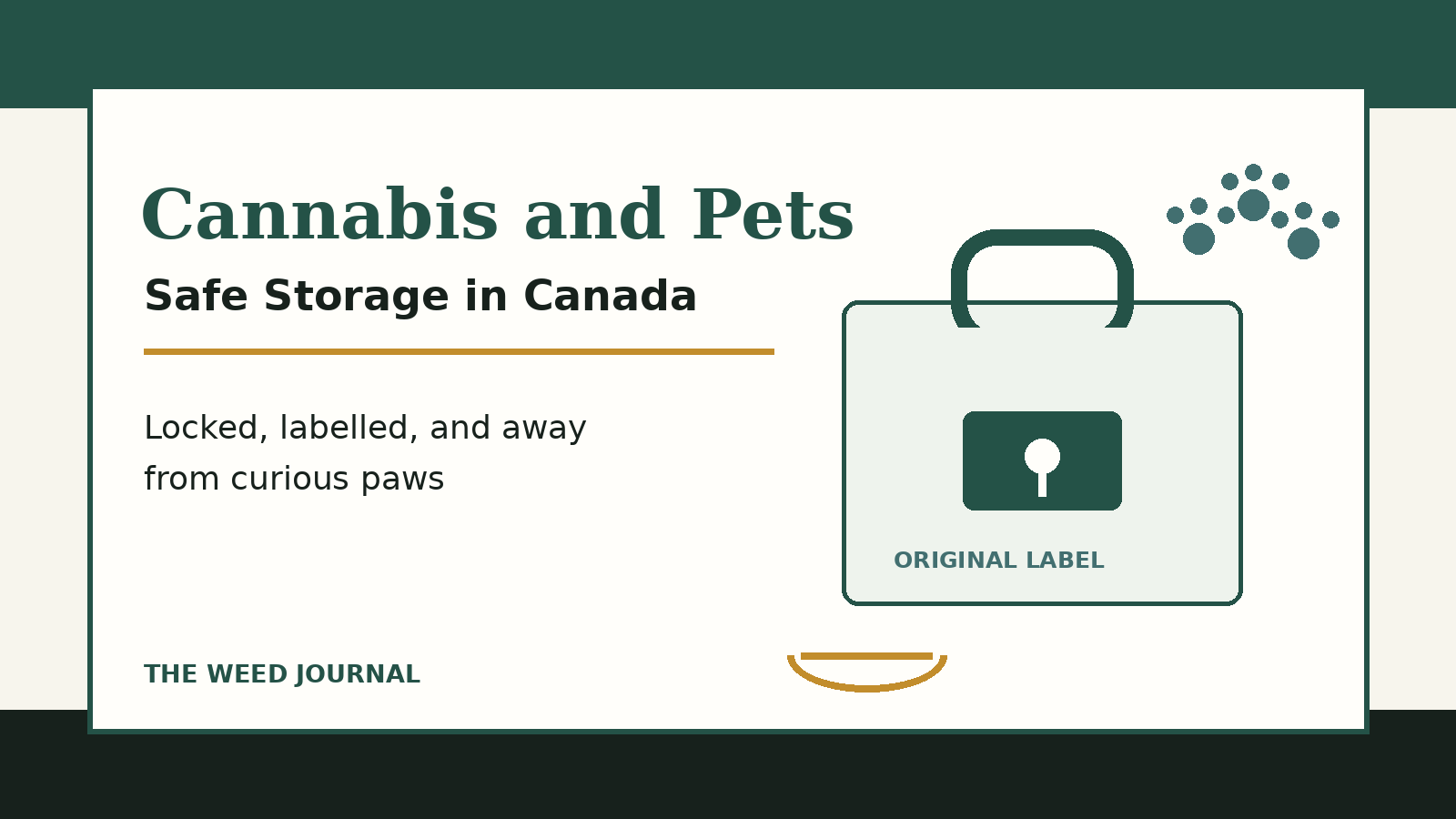
    In a pet-friendly home, cannabis should be treated like medication or household chemicals: keep it in the original child-resistant package, close it fully after use, store it in a locked container, keep it separate from regular food and pet treats, and do not leave leftovers, roaches, vape parts, drinks, oils, or edibles within reach. If a pet may have eaten cannabis, call a veterinarian or emergency veterinary clinic promptly and tell them what the animal may have consumed.

    Do not try to make the pet vomit unless a veterinarian tells you to. Do not wait for “funny” symptoms to become serious. Fast, honest information helps the vet judge risk and avoid guessing.

    Pet-safe cannabis storage checklist

    Storage point Better habit Why it matters
    Original package Keep cannabis in its labelled, child-resistant container The label helps identify THC, CBD, product type, lot details, and warnings
    Locked location Use a lockbox, locked cabinet, or high locked drawer Pets can climb, chew, paw, and open bags more easily than expected
    Food separation Store edibles and drinks away from regular snacks and pet treats Flavoured products can look or smell like food
    After-use cleanup Secure leftovers, ash, roaches, vape carts, wrappers, and infused-oil tools Small residues and discarded items can still attract animals
    Guest routine Ask visitors to keep cannabis zipped, closed, and out of reach Many home risks arrive in purses, backpacks, jackets, and cars
    Emergency info Save your vet and nearest emergency clinic number You should not be searching for help during a poisoning concern
    A pet-safe setup is boring on purpose: labelled package, locked container, food separation, and a clear emergency contact.

    Why pets are a different risk than adults

    Adults can read a label, compare THC amounts, and choose whether to use cannabis. Pets cannot. They encounter cannabis as an unknown scent, oil, plant material, candy-like edible, baked good, capsule, drink, or discarded item. That means prevention has to happen before the product is visible, chewable, or lickable.

    Dogs are often the bigger household risk because they investigate food smells and packaging aggressively, but cats and other animals can also be exposed. The size of the animal matters. A small amount that looks minor to an adult can be a serious exposure for a small pet.

    The product format matters too. Edibles may include chocolate, raisins, xylitol, fats, or other ingredients that create separate veterinary concerns. Vape cartridges, wrappers, and packaging can create chewing or obstruction risks. Flower, concentrates, oils, capsules, and drinks should all be treated as pet hazards, not just gummies.

    Do not give cannabis or CBD to pets casually

    Human cannabis products are not made, labelled, or dosed for animals. Health Canada has stated that there are currently no authorized veterinary drugs containing cannabis, including CBD, in Canada. That matters because a product being legal for adult human use does not make it appropriate for a dog or cat.

    If you are worried about pain, anxiety, appetite, seizures, sleep, behaviour, or aging in a pet, talk to a veterinarian. Do not substitute a human THC or CBD product, a dispensary recommendation, or an online anecdote for veterinary care. A cautious article should not promise pet benefits from cannabis, and this one does not.

    Signs that may suggest cannabis exposure

    Only a veterinarian can assess your pet, but cannabis exposure in pets can involve changes that are hard to miss: wobbling, unusual sleepiness, disorientation, drooling, vomiting, dribbling urine, dilated pupils, agitation, unusual vocalizing, tremors, temperature changes, or heart-rate changes. Severe cases can be more serious.

    Symptoms are not proof of cannabis exposure, and the absence of symptoms does not guarantee safety. If you saw the pet eat something, found a chewed package, or cannot account for a missing edible or capsule, call for veterinary guidance rather than waiting.

    Be honest with the clinic. Tell them the product type, brand if known, Total THC and Total CBD, approximate amount missing, time of possible exposure, the animal’s size, and any other ingredients. Vets are there to treat the animal, not to judge the owner.

    What to do if a pet may have eaten cannabis

    1. Move the pet away from the product and remove any remaining cannabis from reach.
    2. Save the package, label, receipt, wrapper, or photo of the product.
    3. Call your regular veterinarian, an emergency veterinary hospital, or an animal poison-control service if your vet directs you there.
    4. Describe the product clearly: edible, flower, oil, capsule, concentrate, vape cartridge, drink, or unknown.
    5. Share the estimated THC and CBD amount, the time, and the pet’s weight.
    6. Follow veterinary instructions. Do not induce vomiting or give home remedies unless directed.

    If a child or adult may also have consumed the product accidentally, contact the appropriate poison centre or emergency services. Ontario Poison Centre tells families to store cannabis in a locked container, separate from food and drinks, and to keep products labelled. That advice works for mixed households with pets too.

    Where cannabis gets left out by mistake

    Most preventable pet exposures start in ordinary places. A backpack on the floor. A coat pocket after a party. A tray table beside the couch. A glovebox during a road trip. A patio ashtray. A half-finished drink. A baking sheet. A bedside drawer. A bathroom counter. A cottage kitchen where routines are looser than at home.

    Create one rule that survives busy days: cannabis is either in use by an adult or locked away. There is no in-between stage on counters, coffee tables, nightstands, bags, or vehicles. This is especially important when using products covered in our safe cannabis storage checklist, including edibles, drinks, oils, capsules, and concentrates.

    Edibles and drinks need extra care

    Health Canada warns families to keep cannabis away from children, locked away, and separate from regular food and drinks. The same storage logic protects pets. Edibles and beverages can smell like treats, snacks, or leftovers, and they may be more attractive to animals than plain dried flower.

    Legal Canadian edible cannabis has packaging and THC limits that illegal copycat products may not follow. But legal packaging only helps when it is closed, labelled, and stored. Once a gummy, chocolate, brownie, cookie, drink, or infused oil is removed from its package, a pet cannot tell the difference between cannabis and food.

    If edibles are part of your home, read our guides to edible cannabis timing and edible storage and expiry. The reader habit is the same: slow, labelled, separated, and locked.

    Vehicles, walks, and shared spaces

    Pet safety does not stop at the kitchen. Keep cannabis sealed and inaccessible in vehicles, especially when a dog rides in the back seat or cargo area. Do not leave products in hot cars where packaging can degrade and odours can attract attention. If you carry cannabis while walking a dog, use a closed container in a pocket or bag the animal cannot access.

    Watch shared outdoor spaces too. Pets can find discarded joints, edible wrappers, or unknown plant material near parks, sidewalks, trails, parking lots, and festival grounds. If your pet eats something suspicious outside, take a photo if safe, remove the animal from the area, and call a veterinarian for next steps.

    A household rule that actually works

    The safest cannabis routine is simple enough for every adult in the home to follow. Keep one locked storage location. Keep products in original packaging. Put cannabis away before opening pet food, serving snacks, hosting guests, going to bed, or leaving the room. Add a small note inside the lockbox with your vet’s phone number and the nearest emergency clinic.

    If you use cannabis often, make cleanup part of the session rather than the morning-after chore. Ash, roaches, infused-oil droppers, residue, wrappers, baking tools, and half-finished beverages should not be left where an animal can investigate them. If the product is strong enough to affect an adult, assume a pet exposure deserves professional attention.

    Bottom line

    Cannabis and pets are a storage issue first. Do not give human cannabis products to animals. Do not rely on high shelves alone. Keep cannabis legal, labelled, closed, separate from food, locked away, and cleaned up after use. If a pet may have eaten cannabis, call a veterinarian quickly and be specific about what happened.

    FAQ

    Can pets safely use CBD products sold for humans?

    Do not give a human CBD or cannabis product to a pet without veterinary guidance. Health Canada’s current veterinary CBD information says there are no authorized veterinary drugs containing cannabis, including CBD, in Canada.

    What if my dog ate a cannabis edible but seems fine?

    Call a veterinarian or emergency veterinary clinic anyway. Timing, THC amount, other ingredients, and the dog’s size all matter, and symptoms may not be immediate.

    Should I make my pet vomit after cannabis exposure?

    No, not unless a veterinarian specifically instructs you to. Home attempts can add risk, especially if the animal is sleepy, disoriented, or unstable.

    Are legal cannabis products safer around pets than illegal products?

    Legal products have regulated packaging and labels, which helps adults identify the product and amount. They are still unsafe for pets if chewed, eaten, licked, spilled, or left out.

    What cannabis products are highest risk for pets?

    Any cannabis product can be a risk, but edibles, drinks, oils, capsules, concentrates, discarded flower, vape cartridges, and infused baked goods deserve special care because they can be attractive, concentrated, or easy to leave out.

    Sources

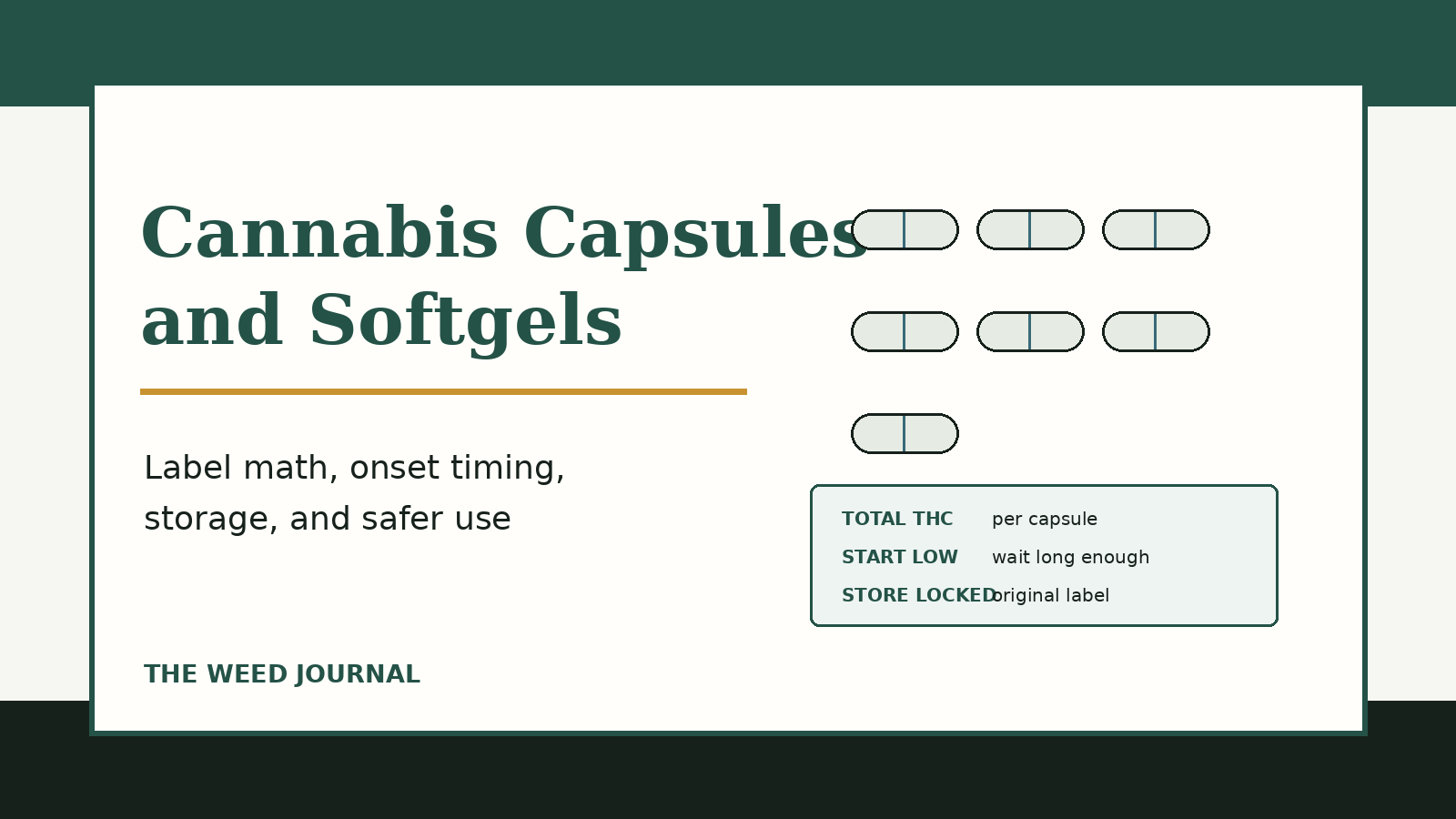
  • Cannabis Capsules in Canada: Softgels and Labels

    Cannabis Capsules in Canada: Softgels and Labels

    Cannabis capsules and softgels look simple because they resemble ordinary supplements: small containers, measured units, tidy labels, no rolling papers, no smoke, and no obvious smell. That simplicity can be useful. It can also make people underestimate the timing and impairment risk.

    This Canada-aware guide is for adults comparing legal cannabis capsules, softgels, and similar ingestible oil products. It is not medical advice, and it is not a recommendation to use cannabis for a health condition. The practical goal is label literacy: know the Total THC and Total CBD per unit, understand that effects can be delayed, store the product securely, and avoid treating a capsule like a harmless vitamin.

    Quick answer

    In Canada, cannabis capsules and softgels should be bought from legal sources and kept in original packaging. Before using one, check the product class, Total THC, Total CBD, amount per capsule or softgel, number of units, lot number, package date, storage instructions, and warnings. Effects from ingestible cannabis can take longer to appear than inhaled cannabis and may last much longer, so taking another capsule too soon is one of the easiest mistakes to make.

    If you are new, sensitive to THC, returning after a break, or trying a new product, choose the lowest practical THC amount, wait long enough before considering more, and do not drive, mix with alcohol, supervise risky activities, or make important decisions while impaired.

    If you are trying to compare capsules with oils, sprays, strips, or lozenges, start with the label unit first: one capsule, one spray, one strip, one lozenge, or one measured mL can all mean different THC amounts.

    Capsule label checklist

    Label item What to check Why it matters
    Total THC per unit Find the amount in each capsule or softgel This is the main impairment number for most THC products
    Total CBD per unit Check CBD separately from THC CBD does not make THC non-impairing or driving-safe
    Unit count Count how many capsules are in the bottle A bottle can contain many separate doses
    Product class Confirm whether it is an extract, edible, or other regulated format Rules, limits, and use directions can differ by class
    Storage instructions Look for heat, light, and child-resistant packaging guidance Oil-based products can be damaged by poor storage
    Lot and package date Keep batch information available Useful for freshness questions and product-quality reports
    Capsules are easiest to compare when you ignore the front-label promise and read the per-unit cannabinoid math first.

    What counts as a cannabis capsule or softgel?

    Most shoppers use “capsule” and “softgel” to describe small swallowable cannabis products made with cannabis extract or oil. Some are THC-forward, some are CBD-forward, and some use balanced ratios. They may be sold as bottles of individual units rather than single edible pieces or drinks.

    The format matters because the experience is usually closer to other ingestible cannabis products than to smoking or vaping. You swallow the product, then wait for the body to process it. That means the onset may be delayed and the duration may be longer than a beginner expects.

    Do not assume a capsule is weaker because it looks clinical or discreet. A small softgel can still contain enough THC to impair judgment, coordination, reaction time, and comfort. Health Canada warns that cannabis can affect attention, memory, reaction time, coordination, and decision-making.

    How capsules differ from oils, edibles, and drinks

    Capsules are often easier to measure than drops because each unit is already portioned. That is the main advantage. You do not need to count drops or estimate how much oil is left on a spoon. The tradeoff is less flexibility: if one capsule contains more THC than you want, splitting it may be messy, inaccurate, or discouraged by the product directions.

    Compared with gummies, chocolates, and beverages, capsules can feel less snack-like. That can reduce accidental nibbling, but it can also create a false sense of seriousness or safety. The product is still cannabis. It still needs a slow timing plan and secure storage.

    For adjacent formats, read our CBD oil buying guide for Canada, THC beverages guide, and tinctures vs edibles comparison.

    Why per-unit math matters

    The most useful capsule question is not “How strong is the bottle?” It is “How much THC and CBD are in the one unit I might take?” A bottle with 30 capsules can display package-level information that is not the same as per-capsule information. Read slowly enough to avoid confusing the total container amount with the amount in each unit.

    For THC products, the lower-risk habit is to choose a small amount when you are unsure and wait through the full onset window before considering more. A higher-THC capsule may be convenient for an experienced consumer with a known tolerance, but it is a poor first comparison point for a beginner.

    CBD-forward capsules still deserve label reading. Some contain little or no THC; others contain enough THC to matter for impairment-sensitive people. If your goal is to avoid a high, verify the Total THC number instead of relying on the front label or ratio language. Our CBD:THC ratios guide explains why ratio is helpful but incomplete.

    Onset: the slow part is the risk

    Capsules and softgels can be tempting because the serving is tidy. The risk is that tidy does not mean immediate. Health Canada tells consumers that cannabis effects from eating or drinking can take longer to appear and can last longer than expected. Many uncomfortable experiences happen when someone takes another ingestible product before the first amount has fully arrived.

    With capsules, the delay can feel especially misleading because there is no flavour, smoke, ritual, or obvious sensory cue. A person may swallow one, go back to normal activity, decide nothing is happening, and take another. Later, both amounts can overlap.

    Build the wait into the plan before using. If you need predictable timing, need to drive later, are mixing with alcohol, or are using cannabis around people who pressure you to keep up, capsules are not a good fit for that situation. Our edibles onset guide is the better timing primer if you are uncertain.

    When capsules are a poor beginner choice

    Capsules can be too inflexible when the per-unit THC amount is higher than your comfort level. A 10 mg THC capsule may look modest beside stronger inhaled products, but for some adults it can be a very strong ingestible amount. Smaller units can be easier to learn from because you can stop after one and wait.

    They may also be a poor fit if you have trouble swallowing pills, have digestive issues that change how products affect you, take medications, have a health condition, are pregnant or breastfeeding, have a personal or family history of psychosis, or need professional advice about personal risk. For health-adjacent questions, talk with a qualified clinician instead of relying on a product page.

    Do not use capsules as a sleep, anxiety, pain, or medical treatment plan based on marketing language. The Weed Journal keeps those topics cautious because cannabis effects vary and evidence is not a substitute for personal medical care.

    Safer-use plan before taking one

    • Buy from a legal Canadian source and keep the original label.
    • Check Total THC and Total CBD per capsule, not just per bottle.
    • Choose the lowest practical THC amount when trying a new product.
    • Use only when you have a clear window with no driving or safety-sensitive duties.
    • Do not mix with alcohol, sedatives, or unknown substances.
    • Set a timer or write down when you took it so you do not redose by guesswork.
    • Wait long enough for ingestible effects before considering more.
    • Stop if you feel anxious, dizzy, unusually sleepy, confused, nauseated, or uncomfortable.
    • Keep the bottle locked away from children, pets, guests, and anyone who should not access cannabis.

    Storage and household safety

    Capsules and softgels can be easier to secure than loose edibles, but only if you keep the system intact. Use original child-resistant packaging, keep the label with the product, close the bottle tightly, and store it cool, dry, dark, and locked. Avoid hot cars, sunny windowsills, bathrooms, and open bedside tables.

    The ordinary-pill appearance is part of the risk. A visitor, roommate, child, or older adult could mistake an unlabelled cannabis capsule for a supplement or medicine. Do not transfer capsules to a weekly pill organizer unless there is a specific medical or caregiver reason and the cannabis warning remains clear. For most homes, the original container inside a locked box is the better routine.

    If a child, pet, or non-consenting adult may have consumed cannabis capsules, treat it as urgent and contact emergency, poison-centre, or veterinary help as appropriate. Do not wait for symptoms to prove the concern.

    Buying questions to ask

    Before checkout, ask three plain questions. First: how many milligrams of Total THC are in one capsule? Second: how long should I plan before deciding whether the first amount has arrived? Third: what will keep this product labelled, locked, and away from people who should not access it?

    If the retailer cannot help you find the per-unit amount, choose a clearer product. If the only available capsule strength is higher than you want, choose another format or skip the purchase. A good cannabis product is not just legal and popular. It is understandable enough that you can use it cautiously.

    Bottom line

    Cannabis capsules and softgels can make dose measurement easier, but they do not remove cannabis risk. The responsible Canadian buying routine is simple: legal source, original packaging, per-unit THC and CBD math, conservative timing, no driving, no alcohol mixing, and locked storage. If you cannot explain the label before taking it, the product is not ready for your plan yet.

    FAQ

    Are cannabis capsules the same as edibles?

    They are not the same product format, but they are usually managed like ingestible cannabis from a timing perspective. Effects can be delayed and may last longer than inhaled cannabis, so redosing too soon is a common risk.

    How much THC should a beginner choose in a capsule?

    There is no universal beginner dose. A cautious adult should choose the lowest practical THC amount, avoid high-THC units, and wait long enough before considering more. People with health conditions, medications, pregnancy, breastfeeding, or personal risk factors should seek professional advice.

    Can CBD capsules make you high?

    CBD itself is not intoxicating in the same way as THC, but some CBD-labelled products contain THC. Read Total THC on the label. Do not use CBD language as a reason to drive or ignore impairment risk.

    Can I open a softgel to take less?

    Do not assume that opening, cutting, or squeezing a capsule gives an accurate smaller serving. Follow product directions. If one unit is too strong or too uncertain, choose a lower-strength product or a format with clearer portion control.

    What if I took too much?

    Do not take more cannabis or alcohol. Move to a calm place, have a sober adult nearby, and monitor how you feel. Seek urgent help if symptoms are severe, unusual, or unsafe. For practical non-emergency steps, read our guide on what to do when you are too high.

    Sources

  • Cannabis and Alcohol in Canada: Why Mixing Raises Risk

    Cannabis and Alcohol in Canada: Why Mixing Raises Risk

    Mixing cannabis and alcohol can feel common at parties, concerts, cottages, bars, and backyard hangs. It is also one of the easiest ways for a moderate night to become more impaired than planned. The issue is not moral panic. It is basic risk management: both substances can affect judgment, coordination, reaction time, nausea, anxiety, and decision-making.

    This Canada-aware guide is for adults who use cannabis, drink alcohol, or spend time around people who do. It is not medical advice, and it is not a treatment plan. The practical takeaway is simple: if you choose to use, pick one substance for the occasion, plan your ride before using anything, and treat a mixed-use situation as higher risk than either substance alone.

    Quick answer

    Health Canada says using cannabis at the same time as alcohol or other drugs can cause more severe impairment and adverse effects. Canada’s Lower-Risk Cannabis Use Guidelines also advise avoiding alcohol and cannabis together because the combination increases impairment. That matters for driving, walking home, consent, dosing decisions, nausea, anxiety, and looking after other people.

    The safer default is to avoid mixing. If mixing has already happened, stop taking more, do not drive or operate machinery, move to a calmer place, have a sober person stay nearby, sip water normally, and seek urgent help if someone is hard to wake, has trouble breathing, has chest pain, has a seizure, is injured, or seems dangerously confused.

    Situation Why risk rises Lower-risk move
    Drinking before using cannabis Alcohol can make it easier to misjudge cannabis dose and impairment Skip cannabis for the night or wait for a different occasion
    Edibles plus alcohol Delayed onset can lead to taking more before the first dose peaks Do not stack doses; avoid driving and plan supervision
    Smoking or vaping after drinks Effects can feel stronger or less predictable when judgment is already affected Choose one substance and keep the other out of reach
    Parties or public events Crowds, noise, heat, and social pressure can hide early warning signs Go with a sober ride plan and a trusted person
    Caregiving or work responsibilities Both substances can affect attention, coordination, and reaction time Stay sober for the responsibility window
    Mixing cannabis and alcohol is less predictable than planning around one substance.

    Why cannabis and alcohol together deserve caution

    People often talk about cannabis and alcohol as separate choices. In real life, they are frequently used in the same social settings. A drink comes first, then a vape is passed around. A cannabis drink is opened beside beer. Someone takes an edible before a dinner where alcohol is served. A person who planned to drink only changes their mind once everyone else is using cannabis.

    That is where the risk changes. The question is not whether every person will have a terrible experience. Many will not. The better question is whether you can still make good decisions if the effects add up faster than expected. Health Canada’s public cannabis guidance warns that combining cannabis with alcohol or other drugs can lead to more severe impairment and adverse effects. The Lower-Risk Cannabis Use Guidelines make the point even more directly: avoid the combination because impairment increases.

    Impairment is not just “feeling high” or “feeling drunk.” It can include slower reaction time, weaker coordination, distorted time perception, reduced attention, poorer judgment, anxiety, dizziness, nausea, sleepiness, and worse decisions about transportation. It can also make it harder for friends to tell whether someone needs rest, reassurance, medical help, or emergency care.

    The order can make the night harder to read

    One reason mixed use is risky is that the effects do not arrive on the same schedule. Alcohol is often consumed over a stretch of time and can reduce caution before cannabis is introduced. Inhaled cannabis can come on quickly. Edibles can take much longer, and the peak may arrive after people assume nothing is happening.

    That timing problem creates bad loops. Someone drinks, feels socially relaxed, and accepts cannabis they would otherwise skip. Someone takes an edible, feels nothing after 30 minutes, drinks more, then gets hit by the edible later. Someone vapes after drinking and suddenly feels much more impaired than expected. None of these scenarios require reckless intent. They only require a poor plan.

    If cannabis is part of the night, keep alcohol out of the plan. If alcohol is part of the night, skip cannabis. That sounds plain, but plain rules are useful when judgment is the thing being affected.

    Driving is the clearest no

    Do not drive after using cannabis and alcohol together. Do not drive after cannabis alone if you are impaired, and do not use alcohol as a measuring stick for whether you are “fine.” Cannabis impairment can affect reaction time, attention, lane tracking, and decision-making. Alcohol adds another layer of risk. Together, they make self-assessment even less reliable.

    Canada’s Lower-Risk Cannabis Use Guidelines advise not driving or operating machinery for at least six hours after using cannabis, and longer if needed. That is a minimum harm-reduction guideline, not a guarantee of fitness to drive. Edibles, higher THC products, low tolerance, fatigue, alcohol, and other drugs can stretch the impairment window.

    Plan transportation before anyone uses anything: sober driver, transit, taxi, rideshare, staying overnight, or walking only when the route and weather are safe and someone sober is present. For more detail, read our guide to cannabis and driving in Canada.

    Edibles and alcohol are a common trouble spot

    Edibles can be harder to manage than inhaled cannabis because the onset is delayed. A person may not feel much at first, especially if they are distracted by food, music, conversation, or alcohol. Then the edible begins to build after more alcohol has already been consumed.

    This is one reason “start low and go slow” is not enough when alcohol is involved. The lower-risk choice is to avoid the mix entirely. If an edible has already been taken, do not add alcohol to test the feeling. If alcohol has already been used, do not add an edible because it seems casual or small. The delayed peak makes the combined result harder to predict.

    Keep serving size visible too. Legal edible cannabis products in Canada have THC limits per package, but homemade edibles and shared portions can be much less clear. When people are drinking, they are also more likely to forget how much they took, misread a label, or accept another piece. Our edibles dose chart for Canada explains why milligrams and timing matter.

    Anxiety, nausea, and “too much” feelings

    Some people mix cannabis and alcohol and mostly feel sleepy. Others feel dizzy, panicky, nauseated, disoriented, or unable to follow the room. Higher THC products, low tolerance, fatigue, dehydration, heat, fast drinking, and crowded environments can all make the experience harder.

    If someone feels too high or too intoxicated, arguing rarely helps. Move them somewhere calm, reduce noise and heat, encourage slow breathing, avoid more substances, and keep them away from driving, swimming, balconies, stairs, and sharp objects. A sober person should stay close enough to monitor changes.

    Get medical help if symptoms seem severe, unusual, or unsafe. Call 911 if the person is unconscious, hard to wake, having trouble breathing, having a seizure, seriously injured, or showing signs that worry you. For a less severe adult cannabis overconsumption situation, our guide on what to do when you are too high gives practical next steps.

    Consent and social decisions matter too

    Impairment is not only about vehicles and emergency rooms. Cannabis and alcohol together can affect memory, boundaries, confidence, and risk perception. That matters for sex, spending money, conflicts, posting online, walking home, accepting rides, and taking more substances.

    A lower-risk social plan should include more than “do not drive.” It should include a trusted check-in person, a way to leave early, a charged phone, a safe place to sleep, and a clear rule that no one pressures anyone to drink, smoke, vape, or take edibles. If someone seems more impaired than expected, pause the party logic and switch into care mode.

    This is especially important for new cannabis consumers. Beginners may not know what a normal cannabis onset feels like, how long THC can last, or how quickly a second decision can stack on the first. Our guide on how long THC lasts in Canada is a useful primer before experimenting with any format.

    A practical mixed-use prevention checklist

    • Choose cannabis or alcohol for the occasion, not both.
    • Decide transportation before using either substance.
    • Do not drive, bike in traffic, operate machinery, swim, or supervise risky activities after using.
    • Keep edibles away from drinking settings where people may forget timing or serving size.
    • Do not accept a vape, joint, edible, or drink just because it is offered.
    • Keep original cannabis labels available so THC amount is not a guess.
    • Have one sober person who can notice if someone is getting too impaired.
    • Use a charged phone and know where you are in case help is needed.
    • Stop adding substances if anyone feels dizzy, panicky, nauseated, confused, or unusually sleepy.
    • Call for help if symptoms become severe or safety is uncertain.

    What friends can do in the moment

    If someone mixed cannabis and alcohol and now feels unwell, keep the response boring and practical. Remove access to more alcohol and cannabis. Help them sit or lie somewhere safe. Keep them away from vehicles, stairs, water, balconies, and isolated outdoor areas. If they may vomit, keep them positioned safely and watch their breathing.

    Do not make them “walk it off” if they are dizzy or unsteady. Do not put them in a cold shower. Do not leave them alone to sleep it off if they are very hard to wake, breathing strangely, injured, or getting worse. A sober adult should monitor them and call for help when needed.

    If you know what they took, write it down: approximate alcohol amount, cannabis product type, THC amount if known, time used, and any other drugs or medications. Clear information helps responders. Guessing is normal, but hiding details can make care harder.

    Canada-aware bottom line

    Legal cannabis does not make mixed use low risk. Alcohol being legal does not make the combination predictable. In Canada, the public-health advice is consistent: mixing cannabis with alcohol can increase impairment, and the safer move is to avoid the combination.

    If you use cannabis, build the rule before the social setting starts: one substance, a ride plan, no driving, no dose stacking, and no pressure. If the plan breaks, stop adding more and shift to safety. That is not overreacting. It is how adults keep a night from turning into a preventable problem.

    FAQ

    Is it ever safe to mix cannabis and alcohol?

    The lower-risk advice is to avoid mixing because the combination can increase impairment and adverse effects. Risk depends on the person, dose, product type, alcohol amount, tolerance, setting, and timing, but the safer plan is to choose one substance for the occasion.

    Can I drive if I only had a small amount of each?

    No. Do not drive after using cannabis and alcohol together. Small amounts can still affect judgment and reaction time, and self-assessment is unreliable when substances are involved.

    Are edibles worse to mix with alcohol than smoking or vaping?

    Edibles have a delayed onset and can last longer, which makes dose stacking easier. Inhaled cannabis can also become more impairing when mixed with alcohol. The safer rule is to avoid mixing alcohol with any cannabis format.

    What should I do if a friend mixed cannabis and alcohol and feels awful?

    Stop additional substances, move them to a safe calm place, keep a sober person nearby, and monitor breathing, responsiveness, vomiting, confusion, and injury. Call 911 if symptoms are severe or safety is uncertain.

    Sources

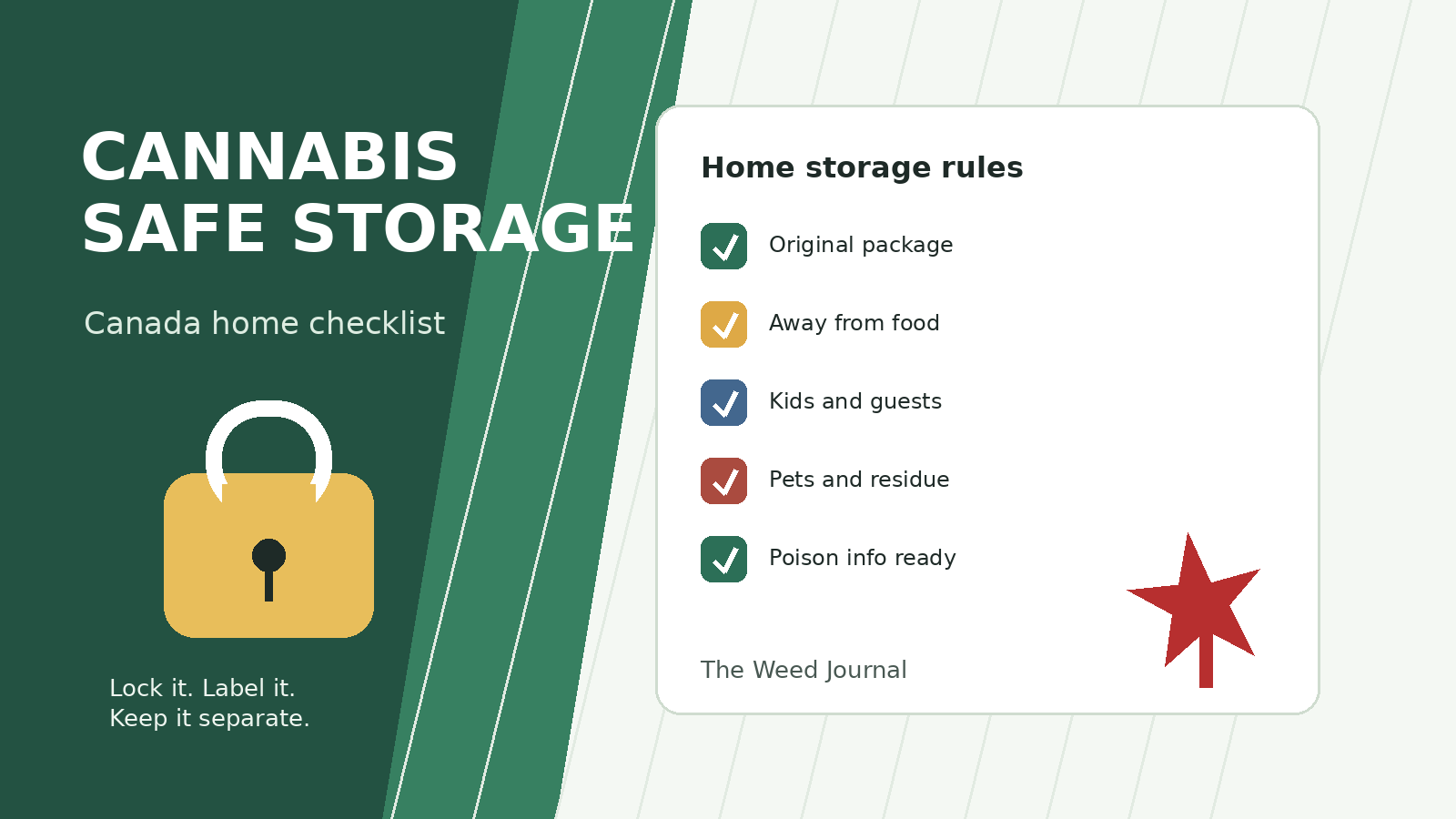
  • Cannabis at Home: Safe Storage Checklist for Canada

    Cannabis at Home: Safe Storage Checklist for Canada

    Cannabis at home needs a storage plan, not just a drawer. A legal product can still become a household risk if a child mistakes an edible for candy, a pet gets into a bag, a guest grabs the wrong container, or an adult takes more than intended because the label is missing.

    This Canada-aware checklist is for adults who keep cannabis at home and want a practical system that works in real life. It is not medical advice, and it is not a parenting lecture. The goal is simple: keep cannabis legal, labelled, locked, separated from regular food, and easy to handle if something goes wrong.

    Quick answer

    Store cannabis in its original child-resistant package whenever possible, lock it away, keep it out of sight and reach of children and pets, and separate edible cannabis from regular food and drinks. Health Canada’s public guidance gives special attention to edibles because they can be mistaken for ordinary snacks. If a child may have consumed cannabis, contact poison control. Call 911 if the child is seriously ill, unresponsive, having trouble breathing, or having a seizure.

    The safest household pattern is boring by design: one locked place, original labels, no loose gummies or baked goods, no cannabis left out during visits, and one sober adult available when children need care.

    Household risk Better storage choice Why it matters
    Edibles look like regular snacks Keep them in original packaging, locked away, and separate from food Children, guests, and adults can confuse cannabis products with ordinary food
    Pets can chew bags or containers Use a locked cabinet, box, or high secure shelf “Out of reach” for people may still be reachable for animals
    Homemade edibles have no regulated label Clearly mark the container and keep it locked away No one should guess whether food contains cannabis
    Visitors do not know your system Put all cannabis away before guests arrive Shared spaces create avoidable mix-ups
    Emergency details are hard to find Keep packaging and product names available for poison control Accurate information helps responders give better guidance
    A useful cannabis storage system is simple enough that every adult in the home can follow it.

    Why safe storage deserves its own checklist

    Many cannabis articles focus on buying, dosing, or product types. Storage can feel like an afterthought once the product is home. That is the wrong order for a shared household. Cannabis is an adult-use product, and the practical risk often begins after the package is opened.

    Health Canada tells adults to store cannabis safely, keep products away from children, youth, and pets, and be especially careful with edibles. Its safe-storage page also advises keeping cannabis locked away and out of sight and reach. Those are not decorative warnings. Edibles, drinks, capsules, oils, concentrates, flower, and homemade infused foods all need a system.

    The need is clearest with edibles. A chocolate, gummy, cookie, brownie, or drink can look ordinary, especially after it leaves the original package. Canada’s regulated edible products have rules, but home storage can undo a lot of that protection if the product is moved into an unmarked kitchen container.

    Use one locked storage place

    The strongest improvement is also the least complicated: choose one locked place for cannabis and use it every time. That might be a small lockbox, a locked cabinet, a locking medicine box, or a dedicated locked drawer. The important part is that it is not a casual drawer, purse, backpack, nightstand, coat pocket, fridge shelf, or open kitchen cupboard.

    “High up” can help, but height alone is not a storage plan. Children climb. Pets jump, chew, and nose into bags. Guests may open a pantry without thinking. A locked container creates a clearer boundary and reduces the chance that the system fails during a distracted moment.

    If you live with other adults, make the system explicit. Everyone should know where cannabis belongs, who has access, and what to do after opening a package. A storage plan that only one person understands is fragile.

    Keep cannabis in original packaging whenever possible

    Original packaging carries information that matters: product name, THC and CBD amounts, lot details, warning labels, excise stamp, packaging date or best-before details when available, and manufacturer information. If something goes wrong, that information can help poison control, a clinician, or another adult understand what was consumed.

    Original packaging is also a guardrail against ordinary mix-ups. A labelled cannabis chocolate package is easier to recognize than a loose square of chocolate in a food container. A labelled oil bottle is safer than an unmarked dropper. A labelled pre-roll tube is clearer than loose joints on a shelf.

    If you transfer cannabis into another container for freshness or smell control, keep the original label with it. For flower freshness, our cannabis storage guide covers temperature, humidity, and container choices. For old products, our edibles expiry guide explains dates, texture, and safety cues.

    Separate edibles from regular food

    Edibles deserve a stricter rule than most product forms: do not store them with regular snacks. A cannabis drink beside ordinary canned drinks, a gummy bag beside candy, or infused brownies in the fridge can create a mistake even in an adult household. The risk grows when children, overnight guests, cleaners, babysitters, relatives, or roommates are present.

    Store edible cannabis in a locked container away from normal food and drinks. If the product needs refrigeration, use a locked fridge box or a clearly marked, inaccessible container. Do not rely on a sticky note if a child can still open the container or a guest might miss the warning.

    Homemade edibles are especially easy to mishandle because they do not have regulated labels or standard servings. If you make infused food, label it plainly, store it separately, and avoid making products that look identical to household snacks. Keep the dosing uncertainty in mind too. Homemade edibles can be unevenly mixed, and the amount of THC per piece may be hard to know. Our edibles dose chart is a better starting point than guessing.

    Do a guest reset before people come over

    Safe storage is not only for parents. Guests change the room. A visiting adult may not use cannabis and may not recognize packaging. A friend may bring a child. A pet may be more curious than yours. A house guest may open the fridge late at night. A dinner party may put people around open counters and snack bowls.

    Before visitors arrive, reset the space: clear counters, put cannabis back in the locked place, remove loose rolling materials, put away vapes and batteries, and check the bathroom, bedroom, patio, and coat area. The goal is not secrecy. It is preventing accidental access in a shared environment.

    If cannabis will be used while guests are present, keep it adult-only, labelled, and separate from regular food. Do not leave infused snacks on a table. Do not serve cannabis drinks in unlabeled glasses beside non-infused drinks. Make sure every adult knows what contains cannabis before anyone consumes it.

    Plan around children and caregiving

    Health Canada’s parenting guidance is blunt about the basics: store cannabis in a locked area, keep it in child-resistant packaging, make sure children cannot see or reach the locked area, and avoid using cannabis while caring for a child. That advice matters because impairment and storage risks can overlap.

    If a child is in the home, there should be a sober, available adult responsible for care. Cannabis can affect attention, reaction time, judgment, and coordination. Even a moderate dose can make routine caregiving harder if a child wakes up sick, needs a ride, or has an emergency.

    Also think beyond your own children. Visiting nieces and nephews, neighbours, grandchildren, babysitting arrangements, and shared custody changes can all turn an adult-only space into a child-accessible space quickly. The storage system should be ready before the visit, not improvised after someone arrives.

    Pets need a storage plan too

    Health Canada’s storage guidance includes pets for good reason. Dogs and cats can get into bags, chew packaging, lick residue, or eat dropped edibles. Edibles may also include ingredients that are harmful to pets independent of cannabis, such as chocolate or xylitol in some non-cannabis foods.

    Do not store cannabis where a pet can smell and reach it. Do not leave roaches, infused food scraps, or oil droppers in open garbage. If a pet may have eaten cannabis, contact a veterinarian or an emergency veterinary clinic. Be direct about what the pet may have consumed; guessing or hiding the information can slow down care.

    What to do if accidental consumption may have happened

    If a child, pet, guest, or non-consenting adult may have consumed cannabis, treat it as a real incident, not a wait-and-see joke. Find the package, estimate the amount, note the time, and contact the appropriate help line. For children in Ontario, the Ontario Poison Centre provides 24-hour poison help. Other provinces and territories have poison-centre access routes as well.

    Health Canada’s poisoning guidance lists warning signs that can include vomiting, confusion, unresponsiveness, slurred speech, unsteadiness, drowsiness, slowed breathing, and seizures. Call 911 immediately if someone is seriously ill, having trouble breathing, unconscious, or having a seizure.

    For adults who took too much intentionally or accidentally, the same basic harm-reduction approach applies: stop taking more, avoid driving, get to a calm place, hydrate normally, and get medical help if symptoms feel severe or unusual. Our guide on what to do when you are too high covers adult self-care steps in more detail.

    A practical home cannabis checklist

    • All cannabis products have one locked storage place.
    • Edibles and drinks are stored separately from regular food and beverages.
    • Original packaging stays with the product whenever possible.
    • Homemade edibles are clearly labelled and locked away.
    • Opened products are returned to storage immediately after use.
    • Guests, children, and pets cannot access cannabis products or residue.
    • One sober adult is available when children need care.
    • Poison control and emergency information is easy to find.
    • Old, mouldy, or unlabelled products are not kept “just in case.”
    • Everyone in the household knows the storage rule.

    That checklist may sound strict, but it is easier than cleaning up a preventable mistake. Cannabis storage works best when it is automatic: use it, close it, lock it, put it back.

    FAQ

    Should cannabis be stored in the fridge?

    Only if the product label or product type calls for it. Many products do not need refrigeration, and the fridge can create accidental-access risk if edibles are stored beside regular food. If refrigeration is needed, use a locked and clearly labelled container.

    Is child-resistant packaging enough?

    No. Child-resistant does not mean child-proof. Keep cannabis locked away, out of sight, and out of reach even when the product is still in its original package.

    What is the safest way to store homemade edibles?

    Use a clearly labelled, locked container that is separate from regular food. Do not store infused food in ordinary snack containers, and do not leave it on counters, tables, or shared fridge shelves.

    What should I do if a child eats cannabis?

    Contact poison control right away and call 911 if the child is seriously ill, unresponsive, having trouble breathing, or having a seizure. Keep the product package available so responders know what may have been consumed.

    Do I need to hide cannabis from adult guests?

    You do not need to hide legal adult-use cannabis, but you should prevent accidental access. Put products away before guests arrive, label anything that contains cannabis, and never mix infused and non-infused food without clear separation.

    Sources

  • Growing Cannabis at Home in Canada: Legal Checklist

    Growing Cannabis at Home in Canada: Legal Checklist

    Growing cannabis at home in Canada sounds simple until you get into the details: four plants is the familiar federal number, but the real checklist also includes legal seeds, household limits, provincial rules, rental or condo restrictions, safe storage, odour, mould prevention, and keeping plants away from minors and pets.

    This guide is for adults who want the legal and practical baseline before they germinate anything. It is not legal advice, and it is not a cultivation manual. Laws can change, and local housing rules may be stricter than the public cannabis rules. Treat this as a Canada-aware starting point, then confirm the rules where you live.

    Start with the short answer

    Under federal cannabis law, adults may generally grow up to four cannabis plants per residence for personal use, using legally obtained seeds or plants. That limit is per household, not per adult. You cannot sell home-grown cannabis unless you are properly licensed. You also need to follow provincial and territorial rules, which can change the practical answer.

    Two important examples make the point. Ontario allows adults 19 and older to grow up to four cannabis plants per residence for personal use. Quebec prohibits cultivating cannabis for personal use and also prohibits possessing a cannabis plant for personal use. Manitoba changed its rules in 2025 and now allows eligible adults to grow up to four plants at home under provincial conditions.

    Question Practical answer Why it matters
    How many plants? Usually up to four per residence, not per person. Four adults in one home do not mean sixteen plants.
    Where do seeds come from? Use legal seeds or plants from an authorized source. Illegal-source seeds can create legal and pesticide-risk problems.
    Can I sell what I grow? No, not without a licence. Sharing and selling are treated differently.
    Do province rules matter? Yes. Quebec prohibits personal cultivation; Manitoba has specific home-grow conditions. Federal permission is not the whole legal picture.
    What about rentals or condos? Check leases, condo bylaws, insurance, and local property rules. Housing rules can restrict growing even where cannabis law allows it.
    Home growing is a legal checklist first. Confirm the current rule for your province or territory before planting.

    Federal baseline: four plants per residence

    Justice Canada’s public cannabis overview says adults can possess up to 30 grams of legal dried cannabis, share up to 30 grams with other adults, buy from provincially licensed retailers, and grow up to four cannabis plants per residence from licensed seed or seedlings. Health Canada’s home-growing page gives the same central limit and stresses that the plant count is per household, not per person.

    That “per residence” language is the detail many new growers miss. A couple, a group of roommates, or a family with multiple adults still needs to count plants by the home, not by headcount. If your household already has plants, seedlings, or immature plants, count them before adding more.

    The federal baseline also does not make every seed source acceptable. Health Canada tells adults to buy seeds or immature plants from legal sources, such as an authorized retailer in their province or territory. That is a legal issue and a product-safety issue. Seeds and plants from unregulated sources may carry pest, disease, or pesticide risks that a beginner will not easily spot.

    Province and territory rules can change the answer

    Canada legalized adult-use cannabis nationally, but provinces and territories control important details such as legal age, retail systems, where cannabis can be used, and some home-cultivation rules. Health Canada maintains a province-and-territory page for authorized cannabis retailers and basic local rules. Use that as a gateway, then click through to your province or territory’s own page.

    Ontario is a straightforward example for many readers: the province says adults 19 and older may grow up to four cannabis plants per residence for personal use. That does not override lease terms, condo bylaws, safety rules, or municipal nuisance issues, but it gives Ontario adults a clear public-law starting point.

    Quebec is different. The Government of Quebec says it is prohibited to cultivate cannabis for personal use, and it is also prohibited to possess a cannabis plant for personal use. The Supreme Court of Canada has also upheld Quebec’s provincial ban. If you live in Quebec, do not rely on the federal four-plant shortcut.

    Manitoba also needs fresh attention because the rule changed recently. Manitoba’s Liquor, Gaming and Cannabis Authority says that as of May 1, 2025, people 19 and older may grow cannabis at home, with a maximum of four plants per household and added conditions, including indoor growing and keeping the grow area inaccessible to people under 19.

    Use legal seeds or plants

    If home growing is allowed where you live, the next question is source. Legal seeds and seedlings are not just a technicality. They are how you keep the grow connected to the regulated system and avoid obvious problems before they start.

    For a beginner, the simplest rule is this: if you cannot verify that the seed or plant came from an authorized source, pause. The same buying discipline that applies to dried flower also applies to seeds. The Weed Journal’s cannabis seeds in Canada checklist walks through the label and source questions in more detail, and the broader legal online buying checklist is useful when you are checking whether an online source is real.

    Be especially cautious with social marketplace listings, anonymous forum sellers, and websites that promise unusual genetics without a clear legal retail pathway. A low price is not very helpful if the source creates legal uncertainty or introduces pests into your home.

    Think about your home before you think about the plant

    A home grow affects more than the person tending the plant. It can affect electricity use, humidity, odour, shared spaces, insurance, and neighbours. That is why a good pre-grow checklist starts with the room, not with the strain name.

    • Access: Can you keep the area away from minors, guests, pets, and anyone who should not handle the plant?
    • Moisture: Can the room handle humidity without creating mould risk?
    • Airflow: Can you manage odour and ventilation without pushing smells into shared hallways or neighbouring units?
    • Electrical load: Are lights, fans, timers, and extension cords used safely?
    • Housing rules: Does your lease, condo board, property manager, or insurer restrict cultivation?
    • Disposal: Do you have a plan for plant waste, soil, water runoff, and cleanup?

    That list may feel less exciting than choosing a cultivar, but it protects the project. A healthy grow in the wrong room can still become a problem if humidity damages walls, odour bothers neighbours, or a landlord has a clearly written restriction.

    Storage and harvested cannabis still matter

    Once cannabis is harvested, the same safety ideas apply as with store-bought products: keep it secure, dry enough to avoid mould, labelled clearly enough that adults in the household know what it is, and away from children and pets. Home-grown cannabis does not arrive in regulated packaging with a THC amount printed on the label, so be careful about assumptions.

    If you dry, cure, or store cannabis poorly, you can waste the crop or create a health concern. The practical cues in our mouldy cannabis flower guide and storage guide apply here too. If cannabis looks or smells mouldy, do not try to rescue it for consumption.

    Home-grown cannabis can also vary a lot in strength. Unlike a regulated product with tested THC and CBD values, a home harvest may be stronger or weaker than expected. Start cautiously, especially with homemade edibles. If you are making infused food, avoid guessing and review the safer-use principles in our edibles dose chart for Canada.

    Sharing is not selling

    Federal public guidance allows adults to share up to 30 grams of cannabis with other adults of legal age. That does not mean a home grow can become an informal side business. Selling cannabis requires licensing, and unlicensed sales can create serious legal risk.

    There is also a practical safety point. If you share home-grown cannabis, the other person may not know the strength, grow conditions, drying process, or storage history. Keep the conversation honest. Do not present home-grown cannabis as tested, standardized, or medically useful unless it truly has gone through an appropriate regulated process. For most personal growers, it has not.

    Common mistakes to avoid

    The biggest beginner mistakes are rarely advanced horticulture problems. They are usually legal and household-management mistakes made before the plant is mature.

    1. Counting plants per adult instead of per residence. The common limit is household-based.
    2. Ignoring Quebec or local restrictions. Province and territory rules matter.
    3. Buying seeds from unclear sources. Legal source matters before germination.
    4. Growing in a damp room. Moisture can create mould risk and property damage.
    5. Forgetting housing rules. A lease or condo rule can still create consequences.
    6. Leaving plants or harvested cannabis accessible. Store and grow securely.
    7. Assuming potency. Home-grown cannabis is not automatically tested or predictable.

    A cautious pre-grow checklist

    Before you plant, run through this short checklist:

    • I checked the current rules for my province or territory.
    • I confirmed the plant limit for my household, not just for myself.
    • I confirmed my seed or plant source is legal.
    • I checked lease, condo, property, and insurance rules that may apply.
    • I can keep the plants inaccessible to minors and pets.
    • I have a realistic plan for humidity, odour, airflow, and electrical safety.
    • I have secure storage for harvested cannabis.
    • I understand that home-grown cannabis is not automatically tested for potency.

    If any item is uncertain, slow down and verify it first. The most responsible grow is the one that stays legal, contained, and boring enough that it does not create problems for the household.

    FAQ

    Can every Canadian adult grow four cannabis plants?

    No. The federal baseline is commonly four plants per residence, but province and territory rules still matter. Quebec prohibits personal cultivation. Manitoba changed its rules in 2025 and now allows eligible adults to grow under specific conditions.

    Is the four-plant limit per person or per household?

    Per household or residence. Health Canada specifically frames the limit as a maximum of four plants per household, not per person.

    Can I grow cannabis from seeds a friend gave me?

    Be careful. Health Canada advises adults to buy seeds or immature plants from legal sources, such as authorized retailers. If you cannot verify the source, do not assume it is legal.

    Can I sell cannabis I grow at home?

    No. Federal guidance distinguishes sharing with adults of legal age from selling. Selling cannabis requires the proper licence.

    Do landlords or condo boards matter if cannabis growing is legal in my province?

    Yes. Public cannabis law is not the only rule. Private housing agreements, condo bylaws, insurance requirements, and property policies can still restrict growing.

    Sources

  • Cannabis Pre-Rolls in Canada: Buying Checklist

    Cannabis Pre-Rolls in Canada: Buying Checklist

    Pre-rolls are easy to buy and easy to misunderstand. A small tube can hide a lot of useful information: how much cannabis is inside, how many joints are in the pack, the Total THC after activation, the package date, whether the seal is intact, and whether the product came from a legal Canadian source.

    This guide is for Canadian adults comparing legal cannabis pre-rolls. It is not medical advice, legal advice, or a recommendation to smoke. Inhaling cannabis carries respiratory and impairment risks. If you choose to use pre-rolls, the more useful question is not which strain sounds strongest. It is whether the product is legal, fresh enough, clearly labelled, and practical for the situation you are in.

    Quick answer

    To buy cannabis pre-rolls in Canada, start with a legal retailer, then check the package date, lot number, net weight, joint count, Total THC, Total CBD, warning information, excise stamp, and seal. Avoid products with damaged packaging, unclear THC math, old or badly stored stock, or marketing that makes health promises. If you are new, returning after a break, or sensitive to THC, choose a lower-THC product, use less than a whole pre-roll, and do not drive or handle safety-sensitive tasks afterward.

    Pre-rolls are convenient, but they are still inhaled cannabis. Health Canada notes that cannabis can impair attention, coordination, and reaction time, and Canada’s lower-risk cannabis use guidance recommends avoiding smoking when possible. A legal pre-roll can be a poor choice if the timing, dose, setting, or storage plan is careless.

    Pre-roll buying checklist

    Check Why it matters Better choice
    Legal source Legal retailers provide regulated packaging, labels, and accountability. Start from your province or territory’s authorized retailer path.
    Package date Pre-rolls can dry out, stale, or burn poorly if stored too long or badly. Prefer fresher stock with intact packaging and clear lot details.
    Total THC THC strength affects impairment risk and comfort, especially for newer users. Choose modest THC instead of chasing the highest number.
    Pack count and weight A 1 g single and a multi-pack of 0.35 g joints are not the same session. Calculate how much cannabis is in each pre-roll before lighting.
    Seal and condition Damaged tubes or loose seals can mean dryness or handling issues. Skip crushed, opened, relabelled, or unclear packages.
    The best pre-roll choice is usually the one that is legal, clearly labelled, fresh enough, and easy to pace.

    Start with legal source, not strain hype

    Health Canada’s legal-cannabis guidance tells consumers to reduce risk by choosing legal cannabis. Legal products are subject to rules for quality, packaging, labelling, promotion, and age-restricted sale. That does not make every legal product right for every person, but it gives you a clearer chain of accountability than an unregulated menu, social account, or anonymous delivery site.

    Pre-rolls are especially easy for illegal sellers to imitate because the format looks simple. A tube, a sticker, and a familiar strain name can feel official even when the source is not. The real check is whether the seller is authorized in your province or territory and whether the product has regulated packaging details.

    If you are unsure where to start, use our legal online buying checklist, the broader Canadian cannabis buying checklist, or the Buying Cannabis in Canada hub before comparing menus.

    Read the label before the strain name

    A pre-roll label should help you answer practical questions. How much cannabis is in the package? How many pre-rolls are inside? How much is in each one? What are the THC and CBD values? Who produced it? What is the lot number? When was it packaged? Does the excise stamp and retailer context make sense for where it is being sold?

    Health Canada’s label guidance explains that cannabis labels carry information meant to help consumers understand and reduce risk. For pre-rolls, the key number is usually Total THC, because dried flower contains cannabinoids that become active when heated. A label may show THC and Total THC separately. Do not treat every percentage or milligram figure as interchangeable.

    For a full label walkthrough, use our guide to reading cannabis labels in Canada. If package symbols are the confusing part, pair it with our Canadian cannabis packaging symbols guide.

    Freshness matters more than people think

    Pre-rolls have more exposed surface area than intact flower buds. That can make dryness more noticeable. A dry pre-roll may burn hot, canoe down one side, taste harsh, or crumble at the end. It may also encourage a person to inhale harder or smoke more quickly, which is not a lower-risk habit.

    Check the package date, but do not use it alone. Ask how the product was stored, look for intact seals, and avoid tubes that appear crushed, opened, dusty, or relabelled. If a legal retailer has multiple options, a fresher package with a modest THC level can be a better beginner choice than an older high-THC product with louder branding.

    For flower-specific freshness signs, read our guide to fresh cannabis flower in Canada. For storage after purchase, use the temperature and humidity storage guide.

    Do the pack-count math

    Pre-roll packages are not all built the same way. One package might contain a single 1 g joint. Another might contain three 0.5 g pre-rolls. Another might contain a ten-pack of smaller joints. The total package weight and the number of pre-rolls both matter because they shape the likely session size.

    If you are new or returning after a break, a whole pre-roll may be more than you intended. You can put it out and save the rest, but that requires planning: a non-flammable surface, a smell-aware storage container, and enough self-control not to keep going just because it is already lit. Do not let the package format decide your dose for you.

    This is also where THC percentage can mislead. A smaller joint with a higher THC percentage may still involve a different total amount than a larger lower-THC joint. The practical question is: how much cannabis am I about to inhale, and how strong is it likely to be for my tolerance?

    Smoking risk and safer-use choices

    Pre-rolls are convenient because they require no grinder, paper, or rolling skill. The tradeoff is that they are smoked cannabis. Health Canada’s lower-risk guidance recommends avoiding smoking cannabis when possible and avoiding deep inhalation or breath-holding. Those habits can increase exposure to smoke and are not needed to feel effects.

    If you choose to smoke a pre-roll, keep the session slow. Take small puffs, wait between them, and stop before you feel pressured to finish the whole thing. Avoid mixing with alcohol or other substances. Use in a calm setting where you do not need to drive, work, cook over heat, care for others alone, or make important decisions while impaired.

    For a method comparison, read vaping vs smoking cannabis in Canada. For product-format tradeoffs beyond pre-rolls, start with Cannabis 101 product types.

    When a pre-roll is the wrong format

    A pre-roll may be the wrong choice if you are trying cannabis for the first time, have a low tolerance, are anxious about THC, dislike smoke, have respiratory concerns, are pregnant or breastfeeding, are taking medication that may interact with cannabis, or need precise dose control. It may also be wrong if you cannot store the leftover product securely or if you will be around children, pets, or anyone who should not be exposed to cannabis smoke.

    Pre-rolls can also create social pressure. People often pass them around, keep pace with a group, or feel awkward putting one out. If you already know you are likely to overdo it in that setting, choose a different format, a lower-THC option, or skip cannabis entirely. Not using is always a valid lower-risk choice.

    After purchase: storage and leftovers

    Keep pre-rolls in their original package until use so the label, lot, producer, package date, and warning information stay with the product. Store them cool, dry, dark, sealed, and locked away from children and pets. Do not leave a tube in a hot car, jacket pocket, damp bathroom, or unmarked container.

    If you put out a partially smoked pre-roll, treat it as stronger-smelling, messier, and easier to mishandle than an unopened one. Let it cool fully, store it separately from fresh products, and do not leave ash or residue where children, pets, or non-consenting adults can access it. If that sounds like too much effort, that is a useful signal to choose a smaller pre-roll or not start one.

    Bottom line

    A good pre-roll purchase is not about finding the biggest THC number or the most famous strain name. It is about buying from a legal source, understanding the label, checking freshness, doing the pack-count math, and planning a lower-risk session before the tube is opened.

    For most Canadian adults, the best pre-roll is the one that is easy to verify, easy to pace, and easy to store responsibly afterward. If the source is unclear, the package is damaged, the THC level is more than you want, or the setting is wrong, skip it.

    FAQ

    Are pre-rolls stronger than loose cannabis flower?

    Not automatically. Strength depends on the cannabis used, Total THC, the amount in each pre-roll, and how much you consume. Read the label instead of assuming the format is stronger or weaker.

    Can I save half a pre-roll for later?

    Yes, but plan for it. Put it out safely, let it cool, and store it securely away from children, pets, heat, moisture, and regular food. Keeping the original labelled package nearby helps preserve product details.

    Sources

  • Cannabis Seeds in Canada: Buying and Label Checklist

    Cannabis Seeds in Canada: Buying and Label Checklist

    Cannabis seeds can look simple: a small packet, a strain name, maybe a promise about yield or flavour. In Canada, they are still regulated cannabis products. That means the safest buying decision starts with legal source, package details, provincial rules, and realistic expectations, not the loudest seed-bank copy.

    This guide is for Canadian adults who are considering seeds for personal home growing where it is allowed. It is not a cultivation manual, legal advice, or a promise that a seed will produce a specific result. It is a buyer’s checklist: where to buy, what to read on the package, what the limits mean, and when to pause before germinating anything.

    Quick answer

    Buy cannabis seeds only from a legal source, such as an authorized retailer in your province or territory. Health Canada says adults may grow up to four cannabis plants per household under federal rules, not four per person, but provinces and territories can add stricter rules. Ontario allows up to four plants per residence for personal use by adults 19 and older. Quebec prohibits personal cultivation and possession of cannabis plants for personal use. Check your local rule before buying seeds, because a seed packet is not useful if you cannot legally grow it where you live.

    For public possession, one cannabis plant seed counts as one gram of dried cannabis equivalent under the federal possession-limit framework. That matters if you are carrying seeds in public alongside flower, edibles, extracts, or other cannabis products.

    Seed buying checklist

    Check Why it matters Pause if you see
    Legal seller Seeds should come through an authorized provincial or territorial channel. Anonymous menus, imported “stealth” shipping, or sellers avoiding legal-source questions.
    Province rules Home grow rules are not identical across Canada. You live somewhere cultivation is restricted or your lease/building rules prohibit it.
    Package label Legal cannabis packaging should give traceable product information. No lot details, no producer information, relabelled bags, or opened packaging.
    Seed count Seeds count toward public possession equivalency. You are carrying seeds plus other cannabis near the 30 g dried-equivalent limit.
    Claims Strain names and breeder descriptions are not guarantees. Medical promises, unrealistic yield claims, or “100%” certainty language.
    Use the checklist before germination. The legal source and local rule are the first two gates.

    What counts as a legal source?

    Health Canada’s home-growing guidance tells consumers to buy seeds or immature plants from legal sources, such as an authorized retailer in the province or territory. It also says it is illegal to use seeds or grow plants that you know came from illegal sources. That is the clean dividing line for buyers: if the seller cannot plausibly fit inside the legal retail system, do not treat the seeds as a shortcut.

    In Ontario, the provincial government says the Ontario Cannabis Store website is the only legal online source for recreational cannabis, while licensed private stores operate in person. Other provinces and territories use different retail models, so the practical move is to start from Health Canada’s authorized retailer list or your provincial cannabis authority rather than a search ad.

    If you need a broader legal-shopping refresher, start with our Canadian cannabis buying checklist or the legal online buying checklist.

    Four plants means household, not person

    The federal home-grow baseline is up to four cannabis plants per household for personal use, not four plants for each adult in the home. That distinction matters in shared houses, apartments, and multi-adult families. A household with three adults does not become a twelve-plant household under the federal baseline.

    Ontario phrases its rule similarly: adults 19 and older may grow up to four plants per residence for personal use, from legal seeds or seedlings. The province also says the plants must not be accessible to anyone under 19. That turns a seed purchase into a household-safety decision, not only a gardening decision.

    Do not assume a federal rule overrides every local restriction. Provinces, territories, municipalities, landlords, condo boards, and federally regulated housing can create additional constraints. Quebec is the clearest example at the provincial level: the Quebec government states that personal cannabis cultivation is prohibited and that possessing a cannabis plant for personal use is also prohibited.

    Seeds and the 30 gram public possession limit

    Canadian adults often remember the public possession limit as 30 grams of dried cannabis or equivalent. Seeds are part of that equivalent system. Health Canada’s possession-limit calculator uses one cannabis plant seed as equivalent to one gram of dried cannabis.

    That does not mean one seed has the same effect as one gram of dried flower. It means the law needs a conversion table for different cannabis forms. If you are carrying seeds in public, include them in your dried-equivalent math alongside dried flower, fresh cannabis, edibles, extracts, topicals, or plants.

    For a deeper walkthrough, read our Canadian cannabis possession limits guide.

    What to read on a seed package

    Seed packaging is not the same as dried flower packaging, but it should still feel traceable and regulated. Look for the product name, producer or brand details, lot or batch information, seed count, package date where available, provincial stamp or retail context where applicable, and any required warning or regulatory elements.

    Health Canada’s consumer label guidance explains why label literacy matters for legal cannabis products: labels carry health and safety information that helps consumers reduce harm. With seeds, the most important label habit is traceability. If the packet becomes part of a concern, you want the product name, lot, seller, and purchase date preserved.

    Do not throw the packaging away as soon as you open it. Keep it at least until you know there is no product concern and until you no longer need the lot details. Our cannabis label guide explains the larger label system, and our packaging symbols guide covers common Canadian packaging markers.

    Feminized, regular, and autoflower: buyer language, not guarantees

    Seed listings often use terms such as feminized, regular, and autoflower. Those terms can help you understand what a product is intended to be, but they should not be read as a guarantee of outcome. Plants are living things, and results depend on genetics, environment, storage, handling, and grower decisions.

    Be cautious with seed descriptions that promise exact effects, medical outcomes, extreme yields, or certainty that no reputable seller can control. A calm listing should tell you what the product is, who produced it, how many seeds are included, and any practical growing context allowed by law. It should not sound like a miracle-cure page or a gambling ad.

    The same principle applies to strain names. A strain name can be useful shorthand, but it does not replace reading the product details. For more on why names and THC numbers can mislead shoppers, see our guide to comparing classic cannabis strains and our explainer on why THC percentage is not everything.

    Storage before germination

    Seeds are easier to ruin than many buyers expect. Heat, moisture, light, rough handling, and casual relabelling can create problems before a seed ever reaches soil. Keep seeds in their original package until you are ready to use them, and store them in a cool, dark, dry, secure place away from children, pets, and anyone who is not allowed to access cannabis.

    Do not store seeds in a hot car, damp basement, bathroom cabinet, sunny windowsill, or unmarked container. If you move them to another container, keep the original package and label with it. Losing the label makes it harder to confirm the strain, source, seed count, and lot details later.

    For household storage habits that also apply to flower and other products, use our cannabis storage guide.

    When not to buy cannabis seeds

    Do not buy seeds if home growing is not allowed where you live, if your housing rules prohibit it, if you cannot keep plants away from minors, if you are already near the public possession limit, or if the seller is outside the legal channel. Also pause if the only reason you are buying is hype: a limited drop, a dramatic strain name, or a claim that sounds too certain.

    Seeds are not a beginner purchase just because they are small. They can become plants, plants create storage and safety obligations, and rules differ across the country. The right decision may be buying a legal finished product instead, or waiting until you have confirmed the household and provincial rules.

    FAQ

    Can I order cannabis seeds from outside Canada?

    For a Canadian adult-use buyer, the cleaner answer is to use authorized Canadian legal channels. Imported or grey-market seed orders can create legal-source, customs, quality, and traceability problems. If a seller is promising stealth shipping or avoiding questions about legality, that is a reason to walk away.

    Can I give cannabis seeds to another adult?

    Federal guidance allows sharing limited amounts of personally grown cannabis with adults of legal age, but selling cannabis requires a Health Canada licence. Because seeds count in the dried-equivalent framework and provincial age rules differ, treat gifting seeds with the same caution as any other cannabis transfer: legal-age adult only, within limits, and never as a sale.

    Should I germinate every seed in a pack?

    Not automatically. The plant limit applies to plants at the household or residence level, and some provinces or housing situations may be stricter. Count what you can legally and safely manage before germination, not after seedlings already exist.

    Sources

  • How to Spot Mouldy Cannabis Flower in Canada

    How to Spot Mouldy Cannabis Flower in Canada

    Mouldy cannabis flower is not something to “test and see.” If flower smells musty, looks fuzzy, feels suspiciously damp, or arrived in damaged packaging, the safest move is to stop, keep the package, and contact the legal retailer or producer instead of consuming it.

    This guide is for Canadian adults who buy dried cannabis flower and want a practical way to tell normal cannabis features from warning signs. It is not medical advice, and it cannot diagnose contamination from a photo or description. The goal is simpler: know when to pause, what evidence to keep, and how to reduce the chance of turning a storage or buying mistake into a safety problem.

    Quick answer

    Do not use cannabis flower that may be mouldy. Warning signs include a basement-like or ammonia smell, fuzzy grey or white patches, damp clumps, visible webbing, strange powder that does not look like trichomes, damaged packaging, or flower that feels wet after opening. Keep the original package, note the lot number and package date, take clear photos if useful, and contact the retailer or producer through an official channel.

    Legal cannabis is still the better starting point because regulated products must meet federal packaging, labelling, and production requirements. But even legal products can be stored poorly after purchase, opened carelessly, or become questionable over time. Freshness checks still matter at home.

    Mould check table

    What you notice Could be normal Stop sign
    White sparkle Trichomes that look crystalline and attached to the flower Fuzzy, dusty, web-like, or patchy growth
    Smell Earthy, citrus, pine, floral, fuel, spice, or skunky aroma Musty basement, mildew, ammonia, wet hay, or rot
    Texture Slight give, not wet, grinds evenly Damp clumps, sticky-wet interior, or powdery breakdown
    Package Sealed, labelled, lot number visible Broken seal, missing label details, wet package, relabelled bag
    Storage history Cool, dark, sealed, original packaging Hot car, sunny window, bathroom, loose jar, shared bag
    If a sign falls in the stop column, treat it as a product concern. Do not try to rescue the flower by drying, baking, freezing, or trimming.

    Mould or trichomes: how to tell the difference

    Trichomes are the tiny resin glands that can make cannabis flower look frosty or sparkling. They usually appear as fine crystals on the surface and are part of normal flower structure. Mould is different. It may look fuzzy, cottony, dusty, web-like, grey-white, blue-green, or patchy, and it may appear in creases inside the bud where moisture can linger.

    Appearance alone can be tricky because dense trichomes and broken plant material can fool the eye. Smell and texture are useful backup checks. A clean cannabis aroma can be strong, but it should not smell like damp basement, mildew, ammonia, rot, or wet hay. Flower should not feel wet or clumped in a way that suggests trapped moisture.

    If you cannot tell, do not consume it. The cost of replacing questionable flower is lower than the risk of inhaling or otherwise using a contaminated product.

    Why legal-source checks matter

    Health Canada advises adults to choose legal cannabis because legal products are subject to rules for quality, packaging, labelling, promotion, and sale. Federal guidance also points consumers toward plain, child-resistant packaging, health warnings, the standardized cannabis symbol when required, excise stamps, and clear THC and CBD information.

    That does not mean every legal flower purchase will be fresh or ideal. It means there should be a traceable package with a lot number, producer details, and a regulated retailer path. Those details matter if you need to report a concern. An unlabelled bag from an anonymous delivery menu gives you much less accountability.

    If the legal-source question is still unclear, use our legal online cannabis buying checklist or broader Canadian cannabis buying checklist before placing another order.

    Check the package before opening

    Before you break the seal, look at the package. It should be intact, clearly labelled, and appropriate for cannabis. Check the product name, net weight, lot number, package date, THC and CBD information, warning elements, and producer or licence holder details. If anything looks tampered with, wet, relabelled, or inconsistent, pause before opening.

    Package date is context, not a guarantee. Older flower can be dry and less aromatic, but age alone does not prove mould. Newer flower can still be a problem if it was mishandled. Read package date alongside storage history, seal condition, texture, aroma, and visual inspection.

    For the full label walkthrough, see our Canadian cannabis label guide and packaging symbols explainer.

    Check the flower after opening

    Open the package somewhere with good light. Do not inspect flower over food, near children or pets, or while rushing. Pouring everything into a decorative jar before checking the product can make it harder to keep evidence organized if something is wrong.

    Use a simple three-part check:

    1. Look: scan the outside and, if needed, gently break apart one bud to inspect the centre.
    2. Smell: notice whether the aroma is cannabis-like or damp, stale, ammonia-like, or rotten.
    3. Feel: check whether the flower is slightly springy, dusty-dry, or suspiciously wet.

    Do not use a product that gives you a strong warning sign in any of those steps. Do not rely on a grinder, vaporizer, or flame to make questionable flower safe.

    What to do if you suspect mould

    First, stop handling the product more than necessary. Put it back in the original package or a clean container, wash your hands, and keep it away from children, pets, food, and shared surfaces. Do not mix it with other cannabis, and do not throw away the label before documenting it.

    Next, record the product name, lot number, package date, retailer, purchase date, and what you noticed. Clear photos can help if you contact the retailer or producer. Use the official customer service route rather than social direct messages or informal reseller channels.

    If you bought from a legal retailer, ask about the product concern process. If you suspect an illegal seller, avoid further orders and use the relevant provincial or local reporting pathway. If someone feels unwell after using cannabis, contact a health professional, poison centre, or emergency service as appropriate.

    Storage mistakes that can create problems

    Most home storage problems are ordinary: too much heat, too much light, too much air, too much moisture, or too many container swaps. Flower left in a hot car, bathroom, sunny window, loose bag, or frequently opened jar can lose quality quickly. Adding fruit peels, wet paper, or improvised humidity tricks can also introduce moisture or contamination.

    Health Canada recommends keeping cannabis products securely stored and away from children and pets. For flower quality, the practical version is: keep it sealed, labelled, cool, dark, and dry enough to avoid moisture problems. If you use humidity packs, use products intended for cannabis storage and do not try homemade moisture fixes.

    Our cannabis storage guide explains temperature, humidity, original packaging, and household safety in more detail.

    When dryness is a quality issue, not a mould issue

    Dry flower can be disappointing without being mouldy. It may crumble too easily, smell muted, vape harshly, or burn quickly. That is a quality and freshness issue, and it can still be worth reporting to the retailer, especially if the product was sold as premium or recently packaged.

    Do not confuse “too dry” with “safe enough no matter what.” If dry flower also smells musty, looks dusty in an unusual way, or has visible patches, treat it as suspicious. If it simply seems old or harsh, use that experience to buy smaller formats, check package dates more carefully, and store future purchases better.

    For more buying context, read our fresh cannabis flower checklist and flower buying checklist.

    Do not try to salvage questionable flower

    Common salvage ideas are not reliable safety plans. Trimming off a visible patch may miss contamination inside the bud. Drying flower out does not prove it is safe. Freezing can change texture and moisture behaviour without solving the underlying concern. Baking or smoking is not a contamination test.

    The better rule is strict: if mould is plausible, stop. Keep evidence, contact the legal retailer or producer, and replace the product through a safer channel. That may feel wasteful, but using a questionable product to avoid wasting money is a bad trade.

    Bottom line

    Mouldy cannabis flower is a stop sign. Buy from legal sources, keep the package, inspect flower in good light, trust musty smells and fuzzy patches as warnings, and store cannabis in a cool, dark, secure place after opening. When in doubt, do not consume it.

    FAQ

    Can mouldy cannabis be cleaned or dried out?

    No. Do not try to clean, dry, trim, freeze, bake, smoke, or vaporize flower that may be mouldy. Treat it as a product concern and keep the package details for the retailer or producer.

    Does legal cannabis ever have mould?

    Legal cannabis is regulated and more accountable than unregulated products, but consumers should still inspect packages and store flower properly after purchase. If a legal product seems contaminated, use the official concern process.

    Is white sparkle on cannabis always mould?

    No. White sparkle can be normal trichomes. The warning signs are fuzzy, web-like, dusty, patchy growth, musty odour, damp clumps, or anything that makes the product look contaminated.

    Sources