A cannabis vape cartridge can look simple: small tank, threaded battery, a flavour name, and a THC number. That simplicity is exactly why it deserves a checklist. A cartridge is an inhaled cannabis extract, and small differences in source, label clarity, hardware, storage, and strength can change the risk profile quickly.
This guide is for adults in Canada who already choose to use cannabis and want a practical way to screen vape cartridges before buying or using them. It is not medical advice, and it does not claim vaping is safe. The goal is narrower: help you spot labels, hardware clues, and red flags that deserve a pause.
If you are still deciding whether inhalation is right for you, start with our comparison of vaping vs smoking cannabis in Canada. This article focuses specifically on pre-filled cartridges and similar extract vapes.
If you are choosing between cartridge extracts and flower-based vaporizing, The Weed Journal now has a separate dry herb vape vs cartridge comparison for Canada that explains how source material, strength, and device style change the tradeoffs.
Quick answer
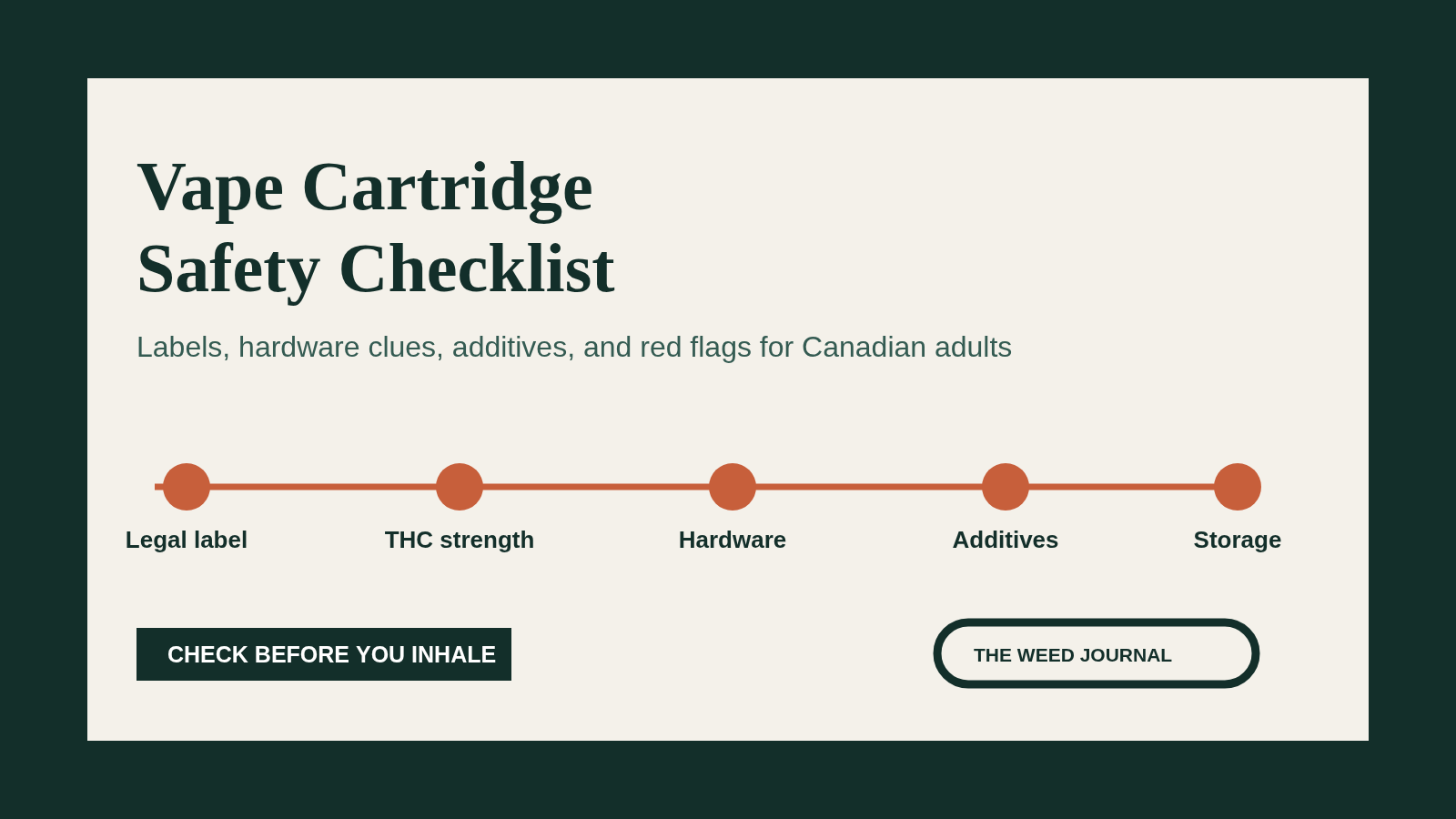
A safer vape cartridge choice starts with five checks: buy from a legal source, read the cannabis label, understand the THC strength, inspect the hardware, and avoid products with unclear ingredients or unregulated-market claims. Legal does not mean risk-free, but legal Canadian products have required labelling and composition rules that unregulated products do not reliably follow.
Health Canada has warned that vaping products from illegal or unregulated sources can increase potential risk, and the Public Health Agency of Canada describes vaping-associated lung illness as an acute respiratory illness linked to use of certain vaping products. For cannabis vapes, treat any missing label, unusually cheap cartridge, mystery liquid, or social-media-only seller as a reason to walk away.
Vape cartridge checklist at a glance
| Check | What to look for | Why it matters |
|---|---|---|
| Legal source | Licensed retailer, provincial store, or clearly legal private retailer where allowed. | Unregulated products may not follow Canadian cannabis rules or testing controls. |
| Label basics | THC, CBD, product class, lot number, packaged date, warning labels, and net weight or volume. | The label is your starting point for strength, traceability, and freshness. |
| Ingredients | Cannabis extract, carrier or permitted formulation details, and any flavouring information shown. | Vape liquids should not be a mystery blend. |
| Hardware | No leaks, cracks, burnt smell, loose centre pin, damaged mouthpiece, or discoloured liquid. | Faulty hardware can overheat, leak, clog, or make dosing unpredictable. |
| Use pattern | Small puffs, wait between pulls, avoid mixing with alcohol, and do not drive. | High-THC inhaled products can feel manageable until they suddenly do not. |
1. Confirm the source before the strain name
The first question is not whether the cartridge is indica, sativa, live resin, distillate, full-spectrum, or terpene-rich. The first question is whether it came through a legal Canadian cannabis channel. In Canada, legal access depends on province or territory, but the practical point is simple: a cartridge should be traceable to a licensed producer and a legal retailer.
If those extract terms are the comparison in front of you, use our live resin vs distillate label checklist alongside this cartridge safety pass.
A legal product should have standardized cannabis packaging and required label details. It should not be sold loose in a blank box, through a private message, from a menu that avoids licensing details, or with claims that sound more like a shortcut than a retailer. If you are unsure how to check a seller, our legal retailer checklist for buying cannabis in Canada covers the broader buying questions.
Unregulated cartridges are especially risky because the user cannot easily see what is in the liquid or how the hardware was manufactured, filled, transported, or stored. A familiar brand name on a package is not proof by itself; counterfeit packaging exists in many consumer categories, and cannabis is no exception.
2. Read the cannabis label, not just the front panel
Vape packaging often leads with a strain name, flavour, terpene note, or THC percentage. Those details may be useful, but they are not enough. The label should tell you what product class it is, the amount of THC and CBD, how much product is in the cartridge, who produced it, when it was packaged, and which lot it came from.
For a deeper walkthrough, use our guide to reading cannabis labels in Canada. For cartridges, pay extra attention to whether the THC is shown as total THC, active THC, or a percentage. A 90% THC cartridge is not a casual beginner product just because the device is small.
Lot numbers and packaged dates matter because they create traceability. They also help you notice old stock. A cartridge that has been sitting in a hot drawer, car, or display case may leak, darken, clog, or taste harsh even if it was originally legal.
3. Treat high THC as a real strength signal
Many vape cartridges are cannabis concentrates. That means the THC level can be much higher than typical dried flower. The dose is not served in a neat edible-style piece, either. It depends on the device, battery voltage, puff length, oil viscosity, airflow, temperature, and how deeply a person inhales.
That is why a cartridge can be deceptively easy to overuse. A few repeated pulls may feel routine until the effects stack. If you are new to inhaled cannabis or have a low tolerance, a high-THC cartridge is a poor first experiment. Start with lower strength, take fewer pulls, and wait before using more. For broader extract context, see our guide to cannabis concentrates in Canada.
For timing context, our guide to how long THC lasts in Canada explains the difference between short-term effects, residual impairment, and testing windows. The driving rule is simple regardless of format: do not drive or do safety-sensitive work after using cannabis.
4. Check the hardware before attaching it
A cartridge is both a cannabis product and a small piece of hardware. Before connecting it to a battery, look closely. The mouthpiece should be secure. The cartridge should not be cracked, leaking, sticky, or separating at the seams. The centre pin should not look pushed in or crooked. The liquid should not contain visible debris.
A darker colour is not automatically proof that a cartridge is bad, because extracts vary. But sudden darkening, burnt odour, leaking oil, or a harsh scorched taste can suggest storage, voltage, age, or hardware problems. Do not try to rescue a cartridge that appears damaged. The small savings are not worth inhaling from a compromised device.
Use the battery recommended for the cartridge style, keep voltage modest if the battery is adjustable, and avoid repeatedly firing the device to clear a clog. Overheating can change the experience and may increase unwanted byproducts. If a cartridge only works when forced, it is telling you something.
5. Pause on additives, flavours, and mystery blends
Canadian cannabis extracts are subject to composition requirements. Health Canada’s composition guide says cannabis extracts must not contain anything that may cause injury when used as intended or in a reasonably foreseeable way. The Cannabis Regulations also restrict certain ingredients in cannabis extracts, including specified prohibited substances and sugars or sweetening agents.
That does not mean every legal vape ingredient is automatically something you want to inhale frequently. It means the label and legal framework give you a baseline for asking better questions. Look for clear ingredient information, avoid products that hide behind vague flavour claims, and be wary of anything that appears to be a homemade blend.
Health Canada and public-health agencies have paid special attention to vaping-associated lung illness since the 2019 outbreak. The practical consumer lesson remains relevant: do not use vaping products from illegal or unregulated sources, and seek medical help promptly if breathing symptoms, chest pain, or other concerning symptoms appear after vaping.
6. Store cartridges like cannabis, not like a gadget
Vape cartridges are easy to misplace because they are small. Store them upright, capped if possible, away from heat, direct sunlight, children, pets, and anyone who may mistake them for a nicotine device. Avoid leaving cartridges in a hot vehicle or pocket where pressure and temperature changes can cause leaks.
Keep the package until the cartridge is finished. The package carries lot, product, and producer information you may need if there is a recall, adverse reaction, or quality complaint. If a cartridge tastes wrong or appears defective, stop using it and keep the product details rather than throwing away the only traceable information.
Red flags that should stop the purchase
- No legal retailer or licensed-source trail.
- No standardized cannabis warning label or lot information.
- Very high THC marketed as beginner-friendly.
- Packaging that looks copied, misspelled, or inconsistent.
- Cartridges sold loose, refilled, or without a sealed package.
- Claims that the product is medical, therapeutic, or risk-free.
- Unclear ingredients, mystery flavouring, or homemade oil.
- Leaks, cracks, debris, burnt smell, or a damaged mouthpiece.
- Pressure to order through social media, cash-only delivery, or disappearing menus.
A practical pre-use checklist
- Confirm the product came from a legal Canadian cannabis source.
- Read THC and CBD amounts before attaching the cartridge.
- Check packaged date, lot number, product class, and producer.
- Inspect the cartridge for leaks, cracks, loose parts, or debris.
- Use the right battery and avoid high-voltage experimentation.
- Start with one small puff and wait before taking more.
- Do not mix with alcohol or other impairing substances.
- Do not drive, work, or handle safety-sensitive tasks afterward.
- Store the cartridge and package securely when finished.
Bottom line
A vape cartridge is not just a strain name in a small tank. It is an inhaled cannabis extract, a piece of heating hardware, and a labelled product that should be traceable. The best checklist is boring on purpose: legal source, clear label, understandable strength, intact hardware, cautious use, and secure storage.
If any part of that chain is missing, pause. Cannabis education is often about knowing when not to use a product, not just how to use one.