Education 8 min read
Cannabis Pre-Rolls in Canada: Buying Checklist
A practical Canada-aware checklist for buying cannabis pre-rolls: legal source, package date, THC, pack count, freshness, and safer-use planning.
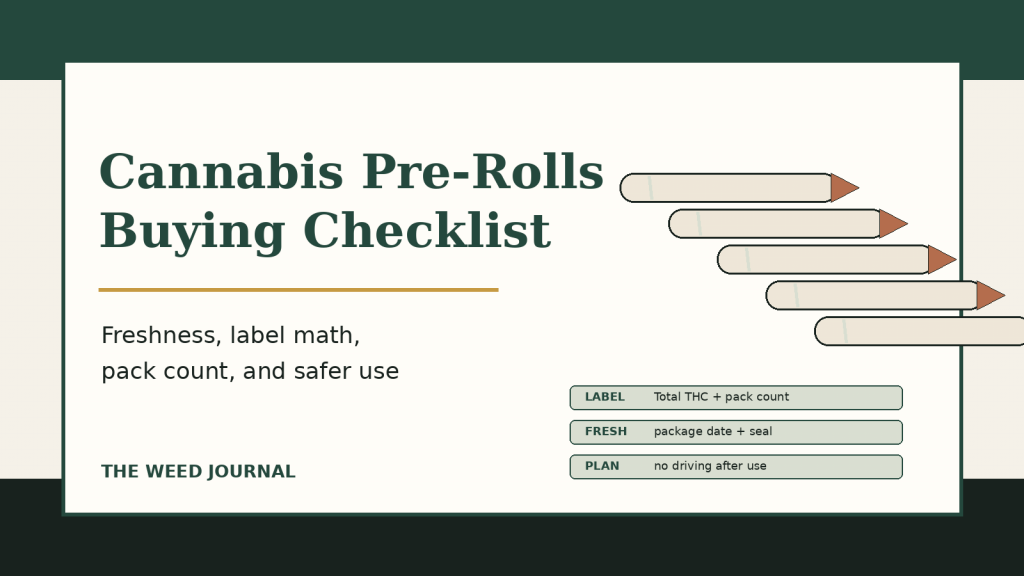
Pre-rolls are easy to buy and easy to misunderstand. A small tube can hide a lot of useful information: how much cannabis is inside, how many joints are in the pack, the Total THC after activation, the package date, whether the seal is intact, and whether the product came from a legal Canadian source.
This guide is for Canadian adults comparing legal cannabis pre-rolls. It is not medical advice, legal advice, or a recommendation to smoke. Inhaling cannabis carries respiratory and impairment risks. If you choose to use pre-rolls, the more useful question is not which strain sounds strongest. It is whether the product is legal, fresh enough, clearly labelled, and practical for the situation you are in.
Quick answer
To buy cannabis pre-rolls in Canada, start with a legal retailer, then check the package date, lot number, net weight, joint count, Total THC, Total CBD, warning information, excise stamp, and seal. Avoid products with damaged packaging, unclear THC math, old or badly stored stock, or marketing that makes health promises. If the product is infused with concentrate, use the infused pre-roll label checklist before comparing it with a regular pre-roll. If you are new, returning after a break, or sensitive to THC, choose a lower-THC product, use less than a whole pre-roll, and do not drive or handle safety-sensitive tasks afterward.
Pre-rolls are convenient, but they are still inhaled cannabis. Health Canada notes that cannabis can impair attention, coordination, and reaction time, and Canada’s lower-risk cannabis use guidance recommends avoiding smoking when possible. A legal pre-roll can be a poor choice if the timing, dose, setting, or storage plan is careless.
Pre-roll buying checklist
| Check | Why it matters | Better choice |
|---|---|---|
| Legal source | Legal retailers provide regulated packaging, labels, and accountability. | Start from your province or territory’s authorized retailer path. |
| Package date | Pre-rolls can dry out, stale, or burn poorly if stored too long or badly. | Prefer fresher stock with intact packaging and clear lot details. |
| Total THC | THC strength affects impairment risk and comfort, especially for newer users. | Choose modest THC instead of chasing the highest number. |
| Pack count and weight | A 1 g single and a multi-pack of 0.35 g joints are not the same session. | Calculate how much cannabis is in each pre-roll before lighting. |
| Seal and condition | Damaged tubes or loose seals can mean dryness or handling issues. | Skip crushed, opened, relabelled, or unclear packages. |
Start with legal source, not strain hype
Health Canada’s legal-cannabis guidance tells consumers to reduce risk by choosing legal cannabis. Legal products are subject to rules for quality, packaging, labelling, promotion, and age-restricted sale. That does not make every legal product right for every person, but it gives you a clearer chain of accountability than an unregulated menu, social account, or anonymous delivery site.
Pre-rolls are especially easy for illegal sellers to imitate because the format looks simple. A tube, a sticker, and a familiar strain name can feel official even when the source is not. The real check is whether the seller is authorized in your province or territory and whether the product has regulated packaging details.
If you are unsure where to start, use our legal online buying checklist, the broader Canadian cannabis buying checklist, or the Buying Cannabis in Canada hub before comparing menus.
Read the label before the strain name
A pre-roll label should help you answer practical questions. How much cannabis is in the package? How many pre-rolls are inside? How much is in each one? What are the THC and CBD values? Who produced it? What is the lot number? When was it packaged? Does the excise stamp and retailer context make sense for where it is being sold?
Health Canada’s label guidance explains that cannabis labels carry information meant to help consumers understand and reduce risk. For pre-rolls, the key number is usually Total THC, because dried flower contains cannabinoids that become active when heated. A label may show THC and Total THC separately. Do not treat every percentage or milligram figure as interchangeable.
For a full label walkthrough, use our guide to reading cannabis labels in Canada. If package symbols are the confusing part, pair it with our Canadian cannabis packaging symbols guide.
Freshness matters more than people think
Pre-rolls have more exposed surface area than intact flower buds. That can make dryness more noticeable. A dry pre-roll may burn hot, canoe down one side, taste harsh, or crumble at the end. It may also encourage a person to inhale harder or smoke more quickly, which is not a lower-risk habit.
Check the package date, but do not use it alone. Ask how the product was stored, look for intact seals, and avoid tubes that appear crushed, opened, dusty, or relabelled. If a legal retailer has multiple options, a fresher package with a modest THC level can be a better beginner choice than an older high-THC product with louder branding.
For flower-specific freshness signs, read our guide to fresh cannabis flower in Canada. For storage after purchase, use the temperature and humidity storage guide.
Do the pack-count math
Pre-roll packages are not all built the same way. One package might contain a single 1 g joint. Another might contain three 0.5 g pre-rolls. Another might contain a ten-pack of smaller joints. The total package weight and the number of pre-rolls both matter because they shape the likely session size.
If you are new or returning after a break, a whole pre-roll may be more than you intended. You can put it out and save the rest, but that requires planning: a non-flammable surface, a smell-aware storage container, and enough self-control not to keep going just because it is already lit. Do not let the package format decide your dose for you.
This is also where THC percentage can mislead. A smaller joint with a higher THC percentage may still involve a different total amount than a larger lower-THC joint. The practical question is: how much cannabis am I about to inhale, and how strong is it likely to be for my tolerance?
Smoking risk and safer-use choices
Pre-rolls are convenient because they require no grinder, paper, or rolling skill. The tradeoff is that they are smoked cannabis. Health Canada’s lower-risk guidance recommends avoiding smoking cannabis when possible and avoiding deep inhalation or breath-holding. Those habits can increase exposure to smoke and are not needed to feel effects.
If you choose to smoke a pre-roll, keep the session slow. Take small puffs, wait between them, and stop before you feel pressured to finish the whole thing. Avoid mixing with alcohol or other substances. Use in a calm setting where you do not need to drive, work, cook over heat, care for others alone, or make important decisions while impaired.
For a method comparison, read vaping vs smoking cannabis in Canada. For product-format tradeoffs beyond pre-rolls, start with Cannabis 101 product types.
When a pre-roll is the wrong format
A pre-roll may be the wrong choice if you are trying cannabis for the first time, have a low tolerance, are anxious about THC, dislike smoke, have respiratory concerns, are pregnant or breastfeeding, are taking medication that may interact with cannabis, or need precise dose control. It may also be wrong if you cannot store the leftover product securely or if you will be around children, pets, or anyone who should not be exposed to cannabis smoke.
Pre-rolls can also create social pressure. People often pass them around, keep pace with a group, or feel awkward putting one out. If you already know you are likely to overdo it in that setting, choose a different format, a lower-THC option, or skip cannabis entirely. Not using is always a valid lower-risk choice.
After purchase: storage and leftovers
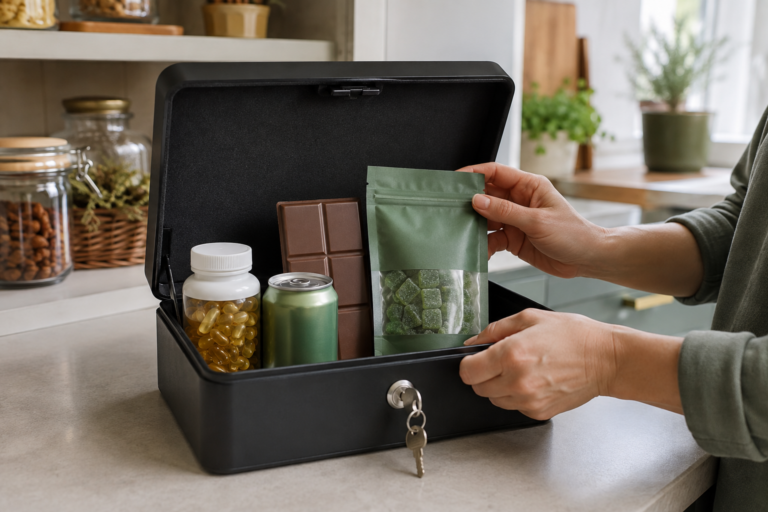
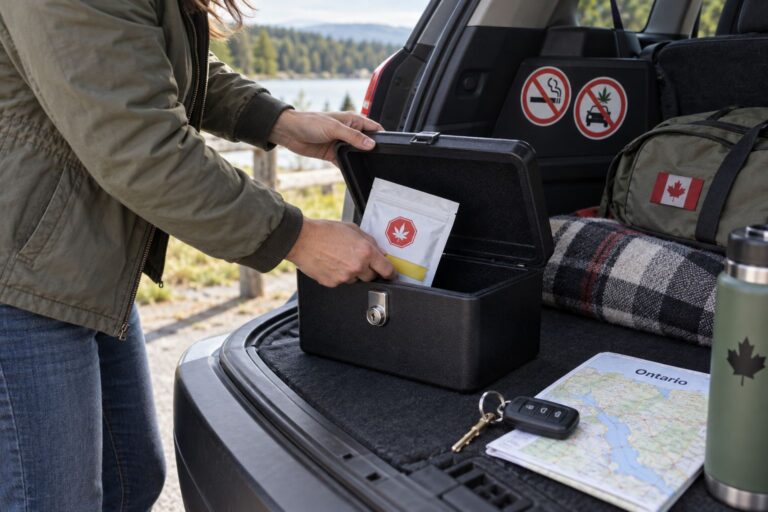
Keep pre-rolls in their original package until use so the label, lot, producer, package date, and warning information stay with the product. Store them cool, dry, dark, sealed, and locked away from children and pets. Do not leave a tube in a hot car, jacket pocket, damp bathroom, or unmarked container.
If you put out a partially smoked pre-roll, treat it as stronger-smelling, messier, and easier to mishandle than an unopened one. Let it cool fully, store it separately from fresh products, and do not leave ash or residue where children, pets, or non-consenting adults can access it. If that sounds like too much effort, that is a useful signal to choose a smaller pre-roll or not start one.
Bottom line
A good pre-roll purchase is not about finding the biggest THC number or the most famous strain name. It is about buying from a legal source, understanding the label, checking freshness, doing the pack-count math, and planning a lower-risk session before the tube is opened.
For most Canadian adults, the best pre-roll is the one that is easy to verify, easy to pace, and easy to store responsibly afterward. If the source is unclear, the package is damaged, the THC level is more than you want, or the setting is wrong, skip it.
FAQ
Are pre-rolls stronger than loose cannabis flower?
Not automatically. Strength depends on the cannabis used, Total THC, the amount in each pre-roll, and how much you consume. Read the label instead of assuming the format is stronger or weaker.
Can I save half a pre-roll for later?
Yes, but plan for it. Put it out safely, let it cool, and store it securely away from children, pets, heat, moisture, and regular food. Keeping the original labelled package nearby helps preserve product details.
Sources
- Health Canada: Reduce your risk: Choose legal cannabis
- Health Canada: How to read and understand a cannabis product label
- Health Canada: Cannabis health effects
- Health Canada: Canada’s lower-risk cannabis use guidelines
- Health Canada: Authorized cannabis retailers in the provinces and territories
Explore the beginner’s guide, or learn how we source and edit our stories.