Education 9 min read
Legal Cannabis in Canada 2026: What Adults Should Know
A plain-language 2026 guide to legal cannabis in Canada, including possession, provincial rules, legal retailers, travel, driving, and safer buying.
Legal cannabis in Canada is simple in one way and easy to misunderstand in another. The simple part: adult-use cannabis is legal under a federal framework. The part people miss: provinces, territories, municipalities, landlords, employers, and border rules can still change what is allowed in a real-life situation.
That matters because many cannabis mistakes are not about whether legalization exists. They are about buying from the wrong source, assuming every province has the same age rules, carrying cannabis into the wrong place, driving after use, travelling across a border, or treating a workplace policy like it does not apply.
This guide explains the 2026 basics for Canadian adults in plain language. It is not legal advice. If a cannabis issue could affect your job, housing, licence, immigration status, travel, court matter, or health, get advice from the right professional or government source.
Quick answer
Canada’s Cannabis Act framework allows adults, subject to provincial and territorial restrictions, to possess up to 30 grams of legal dried cannabis or equivalent in public, share up to 30 grams with other adults, buy from authorized retailers, and grow up to four plants per residence for personal use where local rules allow it.
But “legal in Canada” does not mean “same everywhere.” Provinces and territories can increase the minimum age, lower possession limits, add rules for home growing, restrict where cannabis can be used, and control how legal retail works. Health Canada also reminds consumers that legal cannabis is sold through provincial or territorial authorized retailers, with specific packaging and excise-stamp rules.
Federal vs provincial rules
| Rule area | Federal baseline | Province, territory, or local layer |
|---|---|---|
| Adult possession | Federal adult public possession limit is generally 30 grams dried cannabis or equivalent | Some jurisdictions can set tighter limits or extra restrictions |
| Minimum age | Federal framework starts at 18+ | Most provinces and territories set 19; Alberta is 18 and Quebec is 21 |
| Retail access | Legal sale is controlled through the regulated system | Each province or territory decides public, private, in-person, online, or mixed retail models |
| Home growing | Up to four plants per residence under the federal framework | Local rules may restrict or prohibit growing, and housing rules may also matter |
| Public use | Not a single national permission slip | Smoking, vaping, parks, rental housing, campuses, hotels, and event spaces can all have added rules |
| Driving | Impaired driving remains illegal | Provincial road safety penalties and licence consequences may also apply |
The practical habit is to check two levels: what Canada permits federally and what the province or territory permits where you are standing. If you are visiting another province, use the rules of the place you are visiting, not the rules you remember from home. For a province-by-province breakdown of legal age, retail models, public use, home growing, and delivery checks, use our provincial cannabis rules in Canada guide.
Legal age and public possession by province
Health Canada’s provincial and territorial retailer page summarizes legal age, authorized buying channels, and public possession limits. As of the saved June 12, 2026 source snapshot used for this article, the broad public possession limit listed for provinces and territories is 30 grams of dried cannabis or equivalent, but legal age differs.
| Province or territory | Legal age listed by Health Canada | Public possession limit listed |
|---|---|---|
| Alberta | 18 | 30 grams dried cannabis or equivalent |
| British Columbia | 19 | 30 grams dried cannabis or equivalent |
| Manitoba | 19 | 30 grams dried cannabis or equivalent |
| New Brunswick | 19 | 30 grams dried cannabis or equivalent |
| Newfoundland and Labrador | 19 | 30 grams dried cannabis or equivalent |
| Northwest Territories | 19 | 30 grams dried cannabis or equivalent |
| Nova Scotia | 19 | 30 grams dried cannabis or equivalent |
| Nunavut | 19 | 30 grams dried cannabis or equivalent |
| Ontario | 19 | 30 grams dried cannabis or equivalent |
| Prince Edward Island | 19 | 30 grams dried cannabis or equivalent |
| Quebec | 21 | 30 grams dried cannabis or equivalent |
| Saskatchewan | 19 | 30 grams dried cannabis or equivalent |
| Yukon | 19 | 30 grams dried cannabis or equivalent |
Use this as a starting point, not a substitute for checking local rules. Retail models change, municipal bylaws can matter, and private spaces can have stricter policies than the law requires.
Buying legally in Canada
The safest buying rule is boring: use the official legal channel for the province or territory you are in. Health Canada says legal cannabis products are sold through retailers authorized by provincial and territorial governments, with an exception for people who are medically authorized to buy directly from a federally licensed seller.
Legal products should have consumer information, required warnings, and an excise stamp for the province or territory, except for products with less than 0.3% THC. The stamp matters because it is one of the visible signs that a product came through the regulated system.
Illegal or unverified sellers can look polished online. A nice website, a menu, a fast checkout, or the phrase “dispensary” does not prove a retailer is legal. Health Canada lists warning signs such as no federal licence or provincial authorization, missing excise stamp, no required warning messages, and claims that sound like medical promises.
For a more practical pre-purchase workflow, use our legal retailer checklist for buying cannabis in Canada before ordering online or walking to the counter. If the order is happening online, use the legal online cannabis buying checklist to verify authorized channels, age checks, labels, delivery limits, and payment red flags.
For the broader beginner route through legal sources, labels, red flags, and storage, use our Buying Cannabis in Canada hub.
Legal retailer checklist
- Check the province or territory’s official authorized retailer list before buying.
- Look for required cannabis packaging, warning symbol, and consumer information.
- Check for the correct provincial or territorial excise stamp where required.
- Avoid products that make disease-treatment, cure, or guaranteed-effect claims.
- Be cautious with unlabelled extracts, unusually cheap products, refilled vape cartridges, or cash-only informal delivery.
- Do not buy for someone under the legal age or share cannabis with youth.
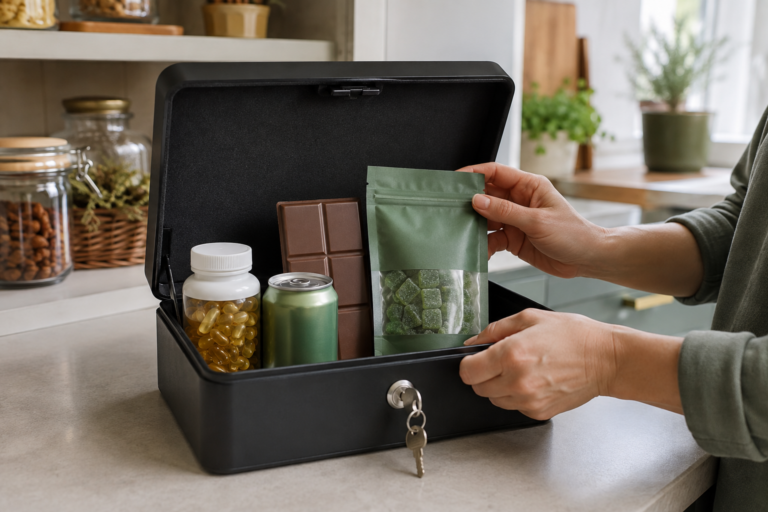
- Store products away from children, pets, guests, and anyone who should not access them.
If you are new to labels, start with The Weed Journal’s guide to reading cannabis labels in Canada. It explains THC, CBD, lot details, packaging dates, and the difference between useful label information and marketing noise.
Possession and “equivalents”
The public possession limit is usually described as 30 grams of dried cannabis or equivalent. That last phrase matters. Cannabis is sold as dried flower, edibles, oils, capsules, concentrates, beverages, seeds, and plants, so the law uses equivalencies to compare formats.
For the detailed product-equivalency table, including drinks, concentrates, seeds, and mixed-product carrying examples, use our cannabis possession limits in Canada guide.
Do not assume that a small package is automatically under the legal possession limit. Concentrates and non-dried products can be treated differently under equivalency rules. If you are carrying multiple product types, especially while travelling within Canada, check the current government equivalency guidance rather than guessing.
Also remember that public possession is not the same as use. You might be allowed to possess legal cannabis but still not be allowed to smoke, vape, or consume it in a certain place.
Home growing is not the same everywhere
The federal framework allows up to four cannabis plants per residence for personal use, from licensed seed or seedlings, subject to provincial and territorial restrictions. The phrase “per residence” is important. It does not mean four plants per adult.
Local rules can be stricter, and private rules can matter too. A condo board, rental agreement, insurance policy, or municipal bylaw may affect what you can do even when federal law sounds permissive. Growing also raises practical safety issues: odour, humidity, electrical load, mould, fire risk, pests, and secure access.
If you cannot keep plants secure from children, pets, guests, or theft, home growing is a poor fit. Legal permission is only one part of responsible use.
Driving and cannabis
Legal cannabis did not make impaired driving legal. Cannabis can affect attention, coordination, reaction time, judgment, and risk perception. The difficult part is that impairment is not controlled by a simple stopwatch. Dose, product type, tolerance, food, sleep, alcohol, and individual response all matter.
Edibles deserve special caution because they can take a long time to peak and may last into the next day. Inhaled cannabis acts faster, but fast onset does not mean fast recovery for every person. If timing is your main question, read our guide to how long THC lasts in Canada.
The practical rule is simple: plan the ride before using cannabis. Do not wait until after use to decide whether you are fine to drive.
Travel within Canada
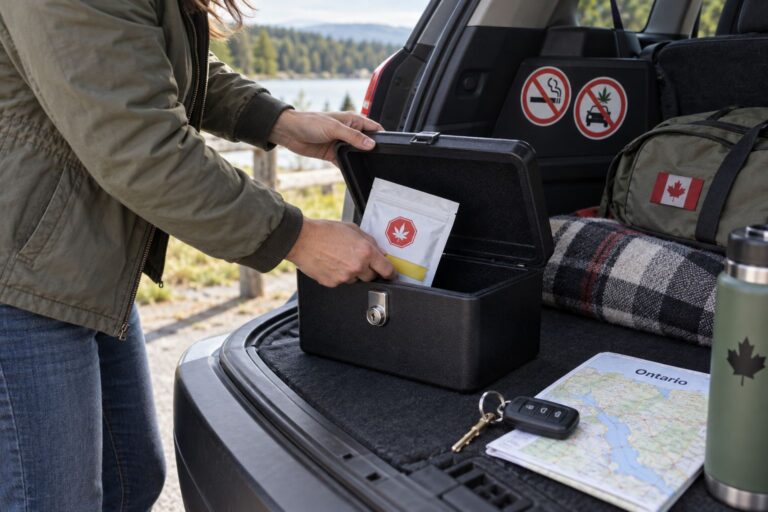
Domestic travel is not automatically a problem, but it is still easy to make mistakes. You need to follow the law where you are departing, where you are arriving, and where you are using or carrying cannabis. If you fly or travel with cannabis, keep it legal, sealed when practical, clearly labelled, and within the possession limit.
Do not use domestic travel as a reason to carry more than you need. Keep products away from youth, avoid open packages in vehicles, and remember that hotels, campuses, rental properties, ferries, workplaces, and event venues can have their own rules.
International travel: do not cross the border with cannabis
International travel is different. The Government of Canada warns travellers not to take cannabis across the Canadian border, whether leaving or entering Canada. This includes destinations where cannabis is legal. It also includes medical cannabis unless you have followed the specific legal requirements that apply to controlled substances and travel.
The safest public-facing advice is blunt: do not bring cannabis across an international border. Buy legal products only where you are legally allowed to buy them, and never assume that Canadian legalization protects you in another country.
Common myths
Myth: If cannabis is legal, any online store is fine.
Reality: Legal cannabis is sold through authorized channels. A professional-looking website is not proof of authorization.
Myth: The age is 19 everywhere.
Reality: Most jurisdictions list 19, but Alberta lists 18 and Quebec lists 21. Always check the province or territory.
Myth: I can grow four plants because I am an adult.
Reality: The federal framework refers to up to four plants per residence, and local or housing rules may add restrictions.
Myth: Legal cannabis means I can drive once I feel normal.
Reality: Feeling normal is not a reliable legal or safety test. Cannabis-impaired driving remains illegal.
Myth: I can take cannabis to another country if it is legal there.
Reality: Crossing the Canadian border with cannabis remains a serious legal risk. Do not do it.
Bottom line
Legal cannabis in Canada is a regulated adult-use system, not a free-for-all. The federal framework sets the foundation, but provinces and territories control many of the details that affect everyday buying and use.
For most adults, the responsible pattern is straightforward: buy from authorized retailers, stay within possession limits, read the label, avoid driving, keep cannabis away from youth and pets, check local rules before travelling, and never cross an international border with cannabis.
When in doubt, use official government sources for the place you are in. Cannabis rules are easier to follow when you treat legalization as a regulated system instead of a blanket permission slip.
Sources
- Justice Canada: Cannabis legalization and regulation
- Health Canada: Cannabis laws and regulations
- Health Canada: Authorized cannabis retailers in the provinces and territories
- Government of Canada: Cannabis and international travel
Explore the beginner’s guide, or learn how we source and edit our stories.