Tag: buying cannabis

  • Cannabis Pre-Rolls in Canada: Buying Checklist

    Cannabis Pre-Rolls in Canada: Buying Checklist

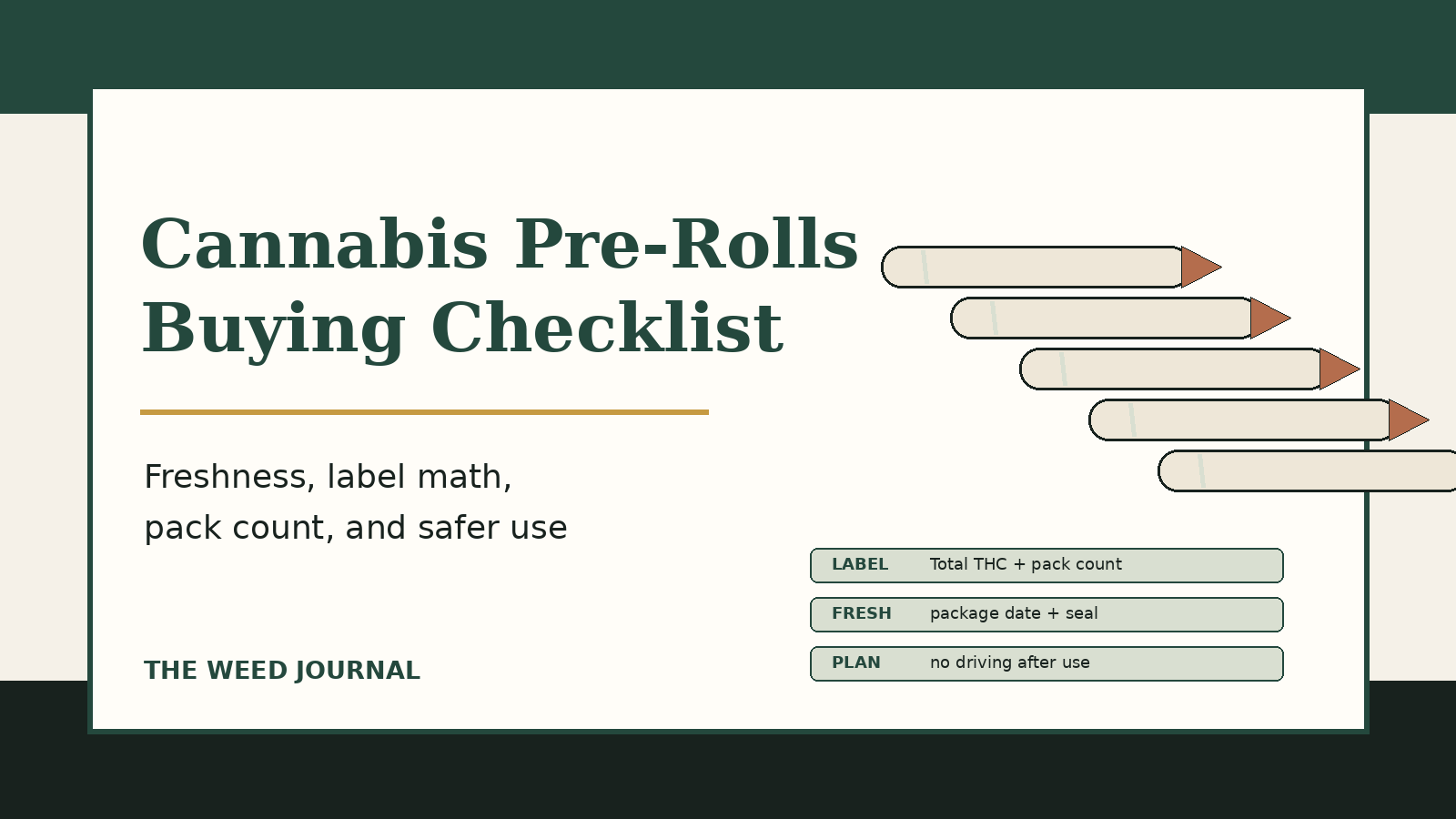
    Pre-rolls are easy to buy and easy to misunderstand. A small tube can hide a lot of useful information: how much cannabis is inside, how many joints are in the pack, the Total THC after activation, the package date, whether the seal is intact, and whether the product came from a legal Canadian source.

    This guide is for Canadian adults comparing legal cannabis pre-rolls. It is not medical advice, legal advice, or a recommendation to smoke. Inhaling cannabis carries respiratory and impairment risks. If you choose to use pre-rolls, the more useful question is not which strain sounds strongest. It is whether the product is legal, fresh enough, clearly labelled, and practical for the situation you are in.

    Quick answer

    To buy cannabis pre-rolls in Canada, start with a legal retailer, then check the package date, lot number, net weight, joint count, Total THC, Total CBD, warning information, excise stamp, and seal. Avoid products with damaged packaging, unclear THC math, old or badly stored stock, or marketing that makes health promises. If you are new, returning after a break, or sensitive to THC, choose a lower-THC product, use less than a whole pre-roll, and do not drive or handle safety-sensitive tasks afterward.

    Pre-rolls are convenient, but they are still inhaled cannabis. Health Canada notes that cannabis can impair attention, coordination, and reaction time, and Canada’s lower-risk cannabis use guidance recommends avoiding smoking when possible. A legal pre-roll can be a poor choice if the timing, dose, setting, or storage plan is careless.

    Pre-roll buying checklist

    Check Why it matters Better choice
    Legal source Legal retailers provide regulated packaging, labels, and accountability. Start from your province or territory’s authorized retailer path.
    Package date Pre-rolls can dry out, stale, or burn poorly if stored too long or badly. Prefer fresher stock with intact packaging and clear lot details.
    Total THC THC strength affects impairment risk and comfort, especially for newer users. Choose modest THC instead of chasing the highest number.
    Pack count and weight A 1 g single and a multi-pack of 0.35 g joints are not the same session. Calculate how much cannabis is in each pre-roll before lighting.
    Seal and condition Damaged tubes or loose seals can mean dryness or handling issues. Skip crushed, opened, relabelled, or unclear packages.
    The best pre-roll choice is usually the one that is legal, clearly labelled, fresh enough, and easy to pace.

    Start with legal source, not strain hype

    Health Canada’s legal-cannabis guidance tells consumers to reduce risk by choosing legal cannabis. Legal products are subject to rules for quality, packaging, labelling, promotion, and age-restricted sale. That does not make every legal product right for every person, but it gives you a clearer chain of accountability than an unregulated menu, social account, or anonymous delivery site.

    Pre-rolls are especially easy for illegal sellers to imitate because the format looks simple. A tube, a sticker, and a familiar strain name can feel official even when the source is not. The real check is whether the seller is authorized in your province or territory and whether the product has regulated packaging details.

    If you are unsure where to start, use our legal online buying checklist, the broader Canadian cannabis buying checklist, or the Buying Cannabis in Canada hub before comparing menus.

    Read the label before the strain name

    A pre-roll label should help you answer practical questions. How much cannabis is in the package? How many pre-rolls are inside? How much is in each one? What are the THC and CBD values? Who produced it? What is the lot number? When was it packaged? Does the excise stamp and retailer context make sense for where it is being sold?

    Health Canada’s label guidance explains that cannabis labels carry information meant to help consumers understand and reduce risk. For pre-rolls, the key number is usually Total THC, because dried flower contains cannabinoids that become active when heated. A label may show THC and Total THC separately. Do not treat every percentage or milligram figure as interchangeable.

    For a full label walkthrough, use our guide to reading cannabis labels in Canada. If package symbols are the confusing part, pair it with our Canadian cannabis packaging symbols guide.

    Freshness matters more than people think

    Pre-rolls have more exposed surface area than intact flower buds. That can make dryness more noticeable. A dry pre-roll may burn hot, canoe down one side, taste harsh, or crumble at the end. It may also encourage a person to inhale harder or smoke more quickly, which is not a lower-risk habit.

    Check the package date, but do not use it alone. Ask how the product was stored, look for intact seals, and avoid tubes that appear crushed, opened, dusty, or relabelled. If a legal retailer has multiple options, a fresher package with a modest THC level can be a better beginner choice than an older high-THC product with louder branding.

    For flower-specific freshness signs, read our guide to fresh cannabis flower in Canada. For storage after purchase, use the temperature and humidity storage guide.

    Do the pack-count math

    Pre-roll packages are not all built the same way. One package might contain a single 1 g joint. Another might contain three 0.5 g pre-rolls. Another might contain a ten-pack of smaller joints. The total package weight and the number of pre-rolls both matter because they shape the likely session size.

    If you are new or returning after a break, a whole pre-roll may be more than you intended. You can put it out and save the rest, but that requires planning: a non-flammable surface, a smell-aware storage container, and enough self-control not to keep going just because it is already lit. Do not let the package format decide your dose for you.

    This is also where THC percentage can mislead. A smaller joint with a higher THC percentage may still involve a different total amount than a larger lower-THC joint. The practical question is: how much cannabis am I about to inhale, and how strong is it likely to be for my tolerance?

    Smoking risk and safer-use choices

    Pre-rolls are convenient because they require no grinder, paper, or rolling skill. The tradeoff is that they are smoked cannabis. Health Canada’s lower-risk guidance recommends avoiding smoking cannabis when possible and avoiding deep inhalation or breath-holding. Those habits can increase exposure to smoke and are not needed to feel effects.

    If you choose to smoke a pre-roll, keep the session slow. Take small puffs, wait between them, and stop before you feel pressured to finish the whole thing. Avoid mixing with alcohol or other substances. Use in a calm setting where you do not need to drive, work, cook over heat, care for others alone, or make important decisions while impaired.

    For a method comparison, read vaping vs smoking cannabis in Canada. For product-format tradeoffs beyond pre-rolls, start with Cannabis 101 product types.

    When a pre-roll is the wrong format

    A pre-roll may be the wrong choice if you are trying cannabis for the first time, have a low tolerance, are anxious about THC, dislike smoke, have respiratory concerns, are pregnant or breastfeeding, are taking medication that may interact with cannabis, or need precise dose control. It may also be wrong if you cannot store the leftover product securely or if you will be around children, pets, or anyone who should not be exposed to cannabis smoke.

    Pre-rolls can also create social pressure. People often pass them around, keep pace with a group, or feel awkward putting one out. If you already know you are likely to overdo it in that setting, choose a different format, a lower-THC option, or skip cannabis entirely. Not using is always a valid lower-risk choice.

    After purchase: storage and leftovers

    Keep pre-rolls in their original package until use so the label, lot, producer, package date, and warning information stay with the product. Store them cool, dry, dark, sealed, and locked away from children and pets. Do not leave a tube in a hot car, jacket pocket, damp bathroom, or unmarked container.

    If you put out a partially smoked pre-roll, treat it as stronger-smelling, messier, and easier to mishandle than an unopened one. Let it cool fully, store it separately from fresh products, and do not leave ash or residue where children, pets, or non-consenting adults can access it. If that sounds like too much effort, that is a useful signal to choose a smaller pre-roll or not start one.

    Bottom line

    A good pre-roll purchase is not about finding the biggest THC number or the most famous strain name. It is about buying from a legal source, understanding the label, checking freshness, doing the pack-count math, and planning a lower-risk session before the tube is opened.

    For most Canadian adults, the best pre-roll is the one that is easy to verify, easy to pace, and easy to store responsibly afterward. If the source is unclear, the package is damaged, the THC level is more than you want, or the setting is wrong, skip it.

    FAQ

    Are pre-rolls stronger than loose cannabis flower?

    Not automatically. Strength depends on the cannabis used, Total THC, the amount in each pre-roll, and how much you consume. Read the label instead of assuming the format is stronger or weaker.

    Can I save half a pre-roll for later?

    Yes, but plan for it. Put it out safely, let it cool, and store it securely away from children, pets, heat, moisture, and regular food. Keeping the original labelled package nearby helps preserve product details.

    Sources

  • Cannabis Seeds in Canada: Buying and Label Checklist

    Cannabis Seeds in Canada: Buying and Label Checklist

    Cannabis seeds can look simple: a small packet, a strain name, maybe a promise about yield or flavour. In Canada, they are still regulated cannabis products. That means the safest buying decision starts with legal source, package details, provincial rules, and realistic expectations, not the loudest seed-bank copy.

    This guide is for Canadian adults who are considering seeds for personal home growing where it is allowed. It is not a cultivation manual, legal advice, or a promise that a seed will produce a specific result. It is a buyer’s checklist: where to buy, what to read on the package, what the limits mean, and when to pause before germinating anything.

    Quick answer

    Buy cannabis seeds only from a legal source, such as an authorized retailer in your province or territory. Health Canada says adults may grow up to four cannabis plants per household under federal rules, not four per person, but provinces and territories can add stricter rules. Ontario allows up to four plants per residence for personal use by adults 19 and older. Quebec prohibits personal cultivation and possession of cannabis plants for personal use. Check your local rule before buying seeds, because a seed packet is not useful if you cannot legally grow it where you live.

    For public possession, one cannabis plant seed counts as one gram of dried cannabis equivalent under the federal possession-limit framework. That matters if you are carrying seeds in public alongside flower, edibles, extracts, or other cannabis products.

    Seed buying checklist

    Check Why it matters Pause if you see
    Legal seller Seeds should come through an authorized provincial or territorial channel. Anonymous menus, imported “stealth” shipping, or sellers avoiding legal-source questions.
    Province rules Home grow rules are not identical across Canada. You live somewhere cultivation is restricted or your lease/building rules prohibit it.
    Package label Legal cannabis packaging should give traceable product information. No lot details, no producer information, relabelled bags, or opened packaging.
    Seed count Seeds count toward public possession equivalency. You are carrying seeds plus other cannabis near the 30 g dried-equivalent limit.
    Claims Strain names and breeder descriptions are not guarantees. Medical promises, unrealistic yield claims, or “100%” certainty language.
    Use the checklist before germination. The legal source and local rule are the first two gates.

    What counts as a legal source?

    Health Canada’s home-growing guidance tells consumers to buy seeds or immature plants from legal sources, such as an authorized retailer in the province or territory. It also says it is illegal to use seeds or grow plants that you know came from illegal sources. That is the clean dividing line for buyers: if the seller cannot plausibly fit inside the legal retail system, do not treat the seeds as a shortcut.

    In Ontario, the provincial government says the Ontario Cannabis Store website is the only legal online source for recreational cannabis, while licensed private stores operate in person. Other provinces and territories use different retail models, so the practical move is to start from Health Canada’s authorized retailer list or your provincial cannabis authority rather than a search ad.

    If you need a broader legal-shopping refresher, start with our Canadian cannabis buying checklist or the legal online buying checklist.

    Four plants means household, not person

    The federal home-grow baseline is up to four cannabis plants per household for personal use, not four plants for each adult in the home. That distinction matters in shared houses, apartments, and multi-adult families. A household with three adults does not become a twelve-plant household under the federal baseline.

    Ontario phrases its rule similarly: adults 19 and older may grow up to four plants per residence for personal use, from legal seeds or seedlings. The province also says the plants must not be accessible to anyone under 19. That turns a seed purchase into a household-safety decision, not only a gardening decision.

    Do not assume a federal rule overrides every local restriction. Provinces, territories, municipalities, landlords, condo boards, and federally regulated housing can create additional constraints. Quebec is the clearest example at the provincial level: the Quebec government states that personal cannabis cultivation is prohibited and that possessing a cannabis plant for personal use is also prohibited.

    Seeds and the 30 gram public possession limit

    Canadian adults often remember the public possession limit as 30 grams of dried cannabis or equivalent. Seeds are part of that equivalent system. Health Canada’s possession-limit calculator uses one cannabis plant seed as equivalent to one gram of dried cannabis.

    That does not mean one seed has the same effect as one gram of dried flower. It means the law needs a conversion table for different cannabis forms. If you are carrying seeds in public, include them in your dried-equivalent math alongside dried flower, fresh cannabis, edibles, extracts, topicals, or plants.

    For a deeper walkthrough, read our Canadian cannabis possession limits guide.

    What to read on a seed package

    Seed packaging is not the same as dried flower packaging, but it should still feel traceable and regulated. Look for the product name, producer or brand details, lot or batch information, seed count, package date where available, provincial stamp or retail context where applicable, and any required warning or regulatory elements.

    Health Canada’s consumer label guidance explains why label literacy matters for legal cannabis products: labels carry health and safety information that helps consumers reduce harm. With seeds, the most important label habit is traceability. If the packet becomes part of a concern, you want the product name, lot, seller, and purchase date preserved.

    Do not throw the packaging away as soon as you open it. Keep it at least until you know there is no product concern and until you no longer need the lot details. Our cannabis label guide explains the larger label system, and our packaging symbols guide covers common Canadian packaging markers.

    Feminized, regular, and autoflower: buyer language, not guarantees

    Seed listings often use terms such as feminized, regular, and autoflower. Those terms can help you understand what a product is intended to be, but they should not be read as a guarantee of outcome. Plants are living things, and results depend on genetics, environment, storage, handling, and grower decisions.

    Be cautious with seed descriptions that promise exact effects, medical outcomes, extreme yields, or certainty that no reputable seller can control. A calm listing should tell you what the product is, who produced it, how many seeds are included, and any practical growing context allowed by law. It should not sound like a miracle-cure page or a gambling ad.

    The same principle applies to strain names. A strain name can be useful shorthand, but it does not replace reading the product details. For more on why names and THC numbers can mislead shoppers, see our guide to comparing classic cannabis strains and our explainer on why THC percentage is not everything.

    Storage before germination

    Seeds are easier to ruin than many buyers expect. Heat, moisture, light, rough handling, and casual relabelling can create problems before a seed ever reaches soil. Keep seeds in their original package until you are ready to use them, and store them in a cool, dark, dry, secure place away from children, pets, and anyone who is not allowed to access cannabis.

    Do not store seeds in a hot car, damp basement, bathroom cabinet, sunny windowsill, or unmarked container. If you move them to another container, keep the original package and label with it. Losing the label makes it harder to confirm the strain, source, seed count, and lot details later.

    For household storage habits that also apply to flower and other products, use our cannabis storage guide.

    When not to buy cannabis seeds

    Do not buy seeds if home growing is not allowed where you live, if your housing rules prohibit it, if you cannot keep plants away from minors, if you are already near the public possession limit, or if the seller is outside the legal channel. Also pause if the only reason you are buying is hype: a limited drop, a dramatic strain name, or a claim that sounds too certain.

    Seeds are not a beginner purchase just because they are small. They can become plants, plants create storage and safety obligations, and rules differ across the country. The right decision may be buying a legal finished product instead, or waiting until you have confirmed the household and provincial rules.

    FAQ

    Can I order cannabis seeds from outside Canada?

    For a Canadian adult-use buyer, the cleaner answer is to use authorized Canadian legal channels. Imported or grey-market seed orders can create legal-source, customs, quality, and traceability problems. If a seller is promising stealth shipping or avoiding questions about legality, that is a reason to walk away.

    Can I give cannabis seeds to another adult?

    Federal guidance allows sharing limited amounts of personally grown cannabis with adults of legal age, but selling cannabis requires a Health Canada licence. Because seeds count in the dried-equivalent framework and provincial age rules differ, treat gifting seeds with the same caution as any other cannabis transfer: legal-age adult only, within limits, and never as a sale.

    Should I germinate every seed in a pack?

    Not automatically. The plant limit applies to plants at the household or residence level, and some provinces or housing situations may be stricter. Count what you can legally and safely manage before germination, not after seedlings already exist.

    Sources

  • How to Spot Mouldy Cannabis Flower in Canada

    How to Spot Mouldy Cannabis Flower in Canada

    Mouldy cannabis flower is not something to “test and see.” If flower smells musty, looks fuzzy, feels suspiciously damp, or arrived in damaged packaging, the safest move is to stop, keep the package, and contact the legal retailer or producer instead of consuming it.

    This guide is for Canadian adults who buy dried cannabis flower and want a practical way to tell normal cannabis features from warning signs. It is not medical advice, and it cannot diagnose contamination from a photo or description. The goal is simpler: know when to pause, what evidence to keep, and how to reduce the chance of turning a storage or buying mistake into a safety problem.

    Quick answer

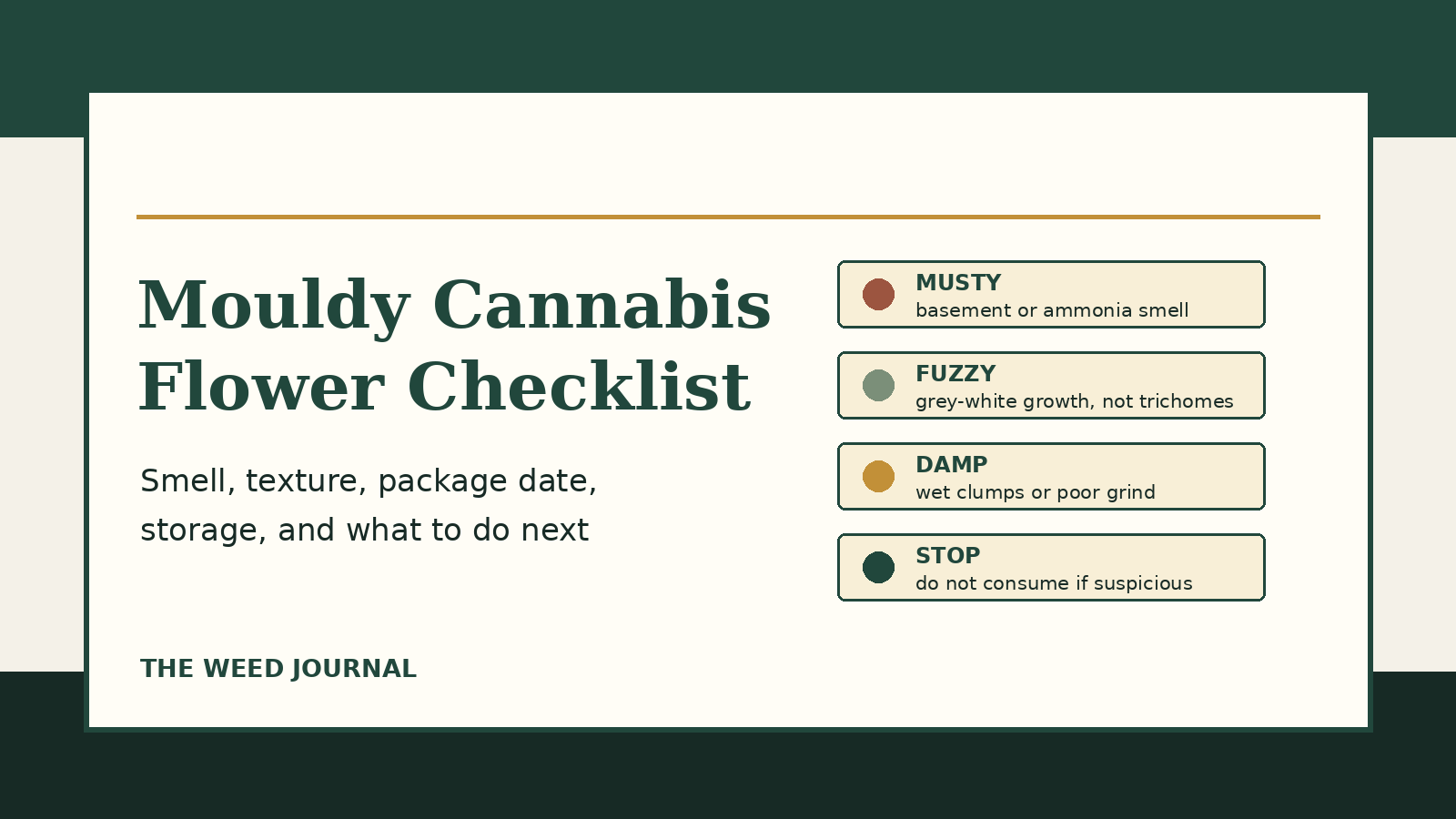
    Do not use cannabis flower that may be mouldy. Warning signs include a basement-like or ammonia smell, fuzzy grey or white patches, damp clumps, visible webbing, strange powder that does not look like trichomes, damaged packaging, or flower that feels wet after opening. Keep the original package, note the lot number and package date, take clear photos if useful, and contact the retailer or producer through an official channel.

    Legal cannabis is still the better starting point because regulated products must meet federal packaging, labelling, and production requirements. But even legal products can be stored poorly after purchase, opened carelessly, or become questionable over time. Freshness checks still matter at home.

    Mould check table

    What you notice Could be normal Stop sign
    White sparkle Trichomes that look crystalline and attached to the flower Fuzzy, dusty, web-like, or patchy growth
    Smell Earthy, citrus, pine, floral, fuel, spice, or skunky aroma Musty basement, mildew, ammonia, wet hay, or rot
    Texture Slight give, not wet, grinds evenly Damp clumps, sticky-wet interior, or powdery breakdown
    Package Sealed, labelled, lot number visible Broken seal, missing label details, wet package, relabelled bag
    Storage history Cool, dark, sealed, original packaging Hot car, sunny window, bathroom, loose jar, shared bag
    If a sign falls in the stop column, treat it as a product concern. Do not try to rescue the flower by drying, baking, freezing, or trimming.

    Mould or trichomes: how to tell the difference

    Trichomes are the tiny resin glands that can make cannabis flower look frosty or sparkling. They usually appear as fine crystals on the surface and are part of normal flower structure. Mould is different. It may look fuzzy, cottony, dusty, web-like, grey-white, blue-green, or patchy, and it may appear in creases inside the bud where moisture can linger.

    Appearance alone can be tricky because dense trichomes and broken plant material can fool the eye. Smell and texture are useful backup checks. A clean cannabis aroma can be strong, but it should not smell like damp basement, mildew, ammonia, rot, or wet hay. Flower should not feel wet or clumped in a way that suggests trapped moisture.

    If you cannot tell, do not consume it. The cost of replacing questionable flower is lower than the risk of inhaling or otherwise using a contaminated product.

    Why legal-source checks matter

    Health Canada advises adults to choose legal cannabis because legal products are subject to rules for quality, packaging, labelling, promotion, and sale. Federal guidance also points consumers toward plain, child-resistant packaging, health warnings, the standardized cannabis symbol when required, excise stamps, and clear THC and CBD information.

    That does not mean every legal flower purchase will be fresh or ideal. It means there should be a traceable package with a lot number, producer details, and a regulated retailer path. Those details matter if you need to report a concern. An unlabelled bag from an anonymous delivery menu gives you much less accountability.

    If the legal-source question is still unclear, use our legal online cannabis buying checklist or broader Canadian cannabis buying checklist before placing another order.

    Check the package before opening

    Before you break the seal, look at the package. It should be intact, clearly labelled, and appropriate for cannabis. Check the product name, net weight, lot number, package date, THC and CBD information, warning elements, and producer or licence holder details. If anything looks tampered with, wet, relabelled, or inconsistent, pause before opening.

    Package date is context, not a guarantee. Older flower can be dry and less aromatic, but age alone does not prove mould. Newer flower can still be a problem if it was mishandled. Read package date alongside storage history, seal condition, texture, aroma, and visual inspection.

    For the full label walkthrough, see our Canadian cannabis label guide and packaging symbols explainer.

    Check the flower after opening

    Open the package somewhere with good light. Do not inspect flower over food, near children or pets, or while rushing. Pouring everything into a decorative jar before checking the product can make it harder to keep evidence organized if something is wrong.

    Use a simple three-part check:

    1. Look: scan the outside and, if needed, gently break apart one bud to inspect the centre.
    2. Smell: notice whether the aroma is cannabis-like or damp, stale, ammonia-like, or rotten.
    3. Feel: check whether the flower is slightly springy, dusty-dry, or suspiciously wet.

    Do not use a product that gives you a strong warning sign in any of those steps. Do not rely on a grinder, vaporizer, or flame to make questionable flower safe.

    What to do if you suspect mould

    First, stop handling the product more than necessary. Put it back in the original package or a clean container, wash your hands, and keep it away from children, pets, food, and shared surfaces. Do not mix it with other cannabis, and do not throw away the label before documenting it.

    Next, record the product name, lot number, package date, retailer, purchase date, and what you noticed. Clear photos can help if you contact the retailer or producer. Use the official customer service route rather than social direct messages or informal reseller channels.

    If you bought from a legal retailer, ask about the product concern process. If you suspect an illegal seller, avoid further orders and use the relevant provincial or local reporting pathway. If someone feels unwell after using cannabis, contact a health professional, poison centre, or emergency service as appropriate.

    Storage mistakes that can create problems

    Most home storage problems are ordinary: too much heat, too much light, too much air, too much moisture, or too many container swaps. Flower left in a hot car, bathroom, sunny window, loose bag, or frequently opened jar can lose quality quickly. Adding fruit peels, wet paper, or improvised humidity tricks can also introduce moisture or contamination.

    Health Canada recommends keeping cannabis products securely stored and away from children and pets. For flower quality, the practical version is: keep it sealed, labelled, cool, dark, and dry enough to avoid moisture problems. If you use humidity packs, use products intended for cannabis storage and do not try homemade moisture fixes.

    Our cannabis storage guide explains temperature, humidity, original packaging, and household safety in more detail.

    When dryness is a quality issue, not a mould issue

    Dry flower can be disappointing without being mouldy. It may crumble too easily, smell muted, vape harshly, or burn quickly. That is a quality and freshness issue, and it can still be worth reporting to the retailer, especially if the product was sold as premium or recently packaged.

    Do not confuse “too dry” with “safe enough no matter what.” If dry flower also smells musty, looks dusty in an unusual way, or has visible patches, treat it as suspicious. If it simply seems old or harsh, use that experience to buy smaller formats, check package dates more carefully, and store future purchases better.

    For more buying context, read our fresh cannabis flower checklist and flower buying checklist.

    Do not try to salvage questionable flower

    Common salvage ideas are not reliable safety plans. Trimming off a visible patch may miss contamination inside the bud. Drying flower out does not prove it is safe. Freezing can change texture and moisture behaviour without solving the underlying concern. Baking or smoking is not a contamination test.

    The better rule is strict: if mould is plausible, stop. Keep evidence, contact the legal retailer or producer, and replace the product through a safer channel. That may feel wasteful, but using a questionable product to avoid wasting money is a bad trade.

    Bottom line

    Mouldy cannabis flower is a stop sign. Buy from legal sources, keep the package, inspect flower in good light, trust musty smells and fuzzy patches as warnings, and store cannabis in a cool, dark, secure place after opening. When in doubt, do not consume it.

    FAQ

    Can mouldy cannabis be cleaned or dried out?

    No. Do not try to clean, dry, trim, freeze, bake, smoke, or vaporize flower that may be mouldy. Treat it as a product concern and keep the package details for the retailer or producer.

    Does legal cannabis ever have mould?

    Legal cannabis is regulated and more accountable than unregulated products, but consumers should still inspect packages and store flower properly after purchase. If a legal product seems contaminated, use the official concern process.

    Is white sparkle on cannabis always mould?

    No. White sparkle can be normal trichomes. The warning signs are fuzzy, web-like, dusty, patchy growth, musty odour, damp clumps, or anything that makes the product look contaminated.

    Sources

  • How to Buy Cannabis Online in Canada Legally

    How to Buy Cannabis Online in Canada Legally

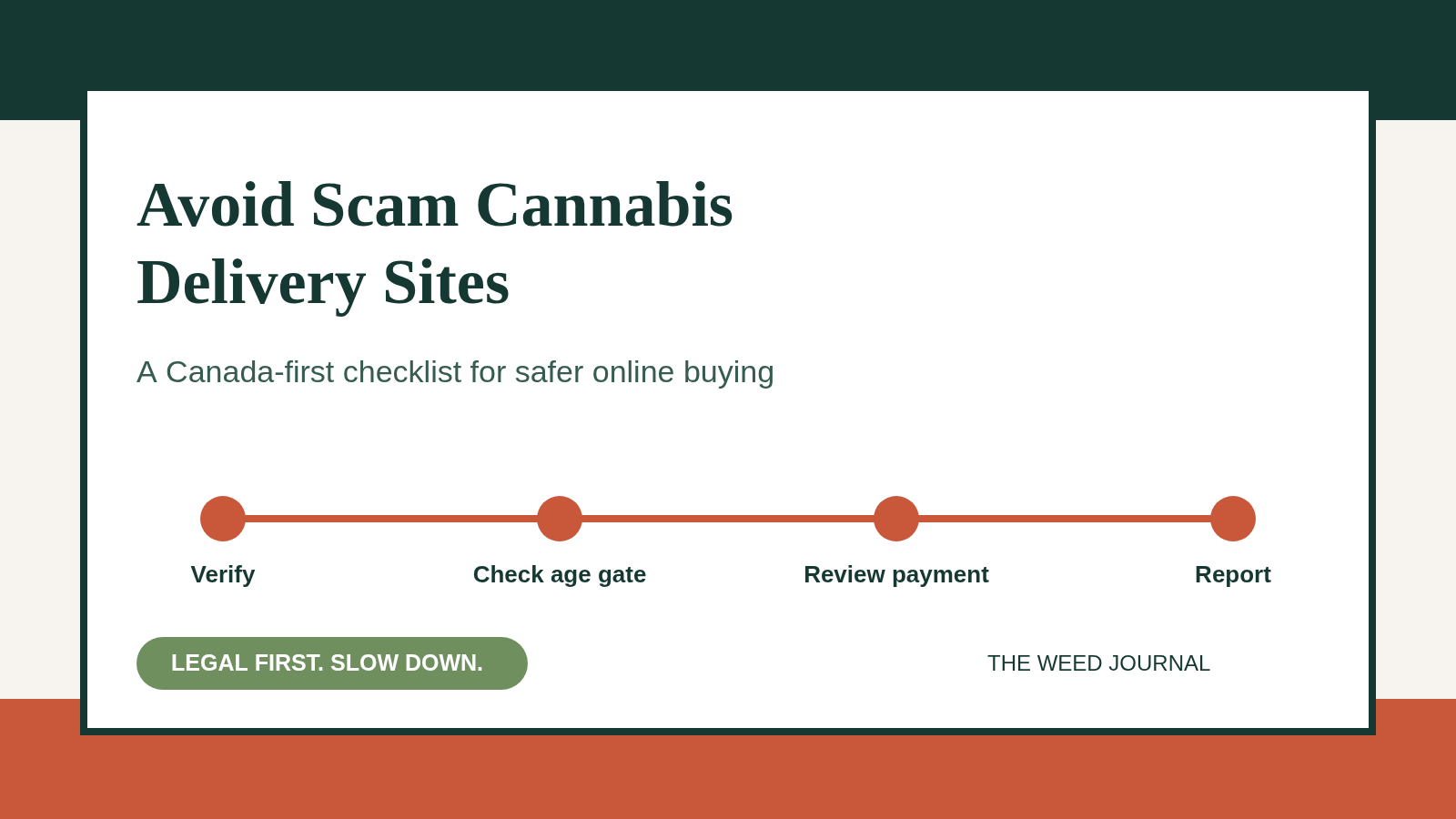
    Buying cannabis online in Canada can be convenient, but the checkout page is not the first thing to inspect. The important question is whether the seller is actually authorized for the province or territory you are in. A polished website, delivery promise, or big discount does not make a cannabis shop legal.

    This guide is for adults who want a practical way to order legal cannabis online without drifting into scam sites, unclear labels, or avoidable safety mistakes. It is not legal advice. Cannabis rules can vary by province, territory, municipality, product type, and date, so use official provincial or territorial sources when the details matter.

    Quick answer

    To buy cannabis online legally in Canada, start from the authorized retailer list for your province or territory, confirm the store or online platform is listed there, check the legal age where you are, and make sure the product arrives in legal packaging with the standardized cannabis symbol, health warning, child-resistant package, and the correct provincial or territorial excise stamp when required. Do not use a site just because it ranks in search or advertises same-day delivery.

    Health Canada says adults of legal age may purchase legal cannabis from authorized retailers, and its authorized-retailer page lists where legal cannabis can be bought in each province and territory. That page is the best starting point because online access is not identical across Canada.

    The online buying checklist

    Check before checkout Why it matters What to look for
    Authorized seller Legal cannabis is sold through provincial or territorial authorized retailers. Find the store or online platform through the official government or regulator list.
    Province or territory Age, online sales model, stores, and added restrictions can vary. Use the rules for where you live or where the product is being delivered.
    Product label Legal products must follow packaging and labelling rules. Look for Total THC, Total CBD, warning information, lot details, and child-resistant packaging.
    Excise stamp Most legal cannabis packages carry a province- or territory-specific stamp. The stamp should match the province or territory where the product is sold, except for certain very low-THC products.
    Delivery handoff Cannabis should not be handed to underage people or left casually accessible. Expect age checks, secure receiving, and a plan to store the package away from children and pets.
    Use this table as a pre-checkout filter. If a seller fails the first line, the rest of the shopping experience does not fix it.

    Start with the official retailer path

    The safest habit is boring: do not begin with a coupon site, social account, map listing, or search ad. Start with the official provincial or territorial retailer page, then follow the approved path from there. Health Canada explains that provinces and territories are responsible for how cannabis is sold and distributed inside their jurisdictions.

    That matters because Canada does not have one single online cannabis store for every adult in every province. Some places use a government-operated online store. Some allow private licensed retailers to sell online. Some have both government and private in-person retail, but online access can still follow a narrower model. If you travel, move, or order from a new address, check again rather than assuming your last province’s pattern applies.

    For a broader overview of how provincial details differ, read our provincial cannabis rules guide. If you want a wider pre-purchase list that also covers in-store buying, use our legal cannabis buying checklist.

    Red flags that a cannabis website may not be legal

    Illegal cannabis websites often borrow trust signals from legal retail: clean branding, fast delivery language, menus that look familiar, and payment flows that feel normal. The difference is usually in the proof. If the site is not connected to an authorized retailer list, treat it as a serious red flag.

    Other warning signs include no clear age gate, no physical or licensing information, pressure-heavy discounts, vague product sources, missing label details, products that appear to ignore Canadian packaging rules, or claims that sound like treatment promises. Be especially cautious with sites that push high-potency products, bulk quantities, or delivery across provincial lines without explaining the legal basis.

    Health Canada’s legal-cannabis guidance says legal products are subject to rules for quality, promotion, packaging, and labelling. A site that talks only about speed and price while hiding legal-source proof is asking you to trust the least important parts first.

    Check age and possession limits before ordering

    The federal minimum age is 18, but provinces and territories can set a higher minimum age. Health Canada’s authorized-retailer page lists provincial and territorial legal ages. Alberta is listed at 18, Quebec at 21, and most other provinces and territories at 19. Confirm the current rule for your location before ordering or accepting delivery.

    The common public possession limit for adults is 30 grams of dried cannabis or equivalent. That limit still deserves attention when you are comparing carts, drinks, edibles, concentrates, seeds, or multiple packages. If you are unsure how product equivalents work, start with our cannabis possession limits guide before adding more to a cart.

    Do not buy for minors. Do not let a package be received by someone under the legal age. Do not assume delivery rules are relaxed because the order happened online.

    Read the product page like a label preview

    A good online menu should help you understand what will arrive, not just make the product sound appealing. Look for the product type, Total THC, Total CBD, package size, unit size, strain or cultivar where relevant, ingredients for edibles and drinks, allergen information where shown, storage directions, and any product-specific warnings.

    For dried flower, concentrates, oils, edibles, drinks, and vapes, potency can be displayed in different units. A percentage, a milligram amount, and a package total do not mean the same thing. Before ordering, convert the label information into the amount you might actually use. Our Canadian cannabis label guide and packaging symbols explainer cover that label math in more detail.

    If the online listing is too vague, choose a different product or ask the legal retailer for clarification. Convenience is not worth guessing your THC dose.

    Delivery does not remove safer-use basics

    Online ordering can make cannabis feel ordinary, but the product still needs careful handling once it arrives. Plan to receive it yourself, keep it in its original package, and store it securely as soon as possible. Legal packaging helps, but child-resistant does not mean child-proof.

    If the order includes edibles, drinks, oils, concentrates, or high-THC products, store them separately from regular food, supplements, and household items. Keep pets in mind too. For storage basics by product type, see our cannabis storage guide.

    Also plan your timing. Do not order with the idea that you can consume quickly and then drive, work, or take care of safety-sensitive tasks. Health Canada notes cannabis can impair attention, coordination, and reaction time. A legal order can still create an unsafe situation if the timing is careless.

    Payment, privacy, and receipts

    Legal online cannabis buying may involve identity and age checks. That can feel intrusive, but it is part of the compliance environment. The privacy question is not whether a legal seller asks for any information; it is whether the seller explains who it is, what jurisdiction it operates in, and how the purchase is handled.

    Keep receipts and order confirmations until the product arrives and you have checked the package. If something looks wrong, the receipt helps you speak with the retailer or regulator. Avoid sending identity documents, payment details, or personal information through informal channels such as direct messages unless the authorized retailer’s official process clearly requires and explains it.

    What to do if something feels off

    1. Pause before paying or accepting the package.
    2. Check the seller against the official provincial or territorial list.
    3. Compare the product package against legal-label expectations.
    4. Do not consume a product if the source or packaging seems suspicious.
    5. Contact the retailer through an official channel if you bought from a legal store.
    6. Use the relevant regulator or local law-enforcement pathway for suspected illegal sales.

    If the issue is a scam-style delivery site, our scam cannabis delivery checklist has a more detailed red-flag walkthrough.

    Bottom line

    Buying cannabis online in Canada should start with legal-source proof, not product hype. Confirm the authorized retailer, check your province or territory’s rules, read the THC and CBD details, expect age-controlled delivery, and store the package securely when it arrives.

    The simplest rule is this: if you cannot connect the website back to an official authorized-retailer path, do not use it. Legal cannabis may not always be the flashiest option online, but it gives adult consumers a clearer chain of accountability.

    FAQ

    Can every Canadian adult buy cannabis online from any province?

    No. Online cannabis access is set by provinces and territories, and legal age rules vary. Use the official retailer path for the place where you live or where the order will be delivered.

    What is the quickest way to spot a risky online cannabis seller?

    Start with authorization. If the website cannot be traced back to an official provincial or territorial retailer list, treat that as the main warning sign before considering price, menu size, or delivery speed.

    Sources

  • Flower Buying Checklist in Canada: Freshness and Labels

    Flower Buying Checklist in Canada: Freshness and Labels

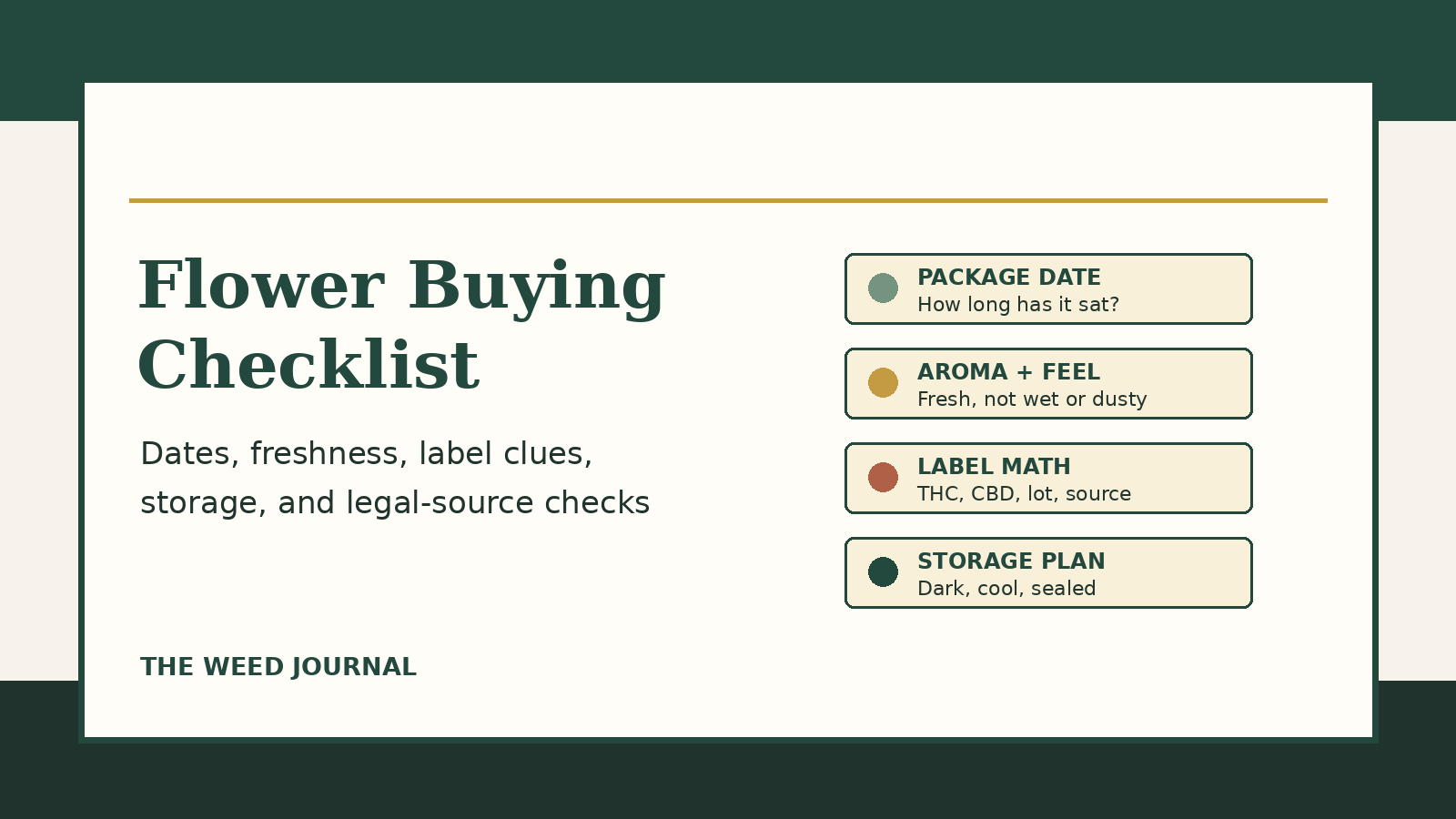
    Buying cannabis flower should not feel like guessing from a strain name and the biggest THC number on the menu. In Canada, legal flower gives adults useful clues before they buy: package dates, lot numbers, THC and CBD values, net weight, warning symbols, producer details, and sometimes terpene or harvest information. The trick is knowing which clues matter in the real world.

    This flower buying checklist is for Canadian adults who want fresher, better-matched cannabis without turning a simple purchase into a chemistry exam. It focuses on legal-source signals, freshness, label reading, aroma and texture, storage plans, and when to walk away.

    Quick answer

    When buying cannabis flower in Canada, check that the seller is legal, the package is sealed and clearly labelled, the package date is reasonable, the product is not overly dry or suspiciously wet, the THC/CBD numbers fit your tolerance, and you have a storage plan before opening it. THC percentage is only one clue. Freshness, product format, terpene profile, lot information, and how you plan to use the flower often matter more than chasing the strongest option.

    If you are new, returning after a tolerance break, or switching from another format, start with modest THC, smaller quantities, and a product you can evaluate slowly. For broader shopping safety, keep our legal cannabis buying checklist for Canada open as a companion.

    The 2-minute flower buying checklist

    Check Green flag Red flag
    Legal source Provincially authorized store or site Anonymous delivery menu, no legal retailer trail
    Package integrity Sealed, child-resistant, labelled package Loose bag, relabelled jar, missing warnings
    Package date Recent enough for the product and price Old date with no discount or storage explanation
    THC/CBD Fits your tolerance and use case Highest THC pushed as the only quality marker
    Freshness Aroma is clean; flower is not dusty or wet Musty smell, visible mould, harsh dryness, damp clumps
    Storage plan Cool, dark, sealed, away from children and pets Left in a hot car, clear jar in sunlight, loose bag
    This checklist is not about finding the strongest flower. It is about avoiding preventable disappointment and obvious safety problems.

    1. Start with the seller, not the strain

    The first quality check is whether the product is coming through a legal channel. Health Canada tells consumers to choose legal cannabis because legal products must meet federal rules for production, packaging, labelling, and testing. Provinces and territories decide how legal retail works, so the exact store system depends on where you live.

    In Ontario, for example, adults can buy recreational cannabis from authorized cannabis stores or the Ontario Cannabis Store. Other provinces have their own legal retail systems. The practical rule is simple: if the source cannot show a clear legal trail, do not let a strain name, discount, or delivery promise distract you.

    Legal does not automatically mean every product will be perfect for you. It does mean the package should carry required information and come through a regulated supply chain. That gives you something to verify before you spend money.

    2. Read the label before you read the hype

    Canadian cannabis flower labels can feel crowded, but a few fields do most of the work. Look for Total THC, Total CBD, net weight, lot number, packaging date, warning label, excise stamp when applicable, and producer information. Some products also list terpenes, harvest date, drying or curing notes, or humidity-pack information.

    Our full Canadian cannabis label guide explains label math in more detail. For a buying decision, ask three fast questions: how strong is this likely to feel for me, how fresh is it likely to be, and can I trace the package to a real legal producer or retailer?

    Be careful with percentages. A flower listed at 29% THC is not automatically better than one listed at 21%. It may be stronger, harsher for your tolerance, older, drier, or simply less enjoyable for your use case. If THC number is becoming the whole decision, read our guide to why THC percentage is not everything.

    3. Treat package date as context, not a pass-fail stamp

    A package date tells you when the product was packaged, not necessarily when it was harvested. Still, it is useful. Flower can dry out, lose aroma, or become less pleasant when it sits too long, especially if the package seal, humidity control, or storage conditions are poor.

    There is no single date where legal flower instantly becomes bad. A recent package can still disappoint, and an older package can still be acceptable if it was stored well and priced honestly. Use the date with the rest of the evidence: aroma, texture, moisture balance, brand track record, product size, and whether the retailer is transparent.

    For a deeper freshness pass, use our guide on how to tell if cannabis flower is fresh in Canada.

    4. Learn the difference between dry, cured, and suspicious

    Good flower is not supposed to feel wet. It should be dry enough to burn or vaporize properly and cured enough to avoid a grassy, harsh, unfinished feel. But there is a difference between properly dried flower and flower so brittle that it turns to dust when handled.

    Use these practical clues after purchase, before use:

    • Too dry: crumbles into powder, weak aroma, harsh smoke or vapour, no spring in the buds.
    • Too wet: spongy or damp clumps, hard to grind, unusual ammonia or musty smell.
    • Possible mould issue: fuzzy growth, grey-white patches that do not look like trichomes, damp basement smell, or visible contamination.
    • Better balance: clean aroma, slight give, no wetness, no visible contamination, and a grind that is not dust.

    If you see or smell something that suggests mould or contamination, do not use the product. Use the mouldy cannabis flower checklist for the stop-use signs, then contact the retailer or producer through the appropriate channel and keep the package information.

    5. Do not buy more than you can store well

    Large formats can look cheaper per gram, but flower quality can fall after opening if you store it poorly. Heat, light, air, and frequent opening can all make flower less enjoyable. Buying a larger bag only helps if you will use it in a reasonable timeframe and keep it sealed properly.

    The safest household move is boring: keep cannabis in its original packaging or a clearly labelled airtight container, store it somewhere cool and dark, and keep it away from children, pets, and anyone who has not agreed to use cannabis. Do not leave flower in a car, window, bathroom, or open tray. Our cannabis storage guide for Canada covers temperature, humidity, and household safety in more detail.

    6. Match the flower to the use case

    A good product for one person can be the wrong product for another. Before buying, decide what you need the flower to do in practical terms. Are you looking for a small evening amount, a lower-THC option, something aromatic for a dry herb vape, or a budget product for experienced use? The answer changes what you should value.

    For beginners or returning adults, moderate THC, smaller package size, and a clear label usually beat a bargain ounce with a high number and little context. For experienced consumers, price-per-gram may matter more, but it still should not override freshness or legal-source checks. For dry herb vaping, grind, moisture balance, and aroma may matter as much as headline potency.

    If you are still comparing formats, start with our Cannabis 101 product type guide before buying flower by habit.

    7. Use terpenes carefully

    Terpene labels can help describe aroma and product character, but they should not be treated like guaranteed effect labels. A listed terpene profile may tell you the flower smells citrusy, piney, earthy, fuel-like, spicy, or floral. It does not prove the product will make you sleepy, creative, calm, or social.

    Use terpenes as one clue among many: aroma preference, THC/CBD amount, your tolerance, the product format, and your own past experience. If a menu turns terpenes into medical promises, slow down. The evidence is more complicated than marketing copy often makes it sound. For a plain-language primer, read Terpenes for Beginners in Canada.

    8. Know when to walk away

    Walk away from any flower purchase when the seller cannot show legal status, the package is not intact, required label information is missing, the price seems tied to unrealistic claims, or the product is being sold with medical promises. Also walk away if you are being pushed toward the highest THC option after saying you want something mild.

    After purchase, do not use flower that appears mouldy, unusually damp, contaminated, or mislabelled. Keep the packaging, document the lot number and retailer, and follow the retailer or provincial process for product concerns. If someone accidentally consumes cannabis, especially a child or pet, treat it as urgent and seek appropriate help.

    A simple decision flow

    1. Confirm the retailer is legal in your province or territory.
    2. Choose the smallest practical size for a new product.
    3. Check Total THC and CBD against your tolerance.
    4. Check package date and any freshness notes.
    5. Prefer clear label information over vague strain hype.
    6. Plan storage before opening the package.
    7. After opening, stop if aroma, texture, or appearance raises concerns.

    Bottom line

    A better flower purchase starts before you smell the jar or grind the bud. Buy from a legal source, read the label, use package date as context, avoid treating THC percentage as the whole story, and store the product properly after opening. The best cannabis flower for you is not the loudest menu item. It is the one that fits your tolerance, budget, use case, and safety boundaries without requiring guesswork.

    Sources

  • Cannabis Topicals in Canada: Creams, Balms, and Labels

    Cannabis Topicals in Canada: Creams, Balms, and Labels

    Cannabis topicals can look familiar at first glance: creams, balms, lotions, oils, bath products, and similar formats meant for the skin. That familiar packaging is exactly why adults in Canada should slow down before buying one. A topical is still a regulated cannabis product, not an ordinary cosmetic with a cannabis-themed label.

    This guide explains what cannabis topicals are in Canada, how to read the label, what they can and cannot promise, and how to choose a product without treating it like a medical shortcut. It is written for adults who want the plain-language version before they add a topical to their routine.

    What counts as a cannabis topical?

    In Canada, cannabis topicals are one of the classes of cannabis that may be sold legally under the federal framework. Health Canada describes topicals as products that include cannabis as an ingredient and are intended for external body surfaces such as skin, hair, or nails. On a retail menu, that can include lotions, creams, balms, bath bombs, body oils, and similar products.

    The important boundary is use. A topical is not an edible, not a tincture, not a vape product, and not dried flower. It should be used only as directed on the package. If the product is meant for external use, do not eat it, smoke it, vape it, or use it in a way the label does not describe.

    If you are still learning the bigger product landscape, start with our Cannabis 101 guide to product types in Canada. Topicals make more sense once you can separate inhaled, ingested, oral, and external-use formats.

    Topicals are regulated cannabis, not casual CBD skincare

    One common mistake is assuming that a CBD cream is automatically outside cannabis rules because it feels like skincare. That is not how CBD is regulated in Canada. Health Canada says CBD and products containing CBD are subject to the rules and requirements that apply to cannabis under the Cannabis Act and its regulations. CBD products are legal only when sold in compliance with that system.

    That matters because unregulated topical products may use vague wellness language, unclear CBD or THC numbers, imported branding, or non-cannabis retail channels that do not match Canadian rules. A legal product should have regulated packaging, a product class on the label, THC and CBD information, required warnings, storage instructions, and a legal purchase channel.

    For Ontario readers, the baseline is simple: adults must be 19 or older to buy, possess, and use recreational cannabis. Legal shopping should go through the Ontario Cannabis Store or authorized retailers. If a topical is being sold through a random wellness shop, social account, or grey-market site with no clear cannabis authorization trail, treat that as a red flag.

    What topicals can and cannot tell you

    A legal topical label can help you understand the product. It is not a guarantee that the product will deliver a specific effect for your body. Cannabis affects people differently, and topical products are especially easy to overinterpret because the packaging can borrow the language of skincare, sports recovery, and wellness.

    Label detailWhat it helps you checkReader-first caution
    Product classConfirms whether the product is a cannabis topical rather than an extract, edible, or cosmetic-style item.Use it only in the way the product class and directions support.
    Total THC and Total CBDShows the cannabinoid amount or concentration declared for the product.Do not assume more THC or CBD means better results.
    Net weight, volume, and unitsHelps compare package size, pumps, bath products, or single-use formats.A larger container can still have a different concentration than a smaller one.
    Directions for useShows where, how much, and how often the product is intended to be used.Avoid broken skin, eyes, mucous membranes, or other use unless the label specifically supports it.
    Storage conditionsExplains temperature, light, and handling instructions for product quality.Keep cannabis products secured away from children and pets.
    Authorized source and excise detailsHelps separate legal cannabis from suspicious products.An attractive brand or review page does not prove legal status.

    Health Canada’s label guidance is useful here because it reminds shoppers to check the product class, THC and CBD amount, health warning, net weight or volume, number of units, and storage conditions. If you cannot find those basics, the product is not giving you enough information to compare it responsibly.

    Will a cannabis topical get you high?

    Many people ask this because topicals may contain THC. The cautious answer is that a topical should not be treated like an edible, vape, or smokeable product. It is intended for external use, and the way cannabinoids interact with the body depends on the product, formulation, amount used, skin condition, and use pattern.

    That does not mean the label can be ignored. You should still read the THC and CBD amounts, follow the directions, and avoid using more than directed because “it is only a cream.” You should also wash your hands after use unless the product is meant for the hands, and you should avoid accidentally transferring product to your eyes, mouth, food, or another person.

    If you are comparing THC strength across product types, our guide on why THC percentage is not everything is a helpful companion. Topicals are another example of why product format and directions matter as much as the cannabinoid number.

    A practical buying checklist

    Use this checklist before buying a cannabis topical in Canada:

    • Confirm the seller is legal for your province or territory.
    • Check that the label identifies the product as a cannabis topical.
    • Read the Total THC and Total CBD information instead of relying on front-label marketing language.
    • Compare concentration, net amount, and number of uses rather than package size alone.
    • Look for clear directions, including where the product should and should not be applied.
    • Check storage instructions and keep the product away from children, pets, and visitors.
    • Avoid products that make strong pain, inflammation, sleep, anxiety, or healing claims without a regulated medical context.
    • Do not use a cannabis topical on irritated or broken skin unless a qualified health professional has advised you and the product directions fit that use.

    This is also where legal-source checks matter. Health Canada notes that legal cannabis products are subject to rules for quality, packaging, labelling, promotion, and recall. Legal does not mean risk-free, but it does give you a clearer trail than an unverified marketplace product.

    How to compare creams, balms, oils, and bath products

    Topicals are not all designed for the same use. A cream may spread differently than a thick balm. A bath product may be used once, while a lotion may be applied in smaller amounts over time. A roll-on may be convenient but harder to compare if you do not know how much product comes out with each use.

    When comparing products, start with format and directions before price. Ask: where is this meant to be used, how much does the label suggest, how many uses does the package realistically contain, and how strong is the cannabinoid concentration per amount used? Those questions are more useful than chasing the highest CBD number on the shelf.

    For broader shopping habits, see our legal retailer checklist for buying cannabis in Canada. The same principle applies here: verify the seller first, then compare the product.

    What claims should make you pause?

    Be careful with products or pages that promise quick relief, guaranteed recovery, anti-inflammatory results, sleep improvement, anxiety control, or treatment for a specific condition. That kind of claim changes the stakes for readers. A general retail cannabis product should not be treated as medical advice.

    It is reasonable to be curious. It is not reasonable for a seller to push certainty where the evidence, your health situation, and the product label do not support it. If you have a medical condition, take prescription medication, have sensitive skin, are pregnant or breastfeeding, or are buying for someone else, speak with a qualified health professional rather than relying on a product page.

    Storage and household safety

    Topicals can be especially risky around children and pets because they may resemble ordinary lotions, balms, bath products, or cosmetics. Keep them in the original child-resistant package when practical, follow the storage directions, and do not leave them in a bathroom, bag, or bedside drawer where someone may mistake them for a regular product.

    Also pay attention to heat and light. Creams, oils, and balms can change texture or separate if stored poorly. The label should provide recommended storage conditions. If the smell, texture, colour, packaging, or seal looks off, do not try to rescue the product. Dispose of it according to local guidance and replace it through a legal source if needed.

    For a deeper storage primer, read our guide to storing cannabis in Canada.

    Bottom line

    Cannabis topicals are easiest to understand when you treat them as their own category. They are external-use cannabis products, not edibles, not extracts to ingest, and not ordinary skincare. Read the label, verify the legal source, avoid medical-claim marketing, follow the directions, and store the product securely.

    If a topical cannot answer the basic questions of what it is, how it is meant to be used, how much THC and CBD it contains, where it came from, and how to store it, choose a clearer product or skip it.

    Sources

  • Budget vs Premium Cannabis in Canada: What Matters

    Budget vs Premium Cannabis in Canada: What Matters

    Budget cannabis can be a smart buy in Canada. Premium cannabis can also be worth paying for. The problem is that neither word tells you much by itself. A low price can hide old flower, weak packaging, or a format that does not fit your use. A high price can hide ordinary cannabis behind nicer branding.

    This guide gives adult shoppers a practical way to compare budget and premium cannabis without treating THC percentage as the whole decision. It is Canada-aware, label-first, and intentionally cautious: no product type is automatically safer or better for everyone, and this is not medical advice.

    Quick answer

    The best value is the product that fits your tolerance, format preference, freshness expectations, label needs, and budget. Budget cannabis is often a better choice for experienced shoppers who know what they like and can read labels closely. Premium cannabis may be worth it when freshness, aroma, terpene information, small-batch handling, or product consistency clearly improve the experience. In both cases, buy legal, check the label, and avoid shopping by THC percentage alone.

    Budget vs premium cannabis at a glance

    Comparison point Budget cannabis Premium cannabis What to check
    Price Lower cost per gram, unit, or package. Higher price because of brand, format, batch size, handling, or perceived quality. Compare value by usable fit, not just sticker price.
    THC percentage May still be high, especially in dried flower or concentrates. May be high, moderate, or balanced. Total THC matters, but higher is not automatically better.
    Freshness Can be fresh, but older packages may be more common in clearance or value bins. Often marketed around freshness, aroma, and craft handling. Look for packaging date, lot details, seal quality, smell after opening, and texture.
    Label detail Sometimes simple, sometimes very complete. Often more detailed, but not always. Read Total THC, Total CBD, ingredients, allergens, warnings, and directions.
    Best use case Everyday shoppers who already understand their tolerance and product preferences. Shoppers who care about aroma, flavour, terpene profile, specific format, or consistency. Choose by purpose: occasional, social, low-dose, format-specific, or aroma-focused.

    Start with legal source, not price tier

    Before comparing budget and premium, confirm the product comes through a legal Canadian source. Health Canada continues to warn that illegal cannabis products are still sold and consumed in Canada. Legal products have required packaging, labelling, child-resistant features, warning information, and a regulated supply chain that illegal sellers may not provide.

    That does not mean every legal product is perfect. It means the baseline comparison is fairer. If one seller cannot show a legal retailer trail, a proper package, clear THC/CBD information, and ordinary consumer protections, the price tier is a distraction. Our legal cannabis buying checklist for Canada is the first page to use when the source itself is uncertain.

    Do not treat THC as the value score

    One of the most common buying mistakes is comparing products by the biggest THC number per dollar. Health Canada explains that THC is responsible for intoxication, and that harmful effects may be greater when THC strength is higher. Higher potency can also make a product less useful if it pushes you past the experience you actually wanted.

    This is especially important when comparing a budget eighth against a premium eighth. A cheaper high-THC flower is not necessarily a better deal if it feels harsh, stale, too strong, or hard to dose. A premium flower is not necessarily better just because it also has a high number. THC percentage is one useful label fact, not the verdict.

    If you want a deeper explanation, read our guide on why THC percentage is not everything in Canada. For today’s shopping decision, the shortcut is simple: match potency to your tolerance and setting before you compare price.

    Read the label like a buyer, not a collector

    Health Canada’s cannabis label guidance says legal labels provide health and safety information that can help reduce harm. For shoppers, that turns the label into the most practical comparison tool. You do not need to know every technical term. You do need to slow down long enough to check the basics.

    Look for Total THC, Total CBD, package date, lot number, net weight or volume, directions for use, warnings, ingredients, and allergens where relevant. For inhaled products, check the format and any hardware requirements. For edibles and oils, check the amount per unit, not just the amount in the whole package.

    A premium-looking label that hides basic information is not shopper-friendly. A budget label that is clear, current, and easy to understand may be a better practical buy. Our Canadian cannabis label guide explains those fields in more detail.

    When budget cannabis can make sense

    Budget cannabis can be a good fit when the product is legal, clearly labelled, reasonably fresh, and aligned with your tolerance. Some value products are simply larger batches, simpler packaging, older brand lines, or lower-margin offerings. A lower price does not automatically mean poor quality.

    Budget flower may make sense for shoppers who use a dry herb vaporizer, roll regularly, cook with legal dried cannabis where permitted, or already know they prefer a certain THC/CBD range. Budget edibles or beverages may make sense when the serving size is clear and the product fits your routine. Budget CBD products may be reasonable when the label is clear and the cannabinoid amount is easy to compare.

    The warning is that budget buying punishes guesswork. If you are new, sensitive to THC, returning after a tolerance break, or shopping for a format you have never used, the cheapest option is not always the lower-risk option. Paying less for a product that is too strong, confusing, or stale is not value.

    When premium cannabis may be worth it

    Premium cannabis may be worth paying for when the extra cost buys something you can actually evaluate: fresher flower, better trim, stronger aroma, more complete terpene information, cleaner handling, format reliability, or a more consistent experience across purchases. The word “premium” should point to evidence, not just packaging.

    For dried flower, useful evidence can include a recent packaging date, good texture, intact aroma after opening, visible care in trim and cure, and label details that match the product story. For vape cartridges, premium should mean clear ingredients, reliable hardware compatibility, appropriate warnings, and no mystery additives. For oils, capsules, or edibles, premium should mean precise serving information, consistency, and clear ingredients.

    Premium is less persuasive when it leans on vague language. “Craft,” “top shelf,” “exclusive,” “reserve,” and “small batch” may describe real differences, but they do not replace label facts. If the product cannot tell you what is in it, how strong it is, how to use it, and when it was packaged, the brand language is doing too much work.

    Freshness is where price tiers often separate

    Freshness is not just a luxury concern. Dry, old, or poorly stored cannabis can smell flat, feel brittle, burn or vape harshly, and make the purchase feel disappointing even if the THC number looked attractive. Yesterday’s storage guide covered why light, heat, air, and moisture matter after purchase; the same logic matters before purchase too.

    When comparing two flower products, check the package date and ask whether the retailer can explain storage basics. Once opened, look for aroma, texture, and obvious signs of age or damage. Cannabis should not be wet, moldy, dusty, or suspiciously perfumed. If flower seems wrong, do not try to rescue it by using more.

    For a buyer-friendly freshness pass, use our fresh cannabis flower checklist. For after-purchase handling, see how to store cannabis in Canada.

    Format changes the value calculation

    Budget vs premium looks different across flower, vapes, edibles, oils, beverages, and concentrates. A cheap flower product may be easy to portion if you know your tolerance. A cheap vape cartridge with unclear ingredients or poor hardware fit can be a bad risk. A premium edible with the same THC per unit as a budget edible may not be meaningfully different if ingredients and serving size are similar.

    Compare products inside the same format first. Dried flower competes with dried flower. A vape cartridge should be compared with other cartridges that use compatible hardware and clear ingredients. Edibles should be compared by THC per unit, CBD amount, ingredients, onset expectations, and serving control. Concentrates should be compared even more carefully because small amounts can carry high THC exposure.

    If you are choosing between formats, step back to the larger product-type decision. Our Cannabis 101 product type guide is a better starting point than a price comparison when the format itself is undecided.

    A practical value checklist

    • Confirm the source. Legal Canadian retailer or proper medical channel first.
    • Match the format to your use. Do not buy a product type you do not understand just because it is discounted.
    • Check Total THC and Total CBD. Choose a strength that fits your tolerance and setting.
    • Read the package date. Especially for dried flower and products where freshness affects aroma or texture.
    • Inspect ingredients. Important for edibles, oils, vapes, beverages, capsules, and allergies.
    • Compare serving control. Products that are easy to portion are often better value for cautious users.
    • Ignore vague prestige words. Premium should mean clear evidence, not just nicer branding.
    • Plan storage. A good purchase can become a poor one if it is left in heat, light, or open air.

    Red flags in both budget and premium products

    Some warning signs apply at every price. Be cautious with missing or unclear label details, unrealistic health claims, cartoonish illegal-style branding, damaged packaging, no legal source trail, vague ingredients, pressure to buy quickly, or claims that a product is “safe” because it is natural. Cannabis is a psychoactive product; natural does not mean risk-free.

    Also be careful with products that make the experience sound guaranteed. Cannabis effects vary by person, tolerance, setting, product format, and other substances. A product cannot promise relaxation, sleep, creativity, pain relief, or anxiety relief for everyone. Those claims are especially risky when they encourage a shopper to ignore dose, potency, or personal health context.

    How to compare two products in the store

    Use a simple four-step scan. First, confirm both products are legal and in the same category. Second, compare Total THC, Total CBD, package size, and serving size. Third, compare freshness and label clarity. Fourth, ask what the higher price or lower price actually changes for you.

    Here is an example: Product A is cheaper flower with high THC, an older package date, and little terpene detail. Product B costs more, has moderate THC, a recent package date, and clearer aroma information. The right answer depends on the buyer. Someone seeking low-cost, familiar flower may choose Product A. Someone who values freshness and a less intense session may choose Product B. Neither decision should be based on the price tag alone.

    Keep notes after purchase if you use cannabis more than occasionally. Product name, format, THC/CBD, amount used, time, food or alcohol context, setting, and how it felt can teach you more than brand language. Over time, those notes make both budget and premium shopping easier.

    Bottom line

    Budget cannabis is not automatically low quality, and premium cannabis is not automatically better. In Canada, the stronger shopping habit is to buy legal, read the label, match potency to your tolerance, check freshness, and compare products by use case.

    If a cheaper product is clear, fresh enough, legal, and easy for you to use responsibly, it may be good value. If a premium product gives you better freshness, clearer information, better format reliability, or a more suitable potency, it may be worth the extra cost. The best buy is the one you can understand before you open it.

    Sources

  • CBD Oil in Canada: What Adults Should Know Before Buying

    CBD Oil in Canada: What Adults Should Know Before Buying

    CBD oil is one of the easiest cannabis products to misunderstand. It can look wellness-adjacent, it is often sold in small bottles, and the label may list several numbers that sound similar. In Canada, though, CBD oil is still a cannabis product. Adults should treat it like cannabis first: buy from a legal source, read the label, understand the THC content, and avoid medical assumptions that the package does not prove.

    This guide is for adults comparing legal CBD oils in Canada. It is not medical advice, and it does not tell anyone to use CBD for a health condition. The goal is practical: understand what you are buying before a bottle ends up in your cart or on your counter.

    Quick answer

    In Canada, CBD oil should be bought through legal recreational retailers or, for registered medical cannabis patients, through the proper medical cannabis channel. The most useful label checks are CBD per activation or per mL, total THC, bottle size, carrier oil, ingredients, lot number, packaging date, expiry date if provided, and the excise stamp for the province or territory where it is sold.

    CBD is not the same as “non-intoxicating no matter what.” Many CBD oils contain some THC, and cannabis can affect people differently depending on dose, product type, body chemistry, other substances, and timing. If you are comparing CBD with other cannabinoids, start with our THC vs CBD vs CBN guide, then use the label-focused checks below.

    CBD oil label checks at a glance

    Label item What to check Why it matters
    CBD amount CBD per mL, per activation, or total bottle amount. This is the number you need for basic serving math.
    Total THC THC per mL and total THC in the bottle. CBD-forward oils may still contain THC.
    Carrier oil MCT, sunflower, olive, or another listed carrier. Useful for allergies, preference, and digestion comfort.
    Package and lot details Lot number, packaging date, and expiry date if provided. Helps with freshness, recalls, and product tracking.
    Excise stamp Province or territory stamp on legal cannabis packaging. Signals legal-duty-paid product in the intended market.
    Directions and warnings Use instructions, storage notes, and cannabis warnings. Legal cannabis packaging is designed to slow down impulsive use.

    What CBD oil is in the Canadian retail context

    CBD oil usually means a cannabis extract diluted into a carrier oil and sold with a dropper or measured activation format. The bottle may be CBD-dominant, balanced with THC, or formulated with other cannabinoids. The exact profile matters more than the front-of-package phrase.

    Health Canada explains that cannabis contains many chemical substances, including cannabinoids such as THC and CBD. THC is the main intoxicating cannabinoid. CBD is not intoxicating in the same way, but that does not turn every CBD product into a risk-free wellness item. The product still needs legal packaging, responsible storage, and careful label reading.

    If the front label says “CBD oil,” do not stop there. Turn the bottle or product page into a simple question: how much CBD, how much THC, how many millilitres, and how is one serving measured?

    Buy legal first

    Before comparing strengths or prices, confirm the seller is legal. Health Canada points consumers to provincial and territorial systems for legal recreational cannabis sales. In Ontario, the official online store is the Ontario Cannabis Store, while private retail stores are licensed by the Alcohol and Gaming Commission of Ontario. Other provinces use different models.

    That matters for CBD oil because illegal sellers may lean heavily on wellness language, imported-looking packaging, or “hemp oil” confusion. A legal Canadian cannabis oil should come through a legal cannabis channel and carry the required cannabis packaging information. If you are unsure how to verify a retailer, use our buying cannabis in Canada checklist before comparing products.

    Read CBD and THC together

    A CBD-forward product can still contain THC. Sometimes the THC amount is small; sometimes the product is intentionally balanced. Either way, the practical question is not “is this CBD?” but “what is the CBD-to-THC profile per measured amount?” If the label gives both cannabinoids but the relationship is unclear, use our CBD:THC ratio guide to compare common product profiles before choosing.

    Look for both the amount of CBD and the amount of THC. If a product lists total bottle amounts only, divide by the bottle volume to estimate mg per mL. If it lists mg per activation, confirm what one activation means. A dropper, spray, capsule, and beverage all create different serving expectations.

    For a deeper walkthrough of package numbers, see our Canadian cannabis label guide.

    Do not treat CBD as medical advice from the shelf

    CBD is often discussed online in the context of sleep, pain, stress, inflammation, and anxiety. Some of that conversation comes from early research, some comes from personal experience, and some comes from marketing. A retail cannabis label is not a diagnosis, prescription, or proof that the product will do what a social post claims.

    Health Canada warns that cannabis can affect mental and physical health and that effects vary by person and product. If someone is pregnant, breastfeeding, taking medication, has a health condition, or is using cannabis for symptom management, that is a health-professional conversation rather than a blog-post decision. The safest editorial stance is to separate label literacy from treatment claims.

    Start low, especially with oils

    Oils are easy to underestimate because they do not look like smoking, vaping, or a strong edible. But swallowed cannabis oils can behave more like edible cannabis than inhaled cannabis. Onset may be delayed, effects may last longer, and taking more too soon can make the experience uncomfortable.

    Health Canada’s lower-risk cannabis use guidance recommends starting with a low amount and going slowly when using cannabis. That advice is especially useful when a CBD oil contains THC or when a person is new to cannabis oils. If you are trying to understand timing, our edibles onset guide explains why swallowed cannabis can take longer to feel than inhaled formats.

    Watch the carrier oil and ingredients

    CBD oil is not only cannabinoids. It also includes a carrier oil and sometimes flavouring or other ingredients. Common carriers can include MCT oil, sunflower oil, olive oil, or other food-grade oils. For many adults this is a preference issue, but for some it can matter because of allergies, digestion, diet, or personal tolerance.

    If a product page hides the ingredient list, that is a reason to slow down. Legal cannabis products should not require guesswork about what is in the bottle. The ingredient list also helps distinguish CBD oil from dried flower, capsules, beverages, and topical products, which all have different use patterns.

    Check age, storage, and household safety

    CBD oil bottles are small and easy to misplace. Keep them in the original child-resistant packaging, away from children and pets, and follow storage directions on the label. Health Canada consumer information repeatedly emphasizes keeping cannabis away from young people and storing products securely.

    Do not transfer CBD oil into an unlabelled dropper, supplement bottle, or kitchen container. That creates avoidable confusion, especially in shared households. The original package keeps the THC/CBD numbers, lot details, warning statements, and purchase context attached to the product.

    Price comparisons: compare mg, not bottle hype

    CBD oil prices are easier to compare when you convert the label into rough cost per mg of CBD, while still accounting for THC, bottle size, carrier oil, legal retailer trust, and product freshness. A larger bottle is not automatically a better deal if the CBD concentration is low, and a high-CBD bottle is not automatically the right fit if the THC amount or carrier oil does not suit you.

    Keep the comparison simple: total CBD in the bottle, total THC in the bottle, bottle volume, price before tax, and whether the retailer is legal. That small spreadsheet-style check prevents the front label from doing all the thinking for you.

    It also helps to write down how you expect to use the product before buying it. A bottle meant for occasional low-dose use is a different purchase from a bottle someone expects to use daily. That planning step can keep price, potency, and storage life in proportion.

    When CBD oil may not be the right product

    CBD oil may not be the right choice if you need precise no-THC assurance, dislike oil-based products, cannot wait for swallowed cannabis timing, are avoiding cannabis for work or driving reasons, or are trying to self-treat a condition without professional guidance. For some adults, a lower-risk decision is to skip the product entirely.

    It is also worth remembering that cannabis impairment and workplace or roadside testing are not the same thing as how a product feels in the moment. If the label shows THC, plan around driving, work, caregiving, and other responsibilities before using it.

    Bottom line

    CBD oil in Canada is best approached as a legal cannabis product, not a vague wellness shortcut. Buy from a verified legal source, read CBD and THC together, check the carrier oil and package details, store it securely, and be cautious about health claims that outrun the evidence.

    The best CBD oil decision is usually quiet and practical: legal source, clear label, low-and-slow approach, and no assumptions.

    Sources

  • How to Avoid Scam Cannabis Delivery Sites in Canada

    How to Avoid Scam Cannabis Delivery Sites in Canada

    Online cannabis shopping in Canada can feel confusing because legal retail, private delivery, provincial rules, medical access, and illegal websites all show up in the same search results. A polished site, a discount code, or a fast-delivery promise does not prove that a seller is legal.

    This guide is for adults who want a practical way to slow down before entering personal information or sending money. It is not legal advice, and it does not recommend any seller. The goal is simple: verify authorization first, then decide whether the site deserves your trust.

    Quick answer

    To avoid scam cannabis delivery sites in Canada, start with your province or territory’s official cannabis retailer list or government-run online store. Health Canada says legal cannabis products are sold only through retailers authorized by provincial or territorial governments, except for people registered to buy medical cannabis from a federally licensed seller.

    Public Safety Canada gives several plain-language warning signs for illegal online cannabis sales: the site does not ask for age before entry, accepts cryptocurrency at checkout, promises mail-order recreational cannabis across provinces, or cannot be verified against an authorized source. If a site fails those basic checks, close it before creating an account.

    If you are new to the legal side of cannabis, read our legal retailer checklist for buying cannabis in Canada first, then use the delivery-specific checks below.

    Scam-site checks at a glance

    Check What to look for Why it matters
    Authorization The store appears on an official provincial, territorial, or regulator list. Legal recreational cannabis sales are controlled by provincial and territorial systems.
    Age gate The site verifies legal age before entry or shopping. Public Safety Canada says a site that does not ask for age before entering is illegal.
    Payment Normal card or debit options through a recognizable checkout. Public Safety Canada says cryptocurrency payment is a sign the site is not legit.
    Service area Delivery is tied to the province, territory, or licensed store rules. Cross-country recreational mail-order promises are a major red flag.
    Product labels Legal packaging, THC/CBD information, excise stamp, warnings, and lot details. Legal cannabis has required packaging and quality-control rules.
    Contact trail Real business details, regulator match, privacy policy, and clear support channel. Scam sites often hide ownership or push buyers into private-message payment.

    Start with the official source, not the search result

    The safest first step is boring: go to the official cannabis page for your province or territory and work outward from there. Health Canada’s authorized retailer page links to provincial and territorial cannabis rules and says legal recreational cannabis is sold through authorized retailers. Our authorized online cannabis retailers checklist turns that habit into a step-by-step pre-order workflow.

    In Ontario, for example, the Ontario Cannabis Store is the province’s official online cannabis store, while private brick-and-mortar cannabis retailers are licensed by the Alcohol and Gaming Commission of Ontario. The AGCO maintains a map of authorized retail stores. Other provinces and territories use different systems, so a habit that is normal in one place may not transfer cleanly to another.

    Do not treat a search engine result, sponsored listing, social post, Telegram group, Reddit comment, or flyer as proof. Those can help you discover names, but authorization has to be checked against an official source.

    Understand what “delivery” can mean

    “Cannabis delivery” is not one uniform thing in Canada. It may mean a government-run online store shipping within a province, a licensed private store offering local delivery where rules permit it, a medical cannabis seller shipping to registered patients, or an illegal site using delivery language to look convenient.

    That difference matters because illegal sellers often copy the language of legitimate ecommerce. They may show glossy menus, fake reviews, countdown discounts, and customer-service chat. None of those elements answer the legal question. Ask first: who authorized this seller to sell recreational cannabis to adults in this province or territory?

    For broader legal context, see our guide to legal cannabis in Canada in 2026.

    Red flag 1: no real age gate

    A legal cannabis site should not feel like an ordinary snack shop. Public Safety Canada says that if a website does not ask for your age before entering, it is illegal. That is one of the quickest checks a reader can run without knowing every provincial detail.

    Age gates can still be imperfect, and a fake site can add one, so this is not the only test. But the absence of an age check is a hard stop. If the site lets anyone browse and buy without age screening, do not keep moving through checkout just because the menu looks professional.

    Red flag 2: cryptocurrency, e-transfer pressure, or private-message payment

    Public Safety Canada specifically warns that if an online cannabis checkout allows payment with cryptocurrency, it is not legit. Be careful with any checkout that pushes you away from ordinary card or debit payment into crypto, gift cards, unusual e-transfer instructions, or direct messages with a “dispatcher.”

    The fraud risk is obvious: once money is sent through a hard-to-reverse channel, the buyer may have little practical recourse. The legal risk is separate: payment convenience does not make an unauthorized cannabis seller legal.

    Red flag 3: the site promises recreational shipping across Canada

    Be skeptical of any recreational cannabis site that claims it can ship anywhere in Canada as if provincial rules do not exist. Public Safety Canada and police guidance commonly point to cross-province recreational shipping promises as a warning sign.

    Medical cannabis is different. Registered medical patients may buy directly from federally licensed sellers they are registered with. That does not mean every “medical” or “mail order” claim is legitimate. It means the verification path is different: check Health Canada’s licensed seller information and your registration details, not a random site’s marketing copy.

    Red flag 4: no match on an official list

    If the store says it is licensed, you should be able to verify that claim. In Ontario, check the AGCO cannabis retail store map or the Ontario Cannabis Store for the legal online channel. In Manitoba, the provincial liquor and cannabis authority lists legal stores. In other provinces, use the equivalent government or regulator page.

    Look for exact business names, addresses, and store details. A scam site may copy a real store name, slightly alter a domain, or use a similar logo. If the domain you are about to use is not connected to the authorized business you found, slow down and contact the store through the official listing rather than through the suspicious site.

    Red flag 5: the site skips product-label basics

    Legal cannabis in Canada comes with required packaging and labelling information. Health Canada explains that legal cannabis labels include details such as product class, THC and CBD information, warning messages, and standardized cannabis symbols where applicable. The package should also carry the right excise stamp for the province or territory where the product is intended to be sold.

    An online menu does not have to show every package detail before checkout, but it should not make legal labels feel irrelevant. If a seller talks only about strain names, celebrity-style effects, secret potency claims, or “no taxes” deals while hiding basic product information, treat that as a quality and legality warning.

    Our Canadian cannabis label guide explains what to look for once you have a legal product in hand.

    Red flag 6: unrealistic discounts and urgency

    Scam ecommerce sites often use urgency to keep shoppers from checking details. With cannabis, that can look like deep first-order discounts, “today only” delivery claims, free gifts that seem too generous, or menus packed with brand names that do not match what legal retailers usually carry.

    A sale is not proof of a scam, but pressure is a signal to pause. Open a second tab, check the official retailer source, search the domain carefully, and look for independent confirmation from the provincial regulator or legal store page.

    What to do before you order

    • Find your province or territory’s official cannabis buying page.
    • Confirm the seller, store, or online channel is authorized.
    • Check whether delivery is allowed in your area and under what conditions.
    • Confirm the site has an age gate before entry.
    • Reject crypto, gift-card, or private-message payment requests.
    • Look for clear business details that match the regulator listing.
    • Read the privacy and refund information before creating an account.
    • Keep screenshots and receipts if you proceed.

    If you already paid a suspicious site

    If you think you paid a scam site, do not send more money to “release” an order, pay a fake insurance fee, or unlock a delivery. Save the URL, screenshots, payment records, email headers, text messages, and any tracking numbers. Contact your bank or card issuer if you used a payment method with fraud protection.

    You can also report fraud or cybercrime to the Canadian Anti-Fraud Centre. The CAFC collects information about fraud and identity theft and provides online and phone reporting options. Reporting matters even when the amount is small because patterns help investigators and public-warning teams.

    Bottom line

    A real cannabis delivery option in Canada should survive boring verification. It should connect back to a provincial, territorial, regulator, or medical authorization path. It should screen for age, use normal payment methods, respect local rules, and provide product information that fits legal Canadian packaging standards.

    If a site asks you to trust speed, price, or secrecy instead of authorization, do not order. Legal first, then convenience.

    Sources

  • Can You Travel With Cannabis in Canada?

    Can You Travel With Cannabis in Canada?

    Travelling with cannabis in Canada is legal in some situations and a serious problem in others. The simple version is this: adults can usually travel domestically with a legal personal amount, but they are responsible for the rules in the province or territory they are visiting, and they should never take cannabis across an international border.

    This guide is for adults who already choose to use cannabis and want a practical, Canada-aware travel checklist. It covers domestic flights, road trips, province rules, packing, hotel etiquette, medical cannabis cautions, and the border rule. It is legal information for general education, not legal advice.

    Quick answer

    You may travel within Canada with cannabis if you are of legal age, the product is legal, and the amount is within the applicable possession limit. For most provinces and territories, Health Canada lists the public possession limit as 30 grams of dried cannabis or equivalent for adults. Quebec sets the legal age at 21, while most provinces and territories list 19 and Alberta lists 18.

    Domestic flights are different from international flights. CATSA says passengers are responsible for knowing the laws at their destination within Canada. CBSA is much stricter at the border: taking cannabis into or out of Canada without a Health Canada permit or exemption remains a serious criminal offence, even if the cannabis is legal where you bought it or legal where you are going.

    Domestic travel vs crossing a border

    Travel situation What to check first Reader-first rule
    Driving within one province Legal age, possession amount, open-container/storage rules, public-use rules. Keep products sealed or stored away from the driver and never consume before driving.
    Travelling between provinces The rules where you start, pass through, and arrive. Do not assume your home-province rules apply at the destination.
    Domestic flight inside Canada CATSA screening rules, liquid limits, destination laws, airline baggage rules. Keep legal products clearly packaged and avoid packing anything questionable.
    International flight or land border CBSA and destination-country rules. Do not bring cannabis across the border in any amount or form unless you hold a valid permit or exemption.
    Cruise, ferry, or mixed itinerary Whether the trip enters another country or crosses customs jurisdiction. Treat border exposure as a stop sign, not a grey area.

    The 30 gram rule is not the only rule

    Adults often hear that they can possess up to 30 grams of dried cannabis or equivalent in public. That is a useful starting point, but it is not the whole travel checklist. Health Canada notes that provinces and territories are responsible for cannabis sale and distribution in their jurisdictions, and that they can add restrictions such as changing legal age, lowering possession limits, or restricting where cannabis may be used in public.

    For travellers, the practical takeaway is straightforward: check the province or territory you are visiting before packing cannabis. A trip from Ontario to Quebec, for example, is not just a change of scenery. Quebec’s listed legal age is 21, while Ontario’s is 19. Public consumption, lodging rules, rental-car rules, campsite rules, and municipal bylaws can also affect what is allowed.

    If you are buying before a trip, use legal retailers only. Our legal retailer checklist for buying cannabis in Canada explains how to spot authorized sellers and avoid sketchy delivery sites.

    Can you fly domestically with cannabis?

    For domestic air travel, CATSA’s public guidance says recreational cannabis passengers are responsible for knowing the laws and regulations at their destination within Canada. It also notes that liquid and topical cannabis products are subject to liquid, aerosol, and gel restrictions in carry-on baggage and must fit with other liquids in the clear one-litre bag.

    That does not mean every cannabis product is a good idea for a flight. Airport screening is stressful enough without loose flower, unlabeled containers, mixed products, or liquids that look confusing. Keep legal products in original packaging when possible. Make sure labels are readable. Do not pack more than a legal personal amount. Do not consume cannabis before flying if it could make the airport process harder, and never consume in restricted airport or aircraft settings.

    If the product format is confusing, start with our Cannabis 101 product type guide. Oils, edibles, vapes, dried flower, capsules, topicals, and concentrates can create different packing questions.

    Do not cross the Canadian border with cannabis

    The border rule is the safest part of this article to remember because it has very little room for interpretation: do not bring cannabis into Canada and do not take cannabis out of Canada unless you have a Health Canada permit or exemption. CBSA says transporting cannabis across the border in any form, including oils containing THC or CBD, without that authorization remains a serious criminal offence.

    CBSA also says this applies regardless of the amount, whether you have a medical document, or whether you are travelling from an area where cannabis is legal or decriminalized. That means “it is legal in Canada” is not a defence for crossing a border with it. “It is legal in the destination state” is not a defence either.

    This includes small amounts, gifts, edibles, CBD oils, vape cartridges, and products purchased legally in Canada. If your trip involves customs, international airspace, a land border, or a country outside Canada, leave cannabis at home.

    Packing checklist for domestic trips

    • Confirm the legal age and possession limit where you are going.
    • Buy from an authorized retailer and keep the product in original packaging when possible.
    • Check the excise stamp and label if you are unsure whether the product is legal.
    • Do not pack more than a personal legal amount.
    • Keep liquids and topicals within carry-on liquid rules for domestic flights.
    • Store cannabis away from children, pets, and anyone who has not consented to use it.
    • Do not drive, cycle, boat, operate equipment, or do safety-sensitive work after using cannabis.
    • Do not consume in hotels, rentals, vehicles, parks, campuses, workplaces, or public spaces unless you have confirmed it is allowed.
    • Do not bring cannabis on any trip that crosses an international border.

    What about edibles?

    Edibles deserve extra caution when travelling because they can look like ordinary food, start slowly, and last longer than expected. If you bring edibles on a domestic trip, keep them in child-resistant legal packaging and do not mix them with regular snacks. Travelling with unlabeled edibles creates avoidable risk for roommates, family members, cleaners, hotel staff, and children.

    On timing, do not treat edibles like a quick pre-flight relaxer. Delayed onset can overlap with airport security, boarding, turbulence, customs-style questioning on unusual itineraries, or ground transportation after landing. If you need a refresher on timing, read how long edibles take to kick in before deciding whether they belong in your travel plan.

    What about vape cartridges?

    Vape cartridges add two sets of questions: cannabis rules and battery rules. For cannabis, confirm the product is legal, labelled, and within the possession limit. For the device, check airline and airport guidance for batteries and cartridges before flying. Do not assume a vape is discreet enough to use anywhere; many places that restrict smoking also restrict vaping.

    For product-quality checks, use our vape cartridge safety checklist. Legal packaging, clear labels, and source traceability matter more when you are away from home and cannot easily fix a bad purchase.

    Hotel, rental, and campground etiquette

    Legal possession does not automatically mean legal use in every space. Hotels, short-term rentals, campgrounds, condos, and campuses can set their own smoke-free or cannabis-free rules. A balcony is not always a permitted consumption area. A campsite may be governed by park rules, municipal rules, or the operator’s own policy.

    Be practical: read the house rules before you consume, avoid smoke or vapour that affects other guests, store products securely, and do not leave cannabis waste behind. If the only available option would bother other people or violate the property’s rules, do not use it there.

    Medical cannabis still needs planning

    Medical authorization does not make border travel simple. CBSA specifically says the border prohibition applies regardless of whether a traveller holds a medical document authorizing cannabis use. CATSA has separate guidance for cannabis oil used for medical purposes, including that larger quantities may need to be presented to the screening officer.

    If you use cannabis for medical purposes, plan earlier than a recreational traveller would. Check Health Canada guidance, carrier rules, destination rules, documentation needs, and storage requirements before travel. If your trip leaves Canada, speak with a qualified professional and do not assume you can carry cannabis with you.

    Common mistakes to avoid

    • Assuming “legal in Canada” means legal everywhere on your itinerary.
    • Bringing cannabis to the airport for an international connection.
    • Packing CBD oil for a border crossing because it “doesn’t get you high.”
    • Using cannabis before driving a rental car after arrival.
    • Carrying loose, unlabeled flower or homemade edibles.
    • Forgetting that Quebec’s legal age is listed as 21.
    • Ignoring hotel, campground, condo, or municipal consumption rules.

    Bottom line

    Travelling with cannabis in Canada is manageable when the trip is domestic, the product is legal, the amount is personal, and you have checked the rules where you are going. It becomes much riskier when you guess, repack products, carry unlabeled edibles, ignore local rules, or involve an international border.

    The safest travel habit is to make the decision before you leave home: Is this a domestic trip only? Am I of legal age at the destination? Is the product legal and labelled? Is the amount clearly within the limit? Do I know where I can and cannot use it? If any answer is unclear, leave it behind or check the official rule before packing.

    Sources