Tag: harm reduction

  • How to Sober Up From Being Too High: Canada Guide

    How to Sober Up From Being Too High: Canada Guide

    Getting too high can be frightening even when the cannabis came from a legal source. The room may feel too bright, time may feel strange, your heart may seem louder than usual, and the thought “I made a mistake” can loop harder than the actual symptoms.

    This guide is for Canadian adults who have taken more THC than they intended, or who are helping another adult through an uncomfortable cannabis experience. It is not medical advice. It is a calm, practical plan for what to do next, when to wait it out, and when to get help instead of trying to handle it alone.

    Quick answer

    There is no reliable instant way to sober up from being too high. The main job is to stop taking more cannabis, avoid alcohol or other substances, move to a safe and quiet place, stay hydrated without overdoing water, use slow breathing, and wait for the effects to pass. A sober trusted adult can help keep the situation grounded.

    Call 911 or seek urgent medical help if there is chest pain, trouble breathing, fainting, a seizure, repeated vomiting, severe confusion, injury, loss of consciousness, or if the person cannot be woken up. If you suspect cannabis poisoning and the person is awake but you are worried, Canada has a toll-free poison-centre number: 1-844-POISON-X, or 1-844-764-7669. In Quebec, call the Centre antipoison du Quebec at 1-800-463-5060.

    First: stop adding variables

    The most important first step is boring: do not take more cannabis. Do not take a second edible because the first one “should be peaking by now.” Do not add alcohol to soften the feeling. Do not take another drug to force a different direction. When someone is already too high, adding variables makes it harder to know what is happening and harder for a helper or clinician to make sense of symptoms.

    If the cannabis was an edible, beverage, oil, capsule, or homemade product, the wait may be longer than expected. Our guide to how long edibles take to kick in explains why delayed onset is one of the easiest ways to overdo it. If you are not sure how much THC was in the product, keep the package nearby so a sober adult, poison centre, or clinician can read the label.

    A calmer recovery checklist

    Step What to do Why it helps When to escalate
    Stop Put cannabis, alcohol, and other substances away Prevents stacking effects and confusion If more was taken accidentally, call for advice
    Sit somewhere safe Choose a quiet room, low light, and a stable chair or bed Reduces sensory overload and fall risk If there is injury, severe dizziness, or fainting
    Tell a sober adult Ask someone calm to stay nearby Reassurance and monitoring are useful when panic rises If the person is alone and symptoms feel unmanageable
    Slow the pace Breathe slowly, sip water, and avoid doom-scrolling Gives the body time without feeding anxiety If breathing is difficult or chest pain appears
    Wait Expect time to pass unevenly; set a simple check-in timer THC effects usually fade with time If symptoms worsen or the person cannot be woken
    This checklist is for uncomfortable overconsumption in adults, not a substitute for emergency care.

    Make the setting less intense

    A cannabis high can feel worse when the setting is loud, crowded, hot, bright, or socially stressful. Move away from the party, store, sidewalk, group chat, or argument if you can do so safely. Sit or lie down somewhere stable. Loosen tight clothing. Use a blanket if you feel cold. Put on quiet familiar audio if silence makes thoughts race, but avoid anything overstimulating.

    Simple reassurance matters. A sober helper can say, “You took too much THC, it feels bad, and we are going to wait this out safely.” That is more useful than debating whether the person “should” feel this way. Panic often feeds on uncertainty, embarrassment, and attempts to prove that nothing is wrong.

    If anxiety is the main symptom, our guide to weed anxiety and safer-use tips covers the THC, setting, tolerance, and expectation patterns that can make cannabis feel mentally uncomfortable.

    Use water and food carefully

    Sip water if your mouth is dry, but do not force large amounts. If you have not eaten and you feel steady enough, a simple snack may make the situation feel more normal. Choose something familiar, not a giant meal or more cannabis-infused food. If there is nausea, go slowly and keep the person seated.

    Caffeine is not a dependable fix. It may make some people feel more alert, but it can also make a racing heart or anxious thoughts feel sharper. The same goes for taking a shower: a comfortable warm shower may help some people feel grounded, but it is a bad idea if someone is dizzy, faint, confused, or unsteady. In those cases, sitting safely is better.

    Know the difference between uncomfortable and urgent

    Health Canada describes cannabis poisoning as temporary adverse effects from accidentally consuming or consuming too much cannabis at a time. It is not generally known to be fatal, but it can be very unpleasant and can sometimes require emergency medical attention. That distinction is important: many too-high experiences pass with time, but some symptoms should not be minimized.

    Get urgent medical help for chest pain, trouble breathing, severe weakness, repeated vomiting, severe confusion, hallucinations that feel dangerous, fainting, seizure, serious injury, or loss of consciousness. Also escalate quickly if the person mixed cannabis with alcohol, opioids, sedatives, unknown substances, or medications that affect breathing, sedation, heart rhythm, or blood pressure.

    If a child or pet may have consumed cannabis, do not wait to see how it goes. Treat that as urgent and contact emergency services, a poison centre, or a veterinarian as appropriate.

    Why edibles and concentrates can feel more intense

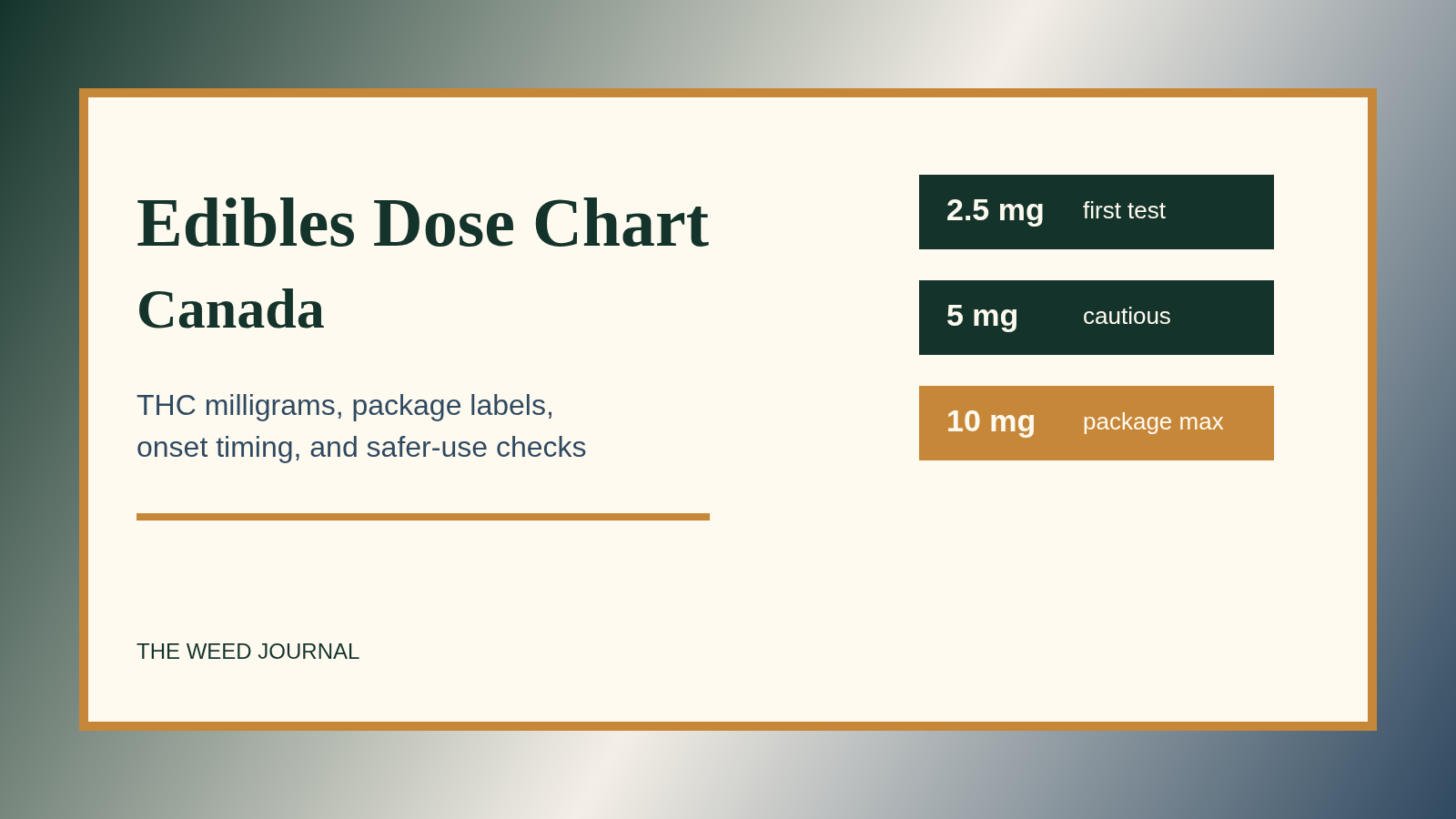
    Edibles are a common route to taking too much because they can take a long time to fully appear. A person may feel nothing, take more, and then realize the first amount was still building. Legal Canadian edible cannabis is limited to 10 mg THC per container, but that full container can still be too much for a beginner, an occasional consumer, or a sensitive adult. Our edibles dose chart for Canada explains the label math.

    Vape cartridges, concentrates, and high-THC flower can also surprise people because effects may arrive quickly and the dose can be harder to judge in the moment. A product that is legal is not automatically low-risk for every person or every setting. Health Canada’s lower-risk guidance emphasizes lower-strength products, avoiding early or frequent use, and avoiding impaired driving or safety-sensitive tasks.

    Do not drive, and do not decide the night is saved

    If you are too high, you are not driving. That includes “just a short drive,” scooters, bikes in traffic, boats, machinery, and safety-sensitive work. Cannabis can affect attention, coordination, reaction time, judgment, and decision-making. Feeling a little better after an hour does not prove you are unimpaired.

    Cancel the errand. Call a sober ride. Stay where you are if it is safe. If you are responsible for children, work, pets, or another person, ask a sober adult for help instead of trying to power through.

    What to write down for later

    When the worst has passed, write down what happened before the details blur. Note the product type, THC amount, CBD amount if listed, route of use, time taken, whether alcohol or other substances were involved, food timing, setting, and what symptoms appeared. This is not about guilt. It is about preventing a repeat.

    Many uncomfortable cannabis experiences come from patterns The Weed Journal has already covered: too much too soon, unclear edible math, chasing THC percentage, using cannabis while anxious, or not respecting tolerance. Start with our guide to beginner cannabis mistakes if you want a broader prevention checklist, and read how long THC lasts if your main question is timing.

    How to reduce the chance next time

    • Use less THC than you think you need, especially after a tolerance break.
    • Avoid edibles when you need a predictable timeline.
    • Do not mix cannabis with alcohol or unknown substances.
    • Choose a low-pressure setting with no driving, work, or childcare obligations.
    • Read Total THC before using any product.
    • Keep cannabis in original packaging and away from children, pets, and visitors.
    • Skip cannabis if it has recently caused panic, paranoia, fainting, or vomiting.
    • Talk to a qualified clinician if you use medications, have a medical condition, or have a personal or family history of psychosis.

    If your goal is to use smaller amounts, our guide to microdosing cannabis in Canada is a safer starting point than trying to rescue another too-high night.

    Bottom line

    You usually cannot snap yourself sober from THC. The practical move is to stop, simplify the environment, avoid adding substances, stay with a sober adult if possible, and let time pass while watching for red flags. Most uncomfortable cannabis experiences fade, but chest pain, breathing trouble, loss of consciousness, seizure, severe confusion, repeated vomiting, child exposure, pet exposure, or mixed-substance uncertainty deserve urgent help.

    Being too high is not a character flaw. It is a signal to change the dose, format, setting, or decision to use cannabis at all.
    Sources

  • Weed Anxiety: Why It Happens and Safer-Use Tips in Canada

    Weed Anxiety: Why It Happens and Safer-Use Tips in Canada

    Weed anxiety can catch people off guard. One person takes a puff and feels relaxed. Another takes the same amount and spends the next hour worrying that their heart is racing, their thoughts are looping, or everyone in the room can tell they are too high. That does not mean cannabis is mysterious or that the person did something wrong. It means the dose, product, setting, body, and expectations all matter.

    This guide is for Canadian adults who want a practical, non-hype answer. Cannabis is not a reliable treatment for anxiety, and this article is not medical advice. The useful question is narrower: why can cannabis make anxiety feel worse for some people, what choices can lower the risk, and what should you do if an uncomfortable high is already happening?

    Quick answer

    Cannabis anxiety is usually connected to too much THC for the person, a fast-onset format, a delayed edible dose that sneaks up later, a stressful setting, low tolerance, mixing substances, or using cannabis when you are already worried or sleep-deprived. Health Canada notes that cannabis can cause anxiety, panic, confusion, impaired attention, and other short-term effects, and that frequent use over time can contribute to poorer mental health for some people.

    The safer-use pattern is simple: choose legal products, read the label, keep THC low, avoid rushing a second dose, use in a calm setting, skip mixing with alcohol or other drugs, and do not drive or handle responsibilities after using. If anxiety becomes intense, recurring, or connected to self-harm thoughts, get real support rather than trying to solve it with more cannabis.

    Why cannabis can feel calming once and anxious another time

    Cannabis effects are variable. THC is the main intoxicating cannabinoid, and it can affect mood, perception, attention, coordination, and sense of time. That variability is why the same product can feel easy one night and overwhelming another night. Your sleep, food, stress level, tolerance, environment, and method of use all change the experience.

    THC percentage or milligrams are not personality traits. They are dose information. A product that is manageable for someone with frequent use may feel intense for a newer adult or someone returning after a long break. A social setting that feels fun while sober may feel loud, exposed, or overstimulating once THC is active. An edible that feels like nothing at 45 minutes can feel like too much at two hours.

    That is why cannabis anxiety is best treated as a planning problem first, not a character flaw. The goal is not to prove you can handle more. The goal is to make choices that fit your tolerance and the situation.

    Common triggers for weed anxiety

    Trigger Why it can raise anxiety risk Lower-risk choice
    High THC Higher THC can increase impairment and unwanted effects, especially for newer users Choose lower THC or more balanced THC:CBD products when appropriate
    Edibles too soon Effects can take much longer to arrive than inhaled cannabis, making repeat dosing easy Wait several hours before considering more
    Low tolerance A long break or occasional use can make a familiar product feel stronger Restart with a smaller amount than you used before
    Stressful setting Crowds, conflict, work pressure, or a loud room can amplify anxious thoughts Use only when the setting is calm and optional
    Mixing substances Alcohol or other drugs can make impairment and nausea harder to predict Avoid mixing, especially when trying a new product
    Using to escape anxiety Short-term relief can become a loop if cannabis replaces support or coping skills Treat recurring anxiety as a reason to talk with a professional
    There is no single cause of weed anxiety. Dose, format, tolerance, setting, and reason for use usually work together.

    If you are comparing products, start with The Weed Journal’s guide to why THC percentage is not everything in Canada. Potency is important, but it is only one part of a safer-use decision.

    THC, CBD, and the limits of label reading

    Labels help, but they do not predict your exact experience. THC and Total THC tell you about intoxicating potential. CBD and Total CBD can help you understand whether a product is THC-dominant, CBD-dominant, or more balanced. Health Canada and Canada’s lower-risk cannabis use guidance encourage people who choose to use cannabis to avoid high-potency products and consider products with lower THC and higher CBD relative to THC.

    That does not mean CBD is a guarantee against anxiety or impairment. It also does not mean a balanced product is automatically right for every person. The label is a starting point. Your amount, format, tolerance, and setting still matter.

    For a broader cannabinoid foundation, read THC vs CBD vs CBN in Canada. For package math and warning-label basics, use the guide to reading cannabis labels in Canada.

    Edibles deserve extra patience

    Edibles are one of the easiest ways to accidentally overshoot. The delay is the trap. Smoking or vaping usually feels more immediate, while edibles need time to move through digestion and metabolism. A person may think the product “is not working,” take more, and then have both amounts arrive later.

    If cannabis anxiety is a recurring issue for you, be especially careful with edibles and drinks. Use a known legal product, read the milligrams of THC per piece or serving, avoid stacking doses, and give the first dose enough time. A low dose can still feel stronger than expected if you are tired, hungry, stressed, or using after a long break.

    The Weed Journal has a separate edibles dose chart for Canada and a guide to how long edibles take to kick in. Those are better places for timing and milligram detail.

    What to do if you are already too high and anxious

    First, reduce stimulation. Sit or lie down somewhere safe, quiet, and familiar. Put away keys. Do not drive, cook over heat, use tools, make serious decisions, or keep scrolling through content that raises your heart rate. If you are with someone calm and trusted, tell them plainly that you feel too high and need a low-pressure environment.

    Second, remind yourself that uncomfortable cannabis effects are usually time-limited. That does not make the feeling pleasant, but it can help interrupt the panic loop. Slow breathing, dimmer lights, water, a light snack, a blanket, and a familiar show or playlist can help some people ride it out. Avoid taking more cannabis to “fix” the feeling.

    For a fuller step-by-step plan, use the Canada guide to what to do when you are too high.

    Third, watch for situations that need support. If someone has chest pain, trouble breathing, fainting, severe confusion, repeated vomiting, signs of psychosis, unsafe behaviour, or thoughts of self-harm, treat it as a health situation and seek urgent help. If a child, pet, or non-consenting person consumed cannabis, contact poison control or emergency services.

    A calmer pre-use checklist

    • Do I know the THC amount, Total THC, and serving size?
    • Is this a legal Canadian product with clear packaging and warnings?
    • Have I used this format before, or should I start much lower?
    • Am I rested, fed, hydrated, and in a calm place?
    • Do I have several hours with no driving, work, caregiving, or safety-sensitive tasks?
    • Am I using because I want to, or because I am trying to escape a hard feeling?
    • Am I avoiding alcohol and other substances tonight?
    • Is someone I trust nearby or reachable if I feel uncomfortable?

    If you cannot answer those questions comfortably, that is a good reason to skip, wait, or choose a smaller amount. Choosing not to use is always a valid lower-risk choice.

    When cannabis and anxiety need a bigger conversation

    Some people reach for cannabis because anxiety is already present. That can create a confusing feedback loop. Cannabis may feel like short-term relief, but frequent use can make it harder to tell what is helping and what is making the baseline worse. Health Canada warns that daily or near-daily use over time can increase the chance of problems related to anxiety and depression, and that cannabis has not been found to improve mental health over time.

    That does not mean every anxious moment after cannabis is a diagnosis. It means recurring patterns deserve attention. If you often feel anxious after using, need cannabis to sleep or socialize, use more than planned, or feel worse when you cut back, consider taking a break and talking with a health professional, counsellor, or local support service.

    People with a personal or family history of psychosis, schizophrenia, substance use problems, or serious mental health concerns should be especially cautious and should get professional advice before using cannabis. Pregnant and breastfeeding people should avoid cannabis unless directed by a qualified health professional.

    Product choices that may lower risk

    There is no anxiety-proof product. Still, some choices are more conservative than others. Lower THC products, smaller amounts, known formats, legal packaging, and slower sessions are easier to manage than high-potency flower, concentrates, dabs, or repeated edible doses. Newer consumers should be wary of concentrates because the onset and intensity can feel abrupt.

    For inhaled products, avoid deep inhalation or breath-holding. Health Canada’s lower-risk guidance recommends avoiding smoking when possible and avoiding practices that increase respiratory exposure. For edibles, avoid homemade mystery doses if you are anxiety-prone, and keep legal products locked away from children and pets.

    Buying from a legal source also matters. Legal products give you standardized labels, warning information, lot details, and regulated packaging. Unregulated products can make dose, contaminants, and source harder to judge.

    Bottom line

    Weed anxiety is common enough that it deserves practical planning, not shame. The strongest risk factors are usually too much THC, a rushed edible dose, low tolerance, a bad setting, mixing substances, or using cannabis as a substitute for real anxiety support.

    If you choose to use cannabis, keep the dose modest, read the label, give edibles time, protect the setting, and leave the rest of your day free of driving or major responsibilities. If cannabis repeatedly makes anxiety worse, the smarter move is not a different strain name. It is a pause, a lower-risk plan, and support from someone qualified to help.

    Sources

  • Edibles Dose Chart in Canada: THC Milligrams and Safer Use

    Edibles Dose Chart in Canada: THC Milligrams and Safer Use

    Edibles are easy to underestimate because they do not feel like smoking or vaping. A gummy, chocolate square, capsule, oil, or infused drink can look familiar, taste mild, and still contain enough THC to make the next several hours uncomfortable if the serving is too high or taken too quickly.

    This Canadian edibles dose chart is not medical advice and it is not a challenge to work upward. It is a practical reading tool for adults who want to understand THC milligrams, legal package limits, delayed onset, and safer-use habits before deciding whether an edible makes sense at all.

    Quick answer

    For legal edible cannabis in Canada, Health Canada says the maximum THC amount is 10 mg per container, no matter how many pieces are inside. A four-piece package labelled 2.5 mg Total THC per unit still equals 10 mg Total THC in the full package. For a new or low-tolerance consumer, 10 mg can be far too much.

    The cautious approach is to start with a very small amount, wait long enough to understand the effect, and avoid taking more just because nothing has happened yet. Edibles can take hours to peak and may last much longer than expected.

    Edibles dose chart for Canadian adults

    THC amount Best understood as Why it matters Safer-use note
    0 mg THC No intoxicating THC dose CBD-only products can still have cautions, but they should not feel like a THC edible Check the label carefully; “CBD” on the front does not replace Total THC
    1 mg THC A very small test amount Useful for highly cautious adults or people unsure about sensitivity Do not stack servings quickly; track timing and next-day grogginess
    2.5 mg THC A common beginner test range Often enough for a first meaningful read without jumping to a full package Wait several hours before considering more
    5 mg THC A moderate low dose for some adults May be too strong for new, occasional, smaller, or sensitive consumers Choose a quiet night with no driving or responsibilities
    10 mg THC The Canadian legal edible package maximum Not a beginner target; one legal package can still be a lot Avoid treating one package as one serving unless you know your response
    More than 10 mg THC Not allowed in one legal edible cannabis container Products presented as higher-dose edibles may be illegal, misclassified, or riskier Use the legal-source and label checks before buying
    Use this as a label-reading chart, not a recommendation to increase dose. Individual response varies.

    Why the package limit is not a serving suggestion

    Canada’s 10 mg THC limit for edible cannabis is a product rule, not a personal dose recommendation. It tells you the maximum amount allowed in one legal edible cannabis container. It does not tell you that 10 mg is right for your body, your tolerance, your plans, or your next morning.

    This distinction matters because packaging can be confusing. One package may contain one piece with 10 mg THC, two pieces with 5 mg each, four pieces with 2.5 mg each, or another split that still adds up to 10 mg. If you eat the whole package, you consume the whole package’s Total THC.

    Health Canada’s label guidance explains that Total THC can be shown by unit and by package. Before you open anything, find both numbers. If a product has multiple pieces, ask: “How much THC is in one piece, and how much is in the full container?”

    How long edibles can take

    The main dosing mistake with edibles is impatience. Ingested cannabis can take longer to feel because it has to move through digestion and metabolism. Health Canada’s lower-risk guidance notes that edible cannabis avoids inhalation-related risks, but delayed psychoactive effects can lead people to use higher doses than intended.

    A person may feel little at 30 minutes, stronger effects at two hours, and a peak later than expected. Food, product type, metabolism, tolerance, sleep, alcohol, and other substances can all change the timeline. That is why taking a second serving too soon is one of the easiest ways to overdo it.

    For a deeper timing guide, read how long edibles take to kick in. If you are comparing edibles with inhaled products, The Weed Journal’s Cannabis 101 product type guide explains why format changes onset and duration.

    What “start low and go slow” means in practice

    “Start low and go slow” is useful, but it can become vague if nobody defines the behaviour. For edibles, it means choosing a small THC amount, using it on a low-risk day, waiting long enough for delayed effects, and avoiding the common urge to add more before the first amount has fully declared itself.

    It also means building in a stop rule before you consume. For example: “Tonight is only a 2.5 mg test,” or “I am not taking any more for the rest of the evening.” A stop rule is easier to respect when it is made before THC changes judgment.

    If your goal is to use less rather than more, our guide on how to microdose cannabis in Canada covers the same cautious mindset from a lower-dose angle.

    A label-reading checklist before any edible

    • Confirm the product is from a legal Canadian source authorized in your province or territory.
    • Find Total THC for the full container.
    • Find Total THC per unit or per piece.
    • Check whether CBD is present, but do not assume CBD cancels THC impairment.
    • Read the serving count and do the math before eating anything.
    • Look for the lot number, packaging date, expiry date if present, and required warnings.
    • Check ingredients and allergens, especially with chocolates, baked goods, and beverages.
    • Store the product locked away from children, pets, roommates, and visitors.

    This checklist is part of a broader buying habit. The Weed Journal also has a practical guide to reading cannabis labels in Canada if you want to compare THC, CBD, terpenes, lot dates, and product details more carefully.

    When even a low dose may be a bad idea

    Some situations are not solved by choosing a smaller edible. Avoid cannabis if you are under the legal age, pregnant or breastfeeding, driving, operating equipment, on call for safety-sensitive work, responsible for urgent childcare, combining with alcohol, or taking medications that warn about sedation or impairment unless a qualified clinician has advised otherwise.

    Edibles can also be a poor fit if cannabis has previously caused panic, paranoia, faintness, confusion, vomiting, or next-day impairment. Health Canada warns that cannabis can impair thinking, concentration, memory, decision-making, coordination, and reaction time. Those effects matter even if the product is legally purchased and carefully labelled.

    People with a personal or family history of psychosis or certain mental-health concerns should be especially cautious and seek medical guidance before using THC products. This article cannot judge those risks for an individual.

    What to do if you took too much

    If an edible feels too strong, do not take more cannabis, alcohol, or other substances to try to change the experience. Move to a calm setting, stay with a trusted sober adult if possible, sip water, and remind yourself that edible effects can take time to pass.

    Get urgent help if someone has trouble breathing, chest pain, severe confusion, repeated vomiting, loss of consciousness, injury, or symptoms that feel dangerous. If a child or pet may have consumed cannabis, treat it as urgent and contact poison control, emergency services, or a veterinarian as appropriate.

    For adult overconsumption planning, The Weed Journal’s guide to beginner cannabis mistakes explains the “too much too soon” pattern and how to avoid repeating it.

    How to compare legal edibles without chasing strength

    Strength is only one product detail. A more useful comparison includes THC per piece, total package THC, CBD amount, format, expected onset, ingredients, freshness, legal source, storage needs, price per serving, and whether the product fits the context in which you plan to use it.

    Be skeptical of products that make medical-style promises, hide the THC math, imitate popular candy too closely, or appear to exceed legal edible limits. Health Canada specifically points to legal products as a way to reduce risk because regulated products must follow rules for THC limits, packaging, warnings, and quality controls.

    Bottom line

    The safest edibles dose chart is not a ladder. It is a brake. In Canada, a legal edible container can contain up to 10 mg THC, but that full amount is not automatically a wise serving for a beginner, an occasional consumer, or anyone with a low tolerance.

    Start with the label, not the marketing. Read Total THC, understand the number of pieces, choose a low-risk setting, wait long enough, and keep the product away from children and pets. If the label math is unclear or the product source looks questionable, skip it.

    Sources

  • What Is CBN? Sleep Claims, Evidence, and Safer Use in Canada

    What Is CBN? Sleep Claims, Evidence, and Safer Use in Canada

    CBN has become one of the most heavily marketed “sleep” cannabinoids in cannabis. You may see it in gummies, oils, capsules, vapes, and product descriptions that imply a calmer night or deeper rest. For Canadian adults trying to make sense of those claims, the useful answer is not “CBN works” or “CBN is fake.” The honest answer is narrower.

    CBN, short for cannabinol, is a minor cannabinoid that can appear as THC ages and oxidizes. It may be interesting for sleep research, and some early human evidence is worth watching. But a CBN label is not a guarantee that a product will fix insomnia, replace medical care, or feel gentle for every person. Dose, THC content, product format, timing, tolerance, medications, alcohol, and sleep habits still matter.

    Quick answer

    CBN is a naturally occurring cannabinoid found in cannabis, usually in much smaller amounts than THC or CBD. It is often marketed for sleep because older cannabis and some CBN-containing products can feel sedating to some consumers. The evidence is still limited, especially compared with the certainty of retail claims.

    If you are considering a legal CBN product in Canada, read the full label first. Check Total THC, Total CBD, serving size, product format, package date, warnings, and whether the product is actually from an authorized legal source. Treat CBN as one possible ingredient, not as a sleep treatment promise.

    What CBN is, in plain language

    CBN is one of many cannabinoids found in the cannabis plant. THC and CBD get most of the attention because they are usually present in larger amounts and have more familiar effects. CBN is considered a minor cannabinoid because it is typically present at lower levels.

    CBN is often connected with older cannabis because THC can degrade into CBN over time when exposed to oxygen, heat, and light. That does not mean old cannabis is automatically better for sleep. Poorly stored flower can lose aroma, become harsh, or develop quality problems. If cannabis smells musty, damp, or mouldy, it should not be used.

    The important distinction is this: CBN is a chemical detail, not a complete product description. A product with CBN may also contain THC, CBD, terpenes, sweeteners, carrier oils, flavouring, or other cannabinoids. The whole formula and the dose matter more than the buzzword on the front of the package.

    How CBN differs from THC and CBD

    Cannabinoid What shoppers usually notice Sleep-related caution Label habit
    THC The main intoxicating cannabinoid in cannabis Low amounts may feel relaxing for some people, but higher amounts can increase anxiety, next-day fog, and sleep disruption Check Total THC before anything else
    CBD Non-intoxicating for most consumers, but still biologically active Not a guaranteed sleep aid and may interact with some medications Check Total CBD and talk to a clinician if using medicines
    CBN A minor cannabinoid often promoted for sleep Evidence is early and product claims can outrun the research Check how much CBN is present and whether THC is included

    For a broader foundation, read The Weed Journal’s guide to THC vs CBD vs CBN in Canada. It explains why cannabinoid names are helpful only when they are connected to the actual amount, format, and intended use.

    Why CBN became a sleep product

    CBN’s sleep reputation comes from a mix of consumer experience, older cannabis folklore, early research, and product marketing. Some people report that CBN products feel drowsy or make bedtime easier. Some products pair CBN with THC, CBD, melatonin, or calming flavours. The problem is that a consumer report does not prove which ingredient caused the effect.

    Sleep is especially hard to judge because expectation, stress, pain, alcohol, caffeine, screen time, room temperature, and bedtime routine all change the result. If someone takes a CBN gummy after a quiet evening, in a dark room, with no early alarm, the product may get credit for conditions that were already sleep-friendly.

    That does not make CBN useless. It means the claim needs humility. A good sleep product claim should tell you what is in the serving, what the THC amount is, how long onset may take, and what risks to consider. It should not imply that CBN will reliably treat insomnia.

    What the evidence says so far

    Health Canada’s clinical information for health professionals notes that cannabis and THC can have dose-dependent effects on sleep, with lower doses showing different effects from higher doses in some human experimental data. It also describes the clinical evidence around cannabinoids and sleep as limited, especially when sleep problems are connected to other health conditions.

    Recent CBN-specific research is still developing. One double-blind, randomized, placebo-controlled study reported that 20 mg CBN reduced nighttime awakenings and overall sleep disturbance compared with placebo, while not showing the same pattern across every sleep measure. That is interesting, but it is not the same as proving that every retail CBN gummy works for every poor sleeper.

    The most reader-safe interpretation is this: CBN deserves continued study, but current evidence does not justify confident cure-style claims. Anyone with persistent insomnia, sleep apnea symptoms, significant anxiety, depression, chronic pain, medication interactions, pregnancy, or safety-sensitive work should treat cannabis sleep products as a health question, not just a shopping choice.

    The THC issue many CBN shoppers miss

    Many CBN products are not CBN-only. They may contain THC, and THC can matter more than the CBN. Health Canada identifies THC as the main intoxicating component of cannabis and warns that cannabis can impair attention, reaction time, coordination, memory, and judgment. It can also cause anxiety, panic, confusion, and sleepiness in the short term.

    For sleep, THC can be a two-sided detail. Some adults feel drowsy after a small amount. Others feel mentally busy, anxious, uncomfortable, or groggy the next day. Higher THC is not automatically better for sleep, and using cannabis every night can create tolerance or make sleep feel harder when cutting back.

    If you are comparing sleep-labelled products, do not start with the word CBN. Start with Total THC per serving and per package. If you are not sure how long effects may last, read our guide to how long THC lasts in Canada before planning a bedtime experiment.

    Format changes the experience

    A CBN oil, edible, capsule, beverage, vape, and dried-flower product can all behave differently. Inhaled products act faster but bring inhalation risks and are not ideal for people trying to protect their lungs. Edibles and oils can take longer to work and can last longer, which may increase next-morning impairment if the timing or dose is wrong.

    Edibles deserve extra caution because people often take more too soon. A product that seems mild at 30 minutes may feel much stronger later. If a CBN product is edible or oil-based, leave enough time for onset and avoid stacking servings just because sleep has not arrived yet. Our guide to how long edibles take to kick in explains why patience matters.

    A practical label checklist for CBN products

    • Confirm the product is from a legal Canadian source authorized in your province or territory.
    • Check Total THC and Total CBD before the CBN claim.
    • Find the CBN amount per serving, not just on the front of the package.
    • Check serving size and package size so you do not confuse one unit with one dose.
    • Look for required warnings, lot information, and packaging details.
    • Avoid products that claim to treat, cure, or guarantee relief from insomnia or anxiety.
    • Do not mix with alcohol, sedatives, or other sleep products without professional advice.
    • Plan for no driving, childcare emergencies, machinery, or safety-sensitive tasks after use.

    This checklist is intentionally conservative. Sleep is not only about falling asleep. It is also about waking clearly, avoiding risky combinations, and not building a nightly habit that becomes hard to stop.

    When CBN is a poor fit

    CBN or CBN-labelled cannabis products may be a poor fit if you are pregnant or breastfeeding, under the legal age, driving or on call, combining substances, using medications with sedation warnings, managing psychosis risk, or dealing with serious mental-health symptoms. The same caution applies if poor sleep is new, severe, or paired with chest pain, breathing pauses, major mood changes, or daytime sleep attacks.

    Cannabis can also affect people differently as use becomes more frequent. CAMH notes that long-term frequent cannabis use can lead to withdrawal symptoms when cutting down, including disturbed sleep. That matters for anyone who starts using cannabis nightly and then finds sleep harder without it.

    If tolerance is already part of the pattern, our cannabis tolerance break guide offers a practical way to think about frequency, planning, and when to ask for support.

    A safer way to test a legal CBN product

    If an adult still chooses to try a legal CBN product, the lower-risk approach is to make the test boring. Choose a night with no early drive, no alcohol, no new medication, no childcare duty that requires quick reaction, and no pressure to perform the next morning. Use the smallest reasonable serving, record the THC and CBN amounts, and do not add more just because the effect is subtle.

    Write down bedtime, timing, amount, food, caffeine, alcohol, stress level, wake-ups, next-day grogginess, mood, and whether the product was worth repeating. After several uses, look for patterns rather than one dramatic conclusion. If the product only seems helpful when the dose keeps increasing, that is not a stable solution.

    If you are still choosing between product types, start with Cannabis 101: product types in Canada before shopping by cannabinoid trend.

    Bottom line

    CBN is a real cannabinoid with a growing sleep-product reputation, but the evidence is not strong enough to support guaranteed sleep claims. In Canada, the smartest way to read a CBN product is to slow down and check the full legal label: THC, CBD, CBN amount, format, serving size, warnings, source, and timing.

    For occasional adult use, a CBN product may be something to evaluate cautiously. For persistent insomnia or health-related sleep problems, it is not a substitute for medical advice. A responsible CBN article should leave you with fewer assumptions, not a stronger sales pitch.

    Sources

  • Cannabis Tolerance Break Guide for Canadians

    Cannabis Tolerance Break Guide for Canadians

    If cannabis has started feeling less predictable, more expensive, or more automatic than intentional, a tolerance break can be a useful reset. For some adults, that means a weekend without cannabis. For others, it means several weeks away from THC so they can notice habits, sleep patterns, cravings, spending, and the dose they actually need.

    This guide is written for adults in Canada who legally choose to use cannabis. It is not medical advice, treatment advice, or a promise that a break will solve anxiety, sleep, pain, or dependence. It is a practical harm-reduction plan: how to decide whether a break makes sense, what withdrawal can feel like, how to make the first week easier, and how to restart more cautiously if you use cannabis again.

    Quick answer

    A cannabis tolerance break is an intentional pause from cannabis, usually taken because regular use no longer feels as effective, affordable, enjoyable, or easy to control. Some people take a short break of a few days. People who use cannabis most days often plan a longer break, sometimes around two to four weeks, because daily use can build tolerance and can make stopping feel uncomfortable.

    Health Canada says tolerance can develop when someone needs larger amounts to get the same effects. It also notes that some people can develop dependence, cravings, and restlessness, mood changes, anxiety, or other symptoms when they are not using cannabis. If stopping feels unmanageable, or cannabis is affecting work, school, relationships, mental health, driving, or finances, it is worth speaking with a qualified health professional.

    A tolerance break at a glance

    Decision A practical default Why it helps
    Goal Pause, reduce, or reassess A clear goal prevents the break from becoming vague.
    Length Pick a date range before you start Open-ended plans are easier to abandon.
    Product rule Avoid THC during the break THC is the main driver of intoxication and tolerance.
    Environment Remove or lock away products Fewer cues means fewer automatic decisions.
    Support Tell one trusted person if useful Accountability helps during cravings or low mood.
    Replacement Plan sleep, meals, movement, and evenings The habit gap is often harder than the rule itself.
    Restart Use less than before, if you restart Tolerance may be lower after a break.

    Signs a tolerance break may be worth trying

    A tolerance break is not only for people who feel out of control. It can also be a routine check-in for adults who use cannabis and want to keep it intentional.

    Consider a break if you are using more THC to get the same effect, reaching for cannabis earlier in the day than you meant to, spending more than planned, feeling foggy the next morning, or choosing high-THC products by default. A break can also help if cannabis has become the only way you relax, sleep, eat, watch a movie, socialize, or handle boredom.

    Another sign is irritation when cannabis is unavailable. Health Canada lists craving, thinking a lot about cannabis, finding it hard to stop or reduce use, increased tolerance, and feeling restless, moody, or anxious when not using as possible signs of dependence. That does not mean every frequent user has cannabis use disorder, but it does mean the pattern deserves attention.

    If you use cannabis for a medical reason, talk to your clinician before making a major change. If you use cannabis to cope with anxiety, depression, trauma, insomnia, or another health issue, a break may bring those symptoms forward. Support is planning.

    Pick the right kind of break

    The best break is the one you can actually complete. A three-day reset may be realistic for someone who uses cannabis occasionally. A person using THC every evening may need a clearer two-week plan. A daily or near-daily user may choose a longer break, especially if the goal is to notice sleep, appetite, cravings, and baseline mood without cannabis.

    Some university harm-reduction resources describe a 21-day break as a useful structure for regular users. Treat that as a planning template, not a medical rule. The right length depends on frequency, product strength, reason for use, mental health, social setting, and whether you are trying to pause, cut down, or stop.

    Write the goal in plain language: I want to see whether I can sleep without THC; I want to lower my dose and spending; I want to stop using cannabis before workdays; I want a month away from vapes and concentrates; or I want to understand whether cannabis is helping or covering a problem.

    Once the goal is written, choose a start date and an end date. Then decide what counts as breaking the break. For most tolerance breaks, that means no THC products: no flower, edibles, vapes, oils, concentrates, infused drinks, or shared joints. If you plan to use CBD, keep it separate from the tolerance-break goal and make sure the product is legal, clearly labelled, and low or non-intoxicating.

    Prepare before day one

    Do not start a tolerance break with a house full of open products and no evening plan. That makes the break harder than it needs to be.

    Before day one, move cannabis out of sight or lock it away. If you do not want cannabis in the home, dispose of it according to local guidance and keep it away from children, pets, and guests. Put accessories away too: grinders, rolling papers, batteries, dab tools, lighters, ashtrays, and edible packaging. Habit cues matter.

    Plan the first three evenings. Those are often the hours when autopilot shows up. Pick low-friction replacements: a walk, a shower, a meal that takes your hands, a call, a game, a book, a gym session, a movie with snacks, or an earlier bedtime. Avoid building the whole plan around willpower.

    If you usually use cannabis before sleep, lower the difficulty where you can. Caffeine earlier in the day, screens late at night, irregular meals, and no wind-down routine can make the first nights feel worse. A tolerance break is not a perfect wellness challenge. It is a practical pause, and practical supports count.

    What withdrawal can feel like

    Not everyone gets withdrawal symptoms, and symptoms vary. People who use cannabis daily or near daily, especially higher-THC products, are more likely to notice discomfort when they stop.

    Health Canada describes possible dependence symptoms such as cravings, difficulty stopping or reducing, feeling like you need cannabis, increased tolerance, and restlessness, moodiness, or anxiety when not using. Other clinical and public-health resources commonly describe sleep disruption, vivid dreams, irritability, reduced appetite, headaches, sweating, low mood, and strong urges to use again.

    For many people, symptoms are unpleasant rather than dangerous. But unpleasant can still be serious if it affects safety, mental health, work, driving, caregiving, or the ability to function. If symptoms feel severe, if you have thoughts of harming yourself, if anxiety or depression spikes, or if you are using other substances heavily, seek professional help quickly.

    The first week is usually the hardest because the habit is fresh and the body is adjusting. That is why the first week should be planned, not improvised.

    A seven-day starter plan

    Day Focus Useful move
    1 Remove cues Put products and accessories away; tell one person if helpful.
    2 Protect sleep Keep caffeine early, eat dinner, and expect sleep to be imperfect.
    3 Handle cravings Delay for 20 minutes, change rooms, walk, shower, or call someone.
    4 Notice triggers Write down when urges show up: boredom, stress, meals, screens, pain, or social cues.
    5 Replace the ritual Keep the same break-time ritual but swap the cannabis part out.
    6 Check mood If anxiety, depression, anger, or insomnia is intense, get support.
    7 Review Decide whether to continue, reduce, or seek help before restarting.

    How to handle cravings without making it dramatic

    Cravings tend to rise, peak, and fall. They can feel like commands, but they are signals. The trick is to create time between the signal and the action.

    Use a short delay: I can decide in 20 minutes. During that time, change the setting. Go outside. Wash dishes. Take a shower. Stretch. Put your phone in another room. Drink water. Eat something simple if you have not eaten. Message someone. The replacement does not need to be inspiring; it only needs to interrupt the loop.

    It also helps to name the trigger without arguing with it. For example: this is the after-dinner craving, this is the stress craving, this is the sleep craving, this is the boredom craving. Once the pattern has a name, it becomes easier to plan around.

    If the craving is tied to a real issue such as pain, panic, grief, insomnia, or alcohol use, treat the underlying issue seriously. Cannabis may have become the tool you reach for, but a tolerance break can reveal that another form of support is needed.

    Avoid the most common break mistakes

    The biggest mistake is replacing cannabis with heavier alcohol use. Health Canada’s lower-risk cannabis guidance warns against combining cannabis with alcohol because impairment can increase. During a break, alcohol can also weaken sleep, mood, impulse control, and the next day’s motivation.

    Another mistake is keeping high-THC products in the easiest possible place. If the vape is on the desk, the break now requires dozens of decisions a day. Move it. Lock it. Make the healthy choice less heroic.

    A third mistake is restarting at the old dose. If the break lowers tolerance, the amount that felt normal before may feel stronger after. That matters with edibles, vapes, concentrates, and high-THC flower.

    Restarting after a tolerance break

    If you decide to use cannabis again, restart like a cautious beginner. Use less than you used before the break. Choose lower THC. Avoid mixing with alcohol. Read the label. Do not drive. Give edibles several hours before considering more. If vaping or smoking, take one small inhalation and wait.

    This is where a break can turn into a better long-term pattern. Instead of going straight back to the strongest product or the same nightly routine, decide what you learned. Maybe weekends only works better. Maybe lower-THC flower is enough. Maybe edibles are too unpredictable. Maybe vapes are too easy to overuse. Maybe microdosing is more aligned with your goals than chasing a strong high.

    Our guide to how to microdose cannabis in Canada can help you think about smaller amounts, and our article on why THC percentage is not everything explains why the highest number is not always the smartest choice.

    When a tolerance break is not enough

    A tolerance break is a tool, not a diagnosis and not a treatment plan. If you repeatedly plan breaks and cannot start, cannot finish, or quickly return to a pattern that causes harm, it may be time for more support.

    Talk to a doctor, nurse practitioner, pharmacist, counsellor, addiction service, or local health line if cannabis is affecting mental health, family life, money, work, school, driving, or responsibilities. This is especially important if you are pregnant, under 25, using cannabis with other substances, have a personal or family history of psychosis, or are using cannabis to manage anxiety or depression without clinical support.

    Health Canada’s mental-health guidance warns that daily or near-daily cannabis use over time can increase risks for some mental-health problems and dependence. Reducing or stopping may help some people, but the transition can be uncomfortable. Get help early if the break makes life feel unsafe or unmanageable.

    Bottom line

    A cannabis tolerance break works best when it is specific: a clear goal, clear dates, fewer cues, planned evenings, and a cautious restart. It does not need to be dramatic. It needs to be honest.

    If cannabis is still useful in your life, a break can help you use less and choose better. If cannabis is creating problems, a break can help you see the pattern clearly. And if stopping feels much harder than expected, that is useful information too. You do not have to handle it alone.

    For more beginner context, start with The Weed Journal’s Start Here guide and our guide to how long THC lasts in Canada.

    Sources

  • Beginner Cannabis Mistakes in Canada: Edibles, Vapes, and Too Much THC

    Beginner Cannabis Mistakes in Canada: Edibles, Vapes, and Too Much THC

    Trying cannabis for the first time, or coming back after a long break, can feel simple until it is not. Legal stores, clear labels, and familiar product formats can make cannabis seem easy to judge at a glance. The beginner mistakes usually happen in the gap between “this looks manageable” and “I did not realize it would hit like that.”

    This Canada-aware guide is for adults who choose to use cannabis and want to avoid the most common errors: taking more edibles too soon, treating vape puffs like they do not add up, chasing THC percentage, skipping the label, mixing substances, storing products carelessly, or driving before impairment has cleared. It is not medical advice. It is a practical harm-reduction checklist.

    Quick answer

    The most common beginner cannabis mistakes in Canada are using too much THC, taking a second edible before the first one peaks, inhaling repeatedly without waiting, choosing high-THC products because the number looks like a quality score, ignoring CBD and product format, mixing cannabis with alcohol, and underestimating next-day impairment.

    Health Canada’s lower-risk advice is simple: start low, go slow, choose lower-THC products, wait for effects before taking more, avoid mixing cannabis with alcohol or other substances, and do not drive while impaired. For edibles, that waiting period matters especially because effects can take 30 minutes to 2 hours to begin and up to 4 hours to feel fully.

    Mistakes and better moves at a glance

    Beginner mistake Why it causes problems Better move
    Taking a second edible too soon Edibles can take hours to peak, so the first dose may not have fully landed. Start with a low THC amount and wait several hours before considering more.
    Puffing repeatedly from a vape Small puffs can stack quickly, especially with concentrated products. Take 1 or 2 small puffs, wait, and track how you feel.
    Shopping by THC percentage only THC does not prove quality, freshness, or the right fit for your tolerance. Compare THC with CBD, format, package date, aroma, dose, and experience level.
    Skipping the label Total THC, Total CBD, package size, and warnings change how a product should be used. Read the label before opening, not after you feel uncomfortable.
    Mixing with alcohol Combining substances can increase impairment and make effects harder to predict. Use one substance at a time, or skip cannabis when drinking.
    Driving too soon Acute impairment can last for hours and varies by person and product. Plan a ride, stay put, or leave driving for another day.
    Leaving edibles where others can find them Edibles can look like ordinary snacks to children, guests, and pets. Keep cannabis labelled, sealed, and locked away.

    Mistake 1: treating edibles like snacks

    Edibles are one of the easiest places to overdo cannabis because the timing is delayed. Someone eats a small gummy, waits 45 minutes, decides nothing is happening, takes another, and then both servings overlap later. Ontario’s edible cannabis guidance warns that taking too much too soon can lead to cannabis poisoning, which can feel intensely unpleasant and may require medical attention.

    The beginner fix is not complicated: start with a low amount of THC and give it time. Health Canada says edible effects may be felt within 30 minutes to 2 hours, and it can take up to 4 hours to feel the full effects. CCSA guidance for edibles also emphasizes patience because the peak does not arrive as quickly as inhaled cannabis.

    If you are new to edibles, do not build your plan around the strongest legal package. Build it around the smallest realistic serving, a calm setting, no driving, no alcohol, and enough time that you are not forced to function while still figuring out the effect. Our guide to how long edibles take to kick in explains the timeline in more detail.

    Mistake 2: assuming vape puffs are automatically low dose

    Vapes can feel controlled because each puff is small. That can be true, but it can also mislead beginners. A cartridge can contain highly concentrated cannabis extract, and repeated puffs can add up before the user has paused long enough to judge the effect.

    Health Canada recommends starting low and going slow with smoking or vaping products too. Its lower-risk page suggests starting with 1 or 2 puffs from a product with 10% THC or less, then waiting because the full effects can take up to about 30 minutes. Many legal vape cartridges are stronger than that, so the label matters.

    The better habit is to treat a vape like a measured product, not a background activity. Read the THC concentration, take a small puff, set the device down, and wait. If the cartridge is unfamiliar, avoid using it while walking into a social setting, heading out, or mixing with alcohol. Our vape cartridge safety checklist covers hardware, labels, additives, and red flags.

    Mistake 3: chasing the highest THC number

    THC percentage is useful, but it is not a quality score. A higher number can mean stronger intoxication potential, but it does not prove freshness, aroma, smoothness, terpene profile, or whether the product fits your tolerance. It also does not mean the experience will be more enjoyable.

    Health Canada notes that higher THC products carry higher risk of adverse effects. For beginners, that matters more than bragging rights. A moderate THC product with a balanced CBD profile, clear label, fresh package date, and manageable serving size can be a better choice than the strongest product available.

    Use THC as one signal. Then check Total CBD, product format, package size, serving size, package date, and your own recent use. If you are returning after weeks or months away, treat yourself like a beginner again. Tolerance can drop, and yesterday’s usual product may not feel usual anymore.

    For a deeper buying framework, read our guide to why THC percentage is not everything in Canada.

    Mistake 4: reading the label after the problem starts

    Legal Canadian cannabis labels are there for a reason. They tell you the product class, Total THC, Total CBD, package information, warnings, and other details that affect how cautiously you should use the product. Beginners often look at the strain name first and the label later.

    That order should be reversed. Read the label before you open the package. Confirm whether the THC amount is per unit, per package, per gram, or shown as a percentage. Check CBD. Look at the package date. Make sure you understand how many servings are in the package.

    This is especially important with edibles and beverages because the package can contain multiple units or a total THC amount that is easy to misunderstand. It also matters for oils, capsules, sprays, concentrates, and vapes because each format has different timing and portioning habits.

    Our Canadian cannabis label guide walks through the label details worth checking first.

    Mistake 5: mixing cannabis with alcohol

    Alcohol changes the risk picture. Health Canada’s lower-risk cannabis use guidelines say combining cannabis and alcohol increases impairment and should be avoided. For beginners, mixing also makes it harder to know which substance is causing dizziness, nausea, anxiety, poor coordination, or poor judgment.

    The practical advice is boring and useful: keep the first few cannabis experiences simple. Use one product, in a small amount, in a setting where you do not need to drive or make important decisions. If you are drinking, consider skipping cannabis. If you are using cannabis, consider skipping alcohol.

    This is not about moralizing. It is about reducing variables. When something feels too strong, it is much easier to respond calmly if you know what you took, how much, when, and whether anything else is involved.

    Mistake 6: ignoring setting, schedule, and responsibilities

    Cannabis timing does not always fit a busy calendar. Inhaled cannabis may be felt quickly, but impairment can still last for hours. Edibles can last longer and can affect some people into the next day. Health Canada says cannabis can impair attention, reaction time, coordination, and decision-making, which are all relevant for driving and machinery.

    The better move is to plan before using. Ask: Do I need to drive later? Am I responsible for children, pets, work, tools, cooking, or a late-night errand? Do I have a quiet place to be if the effect feels stronger than expected? Can I sleep without needing to be sharp early tomorrow?

    If any answer creates pressure, choose a lower amount or wait for another day. A beginner-friendly cannabis experience should have room around it. Our guide to how long THC lasts explains why timing can vary so much.

    Mistake 7: not knowing what to do when it feels too strong

    Too much cannabis can feel scary even when it is temporary. Health Canada describes cannabis poisoning as very unpleasant and sometimes serious enough to require medical attention. Symptoms can include anxiety, panic, confusion, nausea, vomiting, chest pain, fast heartbeat, or other concerning reactions.

    If the effect feels too strong, stop using cannabis. Move to a calm place, sip water, avoid alcohol, and stay with a trusted sober person if possible. Do not drive. If symptoms feel severe, unusual, or unsafe, contact poison control, call local health advice, or seek emergency medical help. If a child or pet may have consumed cannabis, treat it as urgent. For a calmer step-by-step plan, use our guide on what to do when you are too high.

    The goal is not to “tough it out” for pride. The goal is to keep the situation safe until the effect passes or professional help is involved.

    Mistake 8: storing cannabis like ordinary food

    Edibles can look like candy, chocolate, cookies, or drinks. That makes storage a real safety issue. CCSA’s edible cannabis guidance recommends keeping cannabis products labelled, in child-resistant containers, and out of sight and reach of children and pets. A lockbox is a smart default.

    Storage also affects adult use. If you remove edibles from the original package, split products into unmarked containers, or leave a vape cartridge on a table, you make mistakes easier. Keep the label with the product. Keep servings clear. Do not rely on memory.

    If you live with other adults, guests, children, or pets, storage is part of responsible use. It is not an afterthought.

    A safer first-use checklist

    • Choose a legal, clearly labelled product.
    • Pick lower THC rather than the strongest option.
    • Read Total THC, Total CBD, package size, and serving details.
    • Avoid alcohol or other substances.
    • Start with a small amount and wait before using more.
    • Use cannabis in a calm place where you do not need to drive.
    • Keep water and a simple snack nearby.
    • Store all cannabis in its original package or a clearly labelled locked container.
    • Have a sober person available if you are nervous or trying a format for the first time.
    • Seek medical help if symptoms feel severe, unusual, or unsafe.

    Bottom line

    Most beginner cannabis mistakes are planning mistakes. The product is stronger than expected, the edible takes longer than expected, the vape adds up faster than expected, or the person has fewer free hours than expected.

    Canada’s legal cannabis system gives adults better labels and safer access than the unregulated market, but it does not remove the need for caution. Start low, go slow, read the label, respect delayed effects, skip alcohol, store products securely, and leave driving out of the plan.

    Sources

  • How to Avoid Scam Cannabis Delivery Sites in Canada

    How to Avoid Scam Cannabis Delivery Sites in Canada

    Online cannabis shopping in Canada can feel confusing because legal retail, private delivery, provincial rules, medical access, and illegal websites all show up in the same search results. A polished site, a discount code, or a fast-delivery promise does not prove that a seller is legal.

    This guide is for adults who want a practical way to slow down before entering personal information or sending money. It is not legal advice, and it does not recommend any seller. The goal is simple: verify authorization first, then decide whether the site deserves your trust.

    Quick answer

    To avoid scam cannabis delivery sites in Canada, start with your province or territory’s official cannabis retailer list or government-run online store. Health Canada says legal cannabis products are sold only through retailers authorized by provincial or territorial governments, except for people registered to buy medical cannabis from a federally licensed seller.

    Public Safety Canada gives several plain-language warning signs for illegal online cannabis sales: the site does not ask for age before entry, accepts cryptocurrency at checkout, promises mail-order recreational cannabis across provinces, or cannot be verified against an authorized source. If a site fails those basic checks, close it before creating an account.

    If you are new to the legal side of cannabis, read our legal retailer checklist for buying cannabis in Canada first, then use the delivery-specific checks below.

    Scam-site checks at a glance

    Check What to look for Why it matters
    Authorization The store appears on an official provincial, territorial, or regulator list. Legal recreational cannabis sales are controlled by provincial and territorial systems.
    Age gate The site verifies legal age before entry or shopping. Public Safety Canada says a site that does not ask for age before entering is illegal.
    Payment Normal card or debit options through a recognizable checkout. Public Safety Canada says cryptocurrency payment is a sign the site is not legit.
    Service area Delivery is tied to the province, territory, or licensed store rules. Cross-country recreational mail-order promises are a major red flag.
    Product labels Legal packaging, THC/CBD information, excise stamp, warnings, and lot details. Legal cannabis has required packaging and quality-control rules.
    Contact trail Real business details, regulator match, privacy policy, and clear support channel. Scam sites often hide ownership or push buyers into private-message payment.

    Start with the official source, not the search result

    The safest first step is boring: go to the official cannabis page for your province or territory and work outward from there. Health Canada’s authorized retailer page links to provincial and territorial cannabis rules and says legal recreational cannabis is sold through authorized retailers. Our authorized online cannabis retailers checklist turns that habit into a step-by-step pre-order workflow.

    In Ontario, for example, the Ontario Cannabis Store is the province’s official online cannabis store, while private brick-and-mortar cannabis retailers are licensed by the Alcohol and Gaming Commission of Ontario. The AGCO maintains a map of authorized retail stores. Other provinces and territories use different systems, so a habit that is normal in one place may not transfer cleanly to another.

    Do not treat a search engine result, sponsored listing, social post, Telegram group, Reddit comment, or flyer as proof. Those can help you discover names, but authorization has to be checked against an official source.

    Understand what “delivery” can mean

    “Cannabis delivery” is not one uniform thing in Canada. It may mean a government-run online store shipping within a province, a licensed private store offering local delivery where rules permit it, a medical cannabis seller shipping to registered patients, or an illegal site using delivery language to look convenient.

    That difference matters because illegal sellers often copy the language of legitimate ecommerce. They may show glossy menus, fake reviews, countdown discounts, and customer-service chat. None of those elements answer the legal question. Ask first: who authorized this seller to sell recreational cannabis to adults in this province or territory?

    For broader legal context, see our guide to legal cannabis in Canada in 2026.

    Red flag 1: no real age gate

    A legal cannabis site should not feel like an ordinary snack shop. Public Safety Canada says that if a website does not ask for your age before entering, it is illegal. That is one of the quickest checks a reader can run without knowing every provincial detail.

    Age gates can still be imperfect, and a fake site can add one, so this is not the only test. But the absence of an age check is a hard stop. If the site lets anyone browse and buy without age screening, do not keep moving through checkout just because the menu looks professional.

    Red flag 2: cryptocurrency, e-transfer pressure, or private-message payment

    Public Safety Canada specifically warns that if an online cannabis checkout allows payment with cryptocurrency, it is not legit. Be careful with any checkout that pushes you away from ordinary card or debit payment into crypto, gift cards, unusual e-transfer instructions, or direct messages with a “dispatcher.”

    The fraud risk is obvious: once money is sent through a hard-to-reverse channel, the buyer may have little practical recourse. The legal risk is separate: payment convenience does not make an unauthorized cannabis seller legal.

    Red flag 3: the site promises recreational shipping across Canada

    Be skeptical of any recreational cannabis site that claims it can ship anywhere in Canada as if provincial rules do not exist. Public Safety Canada and police guidance commonly point to cross-province recreational shipping promises as a warning sign.

    Medical cannabis is different. Registered medical patients may buy directly from federally licensed sellers they are registered with. That does not mean every “medical” or “mail order” claim is legitimate. It means the verification path is different: check Health Canada’s licensed seller information and your registration details, not a random site’s marketing copy.

    Red flag 4: no match on an official list

    If the store says it is licensed, you should be able to verify that claim. In Ontario, check the AGCO cannabis retail store map or the Ontario Cannabis Store for the legal online channel. In Manitoba, the provincial liquor and cannabis authority lists legal stores. In other provinces, use the equivalent government or regulator page.

    Look for exact business names, addresses, and store details. A scam site may copy a real store name, slightly alter a domain, or use a similar logo. If the domain you are about to use is not connected to the authorized business you found, slow down and contact the store through the official listing rather than through the suspicious site.

    Red flag 5: the site skips product-label basics

    Legal cannabis in Canada comes with required packaging and labelling information. Health Canada explains that legal cannabis labels include details such as product class, THC and CBD information, warning messages, and standardized cannabis symbols where applicable. The package should also carry the right excise stamp for the province or territory where the product is intended to be sold.

    An online menu does not have to show every package detail before checkout, but it should not make legal labels feel irrelevant. If a seller talks only about strain names, celebrity-style effects, secret potency claims, or “no taxes” deals while hiding basic product information, treat that as a quality and legality warning.

    Our Canadian cannabis label guide explains what to look for once you have a legal product in hand.

    Red flag 6: unrealistic discounts and urgency

    Scam ecommerce sites often use urgency to keep shoppers from checking details. With cannabis, that can look like deep first-order discounts, “today only” delivery claims, free gifts that seem too generous, or menus packed with brand names that do not match what legal retailers usually carry.

    A sale is not proof of a scam, but pressure is a signal to pause. Open a second tab, check the official retailer source, search the domain carefully, and look for independent confirmation from the provincial regulator or legal store page.

    What to do before you order

    • Find your province or territory’s official cannabis buying page.
    • Confirm the seller, store, or online channel is authorized.
    • Check whether delivery is allowed in your area and under what conditions.
    • Confirm the site has an age gate before entry.
    • Reject crypto, gift-card, or private-message payment requests.
    • Look for clear business details that match the regulator listing.
    • Read the privacy and refund information before creating an account.
    • Keep screenshots and receipts if you proceed.

    If you already paid a suspicious site

    If you think you paid a scam site, do not send more money to “release” an order, pay a fake insurance fee, or unlock a delivery. Save the URL, screenshots, payment records, email headers, text messages, and any tracking numbers. Contact your bank or card issuer if you used a payment method with fraud protection.

    You can also report fraud or cybercrime to the Canadian Anti-Fraud Centre. The CAFC collects information about fraud and identity theft and provides online and phone reporting options. Reporting matters even when the amount is small because patterns help investigators and public-warning teams.

    Bottom line

    A real cannabis delivery option in Canada should survive boring verification. It should connect back to a provincial, territorial, regulator, or medical authorization path. It should screen for age, use normal payment methods, respect local rules, and provide product information that fits legal Canadian packaging standards.

    If a site asks you to trust speed, price, or secrecy instead of authorization, do not order. Legal first, then convenience.

    Sources

  • How to Microdose Cannabis in Canada: A Practical Low-Dose Guide

    How to Microdose Cannabis in Canada: A Practical Low-Dose Guide

    Microdosing cannabis sounds precise, but the useful version is simple: use less THC than you think you need, give it enough time, and pay attention to whether the amount actually fits your day. It is not a hack, a medical treatment, or a promise that cannabis will improve your mood, sleep, creativity, pain, anxiety, or focus.

    For edible-specific planning, storage, and waiting windows, pair this low-dose article with our edibles dosing and safety hub.

    For Canadian adults who already choose to use cannabis, microdosing is best understood as a lower-dose planning habit. It can help reduce the chance of taking too much, especially with edibles, oils, beverages, vapes, or high-THC flower. The goal is not to feel nothing at all. The goal is to avoid accidentally turning a small experiment into a long, uncomfortable, impairing experience.

    This guide explains how to think about low-dose cannabis in Canada, how to read THC labels, what to track, when to wait, and when microdosing is the wrong fit. It is educational only and not medical advice.

    Quick answer

    Microdosing cannabis usually means choosing a deliberately low THC amount and increasing only slowly, if at all. In Canada, Health Canada’s lower-risk advice says to start low and go slow, choose low-THC products, and wait to feel the effects before taking more. For edibles, Health Canada points readers toward products with 2.5 mg THC or less and notes that full effects can take up to 4 hours. For inhaled cannabis, it suggests 1 or 2 puffs from products with 10% THC or less and waiting because full effects can take up to 30 minutes.

    Those numbers are planning references, not personal guarantees. Your response can change based on product type, THC amount, CBD amount, tolerance, food, sleep, stress, alcohol, medication, and setting.

    Microdosing at a glance

    Choice Lower-dose starting idea Why it matters
    Edibles, capsules, oils, beverages Look for 2.5 mg THC or less per unit when available Edibles can take hours to fully show themselves, so dose stacking is a common mistake.
    Smoking or vaping flower 1 or 2 small puffs from a low-THC product Inhaled cannabis acts faster, but repeated puffs can still add up.
    Vape cartridges and concentrates Use extra caution or avoid if new or occasional Extracts can be highly concentrated and easy to overuse.
    Product balance Consider products with equal or higher CBD than THC CBD may reduce some THC effects, but it does not erase impairment.
    Tracking Record product, THC amount, time, setting, and effects A short log helps you avoid repeating uncomfortable mistakes.

    What microdosing is, and what it is not

    Microdosing is a dose strategy. It is not proof that cannabis is safe for you, and it is not a way to make driving, work, childcare, or safety-sensitive tasks compatible with cannabis use.

    A useful microdose should be small enough that you can clearly observe the effect without chasing intensity. Some people may feel relaxed, sleepy, hungry, social, distracted, anxious, or nothing obvious. A low dose can still impair judgment, attention, coordination, and reaction time, especially if you are sensitive to THC or combine cannabis with alcohol or other substances.

    If you are new to product formats, start with our broader guide to cannabis product types in Canada. Microdosing is easier to understand once you know the difference between flower, edibles, oils, vapes, beverages, and extracts.

    Why Canada’s legal labels matter

    Legal Canadian cannabis products are packaged with required information such as THC, CBD, warning labels, lot or packaging details, and product-specific instructions. That does not make every product suitable, but it gives you a clearer starting point than an unlabelled edible or informal-market vape.

    For microdosing, the key label question is not “how strong is the package?” It is “how much THC is in the amount I am about to use?” A package may contain multiple units. A bottle of oil may list THC per activation, per gram, per millilitre, or total package amount. A flower label may use percent THC or mg/g. If the label makes you unsure, pause before using it.

    Our guide to reading cannabis labels in Canada explains how to check THC, CBD, terpenes, package dates, and storage details.

    Step-by-step: a cautious microdosing approach

    1. Pick one product format. Do not test a new edible, vape, oil, and flower on the same day.
    2. Choose a low-THC product. If you are inexperienced, avoid high-THC concentrates and strong cartridges.
    3. Read the serving amount. Find THC per unit or per measured amount, not just total package THC.
    4. Use it in a safe setting. Stay somewhere familiar, with no driving or important tasks planned.
    5. Take one small amount. Do not chase an immediate result.
    6. Wait based on the format. Inhaled cannabis can build over minutes; edibles can take hours.
    7. Write down what happened. Record product name, THC amount, CBD amount, time, food, setting, and effects.
    8. Change only one thing next time. If you adjust, change the amount, product, or setting separately so you learn something useful.

    This is intentionally boring. Boring is good when the alternative is accidentally taking too much THC.

    Edibles: the microdosing format that needs the most patience

    Edibles are where many low-dose plans go wrong. A person takes a small amount, feels little after 45 minutes, takes more, and then both amounts arrive later. Health Canada warns that edible effects can take time to appear and that full effects can take up to 4 hours. The BC edible safety fact sheet also points to 2.5 mg THC as a low-dose way to learn individual response and advises waiting before taking another amount.

    If your edible is 10 mg THC and you are aiming low, one whole unit may not be a microdose for you. Check whether the product is scored, whether the label describes one unit or the whole package, and whether dividing it is practical. Homemade edibles are especially poor microdosing tools because the THC can be unevenly distributed and the actual amount may be unclear.

    For timing details, read How Long Do Edibles Take to Kick In? before treating an edible as “not working.”

    Inhaled cannabis: faster does not mean risk-free

    Smoking and vaping usually act faster than edibles, which can make small adjustments feel easier. But puff size, inhalation depth, product potency, device temperature, cartridge strength, and tolerance can all change the experience. A low-dose plan can become a high-dose session if you keep taking small puffs without waiting.

    Health Canada’s lower-risk guidance suggests starting with 1 or 2 puffs of a vape or joint with 10% THC or less, then waiting. It also cautions new or occasional users to avoid high-concentration extracts such as hash, kief, wax, or shatter because higher THC can increase impairment and adverse effects.

    If you are choosing between inhaled formats, read our comparison of vaping vs smoking cannabis in Canada.

    What to track in a simple cannabis log

    A short note after each low-dose experiment can prevent repeat mistakes. You do not need a complicated spreadsheet. Track the basics:

    • Product name and legal source
    • Format: edible, oil, beverage, flower, vape, or other
    • THC amount and CBD amount
    • Time used and time effects became noticeable
    • Food, alcohol, caffeine, medication, sleep, and stress context
    • Effects you liked, disliked, or found surprising
    • Whether you felt impaired longer than expected
    • Whether you would repeat, lower, skip, or change the format next time

    This turns microdosing from guessing into learning. It also helps you notice if cannabis is becoming more frequent, less intentional, or harder to skip.

    When microdosing is the wrong fit

    A lower dose is not always a good idea. Skip cannabis, or talk with a qualified professional first, if you are pregnant, breastfeeding, under the legal age, using cannabis because of a health condition, taking medication that could interact, dealing with a history of psychosis or serious mental health symptoms, or responsible for driving, tools, patients, children, or safety-sensitive work.

    Microdosing is also the wrong frame if you are trying to stay “technically functional” while impaired. Cannabis can affect attention, memory, coordination, reaction time, and decision-making. Low dose does not mean no impairment.

    If you notice you need cannabis more often to get the same effect, feel irritable when you skip it, use more than planned, or keep using despite problems, that is not a microdosing issue. That is a signal to step back and consider support.

    Common mistakes

    • Starting with a product that is too strong for the plan.
    • Reading total package THC instead of THC per serving.
    • Taking more edible cannabis before the first amount has peaked.
    • Using high-THC vapes or concentrates as if they are beginner products.
    • Mixing cannabis with alcohol and then blaming the cannabis dose alone.
    • Testing cannabis before driving, work, childcare, or social pressure.
    • Changing product, dose, meal, and setting all at once.
    • Treating CBD as a guarantee against impairment.

    Bottom line

    Microdosing cannabis is not magic. It is a cautious way to use less THC, wait longer, and learn how a product affects you before making bigger decisions. In Canada, the practical starting point is to use legal labelled products, choose low THC, consider CBD balance, avoid high-potency extracts if you are new or occasional, and never use a countdown as permission to drive.

    The best microdose may be no cannabis at all on days when you have responsibilities, uncertainty, or a bad setting. When you do choose to use cannabis, keep the experiment small, slow, and honest.

    Sources

  • How Long Do Edibles Take to Kick In? A Canada Guide

    How Long Do Edibles Take to Kick In? A Canada Guide

    Edibles can feel confusing because nothing happens right away. That quiet first hour is exactly where many people get into trouble. They take a gummy, chocolate, capsule, oil, or drink, decide it “isn’t working,” take more, and then both servings arrive at once.

    If you want the broader beginner map before focusing on onset, use our edibles dosing and safety guide first.

    The simple answer: cannabis edibles often take about 30 minutes to 2 hours to start being felt, can peak several hours after use, and may last much longer than inhaled cannabis. Some people feel effects sooner. Others need more time. The safest habit is to treat the waiting window as part of the dose, not as dead time.

    This Canada-aware guide explains edible onset, peak, duration, label checks, and practical waiting rules. It is not medical advice. If cannabis could affect your medication, health condition, pregnancy, breastfeeding, work, driving, or safety responsibilities, talk with a qualified professional before using it.

    Quick answer

    Most adults should expect edible cannabis to take longer than smoking or vaping because it has to be digested and processed before the effects become clear. Ontario’s public health guidance says edible cannabis can affect people for longer periods of time and advises people to start low and go slow. The Canadian Centre on Substance Use and Addiction also warns that the intoxicating effects of edibles may not appear for about 30 minutes to 2 hours.

    If you are new to edibles, returning after a break, changing product types, or trying a different brand, do not use a second serving just because the first one feels subtle at 45 minutes. Use a low amount, wait long enough, and plan your evening so you are not pressured to drive, work, parent alone, or make important decisions while impaired.

    For dose planning, use our separate guide to edible dosing in Canada. This article focuses on timing.

    If you are deciding between a gummy, drink, capsule, oil, or oral spray, our tinctures vs edibles guide compares the practical label-reading and waiting-window differences before you choose a format.

    If you are intentionally choosing a very small edible amount, pair this timing guide with our practical guide to microdosing cannabis in Canada, which covers low-dose THC planning and tracking.

    Edible timing at a glance

    Stage Typical window What to do
    Before use 0 minutes Read THC per unit, CBD, total package amount, serving size, and warnings.
    Early waiting period 0 to 30 minutes Do not judge the full effect yet. Avoid stacking more THC.
    Possible onset 30 minutes to 2 hours Effects may begin gradually, especially with gummies, baked goods, capsules, oils, and drinks.
    Stronger effects or peak 2 to 4 hours, sometimes longer Stay put, avoid driving, and do not mix with alcohol or other substances.
    Comedown 4 to 8 hours or more Effects may fade slowly. Some people feel tired or foggy afterward.
    Next day varies If you still feel impaired, do not drive or operate equipment.

    These are practical planning ranges, not promises. Product type, food, body size, individual metabolism, tolerance, THC amount, CBD amount, alcohol, sleep, and setting can all change the experience.

    Why edibles take longer than smoking or vaping

    When cannabis is smoked or vaped, cannabinoids reach the bloodstream quickly through the lungs. Edibles follow a different route. They move through digestion first, then the liver helps process THC before effects become obvious.

    That delayed path is why edibles can feel uneventful at first and then suddenly too strong later. It is also why “I do not feel anything yet” is a poor reason to take more. The product may still be working its way through your body.

    Drinks and some newer formats may be marketed as faster acting, but you should still be cautious the first time you use them. Marketing language is not a guarantee of how your body will respond. Treat every unfamiliar edible as a new product until you know its timing for you.

    If the specific format you are comparing is a canned or bottled drink, use our guide to cannabis drinks in Canada for THC beverage label checks, 10 mg container limits, and pacing tips.

    What affects onset time?

    Several ordinary details can change how fast an edible feels noticeable:

    • Product format: gummies, chocolates, baked goods, oils, capsules, beverages, and lozenges do not always behave the same.
    • THC amount: more THC can feel stronger, but it does not make timing perfectly predictable.
    • Food: an empty stomach and a heavy meal can both change the experience in ways that are hard to predict.
    • Tolerance: frequent consumers may notice effects differently than beginners.
    • Individual metabolism: people process cannabinoids at different speeds.
    • CBD and other ingredients: CBD does not erase THC impairment, but product balance can affect how the experience feels.
    • Alcohol or other substances: mixing can make effects harder to judge and can increase risk.
    • Sleep, stress, and setting: being tired, anxious, or uncomfortable can make an edible feel worse.

    If you are comparing two legal products, do not compare only the front label or flavour. Read the actual THC per unit, total THC, CBD, package size, ingredients, and warnings. Our guide to reading cannabis labels in Canada explains what to look for.

    How long should you wait before taking more?

    The reader-first answer is: longer than your impatient brain wants to wait. A common safer-use approach is to start with a low amount and wait at least 2 hours before considering more. Some people should wait even longer, especially if they are new, sensitive to THC, using a higher-dose product, or trying a product type they do not know.

    The point is not to win a tolerance contest. The point is to avoid stacking doses before the first serving has finished arriving.

    If you decide to increase on a different day, change only one variable at a time. Do not change the product, dose, meal, alcohol, setting, and timing all at once. You will have no useful way to know what caused the result.

    Edibles can last longer than expected

    Edibles are often a poor fit for “I have a spare hour.” Effects can last several hours, and some people feel lingering tiredness, fogginess, or slowed reaction time after the main high fades. Health Canada notes that cannabis can affect attention, coordination, judgment, and reaction time. That matters for driving, tools, childcare, cooking, stairs, swimming, and workplace tasks.

    Plan as if the edible may take up most of the evening. Keep your calendar clear. Set up food, water, entertainment, a comfortable place to sit, and a way home before using cannabis. Do not leave transportation decisions for later.

    For a broader look at effects, impairment, tests, and timing, read How Long Does THC Last?

    A practical first-time checklist

    Before using an edible, check the basics:

    • Buy only from a legal, authorized source.
    • Read THC per unit, CBD per unit, total package THC, and serving size.
    • Choose a low amount, especially if you are new or returning after a break.
    • Use it at home or somewhere safe and familiar.
    • Do not combine with alcohol or other substances.
    • Keep the package so you can check what you took.
    • Put the rest away before effects start.
    • Keep edibles locked away from children, pets, guests, and anyone who should not access them.
    • Do not drive, cycle in traffic, use tools, or handle safety-sensitive work after using.
    • Tell a trusted adult what you took if you are nervous or inexperienced.

    If the product looks like regular candy, chocolate, baked goods, or a drink, storage matters even more. Use original packaging when practical and avoid leaving edibles in kitchens, cars, bags, or shared spaces. Our cannabis storage guide covers simple storage habits.

    What if you took too much?

    Taking too much edible cannabis can feel frightening, but panic can make the experience worse. Move to a calm place, sit or lie down safely, sip water, avoid alcohol, avoid taking more cannabis, and remind yourself that the feeling should pass with time.

    Ask a trusted sober adult to stay nearby if possible. Avoid driving yourself anywhere. If symptoms feel severe, unusual, or unsafe, contact local poison control, call emergency services, or seek medical help. Do that especially for chest pain, trouble breathing, fainting, severe confusion, repeated vomiting, injury, or if a child, pet, or someone who did not intend to consume cannabis may have eaten an edible.

    Do not treat internet reassurance as a substitute for help when something feels wrong.

    Common timing mistakes

    The most common mistakes are ordinary:

    • Taking more at 30 to 60 minutes because the first serving feels mild.
    • Forgetting that one package can contain multiple servings.
    • Comparing edibles to smoking or vaping timing.
    • Using edibles before plans that require driving or focus.
    • Eating homemade or informal products with unclear THC.
    • Ignoring CBD, unit size, and total package amount.
    • Leaving the rest of the package within easy reach after the first serving.
    • Trying a new edible while drinking alcohol.

    These mistakes are avoidable. Slow timing is not a flaw in the edible; it is part of how the product works.

    Are legal Canadian edibles safer?

    Legal Canadian edibles are regulated, labelled, and sold through authorized channels. That helps with package information, warnings, child-resistant packaging, and THC limits. It does not mean every legal edible is right for every person or that a legal product cannot be overused.

    The best use of the legal system is to read the label and make a deliberate choice. If a product’s dose, format, or ingredients are unclear to you, pick something simpler or skip it.

    If you are still deciding whether edibles, oils, beverages, flower, or vapes fit your situation, start with Cannabis 101: product types in Canada.

    Bottom line

    Edibles require patience. Expect a delayed onset, avoid taking more too soon, and plan around a longer experience than smoking or vaping. The safer pattern is simple: buy legal, read the label, start low, wait long enough, store the rest securely, and do not drive.

    The edible has not failed just because the first hour is quiet. In many cases, that first hour is the exact time to do nothing.

    Sources

  • Buying Cannabis in Canada: Legal Retailer Checklist

    Buying Cannabis in Canada: Legal Retailer Checklist

    Buying cannabis in Canada should feel less mysterious than it often does. Legalization created a regulated adult-use system, but it did not make every store, website, delivery menu, package, or product claim equally trustworthy.

    The practical question for most adults is not just “Can I buy cannabis?” It is “Am I buying from the right channel, in the right province, with a product I can understand, store safely, and use without creating avoidable problems?”

    This guide is a buyer’s checklist for Canadian adults. It is not legal advice or medical advice. It is a plain-language way to check the basics before you spend money, especially if you are new to cannabis, returning after a long break, travelling within Canada, or trying to compare legal products without getting pulled around by THC percentages and marketing language.

    Quick answer

    In Canada, adults should buy cannabis only from retailers authorized by the province or territory where they are buying. Health Canada’s retailer guidance says legal products are sold through provincial and territorial authorized channels, except for medically authorized consumers who buy directly from federally licensed sellers. Legal products should also carry required packaging, warning information, and, for products over 0.3% THC, the correct provincial or territorial excise stamp.

    If you are still learning the basics, start with our Start Here guide and our overview of legal cannabis in Canada. Then use the checklist below before placing an order or walking to the counter.

    For the full beginner buying path, including legal basics, label reading, product types, and storage, visit the Buying Cannabis in Canada hub.

    The buyer checklist

    Checkpoint What to look for Why it matters
    Legal channel Use the official provincial or territorial retailer list, licensed store, or government online store. A professional-looking website is not proof that the seller is legal.
    Legal age Check the age in the province or territory where you are buying or visiting. Most jurisdictions list 19, Alberta lists 18, and Quebec lists 21 in Health Canada’s retailer summary.
    Possession amount Stay within the public possession limit and remember equivalency rules for non-flower products. Concentrates, edibles, oils, and flower are not always compared by package size alone.
    Packaging Look for required plain packaging, warning information, product details, and child-resistant features. Unlabelled or repackaged products create safety and quality uncertainty.
    Excise stamp For products above 0.3% THC, check that the stamp matches the province or territory. The stamp is one visible sign that a product came through the regulated system.
    Label clarity Review THC, CBD, units, package size, lot details, and dates before buying. Good buying decisions start with what is actually in the package.
    Use plan Plan storage, timing, transportation, and driving before using cannabis. Legal purchase does not remove impairment, storage, or travel risks.

    Check the retailer before the product

    The first buying decision is the seller. Health Canada is clear that adults are responsible for knowing what is legal in the province or territory where they live or visit. Retail systems differ: some places use government stores, some use private licensed stores, some allow online sales through government channels, and some allow private online sales.

    Ontario is a useful example because it has private licensed in-person stores and a government-operated online store. Ontario’s public cannabis page also points adults toward the province’s legal framework, the Ontario Cannabis Store, and the Alcohol and Gaming Commission of Ontario’s licensed retail information. If you are in a different province, use that province’s official list instead of assuming Ontario’s system applies.

    Be cautious with sellers that rely on urgency, vague “same-day” claims, social-media ordering, cash-only delivery, medical-sounding promises, or menus that avoid saying who licensed the retailer. Those details do not automatically prove a site is illegal, but they are reasons to pause and verify before buying.

    Know your province before you buy

    Canada has a federal cannabis framework, but provincial and territorial details shape the everyday buying experience. Minimum age, retail model, online purchasing rules, public use rules, and local restrictions can all change when you cross a provincial border.

    Do not rely on a national habit like “it is legal in Canada” as your whole rulebook. Check the rules where you are standing. This matters for visitors, students, workers on short assignments, and anyone ordering online while travelling. It also matters if you live near a provincial boundary and shop in more than one jurisdiction.

    Public possession limits are also not a shopping recommendation. A legal limit is not a suggestion to buy that much, carry that much, or keep that much accessible at home. Buy what you can store responsibly and understand clearly.

    Read the label before chasing THC

    THC percentage gets the most attention, but it is not the whole product. A high THC number does not guarantee a better experience, and a low number does not automatically mean the product is weak in every format. Edibles, oils, capsules, beverages, dried flower, pre-rolls, vapes, and concentrates all present potency differently.

    Before buying, look for total THC and CBD, amount per unit, total package amount, product format, lot number, packaging date, expiry or best-before information where listed, ingredients, and warnings. If the label is confusing, slow down. The best cannabis product for you is not just the strongest one; it is the one you can understand and use deliberately.

    For a deeper walkthrough, use our guide to reading cannabis labels in Canada. It explains how THC, CBD, terpenes, lot details, and packaging dates fit into a real purchase.

    If you are comparing price tiers, pair label reading with our budget vs premium cannabis guide, which explains when freshness, format, package size, and realistic THC expectations matter more than shelf price.

    Online ordering and delivery red flags

    Online cannabis shopping can be legal, but the legal path depends on the province or territory. The safest habit is to begin from an official government or regulator page, then follow the listed retailer or store link from there. Search results, ads, and social posts can put unverified sellers beside legitimate ones. Use our buy cannabis online legally in Canada checklist when the purchase happens through a website instead of at a counter.

    Red flags include missing licence information, no connection to an official retailer list, no clear age verification, no required product warnings, no excise-stamp information, unusually broad health claims, unclear return or privacy policies, and products that appear to be repackaged or homemade. Be especially cautious with vape cartridges and concentrates from unverified sources because the product and hardware are harder to evaluate by appearance alone.

    Keep a record of where you bought the product, especially for online orders. A confirmation email, order number, store name, and product lot details can help if you later need to check a recall, report a concern, or understand what you actually consumed.

    If a seller’s main pitch is that it is cheaper, faster, stronger, and easier than the regulated system, that is not a reason to skip verification. It is a reason to check harder.

    For a delivery-specific version of this check, use our guide to avoiding scam cannabis delivery sites in Canada before creating an account or sending payment.

    Plan storage before checkout

    Safe storage is part of buying. Cannabis should be kept away from children, pets, visitors, and anyone who should not access it. Edibles deserve extra care because they can resemble regular food, and a single package can contain multiple servings.

    Keep products in their original packaging when practical, especially if you need the label later. Store flower away from excess heat, light, air, and moisture. Do not leave cannabis loose in vehicles, bags, shared kitchens, or places where someone else might mistake it for something harmless. Our cannabis storage guide covers simple ways to keep flower fresher without turning storage into a complicated hobby.

    Have a use plan, not just a shopping list

    Buying legally does not make cannabis risk-free. Health Canada notes that cannabis can affect attention, coordination, judgment, and reaction time, and advises people to lower risk by starting low and going slow. That guidance is especially important with edibles and beverages because onset can be delayed and overconsumption can happen when someone takes more too soon.

    Plan your timing, setting, and ride before using cannabis. Do not drive after use. Avoid mixing cannabis with alcohol or other substances when you do not know how you respond. If you are pregnant, breastfeeding, have a personal or family history of mental health concerns, take medications, or have a medical condition, speak with a qualified professional before using cannabis.

    If you are unsure what format fits your situation, our guide to choosing cannabis product types in Canada is a better starting point than a store’s bestseller list.

    What to avoid

    • Buying from a seller you cannot match to an official authorized retailer list.
    • Choosing only by the highest THC number.
    • Ignoring package size, units, or THC per serving.
    • Assuming a delivery website is legal because it looks polished.
    • Taking cannabis across an international border.
    • Driving because you “feel fine.”
    • Removing products from labelled packaging and then forgetting what they are.
    • Buying more than you can store securely.

    Bottom line

    The best cannabis purchase is the one you can verify, understand, store safely, and use responsibly. In Canada, that starts with authorized retailers and continues with careful label reading, realistic potency expectations, safer storage, and a plan that does not involve driving or guessing.

    Legal cannabis is a regulated system. Treating it that way protects your money, lowers avoidable risk, and makes the buying experience calmer for beginners and experienced consumers alike.

    Sources