Education 8 min read
How to Avoid Scam Cannabis Delivery Sites in Canada
A Canada-first checklist for spotting scam cannabis delivery sites, verifying legal retailers, checking payments, and reporting fraud.
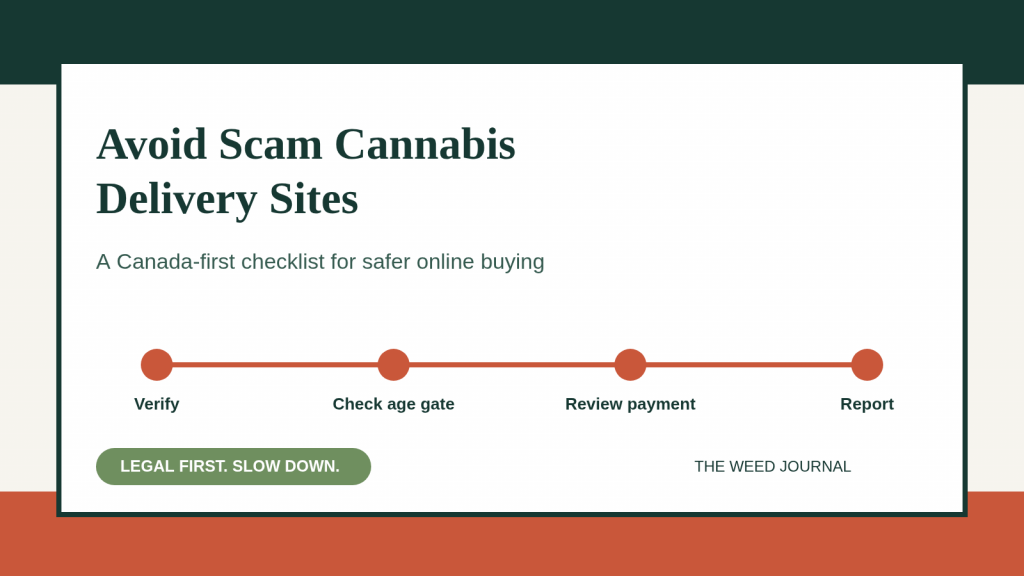
Online cannabis shopping in Canada can feel confusing because legal retail, private delivery, provincial rules, medical access, and illegal websites all show up in the same search results. A polished site, a discount code, or a fast-delivery promise does not prove that a seller is legal.
This guide is for adults who want a practical way to slow down before entering personal information or sending money. It is not legal advice, and it does not recommend any seller. The goal is simple: verify authorization first, then decide whether the site deserves your trust.
Quick answer
To avoid scam cannabis delivery sites in Canada, start with your province or territory’s official cannabis retailer list or government-run online store. Health Canada says legal cannabis products are sold only through retailers authorized by provincial or territorial governments, except for people registered to buy medical cannabis from a federally licensed seller.
Public Safety Canada gives several plain-language warning signs for illegal online cannabis sales: the site does not ask for age before entry, accepts cryptocurrency at checkout, promises mail-order recreational cannabis across provinces, or cannot be verified against an authorized source. If a site fails those basic checks, close it before creating an account.
If you are new to the legal side of cannabis, read our legal retailer checklist for buying cannabis in Canada first, then use the delivery-specific checks below.
Scam-site checks at a glance
| Check | What to look for | Why it matters |
|---|---|---|
| Authorization | The store appears on an official provincial, territorial, or regulator list. | Legal recreational cannabis sales are controlled by provincial and territorial systems. |
| Age gate | The site verifies legal age before entry or shopping. | Public Safety Canada says a site that does not ask for age before entering is illegal. |
| Payment | Normal card or debit options through a recognizable checkout. | Public Safety Canada says cryptocurrency payment is a sign the site is not legit. |
| Service area | Delivery is tied to the province, territory, or licensed store rules. | Cross-country recreational mail-order promises are a major red flag. |
| Product labels | Legal packaging, THC/CBD information, excise stamp, warnings, and lot details. | Legal cannabis has required packaging and quality-control rules. |
| Contact trail | Real business details, regulator match, privacy policy, and clear support channel. | Scam sites often hide ownership or push buyers into private-message payment. |
Start with the official source, not the search result
The safest first step is boring: go to the official cannabis page for your province or territory and work outward from there. Health Canada’s authorized retailer page links to provincial and territorial cannabis rules and says legal recreational cannabis is sold through authorized retailers. Our authorized online cannabis retailers checklist turns that habit into a step-by-step pre-order workflow.
In Ontario, for example, the Ontario Cannabis Store is the province’s official online cannabis store, while private brick-and-mortar cannabis retailers are licensed by the Alcohol and Gaming Commission of Ontario. The AGCO maintains a map of authorized retail stores. Other provinces and territories use different systems, so a habit that is normal in one place may not transfer cleanly to another.
Do not treat a search engine result, sponsored listing, social post, Telegram group, Reddit comment, or flyer as proof. Those can help you discover names, but authorization has to be checked against an official source.
Understand what “delivery” can mean
“Cannabis delivery” is not one uniform thing in Canada. It may mean a government-run online store shipping within a province, a licensed private store offering local delivery where rules permit it, a medical cannabis seller shipping to registered patients, or an illegal site using delivery language to look convenient.
That difference matters because illegal sellers often copy the language of legitimate ecommerce. They may show glossy menus, fake reviews, countdown discounts, and customer-service chat. None of those elements answer the legal question. Ask first: who authorized this seller to sell recreational cannabis to adults in this province or territory?
For broader legal context, see our guide to legal cannabis in Canada in 2026.
Red flag 1: no real age gate
A legal cannabis site should not feel like an ordinary snack shop. Public Safety Canada says that if a website does not ask for your age before entering, it is illegal. That is one of the quickest checks a reader can run without knowing every provincial detail.
Age gates can still be imperfect, and a fake site can add one, so this is not the only test. But the absence of an age check is a hard stop. If the site lets anyone browse and buy without age screening, do not keep moving through checkout just because the menu looks professional.
Red flag 2: cryptocurrency, e-transfer pressure, or private-message payment
Public Safety Canada specifically warns that if an online cannabis checkout allows payment with cryptocurrency, it is not legit. Be careful with any checkout that pushes you away from ordinary card or debit payment into crypto, gift cards, unusual e-transfer instructions, or direct messages with a “dispatcher.”
The fraud risk is obvious: once money is sent through a hard-to-reverse channel, the buyer may have little practical recourse. The legal risk is separate: payment convenience does not make an unauthorized cannabis seller legal.
Red flag 3: the site promises recreational shipping across Canada
Be skeptical of any recreational cannabis site that claims it can ship anywhere in Canada as if provincial rules do not exist. Public Safety Canada and police guidance commonly point to cross-province recreational shipping promises as a warning sign.
Medical cannabis is different. Registered medical patients may buy directly from federally licensed sellers they are registered with. That does not mean every “medical” or “mail order” claim is legitimate. It means the verification path is different: check Health Canada’s licensed seller information and your registration details, not a random site’s marketing copy.
Red flag 4: no match on an official list
If the store says it is licensed, you should be able to verify that claim. In Ontario, check the AGCO cannabis retail store map or the Ontario Cannabis Store for the legal online channel. In Manitoba, the provincial liquor and cannabis authority lists legal stores. In other provinces, use the equivalent government or regulator page.
Look for exact business names, addresses, and store details. A scam site may copy a real store name, slightly alter a domain, or use a similar logo. If the domain you are about to use is not connected to the authorized business you found, slow down and contact the store through the official listing rather than through the suspicious site.
Red flag 5: the site skips product-label basics
Legal cannabis in Canada comes with required packaging and labelling information. Health Canada explains that legal cannabis labels include details such as product class, THC and CBD information, warning messages, and standardized cannabis symbols where applicable. The package should also carry the right excise stamp for the province or territory where the product is intended to be sold.
An online menu does not have to show every package detail before checkout, but it should not make legal labels feel irrelevant. If a seller talks only about strain names, celebrity-style effects, secret potency claims, or “no taxes” deals while hiding basic product information, treat that as a quality and legality warning.
Our Canadian cannabis label guide explains what to look for once you have a legal product in hand.
Red flag 6: unrealistic discounts and urgency
Scam ecommerce sites often use urgency to keep shoppers from checking details. With cannabis, that can look like deep first-order discounts, “today only” delivery claims, free gifts that seem too generous, or menus packed with brand names that do not match what legal retailers usually carry.
A sale is not proof of a scam, but pressure is a signal to pause. Open a second tab, check the official retailer source, search the domain carefully, and look for independent confirmation from the provincial regulator or legal store page.
What to do before you order
- Find your province or territory’s official cannabis buying page.
- Confirm the seller, store, or online channel is authorized.
- Check whether delivery is allowed in your area and under what conditions.
- Confirm the site has an age gate before entry.
- Reject crypto, gift-card, or private-message payment requests.
- Look for clear business details that match the regulator listing.
- Read the privacy and refund information before creating an account.
- Keep screenshots and receipts if you proceed.
If you already paid a suspicious site
If you think you paid a scam site, do not send more money to “release” an order, pay a fake insurance fee, or unlock a delivery. Save the URL, screenshots, payment records, email headers, text messages, and any tracking numbers. Contact your bank or card issuer if you used a payment method with fraud protection.
You can also report fraud or cybercrime to the Canadian Anti-Fraud Centre. The CAFC collects information about fraud and identity theft and provides online and phone reporting options. Reporting matters even when the amount is small because patterns help investigators and public-warning teams.
Bottom line
A real cannabis delivery option in Canada should survive boring verification. It should connect back to a provincial, territorial, regulator, or medical authorization path. It should screen for age, use normal payment methods, respect local rules, and provide product information that fits legal Canadian packaging standards.
If a site asks you to trust speed, price, or secrecy instead of authorization, do not order. Legal first, then convenience.
Sources
- Health Canada: Authorized cannabis retailers in the provinces and territories
- Public Safety Canada: Buying Cannabis – What You Need To Know
- Ontario Cannabis Store
- AGCO: Cannabis Retail Stores in Ontario
- Canadian Anti-Fraud Centre: Report fraud and cybercrime
Explore the beginner’s guide, or learn how we source and edit our stories.