Tag: buying cannabis

  • Why THC Percentage Is Not Everything in Canada

    Why THC Percentage Is Not Everything in Canada

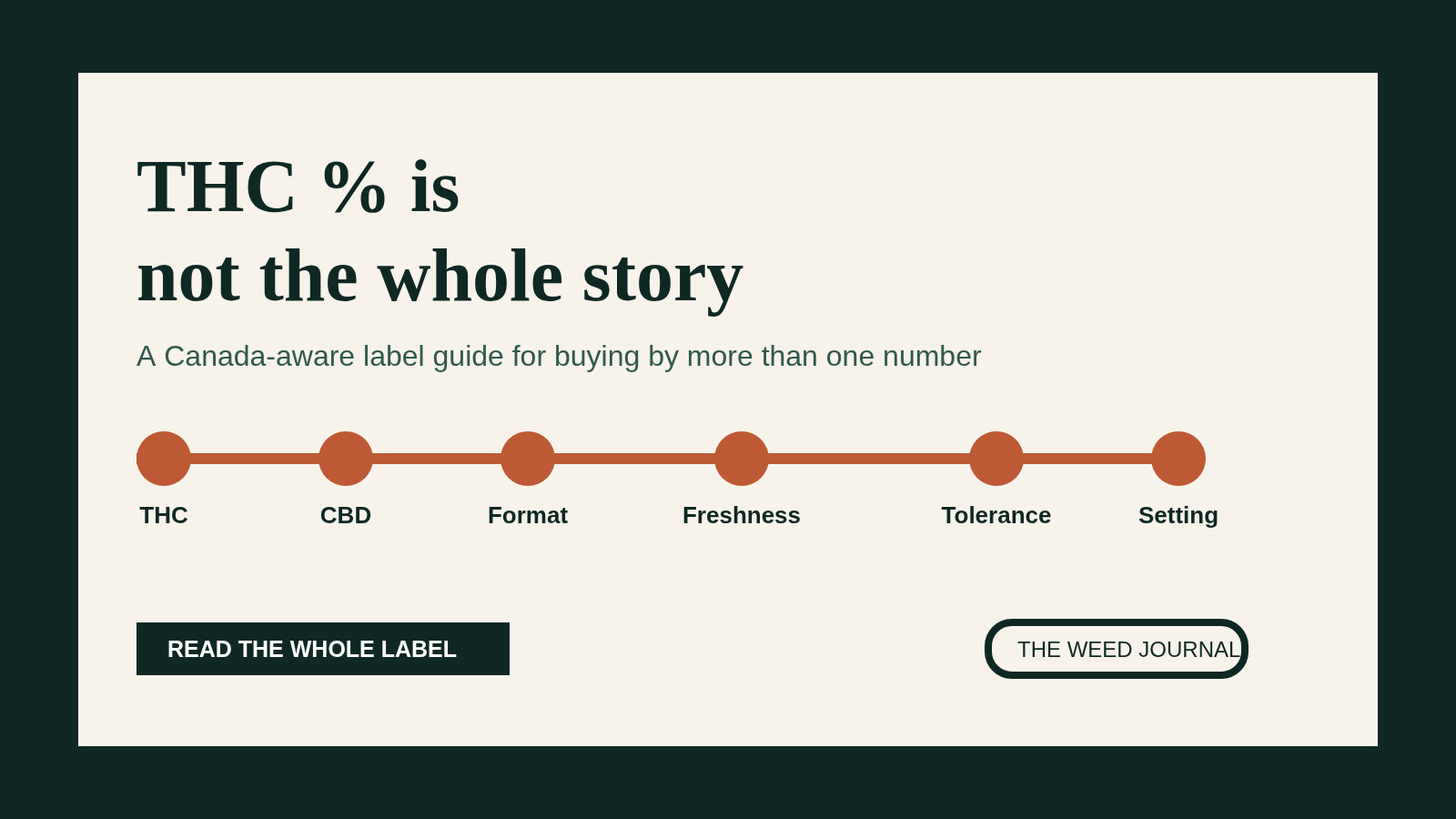
    THC percentage is one of the loudest numbers on a cannabis label. It is also one of the easiest numbers to overread. A dried flower product at 28% THC may sound stronger, better, or more efficient than one at 20%, but the real-world experience depends on more than a single lab value.

    This Canada-aware guide explains what THC percentage can tell you, what it cannot tell you, and how to use it alongside CBD, product type, freshness, label details, terpene information, dose, tolerance, and setting. It is written for adults who choose to use cannabis and want a more practical buying framework. It is not medical advice, and it does not promise any specific effect.

    Quick answer

    THC percentage tells you the concentration of THC in a cannabis product, but it does not tell you whether that product is fresh, well grown, enjoyable, appropriate for your tolerance, or likely to produce a specific effect. In Canada, legal cannabis labels show Total THC and Total CBD, and those numbers are useful. They should be treated as starting points, not quality scores.

    A better product choice combines THC with format, total amount, CBD, freshness, package date, lot information, aroma, intended use, onset time, and your own tolerance. Higher THC can also increase the chance of stronger impairment or an uncomfortable experience, especially for newer consumers or anyone returning after a break.

    What THC percentage actually means

    THC is the main intoxicating cannabinoid in cannabis. On Canadian labels, Health Canada explains that the front of a product label must show Total THC and Total CBD. For dried flower, that may appear as a concentration such as milligrams per gram or a percentage. For edibles, capsules, sprays, and other formats, the label may show THC by unit, activation, or total package amount.

    That distinction matters. A flower label and an edible label are not read the same way. A 20% THC dried flower means the product contains about 200 mg of THC per gram before real-world losses from burning, vaporizing, handling, and individual use. A 10 mg edible means the edible package or unit contains a set amount of THC, but onset and duration are different from inhaled flower.

    If label math feels confusing, start with our guide to reading cannabis labels in Canada. THC percentage is only useful when you know what format the number applies to.

    Why THC percentage is not a quality score

    THC percentage can help you estimate strength, but it does not measure craft, freshness, aroma, smoothness, storage, trim quality, or whether the product suits your use case. A high-THC flower can be dry, stale, harsh, or simply not enjoyable. A moderate-THC flower can be fresh, aromatic, easier to portion, and more appropriate for a quiet evening.

    It is also possible for people to have very different experiences with the same product. Tolerance, recent cannabis use, food, alcohol, sleep, stress, medication, body size, inhalation style, and setting can all change the outcome. That is why chasing the highest number on the shelf is a blunt way to shop.

    Health Canada notes that products with higher THC content are more likely to be associated with adverse effects and greater impairment. That does not mean every higher-THC product is automatically a bad choice for every adult. It does mean higher THC deserves more caution, not less.

    A better way to compare cannabis products

    Label or product factor What it helps you judge What it cannot prove
    Total THC Potential intoxicating strength and how cautiously to start. Freshness, quality, flavour, or whether the effect will feel good.
    Total CBD Whether the product is THC-dominant, CBD-dominant, or more balanced. That the product is risk-free or non-impairing in every situation.
    Product type Likely onset and duration: inhaled flower differs from edibles, oils, and capsules. That two products with the same THC number will feel alike.
    Package date and lot Traceability and a clue about age or stock rotation. That the product was stored perfectly after packaging.
    Aroma and texture Freshness, handling, and whether flower seems stale, damp, or poorly stored. Exact effects or lab-tested potency.
    Terpenes if listed Aroma profile and a more detailed product fingerprint. A guaranteed effect such as sleep, energy, creativity, or anxiety relief.

    The practical move is to compare several signals at once. If a product has extremely high THC but an old package date, weak aroma, poor texture, or a format you do not handle well, the THC number alone should not carry the decision.

    Format changes the meaning of strength

    THC percentage is most familiar on dried flower, but cannabis products are not interchangeable. Inhaled cannabis can take effect within seconds to minutes. Edibles can take much longer to start and can last longer. Oils, sprays, capsules, concentrates, and vape cartridges each change how people portion and experience THC.

    That is why a lower-looking number can still be strong in practice. A small edible with 10 mg THC may be a lot for a new consumer even though the number looks smaller than a flower percentage. A vape cartridge may be highly concentrated and easy to overuse because repeated small puffs do not feel like a measured dose. A concentrate can carry far more THC than typical dried flower.

    For a beginner-friendly format overview, use our Cannabis 101 product type guide. Strength only makes sense inside a format.

    Freshness can matter more than a few THC points

    With dried flower, a few percentage points on a label may matter less than whether the flower is fresh enough to use comfortably. Flower that is overly dry may burn quickly, taste flat, crumble into dust, or feel harsh. Flower that is too damp, musty, or visibly mouldy should not be consumed.

    Package date is not a freshness guarantee, but it is a useful clue. Legal labels should include lot number and packaging date, which also help if you need to report a quality problem. Once opened, aroma, texture, and appearance become part of the decision.

    For the buying side, use our fresh cannabis flower checklist. A moderate THC product that is fresh and well stored can be a better purchase than a high-THC product that is old, dry, or unpleasant.

    CBD changes the picture, but does not erase risk

    CBD is not intoxicating in the same way THC is, but it still can have effects on the body and brain. Health Canada describes THC and CBD as the two most common cannabinoids on cannabis labels, with THC responsible for intoxication and CBD not producing a high. Some public health resources also note that CBD may reduce some effects of THC.

    For shopping, that means a balanced product with meaningful CBD may feel different from a THC-only product at a similar THC level. It does not mean CBD makes cannabis automatically safe, appropriate for driving, or suitable for every person. If you use medications, have health conditions, are pregnant or breastfeeding, or are using cannabis for medical reasons, speak with a qualified health professional.

    For a broader cannabinoid explanation, see THC vs CBD vs CBN.

    Terpenes are useful for aroma, not a promise

    Terpenes are aromatic compounds that contribute to how cannabis smells. Some legal labels or retailer menus list dominant terpenes. That information can help you identify patterns in products you like: citrus, pine, pepper, floral, herbal, fuel-like, earthy, or sweet notes.

    The caution is that terpene lists are often marketed as if they guarantee effects. They do not. A terpene profile can be useful, but it should not be treated as a medical claim or a reliable prediction that a product will make someone sleepy, focused, calm, or creative.

    Use terpene information as a preference tool. Track what aromas and products you enjoy. Avoid turning strain names or terpene names into promises.

    Tolerance changes the whole equation

    The same THC percentage can feel mild to one person and overwhelming to another. Tolerance changes with frequency of use, recent breaks, product format, and personal sensitivity. If you have not used cannabis in weeks or months, do not assume your old dose still applies.

    Newer consumers often do better by choosing lower THC, using less, and waiting before taking more. Experienced consumers can still overdo it when switching formats or trying a stronger product than usual. The safest product choice is often the one that gives you more control, not the one with the biggest number.

    Our guide on how long THC lasts in Canada explains why effects, residual impairment, and testing windows are separate issues. Regardless of tolerance, do not drive or do safety-sensitive work after using cannabis.

    How to shop without chasing the highest THC

    • Start with product type: flower, pre-roll, edible, oil, capsule, vape, or concentrate.
    • Read Total THC and Total CBD in the correct format for that product.
    • Check package date, lot number, producer, and required label information.
    • For flower, compare freshness, aroma, texture, and storage condition.
    • Avoid treating strain names as guaranteed effect labels.
    • Choose lower THC when you are new, returning after a break, or changing formats.
    • Use less than you think you need, especially with edibles and concentrates.
    • Keep notes on what worked by product, lot, THC/CBD, format, and setting.

    When a high-THC product may be the wrong fit

    A high-THC product may be a poor fit if you are new to cannabis, have low tolerance, need a predictable experience, plan to be around responsibilities, are using alcohol or other substances, or are choosing cannabis because you are already anxious or upset. It may also be the wrong fit if the label is unclear, the product is old or stale, or you are buying from a questionable source.

    Legal does not mean risk-free. It means the product should have required labelling, a licensed supply chain, and traceability. The consumer still has to choose a format and strength that make sense.

    Bottom line

    THC percentage is useful, but it is not the final answer. Use it as a caution signal and comparison tool, not as a quality score. The better question is not “What is the highest THC I can buy?” It is “Which legal product gives me the clearest label, suitable strength, appropriate format, good freshness, and enough control for my tolerance and setting?”

    That question leads to better decisions. It also protects the main point of cannabis education: knowing when less is enough.
    Sources

  • How to Tell If Cannabis Flower Is Fresh in Canada

    How to Tell If Cannabis Flower Is Fresh in Canada

    Fresh cannabis flower is not about chasing the loudest smell or the highest THC percentage. For Canadian buyers, the better question is simple: does this package look legal, recent enough, well stored, and usable for the way you plan to consume it?

    This guide gives you a practical flower freshness checklist for legal cannabis in Canada. It focuses on label details, texture, aroma, package dates, storage, and red flags. It is not a quality guarantee, and it is not medical advice. It is a reader-first way to avoid stale, overly dry, suspicious, or poorly stored flower before it turns into a disappointing purchase.

    Quick answer: signs cannabis flower is fresh

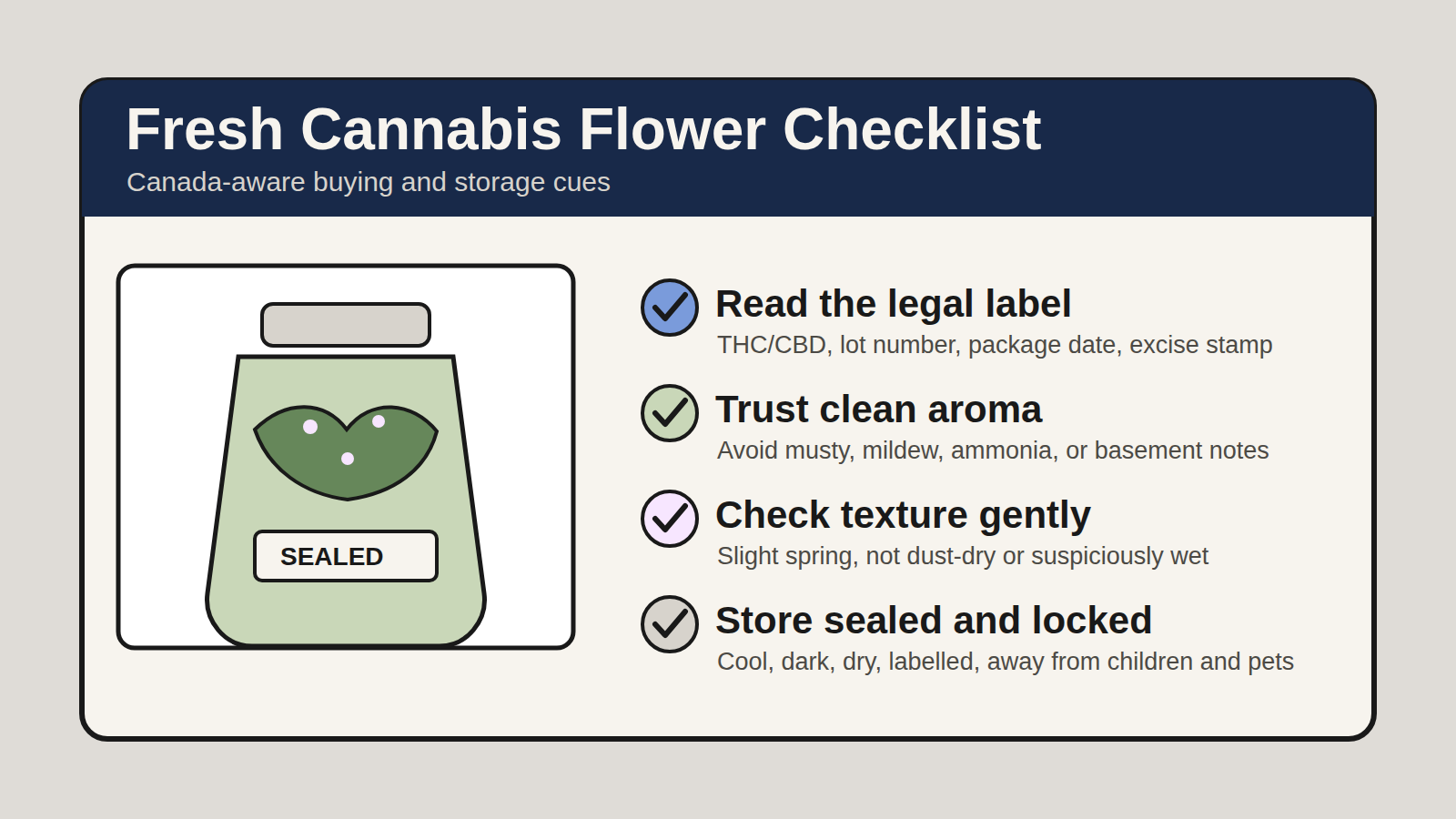
    Fresh cannabis flower usually has a recognizable aroma, a little spring when gently handled, visible structure, and no sign of mould, dampness, or musty odour. In Canada, the first check should happen before you ever open the container: confirm the product came from a legal source, look for the excise stamp where required, read the total THC and CBD values, and check the package date, lot number, and producer information.

    Once opened, good flower should not crumble into dust at the first touch. It also should not feel wet, spongy, or sticky in a way that suggests excess moisture. There is a middle ground: dry enough to burn or vaporize evenly, but not so dry that the buds turn brittle.

    The Canada-first freshness checklist

    Use this checklist when comparing dried flower from a legal retailer. It works best after you have already checked that the retailer itself is legitimate. For that broader step, start with our legal retailer checklist for buying cannabis in Canada.

    What to check What you want to see Possible red flag
    Legal package details Health Canada licence holder, lot number, package date, total THC/CBD, warning information, and excise stamp where required. Missing label details, no clear producer, copied-looking packaging, or no provincial/territorial excise stamp on a THC product that should have one.
    Package date A reasonably recent package date for the product type, with packaging intact and sealed before purchase. Very old stock, damaged seal, or no date visible on the legal label.
    Aroma Distinct but not necessarily overpowering; herbal, citrus, pine, peppery, earthy, sweet, or fuel-like notes can all be normal depending on cultivar. Musty, basement-like, ammonia, mildew, hay-only, or no aroma at all after opening.
    Texture Slight give when gently pressed; breaks apart without becoming powder. Dust-dry crumble, damp clumps, or flower that feels unusually wet.
    Appearance Intact buds, visible trichomes, and colour that looks consistent with the cultivar. Fuzzy white/grey growth, dark wet patches, obvious foreign material, or excessive shake in a premium flower container.
    Storage after opening Kept sealed, cool, dark, dry, and away from children, pets, and anyone who should not access it. Left open, stored in sunlight, stored in a hot car, mixed into unlabelled containers, or kept where children can reach it.

    This table is deliberately practical. Most consumers do not have lab equipment at home. Your job is to combine the legal label, the package condition, and your senses. If a product raises safety concerns, do not try to rescue it by airing it out, baking it, or mixing it with fresher flower.

    Start with the label, not the bud photo

    Canadian cannabis packaging is plain by design, but it still carries useful buying information. Health Canada explains that labels show total THC and total CBD, health warnings, lot details, and other required information. The excise stamp also matters because it helps show the product came through the legal system, although some very low-THC products may not require one.

    For dried flower, the label will not tell you everything about freshness. It cannot tell you whether the aroma will suit you, whether the trim is tidy, or whether the bud structure is better than another lot from the same producer. But it does give you the basics: legal source, cannabinoid strength, package date, quantity, and a way to identify the batch if there is a product issue.

    If label reading still feels confusing, use our separate guide on how to read cannabis labels in Canada. For flower freshness specifically, pay close attention to the package date and lot information. Harvest date is useful when listed, but package date is the detail Canadian buyers are most likely to see consistently.

    How package date should influence your expectations

    A package date is not the same thing as a freshness guarantee. Cannabis can be packaged well and age acceptably, or packaged poorly and feel tired sooner than expected. Still, the date helps you set expectations.

    Recently packaged flower is not automatically excellent. Older flower is not automatically unusable. What matters is how it was dried, cured, packaged, transported, and stored. That said, a package that has been sitting for a long time deserves closer inspection once opened. If it is very dry, muted in aroma, or harsh compared with similar products, age and storage may be part of the reason.

    Legal retailers may also sell value flower, smalls, milled flower, or discounted older stock. Those products can be legitimate. The key is to match the price and format to realistic expectations. A budget ounce may not have the same bud size or aromatic intensity as a small-batch jar. Freshness is about usability and safety first, then preference.

    Smell: useful, but easy to overrate

    Aroma is one of the easiest freshness clues, but it is not a perfect quality score. Some cultivars naturally smell bright and loud. Others are subtler. Packaging can also trap or mute aroma until the flower has been open briefly.

    Good signs include a clear scent profile and no unpleasant damp or mouldy notes. Depending on the cultivar, that scent might lean citrus, floral, pine, spice, gas, berry, tea, wood, or earth. A little grassy note is not automatically a problem, especially with some lots, but a flat hay smell can suggest the flower is tired, dried too aggressively, or simply not very expressive.

    Bad signs are more important than good ones. A musty, mildew-like, ammonia, or basement smell is a stop sign. Do not consume flower that smells like mould or rot. The risk is not worth trying to salvage the purchase.

    Texture: the gentle squeeze test

    Once the package is open, texture tells you a lot. Fresh-enough flower usually has a little give. It should break apart without turning instantly to powder. When ground, it should be workable rather than dusty.

    Too dry: buds snap apart sharply, crumble into dust, taste harsh, burn very quickly, or feel lifeless in the grinder. Overly dry flower is common, especially in small containers or older packages. It is not always dangerous, but it can make the experience less pleasant and harder to portion consistently.

    Too moist: buds feel wet, spongy, unusually heavy, or clump together. Excess moisture can be more concerning than dryness because it raises spoilage questions. If you see fuzzy growth, suspicious white or grey patches, or smell mustiness, do not use it.

    If you are using flower in a dry herb vaporizer, texture matters even more. Very dry flower can toast quickly and taste flat; overly moist flower can vaporize unevenly. For a broader inhalation comparison, see our guide to vaping vs smoking cannabis in Canada.

    Appearance: what looks normal and what does not

    Colour alone does not prove freshness. Cannabis can be light green, deep green, purple, orange-haired, frosty, loose, dense, fluffy, or compact depending on cultivar and production style. Do not reject a product simply because it does not match a social-media photo.

    Look instead for consistency and obvious defects. The buds should look like cannabis flower, not a container of dust unless you intentionally bought milled flower or shake. Trichomes can look like a light frost. Orange or brown pistils can be normal. Purple colouring can be genetic. Small buds can be normal, especially in value products.

    Red flags include visible fuzz, web-like growth, grey or white mould patches, wet dark spots, foreign material, or a smell that confirms something is wrong. If you are uncertain, err on the side of not consuming it. For legal products, keep the package and receipt and contact the retailer or producer with the lot number. For a focused stop-use check, read the mouldy cannabis flower guide.

    Why THC percentage is not a freshness score

    High THC does not mean fresh. It also does not mean the product will feel better for every person. THC percentage is one label detail, not the whole buying decision.

    Freshness depends more on production, curing, packaging, date, storage, and whether the product still has its expected aroma and texture. A moderate-THC flower that is fresh, aromatic, and well stored may be more enjoyable than a high-THC product that is old, dry, and harsh. If you are newer to cannabis, higher THC can also increase the chance of an uncomfortable experience. Start lower than you think you need, especially when switching products or formats.

    For a wider beginner framework, use our Cannabis 101 product type guide. Flower is only one option, and the right choice depends on onset, duration, comfort with inhalation, and your setting.

    How to store flower after you open it

    Freshness can decline quickly if you leave cannabis exposed to air, heat, and light. After opening, keep flower in a sealed container, away from direct sun, and in a cool, dry place. Do not leave it in a hot car or beside a window. Do not store it in an unlabelled snack bag or a container that could confuse someone else in the home.

    Safe storage also means access control. Health Canada and public health sources consistently emphasize keeping cannabis products out of reach of children and pets. A locked box is a better habit than a high shelf, especially in a shared home. Keep original packaging when possible because it preserves product details, warnings, and lot information.

    For more detail, read our Cannabis Storage 101 guide. For a newer format-by-format storage checklist, including temperature, humidity, labels, edibles, vapes, and lockbox habits, use our guide to how to store cannabis in Canada. You do not need fancy gear for basic storage, but you do need consistency: sealed, labelled, cool, dark, dry, and secure.

    What to do if the flower seems stale

    If the flower is simply a bit dry but otherwise normal, some consumers use humidity packs to improve handling. That may make it less brittle, but it does not reverse age or turn poor flower into great flower. Avoid adding fruit peels, wet paper, or random moisture sources. Those can introduce unwanted moisture and contamination risk.

    If the flower smells musty, appears mouldy, has foreign material, or seems wet in a concerning way, do not consume it. Keep the package, note the lot number, and contact the retailer. Legal cannabis products are traceable for a reason.

    If the issue is preference rather than safety, make a note for next time: producer, lot, package date, terpene information if listed, THC/CBD values, price, and what you disliked. Over a few purchases, this simple habit teaches you more than chasing strain names alone.

    Freshness checklist before you buy again

    • Buy from a legal retailer or provincial online store.
    • Check the package date, lot number, producer, total THC, and total CBD.
    • Match price to format: whole flower, smalls, milled flower, value ounce, or premium jar.
    • After opening, reject musty, mouldy, wet, or suspicious flower.
    • Store opened flower sealed, labelled, cool, dark, dry, and locked away from children and pets.
    • Track what worked by lot and producer, not just by strain name.

    Bottom line

    The best flower freshness check in Canada combines legal label reading with common-sense inspection. Start with the package: legal source, excise stamp where required, total THC/CBD, lot number, and package date. Then use your senses: aroma, texture, appearance, and storage condition.

    Fresh flower should be usable, clearly labelled, and free from obvious spoilage signs. It does not need to be the strongest product on the shelf. For most readers, a reliable, well-stored, moderate product from a legal source is a better bet than a mystery package with a loud claim and no traceable label.

    Sources

  • Buying Cannabis in Canada: Legal Retailer Checklist

    Buying Cannabis in Canada: Legal Retailer Checklist

    Buying cannabis in Canada should feel less mysterious than it often does. Legalization created a regulated adult-use system, but it did not make every store, website, delivery menu, package, or product claim equally trustworthy.

    The practical question for most adults is not just “Can I buy cannabis?” It is “Am I buying from the right channel, in the right province, with a product I can understand, store safely, and use without creating avoidable problems?”

    This guide is a buyer’s checklist for Canadian adults. It is not legal advice or medical advice. It is a plain-language way to check the basics before you spend money, especially if you are new to cannabis, returning after a long break, travelling within Canada, or trying to compare legal products without getting pulled around by THC percentages and marketing language.

    Quick answer

    In Canada, adults should buy cannabis only from retailers authorized by the province or territory where they are buying. Health Canada’s retailer guidance says legal products are sold through provincial and territorial authorized channels, except for medically authorized consumers who buy directly from federally licensed sellers. Legal products should also carry required packaging, warning information, and, for products over 0.3% THC, the correct provincial or territorial excise stamp.

    If you are still learning the basics, start with our Start Here guide and our overview of legal cannabis in Canada. Then use the checklist below before placing an order or walking to the counter.

    For the full beginner buying path, including legal basics, label reading, product types, and storage, visit the Buying Cannabis in Canada hub.

    The buyer checklist

    Checkpoint What to look for Why it matters
    Legal channel Use the official provincial or territorial retailer list, licensed store, or government online store. A professional-looking website is not proof that the seller is legal.
    Legal age Check the age in the province or territory where you are buying or visiting. Most jurisdictions list 19, Alberta lists 18, and Quebec lists 21 in Health Canada’s retailer summary.
    Possession amount Stay within the public possession limit and remember equivalency rules for non-flower products. Concentrates, edibles, oils, and flower are not always compared by package size alone.
    Packaging Look for required plain packaging, warning information, product details, and child-resistant features. Unlabelled or repackaged products create safety and quality uncertainty.
    Excise stamp For products above 0.3% THC, check that the stamp matches the province or territory. The stamp is one visible sign that a product came through the regulated system.
    Label clarity Review THC, CBD, units, package size, lot details, and dates before buying. Good buying decisions start with what is actually in the package.
    Use plan Plan storage, timing, transportation, and driving before using cannabis. Legal purchase does not remove impairment, storage, or travel risks.

    Check the retailer before the product

    The first buying decision is the seller. Health Canada is clear that adults are responsible for knowing what is legal in the province or territory where they live or visit. Retail systems differ: some places use government stores, some use private licensed stores, some allow online sales through government channels, and some allow private online sales.

    Ontario is a useful example because it has private licensed in-person stores and a government-operated online store. Ontario’s public cannabis page also points adults toward the province’s legal framework, the Ontario Cannabis Store, and the Alcohol and Gaming Commission of Ontario’s licensed retail information. If you are in a different province, use that province’s official list instead of assuming Ontario’s system applies.

    Be cautious with sellers that rely on urgency, vague “same-day” claims, social-media ordering, cash-only delivery, medical-sounding promises, or menus that avoid saying who licensed the retailer. Those details do not automatically prove a site is illegal, but they are reasons to pause and verify before buying.

    Know your province before you buy

    Canada has a federal cannabis framework, but provincial and territorial details shape the everyday buying experience. Minimum age, retail model, online purchasing rules, public use rules, and local restrictions can all change when you cross a provincial border.

    Do not rely on a national habit like “it is legal in Canada” as your whole rulebook. Check the rules where you are standing. This matters for visitors, students, workers on short assignments, and anyone ordering online while travelling. It also matters if you live near a provincial boundary and shop in more than one jurisdiction.

    Public possession limits are also not a shopping recommendation. A legal limit is not a suggestion to buy that much, carry that much, or keep that much accessible at home. Buy what you can store responsibly and understand clearly.

    Read the label before chasing THC

    THC percentage gets the most attention, but it is not the whole product. A high THC number does not guarantee a better experience, and a low number does not automatically mean the product is weak in every format. Edibles, oils, capsules, beverages, dried flower, pre-rolls, vapes, and concentrates all present potency differently.

    Before buying, look for total THC and CBD, amount per unit, total package amount, product format, lot number, packaging date, expiry or best-before information where listed, ingredients, and warnings. If the label is confusing, slow down. The best cannabis product for you is not just the strongest one; it is the one you can understand and use deliberately.

    For a deeper walkthrough, use our guide to reading cannabis labels in Canada. It explains how THC, CBD, terpenes, lot details, and packaging dates fit into a real purchase.

    If you are comparing price tiers, pair label reading with our budget vs premium cannabis guide, which explains when freshness, format, package size, and realistic THC expectations matter more than shelf price.

    Online ordering and delivery red flags

    Online cannabis shopping can be legal, but the legal path depends on the province or territory. The safest habit is to begin from an official government or regulator page, then follow the listed retailer or store link from there. Search results, ads, and social posts can put unverified sellers beside legitimate ones. Use our buy cannabis online legally in Canada checklist when the purchase happens through a website instead of at a counter.

    Red flags include missing licence information, no connection to an official retailer list, no clear age verification, no required product warnings, no excise-stamp information, unusually broad health claims, unclear return or privacy policies, and products that appear to be repackaged or homemade. Be especially cautious with vape cartridges and concentrates from unverified sources because the product and hardware are harder to evaluate by appearance alone.

    Keep a record of where you bought the product, especially for online orders. A confirmation email, order number, store name, and product lot details can help if you later need to check a recall, report a concern, or understand what you actually consumed.

    If a seller’s main pitch is that it is cheaper, faster, stronger, and easier than the regulated system, that is not a reason to skip verification. It is a reason to check harder.

    For a delivery-specific version of this check, use our guide to avoiding scam cannabis delivery sites in Canada before creating an account or sending payment.

    Plan storage before checkout

    Safe storage is part of buying. Cannabis should be kept away from children, pets, visitors, and anyone who should not access it. Edibles deserve extra care because they can resemble regular food, and a single package can contain multiple servings.

    Keep products in their original packaging when practical, especially if you need the label later. Store flower away from excess heat, light, air, and moisture. Do not leave cannabis loose in vehicles, bags, shared kitchens, or places where someone else might mistake it for something harmless. Our cannabis storage guide covers simple ways to keep flower fresher without turning storage into a complicated hobby.

    Have a use plan, not just a shopping list

    Buying legally does not make cannabis risk-free. Health Canada notes that cannabis can affect attention, coordination, judgment, and reaction time, and advises people to lower risk by starting low and going slow. That guidance is especially important with edibles and beverages because onset can be delayed and overconsumption can happen when someone takes more too soon.

    Plan your timing, setting, and ride before using cannabis. Do not drive after use. Avoid mixing cannabis with alcohol or other substances when you do not know how you respond. If you are pregnant, breastfeeding, have a personal or family history of mental health concerns, take medications, or have a medical condition, speak with a qualified professional before using cannabis.

    If you are unsure what format fits your situation, our guide to choosing cannabis product types in Canada is a better starting point than a store’s bestseller list.

    What to avoid

    • Buying from a seller you cannot match to an official authorized retailer list.
    • Choosing only by the highest THC number.
    • Ignoring package size, units, or THC per serving.
    • Assuming a delivery website is legal because it looks polished.
    • Taking cannabis across an international border.
    • Driving because you “feel fine.”
    • Removing products from labelled packaging and then forgetting what they are.
    • Buying more than you can store securely.

    Bottom line

    The best cannabis purchase is the one you can verify, understand, store safely, and use responsibly. In Canada, that starts with authorized retailers and continues with careful label reading, realistic potency expectations, safer storage, and a plan that does not involve driving or guessing.

    Legal cannabis is a regulated system. Treating it that way protects your money, lowers avoidable risk, and makes the buying experience calmer for beginners and experienced consumers alike.

    Sources

  • Legal Cannabis in Canada 2026: What Adults Should Know

    Legal Cannabis in Canada 2026: What Adults Should Know

    Legal cannabis in Canada is simple in one way and easy to misunderstand in another. The simple part: adult-use cannabis is legal under a federal framework. The part people miss: provinces, territories, municipalities, landlords, employers, and border rules can still change what is allowed in a real-life situation.

    That matters because many cannabis mistakes are not about whether legalization exists. They are about buying from the wrong source, assuming every province has the same age rules, carrying cannabis into the wrong place, driving after use, travelling across a border, or treating a workplace policy like it does not apply.

    This guide explains the 2026 basics for Canadian adults in plain language. It is not legal advice. If a cannabis issue could affect your job, housing, licence, immigration status, travel, court matter, or health, get advice from the right professional or government source.

    Quick answer

    Canada’s Cannabis Act framework allows adults, subject to provincial and territorial restrictions, to possess up to 30 grams of legal dried cannabis or equivalent in public, share up to 30 grams with other adults, buy from authorized retailers, and grow up to four plants per residence for personal use where local rules allow it.

    But “legal in Canada” does not mean “same everywhere.” Provinces and territories can increase the minimum age, lower possession limits, add rules for home growing, restrict where cannabis can be used, and control how legal retail works. Health Canada also reminds consumers that legal cannabis is sold through provincial or territorial authorized retailers, with specific packaging and excise-stamp rules.

    Federal vs provincial rules

    Rule areaFederal baselineProvince, territory, or local layer
    Adult possessionFederal adult public possession limit is generally 30 grams dried cannabis or equivalentSome jurisdictions can set tighter limits or extra restrictions
    Minimum ageFederal framework starts at 18+Most provinces and territories set 19; Alberta is 18 and Quebec is 21
    Retail accessLegal sale is controlled through the regulated systemEach province or territory decides public, private, in-person, online, or mixed retail models
    Home growingUp to four plants per residence under the federal frameworkLocal rules may restrict or prohibit growing, and housing rules may also matter
    Public useNot a single national permission slipSmoking, vaping, parks, rental housing, campuses, hotels, and event spaces can all have added rules
    DrivingImpaired driving remains illegalProvincial road safety penalties and licence consequences may also apply

    The practical habit is to check two levels: what Canada permits federally and what the province or territory permits where you are standing. If you are visiting another province, use the rules of the place you are visiting, not the rules you remember from home. For a province-by-province breakdown of legal age, retail models, public use, home growing, and delivery checks, use our provincial cannabis rules in Canada guide.

    Legal age and public possession by province

    Health Canada’s provincial and territorial retailer page summarizes legal age, authorized buying channels, and public possession limits. As of the saved June 12, 2026 source snapshot used for this article, the broad public possession limit listed for provinces and territories is 30 grams of dried cannabis or equivalent, but legal age differs.

    Province or territoryLegal age listed by Health CanadaPublic possession limit listed
    Alberta1830 grams dried cannabis or equivalent
    British Columbia1930 grams dried cannabis or equivalent
    Manitoba1930 grams dried cannabis or equivalent
    New Brunswick1930 grams dried cannabis or equivalent
    Newfoundland and Labrador1930 grams dried cannabis or equivalent
    Northwest Territories1930 grams dried cannabis or equivalent
    Nova Scotia1930 grams dried cannabis or equivalent
    Nunavut1930 grams dried cannabis or equivalent
    Ontario1930 grams dried cannabis or equivalent
    Prince Edward Island1930 grams dried cannabis or equivalent
    Quebec2130 grams dried cannabis or equivalent
    Saskatchewan1930 grams dried cannabis or equivalent
    Yukon1930 grams dried cannabis or equivalent

    Use this as a starting point, not a substitute for checking local rules. Retail models change, municipal bylaws can matter, and private spaces can have stricter policies than the law requires.

    Buying legally in Canada

    The safest buying rule is boring: use the official legal channel for the province or territory you are in. Health Canada says legal cannabis products are sold through retailers authorized by provincial and territorial governments, with an exception for people who are medically authorized to buy directly from a federally licensed seller.

    Legal products should have consumer information, required warnings, and an excise stamp for the province or territory, except for products with less than 0.3% THC. The stamp matters because it is one of the visible signs that a product came through the regulated system.

    Illegal or unverified sellers can look polished online. A nice website, a menu, a fast checkout, or the phrase “dispensary” does not prove a retailer is legal. Health Canada lists warning signs such as no federal licence or provincial authorization, missing excise stamp, no required warning messages, and claims that sound like medical promises.

    For a more practical pre-purchase workflow, use our legal retailer checklist for buying cannabis in Canada before ordering online or walking to the counter. If the order is happening online, use the legal online cannabis buying checklist to verify authorized channels, age checks, labels, delivery limits, and payment red flags.

    For the broader beginner route through legal sources, labels, red flags, and storage, use our Buying Cannabis in Canada hub.

    Legal retailer checklist

    • Check the province or territory’s official authorized retailer list before buying.
    • Look for required cannabis packaging, warning symbol, and consumer information.
    • Check for the correct provincial or territorial excise stamp where required.
    • Avoid products that make disease-treatment, cure, or guaranteed-effect claims.
    • Be cautious with unlabelled extracts, unusually cheap products, refilled vape cartridges, or cash-only informal delivery.
    • Do not buy for someone under the legal age or share cannabis with youth.
    • Store products away from children, pets, guests, and anyone who should not access them.

    If you are new to labels, start with The Weed Journal’s guide to reading cannabis labels in Canada. It explains THC, CBD, lot details, packaging dates, and the difference between useful label information and marketing noise.

    Possession and “equivalents”

    The public possession limit is usually described as 30 grams of dried cannabis or equivalent. That last phrase matters. Cannabis is sold as dried flower, edibles, oils, capsules, concentrates, beverages, seeds, and plants, so the law uses equivalencies to compare formats.

    For the detailed product-equivalency table, including drinks, concentrates, seeds, and mixed-product carrying examples, use our cannabis possession limits in Canada guide.

    Do not assume that a small package is automatically under the legal possession limit. Concentrates and non-dried products can be treated differently under equivalency rules. If you are carrying multiple product types, especially while travelling within Canada, check the current government equivalency guidance rather than guessing.

    Also remember that public possession is not the same as use. You might be allowed to possess legal cannabis but still not be allowed to smoke, vape, or consume it in a certain place.

    Home growing is not the same everywhere

    The federal framework allows up to four cannabis plants per residence for personal use, from licensed seed or seedlings, subject to provincial and territorial restrictions. The phrase “per residence” is important. It does not mean four plants per adult.

    Local rules can be stricter, and private rules can matter too. A condo board, rental agreement, insurance policy, or municipal bylaw may affect what you can do even when federal law sounds permissive. Growing also raises practical safety issues: odour, humidity, electrical load, mould, fire risk, pests, and secure access.

    If you cannot keep plants secure from children, pets, guests, or theft, home growing is a poor fit. Legal permission is only one part of responsible use.

    Driving and cannabis

    Legal cannabis did not make impaired driving legal. Cannabis can affect attention, coordination, reaction time, judgment, and risk perception. The difficult part is that impairment is not controlled by a simple stopwatch. Dose, product type, tolerance, food, sleep, alcohol, and individual response all matter.

    Edibles deserve special caution because they can take a long time to peak and may last into the next day. Inhaled cannabis acts faster, but fast onset does not mean fast recovery for every person. If timing is your main question, read our guide to how long THC lasts in Canada.

    The practical rule is simple: plan the ride before using cannabis. Do not wait until after use to decide whether you are fine to drive.

    Travel within Canada

    Domestic travel is not automatically a problem, but it is still easy to make mistakes. You need to follow the law where you are departing, where you are arriving, and where you are using or carrying cannabis. If you fly or travel with cannabis, keep it legal, sealed when practical, clearly labelled, and within the possession limit.

    Do not use domestic travel as a reason to carry more than you need. Keep products away from youth, avoid open packages in vehicles, and remember that hotels, campuses, rental properties, ferries, workplaces, and event venues can have their own rules.

    International travel: do not cross the border with cannabis

    International travel is different. The Government of Canada warns travellers not to take cannabis across the Canadian border, whether leaving or entering Canada. This includes destinations where cannabis is legal. It also includes medical cannabis unless you have followed the specific legal requirements that apply to controlled substances and travel.

    The safest public-facing advice is blunt: do not bring cannabis across an international border. Buy legal products only where you are legally allowed to buy them, and never assume that Canadian legalization protects you in another country.

    Common myths

    Myth: If cannabis is legal, any online store is fine.

    Reality: Legal cannabis is sold through authorized channels. A professional-looking website is not proof of authorization.

    Myth: The age is 19 everywhere.

    Reality: Most jurisdictions list 19, but Alberta lists 18 and Quebec lists 21. Always check the province or territory.

    Myth: I can grow four plants because I am an adult.

    Reality: The federal framework refers to up to four plants per residence, and local or housing rules may add restrictions.

    Myth: Legal cannabis means I can drive once I feel normal.

    Reality: Feeling normal is not a reliable legal or safety test. Cannabis-impaired driving remains illegal.

    Myth: I can take cannabis to another country if it is legal there.

    Reality: Crossing the Canadian border with cannabis remains a serious legal risk. Do not do it.

    Bottom line

    Legal cannabis in Canada is a regulated adult-use system, not a free-for-all. The federal framework sets the foundation, but provinces and territories control many of the details that affect everyday buying and use.

    For most adults, the responsible pattern is straightforward: buy from authorized retailers, stay within possession limits, read the label, avoid driving, keep cannabis away from youth and pets, check local rules before travelling, and never cross an international border with cannabis.

    When in doubt, use official government sources for the place you are in. Cannabis rules are easier to follow when you treat legalization as a regulated system instead of a blanket permission slip.

    Sources