Tag: cannabinoids

  • CBD:THC Ratios in Canada: What They Mean

    CBD:THC Ratios in Canada: What They Mean

    CBD:THC ratios look simple until you are standing in front of a Canadian cannabis menu trying to compare oils, capsules, drinks, flower, pre-rolls, vapes, and edibles. A product might say 1:1, 2:1, 10:1, or “balanced.” Another label might list milligrams per gram, milligrams per package, or milligrams per activation. The ratio is useful, but only if you know what it can and cannot tell you.

    This guide is for adults who want a practical, Canada-aware way to read CBD:THC ratios without treating them like medical promises. The short version: the ratio compares the amount of CBD to THC, but the actual dose, product format, your tolerance, timing, and legal label details still matter.

    Quick answer

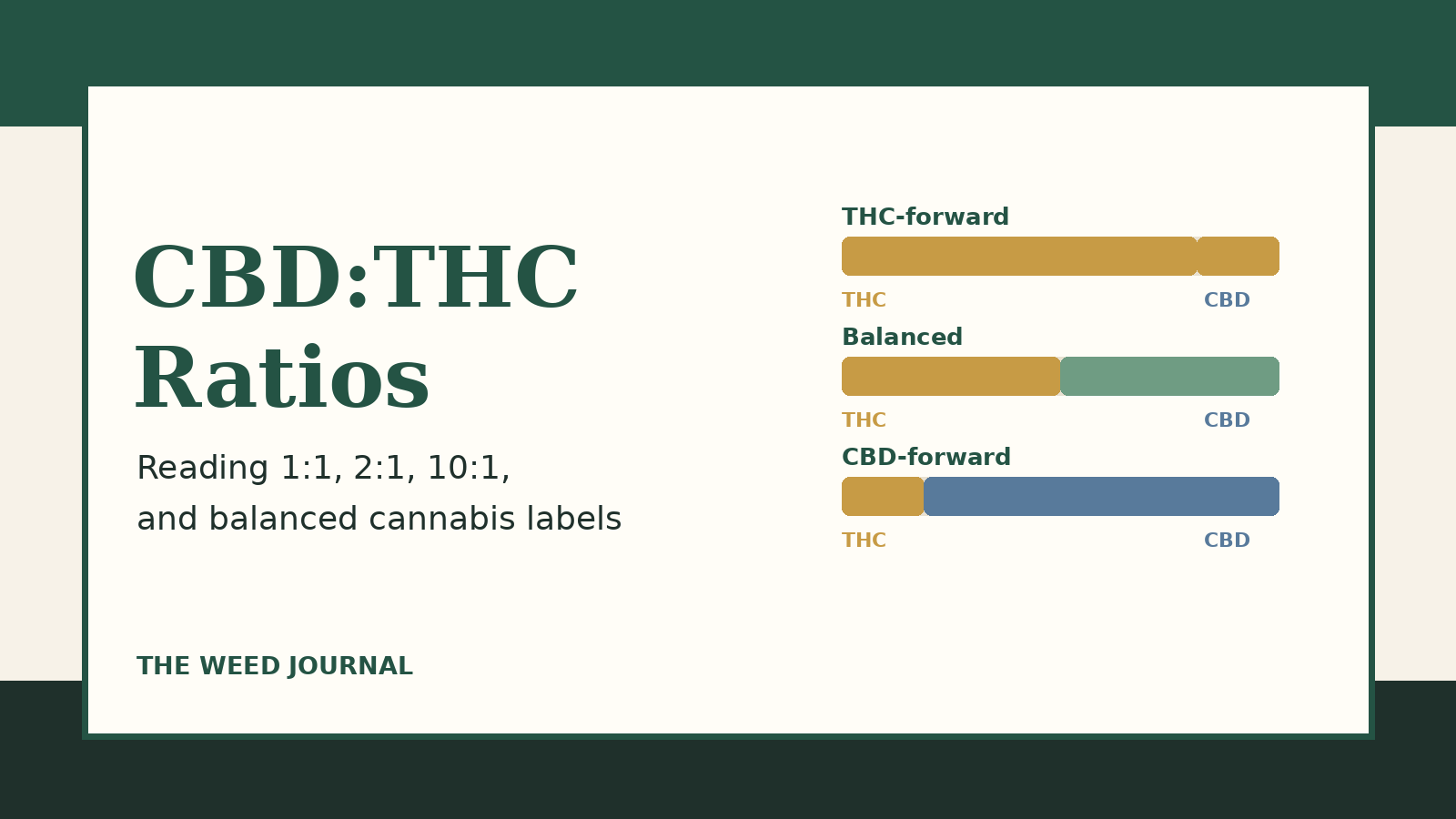
    A CBD:THC ratio compares how much cannabidiol (CBD) is present relative to delta-9-tetrahydrocannabinol (THC). A 1:1 product has roughly equal CBD and THC. A 2:1 product has about twice as much CBD as THC. A 10:1 product is CBD-forward. A 1:2 product is THC-forward. In Canada, read the front label for Total THC and Total CBD, then check the serving size or amount per activation before deciding whether the product fits your tolerance.

    Ratios are not effect guarantees. Health Canada notes that higher THC content is linked with a higher chance of adverse effects and impairment, and that CBD is known to reduce some effects of THC. That does not mean CBD cancels THC or makes a product non-impairing. A balanced edible can still be too strong if the THC milligrams are high for you.

    Common CBD:THC ratios at a glance

    Label ratio Plain meaning What to check before use
    1:1 Roughly equal CBD and THC. The actual THC amount per serving; equal does not mean mild.
    2:1 or 5:1 CBD-forward with some THC. Whether the THC amount is still enough to impair you.
    10:1 or 20:1 Strongly CBD-forward. Whether there is any THC, and how much is in the full dose.
    1:2 or 1:5 THC-forward with some CBD. Your tolerance, setting, timing, and need to avoid driving.
    CBD-only style CBD-dominant, often with very little THC. The label may still show trace THC; check Total THC, not just the name.
    Use ratios as a sorting tool, then make the decision from Total THC, Total CBD, format, serving size, and your own tolerance.

    Ratio is not the same as dose

    The most common mistake is reading a ratio and forgetting the actual amount. A 1:1 product with 2.5 mg THC and 2.5 mg CBD per serving is very different from a 1:1 product with 10 mg THC and 10 mg CBD per serving. The ratio is the same. The dose is not.

    That difference matters most with ingestible products such as oils, capsules, softgels, edibles, and drinks. Inhaled products can be titrated more gradually by some adults because effects are usually felt sooner, but that does not make them risk-free. Edibles and oils can take longer, last longer, and catch people off guard when they stack doses too quickly.

    If you are new, returning after a break, or switching formats, our microdosing guide for Canadians and edibles dose chart are better starting points than ratio shopping alone.

    How Canadian labels show THC and CBD

    Health Canada’s label guidance says cannabis product labels must show Total THC and Total CBD. These are the practical numbers most adult consumers should use when comparing potency. Depending on the product, the amount may be shown as milligrams per package, milligrams per unit, milligrams per gram, or a concentration.

    For dried flower, you may see THC and Total THC. The same pattern can appear for CBD and Total CBD. The “Total” value estimates what is available after activation, which is why it is usually more useful for a buyer than the inactive-acid number alone. Our Canadian cannabis label guide walks through that label math in more detail.

    For oils and ingestibles, check the amount per activation or serving. A bottle might look CBD-forward overall, but the dropper size or activation amount determines what you actually consume. If the label is confusing, slow down and ask the legal retailer to explain the serving math before buying.

    What CBD may change about a THC experience

    CBD and THC are both cannabinoids, but they do not feel the same for most adults. THC is the main intoxicating compound associated with the cannabis high. CBD is not usually described as intoxicating in the same way, and Health Canada says CBD is known to reduce some effects of THC.

    That is useful, but it should be interpreted carefully. CBD does not make THC disappear. It does not make impaired driving safe. It does not guarantee a calm experience, prevent anxiety, or turn a high-dose edible into a beginner product. The National Academies review is also a reminder that cannabis evidence varies by condition and outcome; many claims are supported by limited or insufficient evidence, not certainty.

    The practical takeaway is modest: CBD-forward or balanced products may be worth comparing if THC-heavy products feel too intense for you, but the safer-use decision still comes back to dose, timing, setting, and avoiding risky activities.

    When a 1:1 product makes sense to consider

    A 1:1 product is often marketed as “balanced” because it has similar CBD and THC amounts. That can be helpful language, but balanced does not mean neutral. A balanced product can still be intoxicating, especially if the THC dose is high, the format is an edible, or your tolerance is low.

    Consider a 1:1 product only after checking the THC amount in the actual serving. For example, a legal edible with 10 mg THC and 10 mg CBD in the package may be 1:1, but 10 mg THC can be too much for some adults, especially beginners. A product with 2.5 mg THC and 2.5 mg CBD per serving is a very different starting point.

    If THC percentage or milligrams are becoming the whole decision, read why THC percentage is not everything. Ratio is another useful clue, not a replacement for judgment.

    When CBD-forward products may be the better comparison set

    CBD-forward ratios such as 2:1, 5:1, 10:1, or 20:1 are often chosen by adults who want to avoid a strongly THC-forward experience. They can be a reasonable comparison set for people who find high-THC products unpleasant, but the label still needs attention.

    First, check whether the product contains THC at all. Some CBD-dominant products contain a small amount of THC. Second, calculate the THC in the serving you plan to use. Third, remember that impairment risk is not only about how the product is marketed. Timing, alcohol, other drugs, fatigue, and your own sensitivity can all change the experience.

    For CBD oil specifically, our CBD oil buying guide for Canada covers legal-source checks, label reading, and product-format questions in more detail.

    When THC-forward products deserve extra caution

    THC-forward ratios such as 1:2 or 1:5 mean there is more THC than CBD. Some adults prefer that. The caution is that higher THC products are more likely to create impairment and adverse effects, especially for inexperienced consumers or people using large servings.

    Use extra caution with concentrates, high-THC vapes, infused pre-rolls, and edibles. The label may look familiar, but the dose can be much stronger than an older consumer expects from traditional flower. If anxiety, panic, racing thoughts, dizziness, or discomfort are common for you, a THC-forward product is not the place to prove a point.

    Do not drive after using cannabis. Do not mix cannabis with alcohol to test a ratio. Do not use a ratio label as permission to take more before the first dose has fully arrived.

    A simple way to compare products

    1. Confirm the product is from a legal Canadian source.
    2. Find Total THC and Total CBD on the label.
    3. Convert the label into the amount you will actually consume per serving.
    4. Use the ratio to decide whether the product is THC-forward, balanced, or CBD-forward.
    5. Choose the smallest practical amount when trying a new product.
    6. Wait long enough for the format before considering more.
    7. Avoid driving, work, childcare, water activities, or machinery after use.

    Questions to ask before checkout

    Before buying a ratio product, ask what you are trying to avoid. If the answer is “too much THC,” look at the THC amount first, then the ratio. If the answer is “confusing label math,” choose a product with clear serving information instead of a larger bottle or stronger package. If the answer is “I want CBD but no noticeable high,” check whether the product contains any THC and whether the retailer can explain the Total THC number plainly.

    It also helps to compare products inside the same format. A CBD-forward oil, a balanced edible, and a balanced vape are not interchangeable just because the ratio looks similar. Onset, duration, serving control, and how quickly effects are felt can change the risk of taking too much.

    Bottom line

    CBD:THC ratios are helpful when they stop you from shopping by strain name or THC number alone. They are not enough by themselves. A careful Canadian buyer reads Total THC and Total CBD, checks the serving size, respects the product format, and treats CBD as a possible moderator of some THC effects, not a safety shield.

    If you want the simplest buying rule, use this: ratio first, dose second, format third, tolerance always. That order keeps the label useful without pretending cannabis effects can be predicted from one number.
    Sources

  • What Is THCA? Flower, Concentrates, and Label Math in Canada

    What Is THCA? Flower, Concentrates, and Label Math in Canada

    THCA is one of those cannabis terms that sounds technical until it shows up on a real product label. A dried flower label may list THC and Total THC. A concentrate may mention acidic cannabinoids. A social post may claim that THCA is “not really THC.” For Canadian adults trying to read labels without falling for hype, the useful answer is more practical than that.

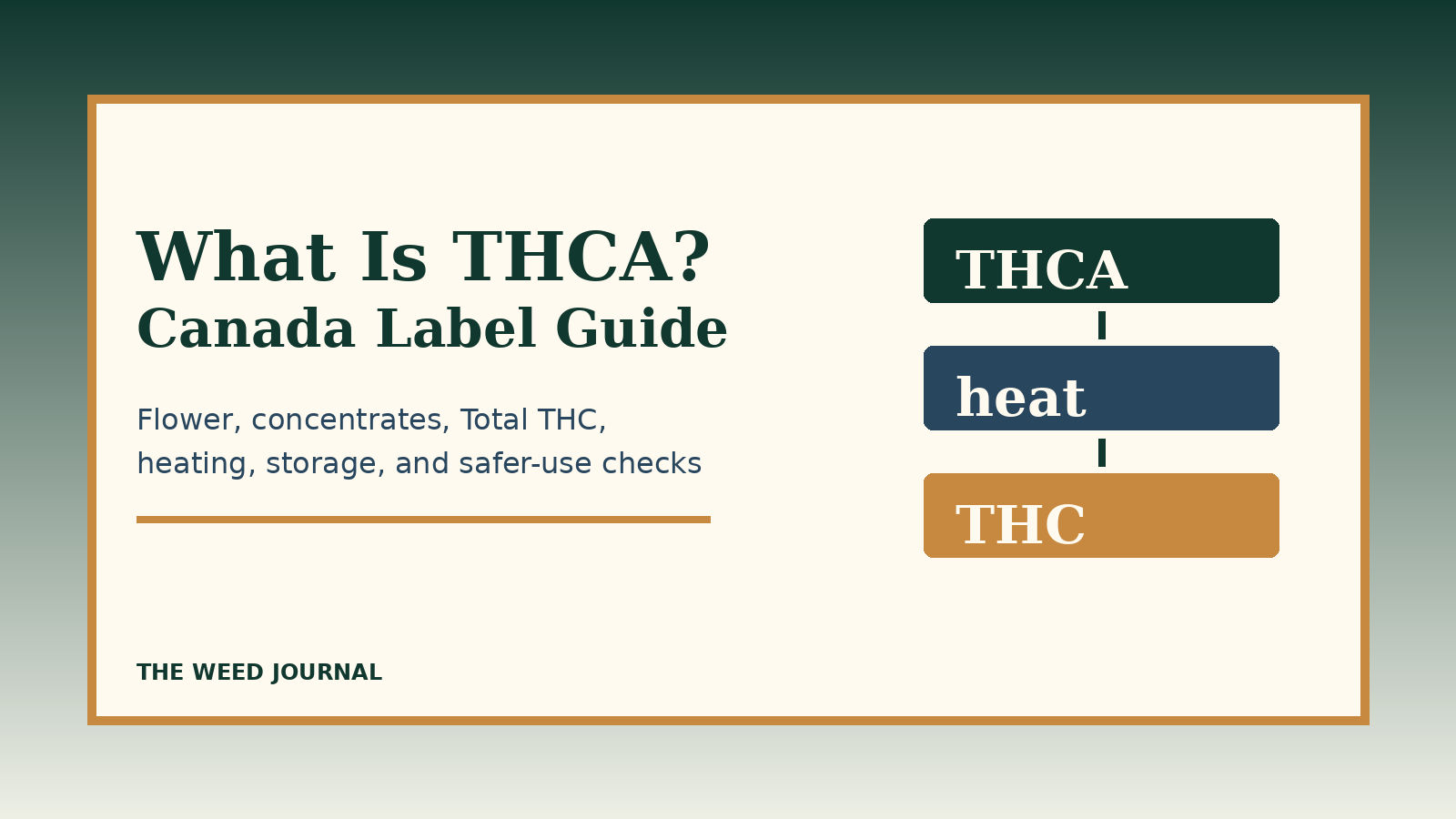
    THCA, short for tetrahydrocannabinolic acid, is the acidic precursor to THC. In plain language, it is a form of cannabinoid found in raw or unheated cannabis that can convert into THC when heated, aged, or processed. That conversion matters because THC is the main intoxicating compound associated with the cannabis high.

    Quick answer

    THCA is not the same label number as active THC, but it is closely connected to THC. When cannabis is heated through smoking, vaping, baking, or processing, some THCA can decarboxylate into THC. That is why Canadian labels focus on Total THC: the amount of THC a product could produce after activation, not only the THC already present before heating.

    For shoppers, the key habit is simple: do not judge a product by the THC line alone. Read Total THC, Total CBD, product type, package date, lot details, warnings, and the legal source. A flower with low “THC” but high “Total THC” can still be a strong intoxicating product once used.

    THCA vs THC vs Total THC

    Label or term What it usually means Why shoppers misread it Better habit
    THCA The acidic precursor cannabinoid naturally present in unheated cannabis It may be treated as harmless or unrelated to THC even though it can convert Ask how the product will be heated, stored, or consumed
    THC The active intoxicating cannabinoid already present in the product A low THC number can look mild if the Total THC number is ignored Use THC as one detail, not the final potency read
    Total THC The label estimate of THC after potential conversion from THCA It can be higher than the THC line, especially on dried flower Use Total THC when comparing likely intoxicating strength
    CBD / Total CBD The same active-vs-potential logic for CBD and CBDA CBD can be overvalued as a guarantee of calm or safety Read both CBD numbers and still check THC
    Canadian cannabis labels are designed to help consumers compare active and potential cannabinoid amounts. Total THC is the safer shopping number for intoxication risk.

    If you want a broader foundation before getting into THCA, start with The Weed Journal’s guide to THC vs CBD vs CBN in Canada. THCA belongs in that same cannabinoid family conversation, but the label math is especially important for flower and concentrates.

    What decarboxylation means

    Decarboxylation is the chemical change that turns acidic cannabinoids into their neutral forms. For THCA, that means conversion toward THC. It can happen slowly during storage and more quickly with heat. Smoking and vaping create heat. Cooking and baking create heat. Some extraction or processing steps can also change cannabinoid forms.

    This is why “raw cannabis has THCA” and “cannabis can get you high” are not contradictory. A raw plant can contain a lot of THCA before use. Once heated, part of that potential can become THC. The exact conversion is not something a consumer can calculate perfectly at home because time, temperature, product moisture, storage, and method all matter.

    The practical takeaway is to avoid loophole thinking. If a product contains meaningful THCA and you plan to heat it, treat it as a product with intoxicating potential.

    Why Canadian labels use Total THC

    Health Canada’s consumer label guidance says the front of a cannabis label must display Total THC and Total CBD. That is not just a design choice. It helps adults understand the amount of cannabinoid the product could produce after activation, rather than only the amount already active in the package.

    The federal packaging and labelling guidance also accounts for the potential conversion of THCA into THC when applying THC quantity limits for some product classes. In other words, Canadian rules are built around the reality that THCA can become THC. This is different from online arguments that treat THCA as if it has no connection to intoxication.

    For dried flower, the difference can be obvious. A label might show a small current THC percentage and a much higher Total THC percentage. The Total THC line is usually the number a buyer should use when comparing how strong the product may feel after smoking or vaping.

    THCA in flower

    Dried cannabis flower is where many adults first notice the THCA issue. Flower is commonly consumed with heat, so a high Total THC value can translate into a stronger experience even if the pre-heated THC line looks modest.

    This also helps explain why chasing the highest THC percentage can lead to poor buying decisions. Total THC may tell you something about potential strength, but it does not tell you freshness, aroma, moisture, terpene profile, harvest quality, or whether the product fits your tolerance. A very strong label number can still come with dry texture, harsh smoke, weak aroma, or an experience that is too intense for the setting.

    For a better shopping frame, pair this article with why THC percentage is not everything in Canada and our fresh cannabis flower checklist.

    THCA in concentrates

    Concentrates can make THCA feel even more confusing because labels and product names may include resin, rosin, diamonds, sauce, shatter, wax, live products, or vape-ready extracts. Some concentrates are designed around high cannabinoid concentration, and some may contain visible crystalline material described as THCA.

    Do not assume the word “THCA” makes a concentrate mild. If the product will be dabbed, vaporized, or otherwise heated, the intoxicating potential can be significant. Concentrates may also deliver cannabinoids quickly and intensely, which can increase the chance of anxiety, dizziness, coughing, overconsumption, or impairment for people with low tolerance.

    If you are newer to cannabis, it is usually wiser to build label-reading habits with lower-potency products before experimenting with concentrates. The same goes for anyone returning after a long break, changing formats, or buying a product type they have not used before.

    THCA does not make health claims safer

    Some cannabis marketing treats minor or acidic cannabinoids as if they are wellness shortcuts. That is not a reliable way to read a product. THCA is an interesting cannabinoid for researchers, but consumer-facing claims often move faster than the evidence. A product should not be treated as a treatment for pain, inflammation, nausea, sleep, anxiety, or any other health condition just because THCA appears on a label.

    Health Canada warns that cannabis can impair memory, concentration, attention, reaction time, coordination, and judgment. Cannabis can also cause anxiety, panic, confusion, sleepiness, dizziness, and other short-term effects. Those risks are still relevant when the label conversation starts with THCA.

    If you use medications, have a personal or family history of psychosis, are pregnant or breastfeeding, have safety-sensitive work, or are dealing with a serious medical symptom, treat cannabis as a health decision and talk to a qualified professional.

    A practical THCA label checklist

    • Confirm the product is from a legal Canadian retailer or provincial online store.
    • Find Total THC before comparing potency or price.
    • Check whether the product will be heated through smoking, vaping, dabbing, baking, or cooking.
    • Do not assume a low THC line means the product is low-strength if Total THC is high.
    • Read Total CBD too, but do not assume CBD removes impairment risk.
    • Check the package date, lot number, storage condition, and warning labels.
    • For concentrates, go slower than you would with dried flower because potency and onset can feel more abrupt.
    • Plan for no driving, work calls, childcare emergencies, or equipment use after consumption.

    For a full label walkthrough, use The Weed Journal’s guide to reading cannabis labels in Canada. THCA makes much more sense once Total THC, format, package date, and intended use are read together.

    How storage changes the picture

    Storage will not turn a weak product into a strong one, but it can change cannabis quality over time. Heat, oxygen, and light can contribute to cannabinoid changes and terpene loss. Poor storage can also dry flower out, flatten aroma, or create quality concerns if moisture is trapped in the wrong conditions.

    Airtight storage, stable room temperature, darkness, and child-resistant security matter more than novelty jars or complicated gear. If flower smells musty, feels damp in a suspicious way, or shows visible mould, skip it. Potency math is irrelevant if the product looks unsafe or badly stored.

    Common THCA mistakes

    The first mistake is reading only the smallest number on the label. A product can show low active THC and higher Total THC because much of its potential THC is still in acidic form before heating.

    The second mistake is treating THCA as a legal or safety loophole. In Canada, legal cannabis products are regulated, packaged, labelled, and sold through authorized channels. If a seller is using THCA language to dodge basic source, age, package, or warning questions, that is a red flag.

    The third mistake is assuming that a high Total THC product is automatically better. It may be stronger, but stronger is not the same as fresher, smoother, more balanced, or more appropriate for your plans. New and occasional consumers often do better with lower potency, small amounts, and a low-pressure setting.

    Bottom line

    THCA is the acidic precursor to THC, and heat can convert some of it into THC. That is why Total THC matters on Canadian cannabis labels. If you are buying flower or concentrates, Total THC is the number that better reflects likely intoxicating potential after activation.

    The reader-first rule is simple: do not let chemistry terms replace common sense. Buy legal, read the full label, understand the format, avoid medical-style claims, start low if you choose to use, and give yourself enough time and space to stay safe.

    Sources

  • What Is CBN? Sleep Claims, Evidence, and Safer Use in Canada

    What Is CBN? Sleep Claims, Evidence, and Safer Use in Canada

    CBN has become one of the most heavily marketed “sleep” cannabinoids in cannabis. You may see it in gummies, oils, capsules, vapes, and product descriptions that imply a calmer night or deeper rest. For Canadian adults trying to make sense of those claims, the useful answer is not “CBN works” or “CBN is fake.” The honest answer is narrower.

    CBN, short for cannabinol, is a minor cannabinoid that can appear as THC ages and oxidizes. It may be interesting for sleep research, and some early human evidence is worth watching. But a CBN label is not a guarantee that a product will fix insomnia, replace medical care, or feel gentle for every person. Dose, THC content, product format, timing, tolerance, medications, alcohol, and sleep habits still matter.

    Quick answer

    CBN is a naturally occurring cannabinoid found in cannabis, usually in much smaller amounts than THC or CBD. It is often marketed for sleep because older cannabis and some CBN-containing products can feel sedating to some consumers. The evidence is still limited, especially compared with the certainty of retail claims.

    If you are considering a legal CBN product in Canada, read the full label first. Check Total THC, Total CBD, serving size, product format, package date, warnings, and whether the product is actually from an authorized legal source. Treat CBN as one possible ingredient, not as a sleep treatment promise.

    What CBN is, in plain language

    CBN is one of many cannabinoids found in the cannabis plant. THC and CBD get most of the attention because they are usually present in larger amounts and have more familiar effects. CBN is considered a minor cannabinoid because it is typically present at lower levels.

    CBN is often connected with older cannabis because THC can degrade into CBN over time when exposed to oxygen, heat, and light. That does not mean old cannabis is automatically better for sleep. Poorly stored flower can lose aroma, become harsh, or develop quality problems. If cannabis smells musty, damp, or mouldy, it should not be used.

    The important distinction is this: CBN is a chemical detail, not a complete product description. A product with CBN may also contain THC, CBD, terpenes, sweeteners, carrier oils, flavouring, or other cannabinoids. The whole formula and the dose matter more than the buzzword on the front of the package.

    How CBN differs from THC and CBD

    Cannabinoid What shoppers usually notice Sleep-related caution Label habit
    THC The main intoxicating cannabinoid in cannabis Low amounts may feel relaxing for some people, but higher amounts can increase anxiety, next-day fog, and sleep disruption Check Total THC before anything else
    CBD Non-intoxicating for most consumers, but still biologically active Not a guaranteed sleep aid and may interact with some medications Check Total CBD and talk to a clinician if using medicines
    CBN A minor cannabinoid often promoted for sleep Evidence is early and product claims can outrun the research Check how much CBN is present and whether THC is included

    For a broader foundation, read The Weed Journal’s guide to THC vs CBD vs CBN in Canada. It explains why cannabinoid names are helpful only when they are connected to the actual amount, format, and intended use.

    Why CBN became a sleep product

    CBN’s sleep reputation comes from a mix of consumer experience, older cannabis folklore, early research, and product marketing. Some people report that CBN products feel drowsy or make bedtime easier. Some products pair CBN with THC, CBD, melatonin, or calming flavours. The problem is that a consumer report does not prove which ingredient caused the effect.

    Sleep is especially hard to judge because expectation, stress, pain, alcohol, caffeine, screen time, room temperature, and bedtime routine all change the result. If someone takes a CBN gummy after a quiet evening, in a dark room, with no early alarm, the product may get credit for conditions that were already sleep-friendly.

    That does not make CBN useless. It means the claim needs humility. A good sleep product claim should tell you what is in the serving, what the THC amount is, how long onset may take, and what risks to consider. It should not imply that CBN will reliably treat insomnia.

    What the evidence says so far

    Health Canada’s clinical information for health professionals notes that cannabis and THC can have dose-dependent effects on sleep, with lower doses showing different effects from higher doses in some human experimental data. It also describes the clinical evidence around cannabinoids and sleep as limited, especially when sleep problems are connected to other health conditions.

    Recent CBN-specific research is still developing. One double-blind, randomized, placebo-controlled study reported that 20 mg CBN reduced nighttime awakenings and overall sleep disturbance compared with placebo, while not showing the same pattern across every sleep measure. That is interesting, but it is not the same as proving that every retail CBN gummy works for every poor sleeper.

    The most reader-safe interpretation is this: CBN deserves continued study, but current evidence does not justify confident cure-style claims. Anyone with persistent insomnia, sleep apnea symptoms, significant anxiety, depression, chronic pain, medication interactions, pregnancy, or safety-sensitive work should treat cannabis sleep products as a health question, not just a shopping choice.

    The THC issue many CBN shoppers miss

    Many CBN products are not CBN-only. They may contain THC, and THC can matter more than the CBN. Health Canada identifies THC as the main intoxicating component of cannabis and warns that cannabis can impair attention, reaction time, coordination, memory, and judgment. It can also cause anxiety, panic, confusion, and sleepiness in the short term.

    For sleep, THC can be a two-sided detail. Some adults feel drowsy after a small amount. Others feel mentally busy, anxious, uncomfortable, or groggy the next day. Higher THC is not automatically better for sleep, and using cannabis every night can create tolerance or make sleep feel harder when cutting back.

    If you are comparing sleep-labelled products, do not start with the word CBN. Start with Total THC per serving and per package. If you are not sure how long effects may last, read our guide to how long THC lasts in Canada before planning a bedtime experiment.

    Format changes the experience

    A CBN oil, edible, capsule, beverage, vape, and dried-flower product can all behave differently. Inhaled products act faster but bring inhalation risks and are not ideal for people trying to protect their lungs. Edibles and oils can take longer to work and can last longer, which may increase next-morning impairment if the timing or dose is wrong.

    Edibles deserve extra caution because people often take more too soon. A product that seems mild at 30 minutes may feel much stronger later. If a CBN product is edible or oil-based, leave enough time for onset and avoid stacking servings just because sleep has not arrived yet. Our guide to how long edibles take to kick in explains why patience matters.

    A practical label checklist for CBN products

    • Confirm the product is from a legal Canadian source authorized in your province or territory.
    • Check Total THC and Total CBD before the CBN claim.
    • Find the CBN amount per serving, not just on the front of the package.
    • Check serving size and package size so you do not confuse one unit with one dose.
    • Look for required warnings, lot information, and packaging details.
    • Avoid products that claim to treat, cure, or guarantee relief from insomnia or anxiety.
    • Do not mix with alcohol, sedatives, or other sleep products without professional advice.
    • Plan for no driving, childcare emergencies, machinery, or safety-sensitive tasks after use.

    This checklist is intentionally conservative. Sleep is not only about falling asleep. It is also about waking clearly, avoiding risky combinations, and not building a nightly habit that becomes hard to stop.

    When CBN is a poor fit

    CBN or CBN-labelled cannabis products may be a poor fit if you are pregnant or breastfeeding, under the legal age, driving or on call, combining substances, using medications with sedation warnings, managing psychosis risk, or dealing with serious mental-health symptoms. The same caution applies if poor sleep is new, severe, or paired with chest pain, breathing pauses, major mood changes, or daytime sleep attacks.

    Cannabis can also affect people differently as use becomes more frequent. CAMH notes that long-term frequent cannabis use can lead to withdrawal symptoms when cutting down, including disturbed sleep. That matters for anyone who starts using cannabis nightly and then finds sleep harder without it.

    If tolerance is already part of the pattern, our cannabis tolerance break guide offers a practical way to think about frequency, planning, and when to ask for support.

    A safer way to test a legal CBN product

    If an adult still chooses to try a legal CBN product, the lower-risk approach is to make the test boring. Choose a night with no early drive, no alcohol, no new medication, no childcare duty that requires quick reaction, and no pressure to perform the next morning. Use the smallest reasonable serving, record the THC and CBN amounts, and do not add more just because the effect is subtle.

    Write down bedtime, timing, amount, food, caffeine, alcohol, stress level, wake-ups, next-day grogginess, mood, and whether the product was worth repeating. After several uses, look for patterns rather than one dramatic conclusion. If the product only seems helpful when the dose keeps increasing, that is not a stable solution.

    If you are still choosing between product types, start with Cannabis 101: product types in Canada before shopping by cannabinoid trend.

    Bottom line

    CBN is a real cannabinoid with a growing sleep-product reputation, but the evidence is not strong enough to support guaranteed sleep claims. In Canada, the smartest way to read a CBN product is to slow down and check the full legal label: THC, CBD, CBN amount, format, serving size, warnings, source, and timing.

    For occasional adult use, a CBN product may be something to evaluate cautiously. For persistent insomnia or health-related sleep problems, it is not a substitute for medical advice. A responsible CBN article should leave you with fewer assumptions, not a stronger sales pitch.

    Sources