Tag: CBD

  • Cannabis Capsules in Canada: Softgels and Labels

    Cannabis Capsules in Canada: Softgels and Labels

    Cannabis capsules and softgels look simple because they resemble ordinary supplements: small containers, measured units, tidy labels, no rolling papers, no smoke, and no obvious smell. That simplicity can be useful. It can also make people underestimate the timing and impairment risk.

    This Canada-aware guide is for adults comparing legal cannabis capsules, softgels, and similar ingestible oil products. It is not medical advice, and it is not a recommendation to use cannabis for a health condition. The practical goal is label literacy: know the Total THC and Total CBD per unit, understand that effects can be delayed, store the product securely, and avoid treating a capsule like a harmless vitamin.

    Quick answer

    In Canada, cannabis capsules and softgels should be bought from legal sources and kept in original packaging. Before using one, check the product class, Total THC, Total CBD, amount per capsule or softgel, number of units, lot number, package date, storage instructions, and warnings. Effects from ingestible cannabis can take longer to appear than inhaled cannabis and may last much longer, so taking another capsule too soon is one of the easiest mistakes to make.

    If you are new, sensitive to THC, returning after a break, or trying a new product, choose the lowest practical THC amount, wait long enough before considering more, and do not drive, mix with alcohol, supervise risky activities, or make important decisions while impaired.

    If you are trying to compare capsules with oils, sprays, strips, or lozenges, start with the label unit first: one capsule, one spray, one strip, one lozenge, or one measured mL can all mean different THC amounts.

    Capsule label checklist

    Label item What to check Why it matters
    Total THC per unit Find the amount in each capsule or softgel This is the main impairment number for most THC products
    Total CBD per unit Check CBD separately from THC CBD does not make THC non-impairing or driving-safe
    Unit count Count how many capsules are in the bottle A bottle can contain many separate doses
    Product class Confirm whether it is an extract, edible, or other regulated format Rules, limits, and use directions can differ by class
    Storage instructions Look for heat, light, and child-resistant packaging guidance Oil-based products can be damaged by poor storage
    Lot and package date Keep batch information available Useful for freshness questions and product-quality reports
    Capsules are easiest to compare when you ignore the front-label promise and read the per-unit cannabinoid math first.

    What counts as a cannabis capsule or softgel?

    Most shoppers use “capsule” and “softgel” to describe small swallowable cannabis products made with cannabis extract or oil. Some are THC-forward, some are CBD-forward, and some use balanced ratios. They may be sold as bottles of individual units rather than single edible pieces or drinks.

    The format matters because the experience is usually closer to other ingestible cannabis products than to smoking or vaping. You swallow the product, then wait for the body to process it. That means the onset may be delayed and the duration may be longer than a beginner expects.

    Do not assume a capsule is weaker because it looks clinical or discreet. A small softgel can still contain enough THC to impair judgment, coordination, reaction time, and comfort. Health Canada warns that cannabis can affect attention, memory, reaction time, coordination, and decision-making.

    How capsules differ from oils, edibles, and drinks

    Capsules are often easier to measure than drops because each unit is already portioned. That is the main advantage. You do not need to count drops or estimate how much oil is left on a spoon. The tradeoff is less flexibility: if one capsule contains more THC than you want, splitting it may be messy, inaccurate, or discouraged by the product directions.

    Compared with gummies, chocolates, and beverages, capsules can feel less snack-like. That can reduce accidental nibbling, but it can also create a false sense of seriousness or safety. The product is still cannabis. It still needs a slow timing plan and secure storage.

    For adjacent formats, read our CBD oil buying guide for Canada, THC beverages guide, and tinctures vs edibles comparison.

    Why per-unit math matters

    The most useful capsule question is not “How strong is the bottle?” It is “How much THC and CBD are in the one unit I might take?” A bottle with 30 capsules can display package-level information that is not the same as per-capsule information. Read slowly enough to avoid confusing the total container amount with the amount in each unit.

    For THC products, the lower-risk habit is to choose a small amount when you are unsure and wait through the full onset window before considering more. A higher-THC capsule may be convenient for an experienced consumer with a known tolerance, but it is a poor first comparison point for a beginner.

    CBD-forward capsules still deserve label reading. Some contain little or no THC; others contain enough THC to matter for impairment-sensitive people. If your goal is to avoid a high, verify the Total THC number instead of relying on the front label or ratio language. Our CBD:THC ratios guide explains why ratio is helpful but incomplete.

    Onset: the slow part is the risk

    Capsules and softgels can be tempting because the serving is tidy. The risk is that tidy does not mean immediate. Health Canada tells consumers that cannabis effects from eating or drinking can take longer to appear and can last longer than expected. Many uncomfortable experiences happen when someone takes another ingestible product before the first amount has fully arrived.

    With capsules, the delay can feel especially misleading because there is no flavour, smoke, ritual, or obvious sensory cue. A person may swallow one, go back to normal activity, decide nothing is happening, and take another. Later, both amounts can overlap.

    Build the wait into the plan before using. If you need predictable timing, need to drive later, are mixing with alcohol, or are using cannabis around people who pressure you to keep up, capsules are not a good fit for that situation. Our edibles onset guide is the better timing primer if you are uncertain.

    When capsules are a poor beginner choice

    Capsules can be too inflexible when the per-unit THC amount is higher than your comfort level. A 10 mg THC capsule may look modest beside stronger inhaled products, but for some adults it can be a very strong ingestible amount. Smaller units can be easier to learn from because you can stop after one and wait.

    They may also be a poor fit if you have trouble swallowing pills, have digestive issues that change how products affect you, take medications, have a health condition, are pregnant or breastfeeding, have a personal or family history of psychosis, or need professional advice about personal risk. For health-adjacent questions, talk with a qualified clinician instead of relying on a product page.

    Do not use capsules as a sleep, anxiety, pain, or medical treatment plan based on marketing language. The Weed Journal keeps those topics cautious because cannabis effects vary and evidence is not a substitute for personal medical care.

    Safer-use plan before taking one

    • Buy from a legal Canadian source and keep the original label.
    • Check Total THC and Total CBD per capsule, not just per bottle.
    • Choose the lowest practical THC amount when trying a new product.
    • Use only when you have a clear window with no driving or safety-sensitive duties.
    • Do not mix with alcohol, sedatives, or unknown substances.
    • Set a timer or write down when you took it so you do not redose by guesswork.
    • Wait long enough for ingestible effects before considering more.
    • Stop if you feel anxious, dizzy, unusually sleepy, confused, nauseated, or uncomfortable.
    • Keep the bottle locked away from children, pets, guests, and anyone who should not access cannabis.

    Storage and household safety

    Capsules and softgels can be easier to secure than loose edibles, but only if you keep the system intact. Use original child-resistant packaging, keep the label with the product, close the bottle tightly, and store it cool, dry, dark, and locked. Avoid hot cars, sunny windowsills, bathrooms, and open bedside tables.

    The ordinary-pill appearance is part of the risk. A visitor, roommate, child, or older adult could mistake an unlabelled cannabis capsule for a supplement or medicine. Do not transfer capsules to a weekly pill organizer unless there is a specific medical or caregiver reason and the cannabis warning remains clear. For most homes, the original container inside a locked box is the better routine.

    If a child, pet, or non-consenting adult may have consumed cannabis capsules, treat it as urgent and contact emergency, poison-centre, or veterinary help as appropriate. Do not wait for symptoms to prove the concern.

    Buying questions to ask

    Before checkout, ask three plain questions. First: how many milligrams of Total THC are in one capsule? Second: how long should I plan before deciding whether the first amount has arrived? Third: what will keep this product labelled, locked, and away from people who should not access it?

    If the retailer cannot help you find the per-unit amount, choose a clearer product. If the only available capsule strength is higher than you want, choose another format or skip the purchase. A good cannabis product is not just legal and popular. It is understandable enough that you can use it cautiously.

    Bottom line

    Cannabis capsules and softgels can make dose measurement easier, but they do not remove cannabis risk. The responsible Canadian buying routine is simple: legal source, original packaging, per-unit THC and CBD math, conservative timing, no driving, no alcohol mixing, and locked storage. If you cannot explain the label before taking it, the product is not ready for your plan yet.

    FAQ

    Are cannabis capsules the same as edibles?

    They are not the same product format, but they are usually managed like ingestible cannabis from a timing perspective. Effects can be delayed and may last longer than inhaled cannabis, so redosing too soon is a common risk.

    How much THC should a beginner choose in a capsule?

    There is no universal beginner dose. A cautious adult should choose the lowest practical THC amount, avoid high-THC units, and wait long enough before considering more. People with health conditions, medications, pregnancy, breastfeeding, or personal risk factors should seek professional advice.

    Can CBD capsules make you high?

    CBD itself is not intoxicating in the same way as THC, but some CBD-labelled products contain THC. Read Total THC on the label. Do not use CBD language as a reason to drive or ignore impairment risk.

    Can I open a softgel to take less?

    Do not assume that opening, cutting, or squeezing a capsule gives an accurate smaller serving. Follow product directions. If one unit is too strong or too uncertain, choose a lower-strength product or a format with clearer portion control.

    What if I took too much?

    Do not take more cannabis or alcohol. Move to a calm place, have a sober adult nearby, and monitor how you feel. Seek urgent help if symptoms are severe, unusual, or unsafe. For practical non-emergency steps, read our guide on what to do when you are too high.
    Sources

  • CBD:THC Ratios in Canada: What They Mean

    CBD:THC Ratios in Canada: What They Mean

    CBD:THC ratios look simple until you are standing in front of a Canadian cannabis menu trying to compare oils, capsules, drinks, flower, pre-rolls, vapes, and edibles. A product might say 1:1, 2:1, 10:1, or “balanced.” Another label might list milligrams per gram, milligrams per package, or milligrams per activation. The ratio is useful, but only if you know what it can and cannot tell you.

    This guide is for adults who want a practical, Canada-aware way to read CBD:THC ratios without treating them like medical promises. The short version: the ratio compares the amount of CBD to THC, but the actual dose, product format, your tolerance, timing, and legal label details still matter.

    Quick answer

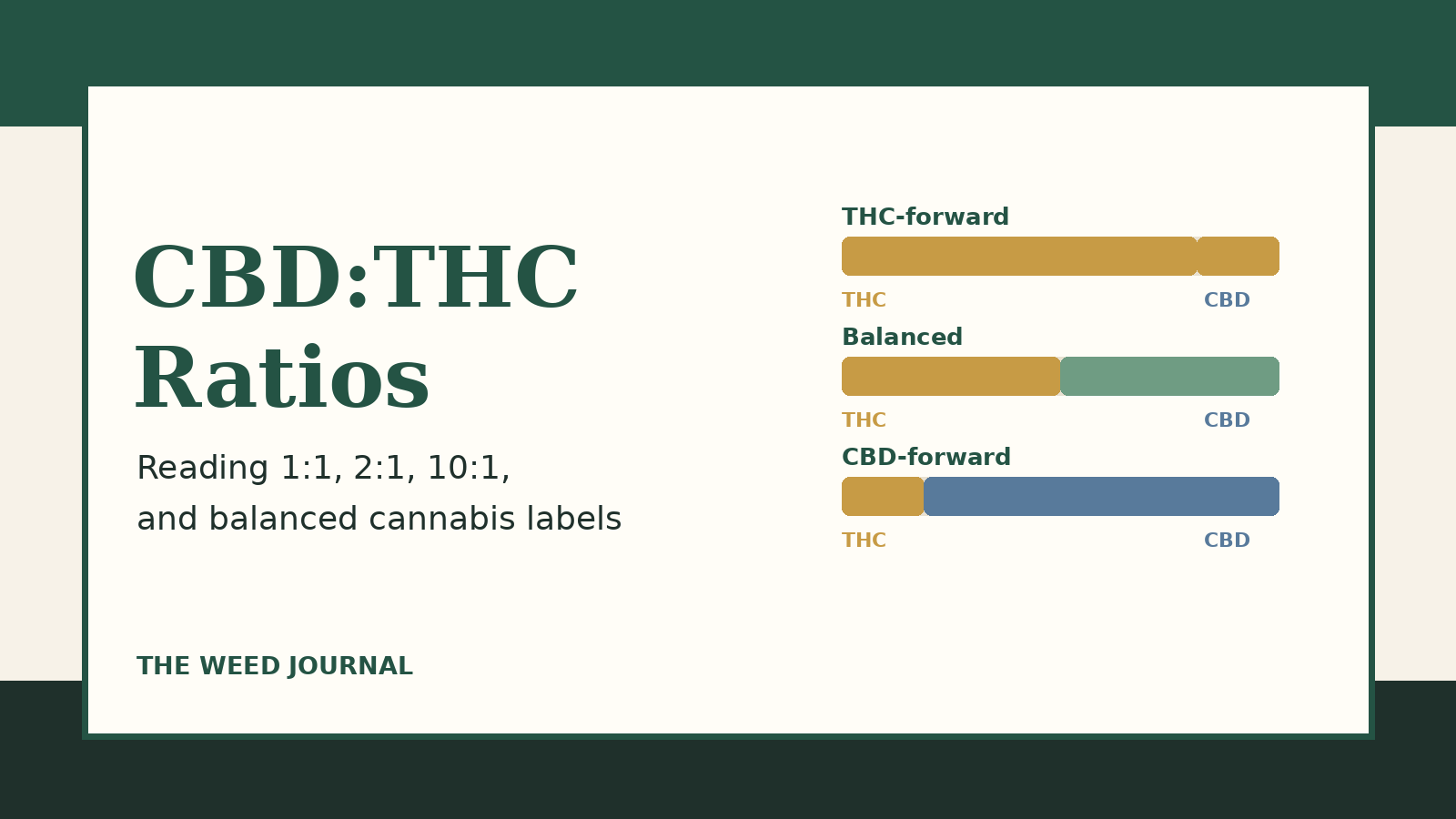
    A CBD:THC ratio compares how much cannabidiol (CBD) is present relative to delta-9-tetrahydrocannabinol (THC). A 1:1 product has roughly equal CBD and THC. A 2:1 product has about twice as much CBD as THC. A 10:1 product is CBD-forward. A 1:2 product is THC-forward. In Canada, read the front label for Total THC and Total CBD, then check the serving size or amount per activation before deciding whether the product fits your tolerance.

    Ratios are not effect guarantees. Health Canada notes that higher THC content is linked with a higher chance of adverse effects and impairment, and that CBD is known to reduce some effects of THC. That does not mean CBD cancels THC or makes a product non-impairing. A balanced edible can still be too strong if the THC milligrams are high for you.

    Common CBD:THC ratios at a glance

    Label ratio Plain meaning What to check before use
    1:1 Roughly equal CBD and THC. The actual THC amount per serving; equal does not mean mild.
    2:1 or 5:1 CBD-forward with some THC. Whether the THC amount is still enough to impair you.
    10:1 or 20:1 Strongly CBD-forward. Whether there is any THC, and how much is in the full dose.
    1:2 or 1:5 THC-forward with some CBD. Your tolerance, setting, timing, and need to avoid driving.
    CBD-only style CBD-dominant, often with very little THC. The label may still show trace THC; check Total THC, not just the name.
    Use ratios as a sorting tool, then make the decision from Total THC, Total CBD, format, serving size, and your own tolerance.

    Ratio is not the same as dose

    The most common mistake is reading a ratio and forgetting the actual amount. A 1:1 product with 2.5 mg THC and 2.5 mg CBD per serving is very different from a 1:1 product with 10 mg THC and 10 mg CBD per serving. The ratio is the same. The dose is not.

    That difference matters most with ingestible products such as oils, capsules, softgels, edibles, and drinks. Inhaled products can be titrated more gradually by some adults because effects are usually felt sooner, but that does not make them risk-free. Edibles and oils can take longer, last longer, and catch people off guard when they stack doses too quickly.

    If you are new, returning after a break, or switching formats, our microdosing guide for Canadians and edibles dose chart are better starting points than ratio shopping alone.

    How Canadian labels show THC and CBD

    Health Canada’s label guidance says cannabis product labels must show Total THC and Total CBD. These are the practical numbers most adult consumers should use when comparing potency. Depending on the product, the amount may be shown as milligrams per package, milligrams per unit, milligrams per gram, or a concentration.

    For dried flower, you may see THC and Total THC. The same pattern can appear for CBD and Total CBD. The “Total” value estimates what is available after activation, which is why it is usually more useful for a buyer than the inactive-acid number alone. Our Canadian cannabis label guide walks through that label math in more detail.

    For oils and ingestibles, check the amount per activation or serving. A bottle might look CBD-forward overall, but the dropper size or activation amount determines what you actually consume. If the label is confusing, slow down and ask the legal retailer to explain the serving math before buying.

    What CBD may change about a THC experience

    CBD and THC are both cannabinoids, but they do not feel the same for most adults. THC is the main intoxicating compound associated with the cannabis high. CBD is not usually described as intoxicating in the same way, and Health Canada says CBD is known to reduce some effects of THC.

    That is useful, but it should be interpreted carefully. CBD does not make THC disappear. It does not make impaired driving safe. It does not guarantee a calm experience, prevent anxiety, or turn a high-dose edible into a beginner product. The National Academies review is also a reminder that cannabis evidence varies by condition and outcome; many claims are supported by limited or insufficient evidence, not certainty.

    The practical takeaway is modest: CBD-forward or balanced products may be worth comparing if THC-heavy products feel too intense for you, but the safer-use decision still comes back to dose, timing, setting, and avoiding risky activities.

    When a 1:1 product makes sense to consider

    A 1:1 product is often marketed as “balanced” because it has similar CBD and THC amounts. That can be helpful language, but balanced does not mean neutral. A balanced product can still be intoxicating, especially if the THC dose is high, the format is an edible, or your tolerance is low.

    Consider a 1:1 product only after checking the THC amount in the actual serving. For example, a legal edible with 10 mg THC and 10 mg CBD in the package may be 1:1, but 10 mg THC can be too much for some adults, especially beginners. A product with 2.5 mg THC and 2.5 mg CBD per serving is a very different starting point.

    If THC percentage or milligrams are becoming the whole decision, read why THC percentage is not everything. Ratio is another useful clue, not a replacement for judgment.

    When CBD-forward products may be the better comparison set

    CBD-forward ratios such as 2:1, 5:1, 10:1, or 20:1 are often chosen by adults who want to avoid a strongly THC-forward experience. They can be a reasonable comparison set for people who find high-THC products unpleasant, but the label still needs attention.

    First, check whether the product contains THC at all. Some CBD-dominant products contain a small amount of THC. Second, calculate the THC in the serving you plan to use. Third, remember that impairment risk is not only about how the product is marketed. Timing, alcohol, other drugs, fatigue, and your own sensitivity can all change the experience.

    For CBD oil specifically, our CBD oil buying guide for Canada covers legal-source checks, label reading, and product-format questions in more detail.

    When THC-forward products deserve extra caution

    THC-forward ratios such as 1:2 or 1:5 mean there is more THC than CBD. Some adults prefer that. The caution is that higher THC products are more likely to create impairment and adverse effects, especially for inexperienced consumers or people using large servings.

    Use extra caution with concentrates, high-THC vapes, infused pre-rolls, and edibles. The label may look familiar, but the dose can be much stronger than an older consumer expects from traditional flower. If anxiety, panic, racing thoughts, dizziness, or discomfort are common for you, a THC-forward product is not the place to prove a point.

    Do not drive after using cannabis. Do not mix cannabis with alcohol to test a ratio. Do not use a ratio label as permission to take more before the first dose has fully arrived.

    A simple way to compare products

    1. Confirm the product is from a legal Canadian source.
    2. Find Total THC and Total CBD on the label.
    3. Convert the label into the amount you will actually consume per serving.
    4. Use the ratio to decide whether the product is THC-forward, balanced, or CBD-forward.
    5. Choose the smallest practical amount when trying a new product.
    6. Wait long enough for the format before considering more.
    7. Avoid driving, work, childcare, water activities, or machinery after use.

    Questions to ask before checkout

    Before buying a ratio product, ask what you are trying to avoid. If the answer is “too much THC,” look at the THC amount first, then the ratio. If the answer is “confusing label math,” choose a product with clear serving information instead of a larger bottle or stronger package. If the answer is “I want CBD but no noticeable high,” check whether the product contains any THC and whether the retailer can explain the Total THC number plainly.

    It also helps to compare products inside the same format. A CBD-forward oil, a balanced edible, and a balanced vape are not interchangeable just because the ratio looks similar. Onset, duration, serving control, and how quickly effects are felt can change the risk of taking too much.

    Bottom line

    CBD:THC ratios are helpful when they stop you from shopping by strain name or THC number alone. They are not enough by themselves. A careful Canadian buyer reads Total THC and Total CBD, checks the serving size, respects the product format, and treats CBD as a possible moderator of some THC effects, not a safety shield.

    If you want the simplest buying rule, use this: ratio first, dose second, format third, tolerance always. That order keeps the label useful without pretending cannabis effects can be predicted from one number.

    Sources

  • Cannabis Topicals in Canada: Creams, Balms, and Labels

    Cannabis Topicals in Canada: Creams, Balms, and Labels

    Cannabis topicals can look familiar at first glance: creams, balms, lotions, oils, bath products, and similar formats meant for the skin. That familiar packaging is exactly why adults in Canada should slow down before buying one. A topical is still a regulated cannabis product, not an ordinary cosmetic with a cannabis-themed label.

    This guide explains what cannabis topicals are in Canada, how to read the label, what they can and cannot promise, and how to choose a product without treating it like a medical shortcut. It is written for adults who want the plain-language version before they add a topical to their routine.

    What counts as a cannabis topical?

    In Canada, cannabis topicals are one of the classes of cannabis that may be sold legally under the federal framework. Health Canada describes topicals as products that include cannabis as an ingredient and are intended for external body surfaces such as skin, hair, or nails. On a retail menu, that can include lotions, creams, balms, bath bombs, body oils, and similar products.

    The important boundary is use. A topical is not an edible, not a tincture, not a vape product, and not dried flower. It should be used only as directed on the package. If the product is meant for external use, do not eat it, smoke it, vape it, or use it in a way the label does not describe.

    If you are still learning the bigger product landscape, start with our Cannabis 101 guide to product types in Canada. Topicals make more sense once you can separate inhaled, ingested, oral, and external-use formats.

    Topicals are regulated cannabis, not casual CBD skincare

    One common mistake is assuming that a CBD cream is automatically outside cannabis rules because it feels like skincare. That is not how CBD is regulated in Canada. Health Canada says CBD and products containing CBD are subject to the rules and requirements that apply to cannabis under the Cannabis Act and its regulations. CBD products are legal only when sold in compliance with that system.

    That matters because unregulated topical products may use vague wellness language, unclear CBD or THC numbers, imported branding, or non-cannabis retail channels that do not match Canadian rules. A legal product should have regulated packaging, a product class on the label, THC and CBD information, required warnings, storage instructions, and a legal purchase channel.

    For Ontario readers, the baseline is simple: adults must be 19 or older to buy, possess, and use recreational cannabis. Legal shopping should go through the Ontario Cannabis Store or authorized retailers. If a topical is being sold through a random wellness shop, social account, or grey-market site with no clear cannabis authorization trail, treat that as a red flag.

    What topicals can and cannot tell you

    A legal topical label can help you understand the product. It is not a guarantee that the product will deliver a specific effect for your body. Cannabis affects people differently, and topical products are especially easy to overinterpret because the packaging can borrow the language of skincare, sports recovery, and wellness.

    Label detailWhat it helps you checkReader-first caution
    Product classConfirms whether the product is a cannabis topical rather than an extract, edible, or cosmetic-style item.Use it only in the way the product class and directions support.
    Total THC and Total CBDShows the cannabinoid amount or concentration declared for the product.Do not assume more THC or CBD means better results.
    Net weight, volume, and unitsHelps compare package size, pumps, bath products, or single-use formats.A larger container can still have a different concentration than a smaller one.
    Directions for useShows where, how much, and how often the product is intended to be used.Avoid broken skin, eyes, mucous membranes, or other use unless the label specifically supports it.
    Storage conditionsExplains temperature, light, and handling instructions for product quality.Keep cannabis products secured away from children and pets.
    Authorized source and excise detailsHelps separate legal cannabis from suspicious products.An attractive brand or review page does not prove legal status.

    Health Canada’s label guidance is useful here because it reminds shoppers to check the product class, THC and CBD amount, health warning, net weight or volume, number of units, and storage conditions. If you cannot find those basics, the product is not giving you enough information to compare it responsibly.

    Will a cannabis topical get you high?

    Many people ask this because topicals may contain THC. The cautious answer is that a topical should not be treated like an edible, vape, or smokeable product. It is intended for external use, and the way cannabinoids interact with the body depends on the product, formulation, amount used, skin condition, and use pattern.

    That does not mean the label can be ignored. You should still read the THC and CBD amounts, follow the directions, and avoid using more than directed because “it is only a cream.” You should also wash your hands after use unless the product is meant for the hands, and you should avoid accidentally transferring product to your eyes, mouth, food, or another person.

    If you are comparing THC strength across product types, our guide on why THC percentage is not everything is a helpful companion. Topicals are another example of why product format and directions matter as much as the cannabinoid number.

    A practical buying checklist

    Use this checklist before buying a cannabis topical in Canada:

    • Confirm the seller is legal for your province or territory.
    • Check that the label identifies the product as a cannabis topical.
    • Read the Total THC and Total CBD information instead of relying on front-label marketing language.
    • Compare concentration, net amount, and number of uses rather than package size alone.
    • Look for clear directions, including where the product should and should not be applied.
    • Check storage instructions and keep the product away from children, pets, and visitors.
    • Avoid products that make strong pain, inflammation, sleep, anxiety, or healing claims without a regulated medical context.
    • Do not use a cannabis topical on irritated or broken skin unless a qualified health professional has advised you and the product directions fit that use.

    This is also where legal-source checks matter. Health Canada notes that legal cannabis products are subject to rules for quality, packaging, labelling, promotion, and recall. Legal does not mean risk-free, but it does give you a clearer trail than an unverified marketplace product.

    How to compare creams, balms, oils, and bath products

    Topicals are not all designed for the same use. A cream may spread differently than a thick balm. A bath product may be used once, while a lotion may be applied in smaller amounts over time. A roll-on may be convenient but harder to compare if you do not know how much product comes out with each use.

    When comparing products, start with format and directions before price. Ask: where is this meant to be used, how much does the label suggest, how many uses does the package realistically contain, and how strong is the cannabinoid concentration per amount used? Those questions are more useful than chasing the highest CBD number on the shelf.

    For broader shopping habits, see our legal retailer checklist for buying cannabis in Canada. The same principle applies here: verify the seller first, then compare the product.

    What claims should make you pause?

    Be careful with products or pages that promise quick relief, guaranteed recovery, anti-inflammatory results, sleep improvement, anxiety control, or treatment for a specific condition. That kind of claim changes the stakes for readers. A general retail cannabis product should not be treated as medical advice.

    It is reasonable to be curious. It is not reasonable for a seller to push certainty where the evidence, your health situation, and the product label do not support it. If you have a medical condition, take prescription medication, have sensitive skin, are pregnant or breastfeeding, or are buying for someone else, speak with a qualified health professional rather than relying on a product page.

    Storage and household safety

    Topicals can be especially risky around children and pets because they may resemble ordinary lotions, balms, bath products, or cosmetics. Keep them in the original child-resistant package when practical, follow the storage directions, and do not leave them in a bathroom, bag, or bedside drawer where someone may mistake them for a regular product.

    Also pay attention to heat and light. Creams, oils, and balms can change texture or separate if stored poorly. The label should provide recommended storage conditions. If the smell, texture, colour, packaging, or seal looks off, do not try to rescue the product. Dispose of it according to local guidance and replace it through a legal source if needed.

    For a deeper storage primer, read our guide to storing cannabis in Canada.

    Bottom line

    Cannabis topicals are easiest to understand when you treat them as their own category. They are external-use cannabis products, not edibles, not extracts to ingest, and not ordinary skincare. Read the label, verify the legal source, avoid medical-claim marketing, follow the directions, and store the product securely.

    If a topical cannot answer the basic questions of what it is, how it is meant to be used, how much THC and CBD it contains, where it came from, and how to store it, choose a clearer product or skip it.

    Sources

  • CBD Oil in Canada: What Adults Should Know Before Buying

    CBD Oil in Canada: What Adults Should Know Before Buying

    CBD oil is one of the easiest cannabis products to misunderstand. It can look wellness-adjacent, it is often sold in small bottles, and the label may list several numbers that sound similar. In Canada, though, CBD oil is still a cannabis product. Adults should treat it like cannabis first: buy from a legal source, read the label, understand the THC content, and avoid medical assumptions that the package does not prove.

    This guide is for adults comparing legal CBD oils in Canada. It is not medical advice, and it does not tell anyone to use CBD for a health condition. The goal is practical: understand what you are buying before a bottle ends up in your cart or on your counter.

    Quick answer

    In Canada, CBD oil should be bought through legal recreational retailers or, for registered medical cannabis patients, through the proper medical cannabis channel. The most useful label checks are CBD per activation or per mL, total THC, bottle size, carrier oil, ingredients, lot number, packaging date, expiry date if provided, and the excise stamp for the province or territory where it is sold.

    CBD is not the same as “non-intoxicating no matter what.” Many CBD oils contain some THC, and cannabis can affect people differently depending on dose, product type, body chemistry, other substances, and timing. If you are comparing CBD with other cannabinoids, start with our THC vs CBD vs CBN guide, then use the label-focused checks below.

    CBD oil label checks at a glance

    Label item What to check Why it matters
    CBD amount CBD per mL, per activation, or total bottle amount. This is the number you need for basic serving math.
    Total THC THC per mL and total THC in the bottle. CBD-forward oils may still contain THC.
    Carrier oil MCT, sunflower, olive, or another listed carrier. Useful for allergies, preference, and digestion comfort.
    Package and lot details Lot number, packaging date, and expiry date if provided. Helps with freshness, recalls, and product tracking.
    Excise stamp Province or territory stamp on legal cannabis packaging. Signals legal-duty-paid product in the intended market.
    Directions and warnings Use instructions, storage notes, and cannabis warnings. Legal cannabis packaging is designed to slow down impulsive use.

    What CBD oil is in the Canadian retail context

    CBD oil usually means a cannabis extract diluted into a carrier oil and sold with a dropper or measured activation format. The bottle may be CBD-dominant, balanced with THC, or formulated with other cannabinoids. The exact profile matters more than the front-of-package phrase.

    Health Canada explains that cannabis contains many chemical substances, including cannabinoids such as THC and CBD. THC is the main intoxicating cannabinoid. CBD is not intoxicating in the same way, but that does not turn every CBD product into a risk-free wellness item. The product still needs legal packaging, responsible storage, and careful label reading.

    If the front label says “CBD oil,” do not stop there. Turn the bottle or product page into a simple question: how much CBD, how much THC, how many millilitres, and how is one serving measured?

    Buy legal first

    Before comparing strengths or prices, confirm the seller is legal. Health Canada points consumers to provincial and territorial systems for legal recreational cannabis sales. In Ontario, the official online store is the Ontario Cannabis Store, while private retail stores are licensed by the Alcohol and Gaming Commission of Ontario. Other provinces use different models.

    That matters for CBD oil because illegal sellers may lean heavily on wellness language, imported-looking packaging, or “hemp oil” confusion. A legal Canadian cannabis oil should come through a legal cannabis channel and carry the required cannabis packaging information. If you are unsure how to verify a retailer, use our buying cannabis in Canada checklist before comparing products.

    Read CBD and THC together

    A CBD-forward product can still contain THC. Sometimes the THC amount is small; sometimes the product is intentionally balanced. Either way, the practical question is not “is this CBD?” but “what is the CBD-to-THC profile per measured amount?” If the label gives both cannabinoids but the relationship is unclear, use our CBD:THC ratio guide to compare common product profiles before choosing.

    Look for both the amount of CBD and the amount of THC. If a product lists total bottle amounts only, divide by the bottle volume to estimate mg per mL. If it lists mg per activation, confirm what one activation means. A dropper, spray, capsule, and beverage all create different serving expectations.

    For a deeper walkthrough of package numbers, see our Canadian cannabis label guide.

    Do not treat CBD as medical advice from the shelf

    CBD is often discussed online in the context of sleep, pain, stress, inflammation, and anxiety. Some of that conversation comes from early research, some comes from personal experience, and some comes from marketing. A retail cannabis label is not a diagnosis, prescription, or proof that the product will do what a social post claims.

    Health Canada warns that cannabis can affect mental and physical health and that effects vary by person and product. If someone is pregnant, breastfeeding, taking medication, has a health condition, or is using cannabis for symptom management, that is a health-professional conversation rather than a blog-post decision. The safest editorial stance is to separate label literacy from treatment claims.

    Start low, especially with oils

    Oils are easy to underestimate because they do not look like smoking, vaping, or a strong edible. But swallowed cannabis oils can behave more like edible cannabis than inhaled cannabis. Onset may be delayed, effects may last longer, and taking more too soon can make the experience uncomfortable.

    Health Canada’s lower-risk cannabis use guidance recommends starting with a low amount and going slowly when using cannabis. That advice is especially useful when a CBD oil contains THC or when a person is new to cannabis oils. If you are trying to understand timing, our edibles onset guide explains why swallowed cannabis can take longer to feel than inhaled formats.

    Watch the carrier oil and ingredients

    CBD oil is not only cannabinoids. It also includes a carrier oil and sometimes flavouring or other ingredients. Common carriers can include MCT oil, sunflower oil, olive oil, or other food-grade oils. For many adults this is a preference issue, but for some it can matter because of allergies, digestion, diet, or personal tolerance.

    If a product page hides the ingredient list, that is a reason to slow down. Legal cannabis products should not require guesswork about what is in the bottle. The ingredient list also helps distinguish CBD oil from dried flower, capsules, beverages, and topical products, which all have different use patterns.

    Check age, storage, and household safety

    CBD oil bottles are small and easy to misplace. Keep them in the original child-resistant packaging, away from children and pets, and follow storage directions on the label. Health Canada consumer information repeatedly emphasizes keeping cannabis away from young people and storing products securely.

    Do not transfer CBD oil into an unlabelled dropper, supplement bottle, or kitchen container. That creates avoidable confusion, especially in shared households. The original package keeps the THC/CBD numbers, lot details, warning statements, and purchase context attached to the product.

    Price comparisons: compare mg, not bottle hype

    CBD oil prices are easier to compare when you convert the label into rough cost per mg of CBD, while still accounting for THC, bottle size, carrier oil, legal retailer trust, and product freshness. A larger bottle is not automatically a better deal if the CBD concentration is low, and a high-CBD bottle is not automatically the right fit if the THC amount or carrier oil does not suit you.

    Keep the comparison simple: total CBD in the bottle, total THC in the bottle, bottle volume, price before tax, and whether the retailer is legal. That small spreadsheet-style check prevents the front label from doing all the thinking for you.

    It also helps to write down how you expect to use the product before buying it. A bottle meant for occasional low-dose use is a different purchase from a bottle someone expects to use daily. That planning step can keep price, potency, and storage life in proportion.

    When CBD oil may not be the right product

    CBD oil may not be the right choice if you need precise no-THC assurance, dislike oil-based products, cannot wait for swallowed cannabis timing, are avoiding cannabis for work or driving reasons, or are trying to self-treat a condition without professional guidance. For some adults, a lower-risk decision is to skip the product entirely.

    It is also worth remembering that cannabis impairment and workplace or roadside testing are not the same thing as how a product feels in the moment. If the label shows THC, plan around driving, work, caregiving, and other responsibilities before using it.

    Bottom line

    CBD oil in Canada is best approached as a legal cannabis product, not a vague wellness shortcut. Buy from a verified legal source, read CBD and THC together, check the carrier oil and package details, store it securely, and be cautious about health claims that outrun the evidence.

    The best CBD oil decision is usually quiet and practical: legal source, clear label, low-and-slow approach, and no assumptions.

    Sources