Tag: Canada

  • How to Buy Cannabis Online in Canada Legally

    How to Buy Cannabis Online in Canada Legally

    Buying cannabis online in Canada can be convenient, but the checkout page is not the first thing to inspect. The important question is whether the seller is actually authorized for the province or territory you are in. A polished website, delivery promise, or big discount does not make a cannabis shop legal.

    This guide is for adults who want a practical way to order legal cannabis online without drifting into scam sites, unclear labels, or avoidable safety mistakes. It is not legal advice. Cannabis rules can vary by province, territory, municipality, product type, and date, so use official provincial or territorial sources when the details matter.

    Quick answer

    To buy cannabis online legally in Canada, start from the authorized retailer list for your province or territory, confirm the store or online platform is listed there, check the legal age where you are, and make sure the product arrives in legal packaging with the standardized cannabis symbol, health warning, child-resistant package, and the correct provincial or territorial excise stamp when required. Do not use a site just because it ranks in search or advertises same-day delivery.

    Health Canada says adults of legal age may purchase legal cannabis from authorized retailers, and its authorized-retailer page lists where legal cannabis can be bought in each province and territory. That page is the best starting point because online access is not identical across Canada.

    The online buying checklist

    Check before checkout Why it matters What to look for
    Authorized seller Legal cannabis is sold through provincial or territorial authorized retailers. Find the store or online platform through the official government or regulator list.
    Province or territory Age, online sales model, stores, and added restrictions can vary. Use the rules for where you live or where the product is being delivered.
    Product label Legal products must follow packaging and labelling rules. Look for Total THC, Total CBD, warning information, lot details, and child-resistant packaging.
    Excise stamp Most legal cannabis packages carry a province- or territory-specific stamp. The stamp should match the province or territory where the product is sold, except for certain very low-THC products.
    Delivery handoff Cannabis should not be handed to underage people or left casually accessible. Expect age checks, secure receiving, and a plan to store the package away from children and pets.
    Use this table as a pre-checkout filter. If a seller fails the first line, the rest of the shopping experience does not fix it.

    Start with the official retailer path

    The safest habit is boring: do not begin with a coupon site, social account, map listing, or search ad. Start with the official provincial or territorial retailer page, then follow the approved path from there. Health Canada explains that provinces and territories are responsible for how cannabis is sold and distributed inside their jurisdictions.

    That matters because Canada does not have one single online cannabis store for every adult in every province. Some places use a government-operated online store. Some allow private licensed retailers to sell online. Some have both government and private in-person retail, but online access can still follow a narrower model. If you travel, move, or order from a new address, check again rather than assuming your last province’s pattern applies.

    For a broader overview of how provincial details differ, read our provincial cannabis rules guide. If you want a wider pre-purchase list that also covers in-store buying, use our legal cannabis buying checklist.

    Red flags that a cannabis website may not be legal

    Illegal cannabis websites often borrow trust signals from legal retail: clean branding, fast delivery language, menus that look familiar, and payment flows that feel normal. The difference is usually in the proof. If the site is not connected to an authorized retailer list, treat it as a serious red flag.

    Other warning signs include no clear age gate, no physical or licensing information, pressure-heavy discounts, vague product sources, missing label details, products that appear to ignore Canadian packaging rules, or claims that sound like treatment promises. Be especially cautious with sites that push high-potency products, bulk quantities, or delivery across provincial lines without explaining the legal basis.

    Health Canada’s legal-cannabis guidance says legal products are subject to rules for quality, promotion, packaging, and labelling. A site that talks only about speed and price while hiding legal-source proof is asking you to trust the least important parts first.

    Check age and possession limits before ordering

    The federal minimum age is 18, but provinces and territories can set a higher minimum age. Health Canada’s authorized-retailer page lists provincial and territorial legal ages. Alberta is listed at 18, Quebec at 21, and most other provinces and territories at 19. Confirm the current rule for your location before ordering or accepting delivery.

    The common public possession limit for adults is 30 grams of dried cannabis or equivalent. That limit still deserves attention when you are comparing carts, drinks, edibles, concentrates, seeds, or multiple packages. If you are unsure how product equivalents work, start with our cannabis possession limits guide before adding more to a cart.

    Do not buy for minors. Do not let a package be received by someone under the legal age. Do not assume delivery rules are relaxed because the order happened online.

    Read the product page like a label preview

    A good online menu should help you understand what will arrive, not just make the product sound appealing. Look for the product type, Total THC, Total CBD, package size, unit size, strain or cultivar where relevant, ingredients for edibles and drinks, allergen information where shown, storage directions, and any product-specific warnings.

    For dried flower, concentrates, oils, edibles, drinks, and vapes, potency can be displayed in different units. A percentage, a milligram amount, and a package total do not mean the same thing. Before ordering, convert the label information into the amount you might actually use. Our Canadian cannabis label guide and packaging symbols explainer cover that label math in more detail.

    If the online listing is too vague, choose a different product or ask the legal retailer for clarification. Convenience is not worth guessing your THC dose.

    Delivery does not remove safer-use basics

    Online ordering can make cannabis feel ordinary, but the product still needs careful handling once it arrives. Plan to receive it yourself, keep it in its original package, and store it securely as soon as possible. Legal packaging helps, but child-resistant does not mean child-proof.

    If the order includes edibles, drinks, oils, concentrates, or high-THC products, store them separately from regular food, supplements, and household items. Keep pets in mind too. For storage basics by product type, see our cannabis storage guide.

    Also plan your timing. Do not order with the idea that you can consume quickly and then drive, work, or take care of safety-sensitive tasks. Health Canada notes cannabis can impair attention, coordination, and reaction time. A legal order can still create an unsafe situation if the timing is careless.

    Payment, privacy, and receipts

    Legal online cannabis buying may involve identity and age checks. That can feel intrusive, but it is part of the compliance environment. The privacy question is not whether a legal seller asks for any information; it is whether the seller explains who it is, what jurisdiction it operates in, and how the purchase is handled.

    Keep receipts and order confirmations until the product arrives and you have checked the package. If something looks wrong, the receipt helps you speak with the retailer or regulator. Avoid sending identity documents, payment details, or personal information through informal channels such as direct messages unless the authorized retailer’s official process clearly requires and explains it.

    What to do if something feels off

    1. Pause before paying or accepting the package.
    2. Check the seller against the official provincial or territorial list.
    3. Compare the product package against legal-label expectations.
    4. Do not consume a product if the source or packaging seems suspicious.
    5. Contact the retailer through an official channel if you bought from a legal store.
    6. Use the relevant regulator or local law-enforcement pathway for suspected illegal sales.

    If the issue is a scam-style delivery site, our scam cannabis delivery checklist has a more detailed red-flag walkthrough.

    Bottom line

    Buying cannabis online in Canada should start with legal-source proof, not product hype. Confirm the authorized retailer, check your province or territory’s rules, read the THC and CBD details, expect age-controlled delivery, and store the package securely when it arrives.

    The simplest rule is this: if you cannot connect the website back to an official authorized-retailer path, do not use it. Legal cannabis may not always be the flashiest option online, but it gives adult consumers a clearer chain of accountability.

    FAQ

    Can every Canadian adult buy cannabis online from any province?

    No. Online cannabis access is set by provinces and territories, and legal age rules vary. Use the official retailer path for the place where you live or where the order will be delivered.

    What is the quickest way to spot a risky online cannabis seller?

    Start with authorization. If the website cannot be traced back to an official provincial or territorial retailer list, treat that as the main warning sign before considering price, menu size, or delivery speed.
    Sources

  • CBD:THC Ratios in Canada: What They Mean

    CBD:THC Ratios in Canada: What They Mean

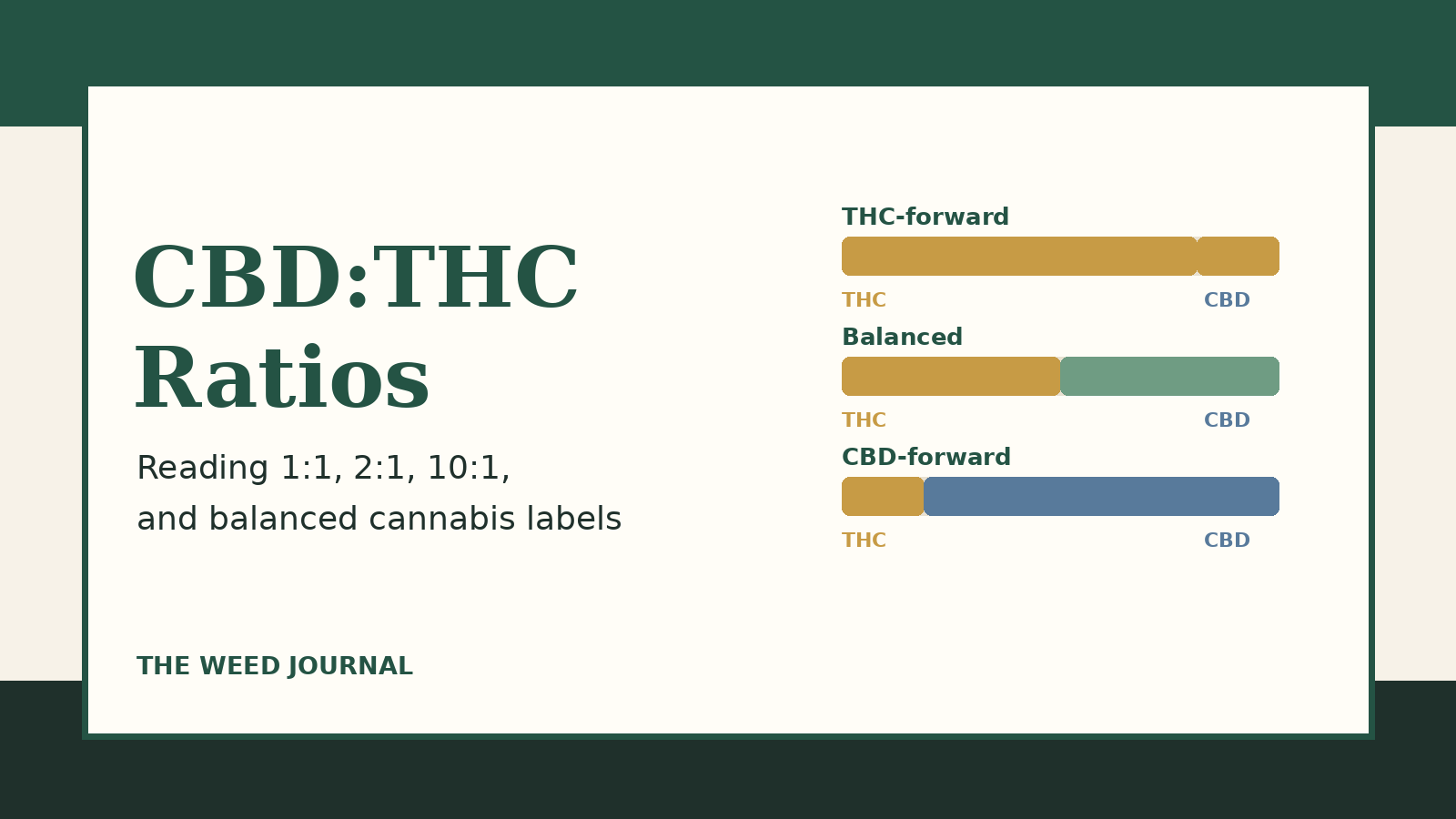
    CBD:THC ratios look simple until you are standing in front of a Canadian cannabis menu trying to compare oils, capsules, drinks, flower, pre-rolls, vapes, and edibles. A product might say 1:1, 2:1, 10:1, or “balanced.” Another label might list milligrams per gram, milligrams per package, or milligrams per activation. The ratio is useful, but only if you know what it can and cannot tell you.

    This guide is for adults who want a practical, Canada-aware way to read CBD:THC ratios without treating them like medical promises. The short version: the ratio compares the amount of CBD to THC, but the actual dose, product format, your tolerance, timing, and legal label details still matter.

    Quick answer

    A CBD:THC ratio compares how much cannabidiol (CBD) is present relative to delta-9-tetrahydrocannabinol (THC). A 1:1 product has roughly equal CBD and THC. A 2:1 product has about twice as much CBD as THC. A 10:1 product is CBD-forward. A 1:2 product is THC-forward. In Canada, read the front label for Total THC and Total CBD, then check the serving size or amount per activation before deciding whether the product fits your tolerance.

    Ratios are not effect guarantees. Health Canada notes that higher THC content is linked with a higher chance of adverse effects and impairment, and that CBD is known to reduce some effects of THC. That does not mean CBD cancels THC or makes a product non-impairing. A balanced edible can still be too strong if the THC milligrams are high for you.

    Common CBD:THC ratios at a glance

    Label ratio Plain meaning What to check before use
    1:1 Roughly equal CBD and THC. The actual THC amount per serving; equal does not mean mild.
    2:1 or 5:1 CBD-forward with some THC. Whether the THC amount is still enough to impair you.
    10:1 or 20:1 Strongly CBD-forward. Whether there is any THC, and how much is in the full dose.
    1:2 or 1:5 THC-forward with some CBD. Your tolerance, setting, timing, and need to avoid driving.
    CBD-only style CBD-dominant, often with very little THC. The label may still show trace THC; check Total THC, not just the name.
    Use ratios as a sorting tool, then make the decision from Total THC, Total CBD, format, serving size, and your own tolerance.

    Ratio is not the same as dose

    The most common mistake is reading a ratio and forgetting the actual amount. A 1:1 product with 2.5 mg THC and 2.5 mg CBD per serving is very different from a 1:1 product with 10 mg THC and 10 mg CBD per serving. The ratio is the same. The dose is not.

    That difference matters most with ingestible products such as oils, capsules, softgels, edibles, and drinks. Inhaled products can be titrated more gradually by some adults because effects are usually felt sooner, but that does not make them risk-free. Edibles and oils can take longer, last longer, and catch people off guard when they stack doses too quickly.

    If you are new, returning after a break, or switching formats, our microdosing guide for Canadians and edibles dose chart are better starting points than ratio shopping alone.

    How Canadian labels show THC and CBD

    Health Canada’s label guidance says cannabis product labels must show Total THC and Total CBD. These are the practical numbers most adult consumers should use when comparing potency. Depending on the product, the amount may be shown as milligrams per package, milligrams per unit, milligrams per gram, or a concentration.

    For dried flower, you may see THC and Total THC. The same pattern can appear for CBD and Total CBD. The “Total” value estimates what is available after activation, which is why it is usually more useful for a buyer than the inactive-acid number alone. Our Canadian cannabis label guide walks through that label math in more detail.

    For oils and ingestibles, check the amount per activation or serving. A bottle might look CBD-forward overall, but the dropper size or activation amount determines what you actually consume. If the label is confusing, slow down and ask the legal retailer to explain the serving math before buying.

    What CBD may change about a THC experience

    CBD and THC are both cannabinoids, but they do not feel the same for most adults. THC is the main intoxicating compound associated with the cannabis high. CBD is not usually described as intoxicating in the same way, and Health Canada says CBD is known to reduce some effects of THC.

    That is useful, but it should be interpreted carefully. CBD does not make THC disappear. It does not make impaired driving safe. It does not guarantee a calm experience, prevent anxiety, or turn a high-dose edible into a beginner product. The National Academies review is also a reminder that cannabis evidence varies by condition and outcome; many claims are supported by limited or insufficient evidence, not certainty.

    The practical takeaway is modest: CBD-forward or balanced products may be worth comparing if THC-heavy products feel too intense for you, but the safer-use decision still comes back to dose, timing, setting, and avoiding risky activities.

    When a 1:1 product makes sense to consider

    A 1:1 product is often marketed as “balanced” because it has similar CBD and THC amounts. That can be helpful language, but balanced does not mean neutral. A balanced product can still be intoxicating, especially if the THC dose is high, the format is an edible, or your tolerance is low.

    Consider a 1:1 product only after checking the THC amount in the actual serving. For example, a legal edible with 10 mg THC and 10 mg CBD in the package may be 1:1, but 10 mg THC can be too much for some adults, especially beginners. A product with 2.5 mg THC and 2.5 mg CBD per serving is a very different starting point.

    If THC percentage or milligrams are becoming the whole decision, read why THC percentage is not everything. Ratio is another useful clue, not a replacement for judgment.

    When CBD-forward products may be the better comparison set

    CBD-forward ratios such as 2:1, 5:1, 10:1, or 20:1 are often chosen by adults who want to avoid a strongly THC-forward experience. They can be a reasonable comparison set for people who find high-THC products unpleasant, but the label still needs attention.

    First, check whether the product contains THC at all. Some CBD-dominant products contain a small amount of THC. Second, calculate the THC in the serving you plan to use. Third, remember that impairment risk is not only about how the product is marketed. Timing, alcohol, other drugs, fatigue, and your own sensitivity can all change the experience.

    For CBD oil specifically, our CBD oil buying guide for Canada covers legal-source checks, label reading, and product-format questions in more detail.

    When THC-forward products deserve extra caution

    THC-forward ratios such as 1:2 or 1:5 mean there is more THC than CBD. Some adults prefer that. The caution is that higher THC products are more likely to create impairment and adverse effects, especially for inexperienced consumers or people using large servings.

    Use extra caution with concentrates, high-THC vapes, infused pre-rolls, and edibles. The label may look familiar, but the dose can be much stronger than an older consumer expects from traditional flower. If anxiety, panic, racing thoughts, dizziness, or discomfort are common for you, a THC-forward product is not the place to prove a point.

    Do not drive after using cannabis. Do not mix cannabis with alcohol to test a ratio. Do not use a ratio label as permission to take more before the first dose has fully arrived.

    A simple way to compare products

    1. Confirm the product is from a legal Canadian source.
    2. Find Total THC and Total CBD on the label.
    3. Convert the label into the amount you will actually consume per serving.
    4. Use the ratio to decide whether the product is THC-forward, balanced, or CBD-forward.
    5. Choose the smallest practical amount when trying a new product.
    6. Wait long enough for the format before considering more.
    7. Avoid driving, work, childcare, water activities, or machinery after use.

    Questions to ask before checkout

    Before buying a ratio product, ask what you are trying to avoid. If the answer is “too much THC,” look at the THC amount first, then the ratio. If the answer is “confusing label math,” choose a product with clear serving information instead of a larger bottle or stronger package. If the answer is “I want CBD but no noticeable high,” check whether the product contains any THC and whether the retailer can explain the Total THC number plainly.

    It also helps to compare products inside the same format. A CBD-forward oil, a balanced edible, and a balanced vape are not interchangeable just because the ratio looks similar. Onset, duration, serving control, and how quickly effects are felt can change the risk of taking too much.

    Bottom line

    CBD:THC ratios are helpful when they stop you from shopping by strain name or THC number alone. They are not enough by themselves. A careful Canadian buyer reads Total THC and Total CBD, checks the serving size, respects the product format, and treats CBD as a possible moderator of some THC effects, not a safety shield.

    If you want the simplest buying rule, use this: ratio first, dose second, format third, tolerance always. That order keeps the label useful without pretending cannabis effects can be predicted from one number.

    Sources

  • Flower Buying Checklist in Canada: Freshness and Labels

    Flower Buying Checklist in Canada: Freshness and Labels

    Buying cannabis flower should not feel like guessing from a strain name and the biggest THC number on the menu. In Canada, legal flower gives adults useful clues before they buy: package dates, lot numbers, THC and CBD values, net weight, warning symbols, producer details, and sometimes terpene or harvest information. The trick is knowing which clues matter in the real world.

    This flower buying checklist is for Canadian adults who want fresher, better-matched cannabis without turning a simple purchase into a chemistry exam. It focuses on legal-source signals, freshness, label reading, aroma and texture, storage plans, and when to walk away.

    Quick answer

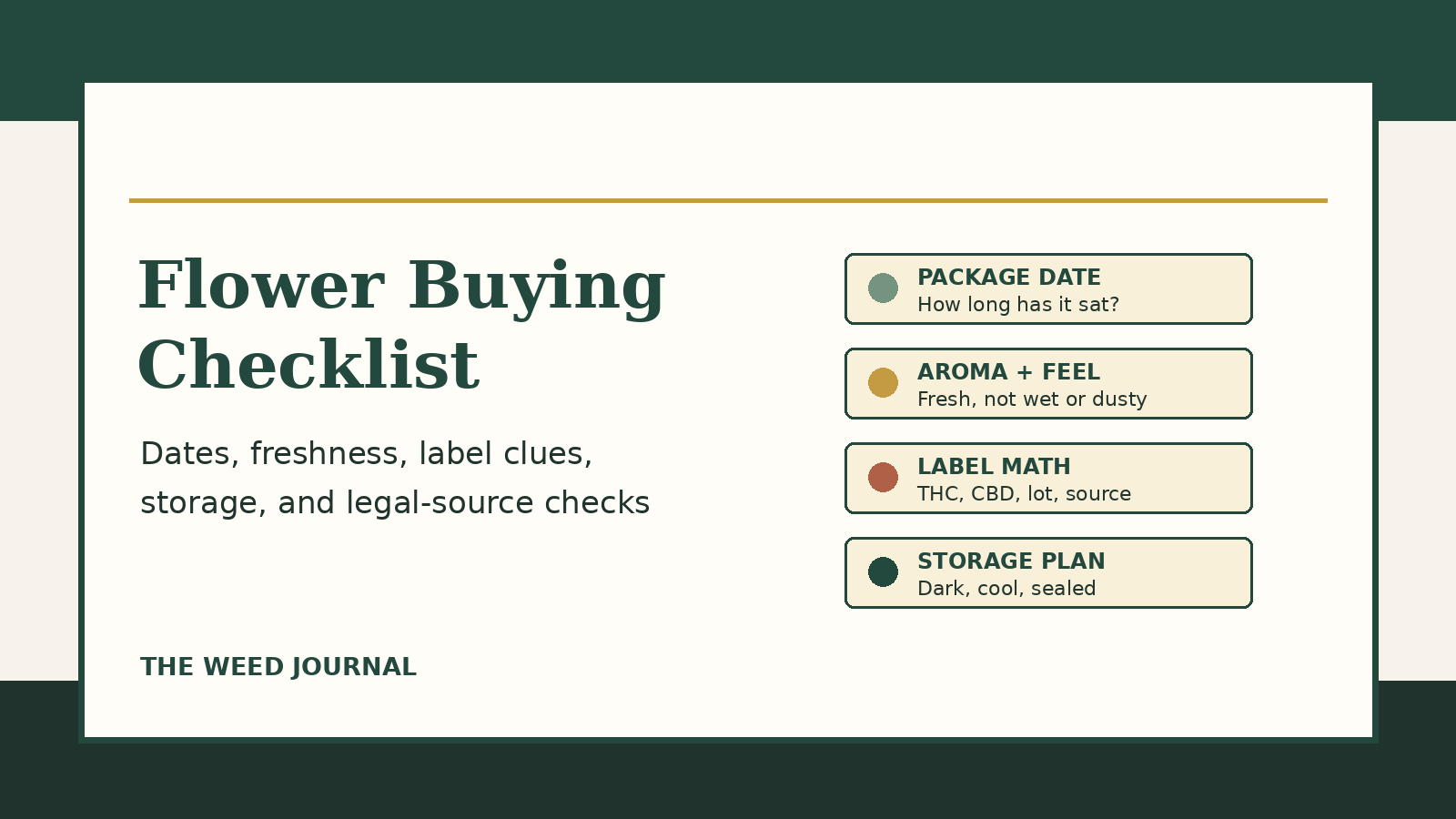
    When buying cannabis flower in Canada, check that the seller is legal, the package is sealed and clearly labelled, the package date is reasonable, the product is not overly dry or suspiciously wet, the THC/CBD numbers fit your tolerance, and you have a storage plan before opening it. THC percentage is only one clue. Freshness, product format, terpene profile, lot information, and how you plan to use the flower often matter more than chasing the strongest option.

    If you are new, returning after a tolerance break, or switching from another format, start with modest THC, smaller quantities, and a product you can evaluate slowly. For broader shopping safety, keep our legal cannabis buying checklist for Canada open as a companion.

    The 2-minute flower buying checklist

    Check Green flag Red flag
    Legal source Provincially authorized store or site Anonymous delivery menu, no legal retailer trail
    Package integrity Sealed, child-resistant, labelled package Loose bag, relabelled jar, missing warnings
    Package date Recent enough for the product and price Old date with no discount or storage explanation
    THC/CBD Fits your tolerance and use case Highest THC pushed as the only quality marker
    Freshness Aroma is clean; flower is not dusty or wet Musty smell, visible mould, harsh dryness, damp clumps
    Storage plan Cool, dark, sealed, away from children and pets Left in a hot car, clear jar in sunlight, loose bag
    This checklist is not about finding the strongest flower. It is about avoiding preventable disappointment and obvious safety problems.

    1. Start with the seller, not the strain

    The first quality check is whether the product is coming through a legal channel. Health Canada tells consumers to choose legal cannabis because legal products must meet federal rules for production, packaging, labelling, and testing. Provinces and territories decide how legal retail works, so the exact store system depends on where you live.

    In Ontario, for example, adults can buy recreational cannabis from authorized cannabis stores or the Ontario Cannabis Store. Other provinces have their own legal retail systems. The practical rule is simple: if the source cannot show a clear legal trail, do not let a strain name, discount, or delivery promise distract you.

    Legal does not automatically mean every product will be perfect for you. It does mean the package should carry required information and come through a regulated supply chain. That gives you something to verify before you spend money.

    2. Read the label before you read the hype

    Canadian cannabis flower labels can feel crowded, but a few fields do most of the work. Look for Total THC, Total CBD, net weight, lot number, packaging date, warning label, excise stamp when applicable, and producer information. Some products also list terpenes, harvest date, drying or curing notes, or humidity-pack information.

    Our full Canadian cannabis label guide explains label math in more detail. For a buying decision, ask three fast questions: how strong is this likely to feel for me, how fresh is it likely to be, and can I trace the package to a real legal producer or retailer?

    Be careful with percentages. A flower listed at 29% THC is not automatically better than one listed at 21%. It may be stronger, harsher for your tolerance, older, drier, or simply less enjoyable for your use case. If THC number is becoming the whole decision, read our guide to why THC percentage is not everything.

    3. Treat package date as context, not a pass-fail stamp

    A package date tells you when the product was packaged, not necessarily when it was harvested. Still, it is useful. Flower can dry out, lose aroma, or become less pleasant when it sits too long, especially if the package seal, humidity control, or storage conditions are poor.

    There is no single date where legal flower instantly becomes bad. A recent package can still disappoint, and an older package can still be acceptable if it was stored well and priced honestly. Use the date with the rest of the evidence: aroma, texture, moisture balance, brand track record, product size, and whether the retailer is transparent.

    For a deeper freshness pass, use our guide on how to tell if cannabis flower is fresh in Canada.

    4. Learn the difference between dry, cured, and suspicious

    Good flower is not supposed to feel wet. It should be dry enough to burn or vaporize properly and cured enough to avoid a grassy, harsh, unfinished feel. But there is a difference between properly dried flower and flower so brittle that it turns to dust when handled.

    Use these practical clues after purchase, before use:

    • Too dry: crumbles into powder, weak aroma, harsh smoke or vapour, no spring in the buds.
    • Too wet: spongy or damp clumps, hard to grind, unusual ammonia or musty smell.
    • Possible mould issue: fuzzy growth, grey-white patches that do not look like trichomes, damp basement smell, or visible contamination.
    • Better balance: clean aroma, slight give, no wetness, no visible contamination, and a grind that is not dust.

    If you see or smell something that suggests mould or contamination, do not use the product. Use the mouldy cannabis flower checklist for the stop-use signs, then contact the retailer or producer through the appropriate channel and keep the package information.

    5. Do not buy more than you can store well

    Large formats can look cheaper per gram, but flower quality can fall after opening if you store it poorly. Heat, light, air, and frequent opening can all make flower less enjoyable. Buying a larger bag only helps if you will use it in a reasonable timeframe and keep it sealed properly.

    The safest household move is boring: keep cannabis in its original packaging or a clearly labelled airtight container, store it somewhere cool and dark, and keep it away from children, pets, and anyone who has not agreed to use cannabis. Do not leave flower in a car, window, bathroom, or open tray. Our cannabis storage guide for Canada covers temperature, humidity, and household safety in more detail.

    6. Match the flower to the use case

    A good product for one person can be the wrong product for another. Before buying, decide what you need the flower to do in practical terms. Are you looking for a small evening amount, a lower-THC option, something aromatic for a dry herb vape, or a budget product for experienced use? The answer changes what you should value.

    For beginners or returning adults, moderate THC, smaller package size, and a clear label usually beat a bargain ounce with a high number and little context. For experienced consumers, price-per-gram may matter more, but it still should not override freshness or legal-source checks. For dry herb vaping, grind, moisture balance, and aroma may matter as much as headline potency.

    If you are still comparing formats, start with our Cannabis 101 product type guide before buying flower by habit.

    7. Use terpenes carefully

    Terpene labels can help describe aroma and product character, but they should not be treated like guaranteed effect labels. A listed terpene profile may tell you the flower smells citrusy, piney, earthy, fuel-like, spicy, or floral. It does not prove the product will make you sleepy, creative, calm, or social.

    Use terpenes as one clue among many: aroma preference, THC/CBD amount, your tolerance, the product format, and your own past experience. If a menu turns terpenes into medical promises, slow down. The evidence is more complicated than marketing copy often makes it sound. For a plain-language primer, read Terpenes for Beginners in Canada.

    8. Know when to walk away

    Walk away from any flower purchase when the seller cannot show legal status, the package is not intact, required label information is missing, the price seems tied to unrealistic claims, or the product is being sold with medical promises. Also walk away if you are being pushed toward the highest THC option after saying you want something mild.

    After purchase, do not use flower that appears mouldy, unusually damp, contaminated, or mislabelled. Keep the packaging, document the lot number and retailer, and follow the retailer or provincial process for product concerns. If someone accidentally consumes cannabis, especially a child or pet, treat it as urgent and seek appropriate help.

    A simple decision flow

    1. Confirm the retailer is legal in your province or territory.
    2. Choose the smallest practical size for a new product.
    3. Check Total THC and CBD against your tolerance.
    4. Check package date and any freshness notes.
    5. Prefer clear label information over vague strain hype.
    6. Plan storage before opening the package.
    7. After opening, stop if aroma, texture, or appearance raises concerns.

    Bottom line

    A better flower purchase starts before you smell the jar or grind the bud. Buy from a legal source, read the label, use package date as context, avoid treating THC percentage as the whole story, and store the product properly after opening. The best cannabis flower for you is not the loudest menu item. It is the one that fits your tolerance, budget, use case, and safety boundaries without requiring guesswork.

    Sources

  • Cannabis Packaging Symbols in Canada: What Labels Mean

    Cannabis Packaging Symbols in Canada: What Labels Mean

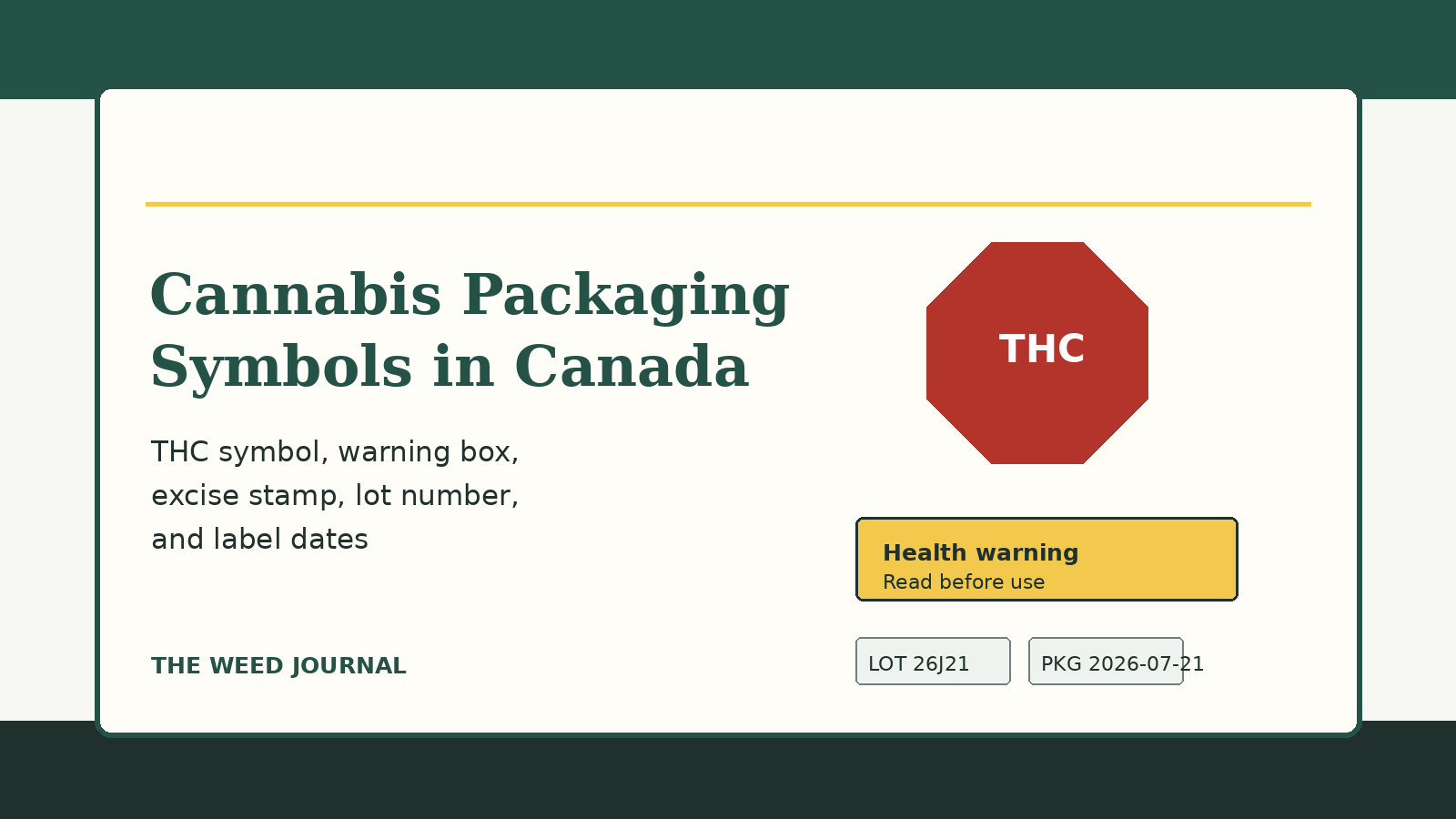
    Canadian cannabis packages can look plain, but they carry a lot of important information. The red THC symbol, yellow warning box, excise stamp, lot number, THC and CBD values, and packaging date all help answer the same practical question: what exactly is this product, and how should an adult read it before using it?

    This guide is for adults who want to make sense of legal cannabis packaging in Canada without turning a label into a chemistry exam. It explains the main symbols and label sections, what they can tell you, what they cannot prove, and which details deserve a second look before you buy.

    Start With the Big Three

    If you only have ten seconds in a store or on a provincial retailer site, check three things first: the red THC symbol, the THC/CBD line, and the product class. Those three details tell you whether the product contains meaningful THC, how the label expresses potency, and whether you are comparing flower, edibles, extracts, drinks, topicals, or another format.

    Health Canada says the standardized cannabis symbol is used to warn consumers that a product contains THC. On most THC-containing legal products, it appears as a red octagon with a white cannabis leaf and “THC.” Health Canada’s consumer label guide says the symbol is required on the front of cannabis products that contain more than 10 micrograms per gram of THC.

    The THC and CBD line matters because different formats use different units. A dried flower label may show milligrams per gram. An edible may show total THC per unit and total THC for the whole package. A spray may show THC per activation. If you compare those numbers as if they were the same unit, you can misjudge strength quickly.

    The product class matters because the experience, onset, storage needs, and legal packaging limits differ by format. For example, an edible, a vape cartridge, a dried flower jar, a topical, and an oral oil should not be compared by THC number alone. For a broader label walkthrough, start with The Weed Journal’s Canadian cannabis label guide.

    Quick Label Decoder

    Label item What it usually means What to check before buying
    Red THC symbol The product contains THC above the symbol threshold or the producer has used the symbol voluntarily. Do not stop at the symbol. Read the THC amount, unit, and product format.
    Yellow health warning A required warning message about potential risks and effects of cannabis use. Treat it as safety information, especially for new users, edibles, high-THC products, and anyone with health concerns.
    Excise stamp A sign that the product came through the legal regulated supply chain, with provincial or territorial stamp colour differences. Match the stamp to the market where the product is sold and be cautious with missing, altered, or suspicious packaging.
    Total THC / Total CBD The amount or concentration of THC and CBD the product can yield, depending on format. Check whether the unit is mg, mg/g, per unit, per activation, or total package.
    Lot number A traceability code tied to production records and possible recall identification. Keep it if you report a product issue or compare two packages from different batches.
    Packaging date The date the product was packaged, not necessarily the harvest or production date. For flower, freshness still depends on storage, seal quality, aroma, texture, and package condition.
    A practical first-pass decoder for legal cannabis packaging in Canada. Always read the unit and format before comparing potency.

    What the Red THC Symbol Does and Does Not Tell You

    The red THC symbol is a warning sign, not a complete potency guide. Its job is to make THC-containing cannabis products easy to identify at a glance. That is useful, especially in homes where adults want to avoid mix-ups with non-cannabis products or keep cannabis away from children, guests, and pets.

    But the symbol does not tell you how strong the product will feel for you. A 2.5 mg THC edible, a 25% THC dried flower, a balanced THC/CBD oil, and a high-THC vape cartridge can all involve THC, but they are not interchangeable. Your tolerance, dose, route of use, timing, recent food intake, and setting all affect the experience.

    For beginners, the better question is not “Does it have the symbol?” but “How much THC is in the amount I might actually use?” That is why edible labels deserve special care. A package may show total THC per unit and total THC for the entire package. If you need a separate dosing reference, use the edibles dose chart for Canada before assuming one piece, sip, or activation is right for you.

    How to Read THC and CBD Units Without Getting Lost

    Canadian labels commonly show “Total THC” and “Total CBD,” but the unit changes with the product. That unit is the detail many shoppers miss.

    For dried flower, THC and CBD may be shown as milligrams per gram. Some shoppers mentally convert that to a percentage. For example, 200 mg/g is roughly 20% by weight. Even then, THC percentage is not the whole story. Freshness, aroma, terpene profile, moisture level, grind, device, dose size, and tolerance all matter. The Weed Journal’s guide to why THC percentage is not everything explains that problem in more detail.

    For edibles and drinks, look for per-unit and total-package information. If one edible unit says 2.5 mg THC and the package contains four pieces, the total package may contain 10 mg THC. That does not mean one piece is 10 mg. It also does not mean a beginner should automatically take the full package.

    For sprays and some extracts, the label may show THC per activation. In plain language, that means the amount dispensed per spray, pump, or measured use. Check the number of activations in the package if you are trying to understand the total amount available.

    For topicals, reading THC and CBD can be more confusing because the product is used on the skin and is not meant to be eaten or inhaled. Labels still matter, but you should avoid treating a topical THC number as if it predicts the same experience as smoking, vaping, or eating cannabis. For that format specifically, see The Weed Journal’s cannabis topicals guide.

    The Yellow Warning Box Is Not Decoration

    Legal cannabis labels include a health warning message in a yellow box. Health Canada’s packaging guidance says health warning messages are displayed on the principal display panel and are intended to inform consumers about potential health risks and effects. Health Canada’s consumer label page also notes that its health warning messages were updated in early 2025.

    For readers, the practical takeaway is simple: do not tune out the warning because you have seen similar boxes before. The warning is part of the label’s safety system. It is especially worth reading when you are trying a new format, choosing a stronger product than usual, using edibles, mixing cannabis with alcohol or other substances, or shopping for someone else’s household where storage risks matter.

    Warnings also help counter the “plain package means low risk” assumption. Legal packaging is designed to reduce youth appeal and communicate risk; it does not mean cannabis is risk-free. Cannabis can impair attention, coordination, reaction time, and judgment, and effects can vary from person to person.

    What the Excise Stamp Means

    The excise stamp is one of the easiest ways to distinguish legal regulated cannabis from suspicious packaging. Health Canada’s consumer label guide says the excise stamp tells you the product came from a Health Canada licence holder. It also notes that certain low-THC products and prescription cannabis products may not need excise stamps, and that each province and territory has a different coloured stamp.

    That makes the stamp a useful legal-source signal, but it should not be treated as the only check. Buy from authorized retailers, keep an eye out for packaging that looks altered or reused, and be skeptical of products that copy regulated packaging cues while avoiding the required information. Ontario readers can cross-check legal buying basics with Ontario’s own recreational cannabis guidance, while broader Canadian readers can use Health Canada’s advice to reduce risk by choosing legal cannabis.

    If the product is being sold outside a legal retailer system, the label may not mean what it appears to mean. A convincing-looking package can still be unregulated. For a fuller safety screen, The Weed Journal’s legal retailer checklist for buying cannabis in Canada is the better starting point.

    Lot Numbers, Packaging Dates, and Freshness

    The lot number is not exciting, but it matters. Health Canada’s label guide explains that product labels contain the lot number and the date when the product was packaged. A lot number can help identify a specific batch if there is a product issue, recall, complaint, or quality question.

    The packaging date is useful, but it does not tell the whole freshness story. A flower jar packaged recently can still be dry if storage was poor or the seal failed. A product with an older packaging date may still be acceptable if it was sealed, stored well, and appropriate for the format. Packaging date is a clue, not a verdict.

    For dried flower, combine the date with a freshness check: intact seal, normal aroma for the product, no visible mould, reasonable texture, and no strange moisture or dustiness. After purchase, storage matters too. Keep cannabis sealed, labelled, away from children and pets, and stored according to the package directions. For practical storage steps, use the guide to storing cannabis in Canada.

    Plain Packaging and Youth Appeal Rules

    Canadian cannabis packaging is intentionally restricted. Health Canada’s packaging and labelling guide says the Cannabis Act and regulations require plain packaging and labelling, child-resistant containers for most cannabis products, mandatory warning messages, the standardized cannabis symbol where applicable, and specific product information such as brand name, class, THC/CBD information, and licence holder information.

    This is why legal cannabis packaging often looks calmer than alcohol, candy, snack, or supplement packaging. The plainness is a policy choice. It is meant to reduce youth appeal, reduce misleading presentation, and make key safety details easier to find.

    That plainness can also make labels feel dense. A shopper may see the same colours, warning blocks, and symbols across many products and stop reading closely. That is a mistake. The common packaging system gives you a consistent place to look; the product-specific details still change.

    A Two-Minute Package Check Before You Buy

    1. Confirm the source. Buy from an authorized retailer or provincial legal channel. Treat suspicious private-market packaging as unverified, even if it imitates legal design.
    2. Find the product class. Flower, edible, extract, topical, drink, vape, and oil labels should not be compared as if they work the same way.
    3. Read the THC unit. Look for mg/g, mg per unit, total package, or per activation. The unit changes the meaning of the number.
    4. Check CBD too. CBD does not produce a high like THC, but it can still have effects and may matter for product fit.
    5. Read the warning box. Pay closer attention if the product is new to you, higher in THC, edible, or likely to be stored around other people.
    6. Check lot and date details. Save the package if you need to report a quality issue or compare products later.
    7. Plan storage before opening. Keep original packaging when possible because it preserves warnings, lot details, and child-resistant features.

    Common Label Mistakes to Avoid

    The first mistake is comparing every cannabis product by the biggest THC number on the front. That can push adults toward stronger products without answering whether the format, dose, timing, or experience is actually a good fit.

    The second mistake is ignoring “per unit” language. Per-unit information is there to help you avoid confusing one serving, one piece, one activation, or one container with another. This matters most with edibles, drinks, sprays, and multi-unit packages.

    The third mistake is treating legal packaging as a quality guarantee for your personal preferences. Legal cannabis is regulated, but that does not mean every product will match your tolerance, taste, budget, or desired experience. Labels help you screen products; they do not replace careful use.

    The fourth mistake is throwing away the package immediately. The package contains the lot number, warnings, cannabinoid information, storage instructions, and legal-source signals. If you transfer cannabis to another container, keep the original label information somewhere safe and inaccessible to children.

    Bottom Line

    Canadian cannabis labels are built to do more than satisfy regulations. They give adult consumers a repeatable way to check legal source, THC and CBD amounts, product class, warning information, traceability, and storage details. The trick is to read the unit, not just the number.

    Start with the red THC symbol, THC/CBD line, product class, warning box, excise stamp, lot number, and packaging date. Then connect those details to the product format and your own tolerance. That small pause can prevent many of the most common buying and dosing mistakes.

    Sources

  • Cannabis Topicals in Canada: Creams, Balms, and Labels

    Cannabis Topicals in Canada: Creams, Balms, and Labels

    Cannabis topicals can look familiar at first glance: creams, balms, lotions, oils, bath products, and similar formats meant for the skin. That familiar packaging is exactly why adults in Canada should slow down before buying one. A topical is still a regulated cannabis product, not an ordinary cosmetic with a cannabis-themed label.

    This guide explains what cannabis topicals are in Canada, how to read the label, what they can and cannot promise, and how to choose a product without treating it like a medical shortcut. It is written for adults who want the plain-language version before they add a topical to their routine.

    What counts as a cannabis topical?

    In Canada, cannabis topicals are one of the classes of cannabis that may be sold legally under the federal framework. Health Canada describes topicals as products that include cannabis as an ingredient and are intended for external body surfaces such as skin, hair, or nails. On a retail menu, that can include lotions, creams, balms, bath bombs, body oils, and similar products.

    The important boundary is use. A topical is not an edible, not a tincture, not a vape product, and not dried flower. It should be used only as directed on the package. If the product is meant for external use, do not eat it, smoke it, vape it, or use it in a way the label does not describe.

    If you are still learning the bigger product landscape, start with our Cannabis 101 guide to product types in Canada. Topicals make more sense once you can separate inhaled, ingested, oral, and external-use formats.

    Topicals are regulated cannabis, not casual CBD skincare

    One common mistake is assuming that a CBD cream is automatically outside cannabis rules because it feels like skincare. That is not how CBD is regulated in Canada. Health Canada says CBD and products containing CBD are subject to the rules and requirements that apply to cannabis under the Cannabis Act and its regulations. CBD products are legal only when sold in compliance with that system.

    That matters because unregulated topical products may use vague wellness language, unclear CBD or THC numbers, imported branding, or non-cannabis retail channels that do not match Canadian rules. A legal product should have regulated packaging, a product class on the label, THC and CBD information, required warnings, storage instructions, and a legal purchase channel.

    For Ontario readers, the baseline is simple: adults must be 19 or older to buy, possess, and use recreational cannabis. Legal shopping should go through the Ontario Cannabis Store or authorized retailers. If a topical is being sold through a random wellness shop, social account, or grey-market site with no clear cannabis authorization trail, treat that as a red flag.

    What topicals can and cannot tell you

    A legal topical label can help you understand the product. It is not a guarantee that the product will deliver a specific effect for your body. Cannabis affects people differently, and topical products are especially easy to overinterpret because the packaging can borrow the language of skincare, sports recovery, and wellness.

    Label detailWhat it helps you checkReader-first caution
    Product classConfirms whether the product is a cannabis topical rather than an extract, edible, or cosmetic-style item.Use it only in the way the product class and directions support.
    Total THC and Total CBDShows the cannabinoid amount or concentration declared for the product.Do not assume more THC or CBD means better results.
    Net weight, volume, and unitsHelps compare package size, pumps, bath products, or single-use formats.A larger container can still have a different concentration than a smaller one.
    Directions for useShows where, how much, and how often the product is intended to be used.Avoid broken skin, eyes, mucous membranes, or other use unless the label specifically supports it.
    Storage conditionsExplains temperature, light, and handling instructions for product quality.Keep cannabis products secured away from children and pets.
    Authorized source and excise detailsHelps separate legal cannabis from suspicious products.An attractive brand or review page does not prove legal status.

    Health Canada’s label guidance is useful here because it reminds shoppers to check the product class, THC and CBD amount, health warning, net weight or volume, number of units, and storage conditions. If you cannot find those basics, the product is not giving you enough information to compare it responsibly.

    Will a cannabis topical get you high?

    Many people ask this because topicals may contain THC. The cautious answer is that a topical should not be treated like an edible, vape, or smokeable product. It is intended for external use, and the way cannabinoids interact with the body depends on the product, formulation, amount used, skin condition, and use pattern.

    That does not mean the label can be ignored. You should still read the THC and CBD amounts, follow the directions, and avoid using more than directed because “it is only a cream.” You should also wash your hands after use unless the product is meant for the hands, and you should avoid accidentally transferring product to your eyes, mouth, food, or another person.

    If you are comparing THC strength across product types, our guide on why THC percentage is not everything is a helpful companion. Topicals are another example of why product format and directions matter as much as the cannabinoid number.

    A practical buying checklist

    Use this checklist before buying a cannabis topical in Canada:

    • Confirm the seller is legal for your province or territory.
    • Check that the label identifies the product as a cannabis topical.
    • Read the Total THC and Total CBD information instead of relying on front-label marketing language.
    • Compare concentration, net amount, and number of uses rather than package size alone.
    • Look for clear directions, including where the product should and should not be applied.
    • Check storage instructions and keep the product away from children, pets, and visitors.
    • Avoid products that make strong pain, inflammation, sleep, anxiety, or healing claims without a regulated medical context.
    • Do not use a cannabis topical on irritated or broken skin unless a qualified health professional has advised you and the product directions fit that use.

    This is also where legal-source checks matter. Health Canada notes that legal cannabis products are subject to rules for quality, packaging, labelling, promotion, and recall. Legal does not mean risk-free, but it does give you a clearer trail than an unverified marketplace product.

    How to compare creams, balms, oils, and bath products

    Topicals are not all designed for the same use. A cream may spread differently than a thick balm. A bath product may be used once, while a lotion may be applied in smaller amounts over time. A roll-on may be convenient but harder to compare if you do not know how much product comes out with each use.

    When comparing products, start with format and directions before price. Ask: where is this meant to be used, how much does the label suggest, how many uses does the package realistically contain, and how strong is the cannabinoid concentration per amount used? Those questions are more useful than chasing the highest CBD number on the shelf.

    For broader shopping habits, see our legal retailer checklist for buying cannabis in Canada. The same principle applies here: verify the seller first, then compare the product.

    What claims should make you pause?

    Be careful with products or pages that promise quick relief, guaranteed recovery, anti-inflammatory results, sleep improvement, anxiety control, or treatment for a specific condition. That kind of claim changes the stakes for readers. A general retail cannabis product should not be treated as medical advice.

    It is reasonable to be curious. It is not reasonable for a seller to push certainty where the evidence, your health situation, and the product label do not support it. If you have a medical condition, take prescription medication, have sensitive skin, are pregnant or breastfeeding, or are buying for someone else, speak with a qualified health professional rather than relying on a product page.

    Storage and household safety

    Topicals can be especially risky around children and pets because they may resemble ordinary lotions, balms, bath products, or cosmetics. Keep them in the original child-resistant package when practical, follow the storage directions, and do not leave them in a bathroom, bag, or bedside drawer where someone may mistake them for a regular product.

    Also pay attention to heat and light. Creams, oils, and balms can change texture or separate if stored poorly. The label should provide recommended storage conditions. If the smell, texture, colour, packaging, or seal looks off, do not try to rescue the product. Dispose of it according to local guidance and replace it through a legal source if needed.

    For a deeper storage primer, read our guide to storing cannabis in Canada.

    Bottom line

    Cannabis topicals are easiest to understand when you treat them as their own category. They are external-use cannabis products, not edibles, not extracts to ingest, and not ordinary skincare. Read the label, verify the legal source, avoid medical-claim marketing, follow the directions, and store the product securely.

    If a topical cannot answer the basic questions of what it is, how it is meant to be used, how much THC and CBD it contains, where it came from, and how to store it, choose a clearer product or skip it.

    Sources

  • How To Compare Classic Cannabis Strains Without Chasing THC Alone

    How To Compare Classic Cannabis Strains Without Chasing THC Alone

    Classic cannabis strain names are useful shortcuts, but they are not reliable buying instructions. OG Kush, Sour Diesel, Jack Herer, Durban Poison, Granddaddy Purple, Gelato, MAC 1, and other familiar names can help you understand how a product is being positioned. They cannot tell you the exact THC amount, freshness, aroma, batch quality, or how a specific adult will feel after using it.

    The smarter comparison starts with the legal product label, the format, the cannabinoid numbers, the terpene or aroma notes when available, and your own tolerance. A strain name can be a clue. The package, retailer, and product condition are the evidence.

    This Canada-aware guide is for adult readers who want to compare classic strains without chasing hype or the highest THC number on the menu. It is not medical advice, and it does not promise specific effects from any strain.

    The Quick Rule: Compare the Product, Not Just the Name

    Two products can share a strain name and still be very different. One “Sour Diesel” might be dried flower from a recent lot. Another might be a pre-roll blend. A third might be a vape cartridge, concentrate, or infused product using strain-inspired branding. They should not be compared as if the name alone makes them the same thing.

    Before comparing effects language, check these basics first:

    • Product format: flower, pre-roll, vape, edible, oil, capsule, concentrate, or drink.
    • THC and CBD amount, including whether the label uses a percentage, milligrams, or a range.
    • Package size, unit count, and serving information.
    • Packaging date, lot number, storage instructions, and visible freshness cues.
    • Whether aroma notes and terpene details are descriptive rather than medical.
    • Whether the retailer or product page makes the legal source and age expectations clear.

    If you are still learning product formats, start with our Cannabis 101 product type guide. If your comparison is mostly about numbers, read why THC percentage is not everything before deciding.

    Why Classic Strain Names Can Mislead Buyers

    Classic strain names carry a lot of cultural memory. Some people associate Durban Poison with a brighter daytime profile, Granddaddy Purple with heavier evening use, Sour Diesel with sharp fuel-like aroma, or OG Kush with a familiar earthy profile. Those associations can be useful for conversation, but they are not lab results.

    Modern legal products are shaped by genetics, growing conditions, curing, storage, producer choices, batch variation, and format. A name that sounds familiar may still produce a very different experience depending on the lot, potency, freshness, and method of use. Even within dried flower, one batch can be fresher, drier, more aromatic, or more balanced than another.

    This is why it is risky to treat strain names as promises. They are best used as labels for comparison, not as guarantees of energy, sleep, creativity, pain relief, anxiety relief, or any other health outcome.

    Do Not Compare by THC Alone

    THC percentage can be useful when comparing similar dried flower products, but it is a weak shortcut when used by itself. A higher number does not automatically mean a better purchase. It can also mean a product is stronger than you wanted, harder to pace, more likely to feel uncomfortable, or less aligned with the setting you had in mind.

    THC also appears in different units across formats. Flower often uses a percentage or range. Edibles and drinks usually show milligrams per package or per unit. Oils, capsules, vapes, and concentrates can use product-specific measurements that are easy to misread if you compare them too quickly. Health Canada’s guide to reading cannabis product labels explains the information shown on legal product packaging.

    Before choosing the highest number on the menu, ask whether the format, unit, CBD amount, package size, and serving plan actually match what you want. Our THC vs CBD vs CBN guide can help if you are comparing cannabinoid profiles for the first time.

    Comparison pointWhy it mattersReader-first question
    THC amountShows potential intensity, but not overall qualityIs this strength realistic for my tolerance?
    CBD amountAdds cannabinoid context, especially for balanced productsIs this THC-dominant, CBD-dominant, or balanced?
    FormatChanges onset, pacing, convenience, and risk of overuseAm I comparing the same product type?
    Freshness cuesAffects aroma, texture, smoke quality, and satisfactionDoes the product seem fresh and well stored?
    Legal-source signalsHelps avoid unclear products and unsupported claimsCan I verify the source and label details?
    Use strain names as a starting label, then compare the product details that actually shape the buying decision.

    Compare Format Before Effects Language

    The same strain name can appear as dried flower, pre-rolls, vape cartridges, concentrates, oils, or infused products. Those formats should not be treated as interchangeable. A flower listing and a vape listing can share a familiar name while representing very different buying decisions.

    A pre-roll can be convenient, but it may offer less control than loose flower because the grind, packing, and blend are already decided. A vape cartridge can be discreet and potent, but hardware and additives deserve careful attention. A concentrate may use a classic name while requiring a much higher level of product knowledge. An edible or drink may use strain-inspired branding, but onset and serving size matter more than the name on the package.

    For vapes, use our vape cartridge safety checklist. For infused products, compare the label against the edibles dose chart and the edibles onset guide.

    Use Aroma and Terpene Notes Carefully

    Aroma notes can make classic strains easier to compare. Earthy, citrus, pine, sweet, spicy, floral, fuel, diesel, skunky, or peppery language can describe what a product may smell or taste like. Those words should not be turned into medical promises or rigid effect predictions.

    Terpene information can add useful detail when it is available, especially for readers comparing similar legal products. It remains one layer of information, not a replacement for label details, tolerance, product condition, and responsible use. The safest way to use terpene notes is as a sensory filter: “I tend to like citrus and pine profiles” is more useful than “this terpene will make me feel a guaranteed way.”

    For a deeper explanation, use our terpenes for beginners guide. It explains how to read terpene language without treating it like a certainty machine.

    Freshness Still Matters

    Freshness can change how a product feels to handle and use. Dried flower that is extremely dry may crumble into dust, burn harshly, or lose much of its aroma. Flower that is too moist or stored badly can raise quality concerns. Pre-rolls can dry out. Vapes can leak or taste off. Edibles and drinks have their own best-before and storage issues.

    When comparing classic strain products, check package date, lot number, storage instructions, container condition, aroma, texture, and whether the product has been kept away from heat, light, air, and excess moisture. Health Canada notes that legal cannabis products must carry required labelling information, and the federal packaging rules are designed to support safer adult use and product identification.

    For dried flower specifically, use our fresh cannabis flower checklist. For storage, use the cannabis storage guide.

    Check Legal-Source Signals

    A useful cannabis product page should make the source, age expectations, package details, and final buying flow clear. If a listing hides basic label information, makes unsupported medical claims, or pushes buyers toward payment before showing key details, slow down.

    Health Canada recommends that adults choose cannabis from legal sources. Legal-source signals do not make every product perfect, but they help filter out unclear or risky shopping paths. Look for transparent product categories, readable cannabinoid details, age-gated expectations, realistic copy, and a checkout flow that does not hide total cost or substitution rules.

    When comparing retailers or menus, a directory such as CannaRadar can be a starting point for discovery, but the final check should always be the actual retailer, provincial rules, and the product label in front of you.

    A Simple Classic-Strain Comparison Workflow

    Use this workflow when two or more familiar names are competing for your attention:

    1. Pick the format first. Do not compare flower against vapes or edibles as if they are the same decision.
    2. Check THC and CBD in the correct units. Percentages and milligrams are not interchangeable.
    3. Read the package size and unit count. A small package with a high number may not be the value or experience you expect.
    4. Scan aroma and terpene notes as sensory descriptions, not promises.
    5. Check freshness and storage clues. Packaging date and product condition matter.
    6. Choose the product that fits your tolerance, timing, setting, and comfort level.
    7. Keep the package, follow label instructions, store it safely, and avoid driving after use.

    Reader Checklist

    • Am I comparing the same format?
    • Is THC shown as a percentage, milligrams, range, or package total?
    • Is CBD listed clearly?
    • Does the page explain package amount and unit count?
    • Are aroma or terpene notes descriptive rather than medical?
    • Can I confirm the source is legal for adult-use cannabis?
    • Does the product fit my tolerance, timing, and setting?
    • Can I store it safely away from children, pets, and guests?

    FAQ

    Are classic strain names reliable?

    They are useful labels, but they are not reliable by themselves. The same name can vary by producer, batch, format, freshness, and cannabinoid profile. Use the name as a starting point, then read the label.

    Is indica vs sativa enough to choose a product?

    No. Indica, sativa, and hybrid language can be a rough menu category, but it should not replace THC/CBD details, terpene notes, format, tolerance, or freshness. Our indica vs sativa vs hybrid guide explains the limits of those labels.

    Should beginners avoid high-THC classic strains?

    Beginners should be cautious with high-THC products in any strain family. Lower-strength products, smaller servings, and slower pacing are easier to manage. If you are unsure, avoid making your first decision based on THC percentage alone.

    Can strain names predict medical benefits?

    No. Strain names should not be used to predict or promise medical benefits. If you are using cannabis for a health reason, speak with a qualified health professional and avoid product pages that make unsupported health claims.

    Bottom Line

    Classic strain names are helpful labels, not shortcuts. Use them as one layer of comparison, then return to format, label details, legal source, freshness, and personal tolerance before buying. Avoid driving after cannabis use, follow local age and possession rules, and keep products locked away from children, pets, and anyone who should not access them.

    Sources

  • Do Edibles Expire in Canada? Dates, Storage, and Safety

    Do Edibles Expire in Canada? Dates, Storage, and Safety

    Old cannabis edibles create a specific kind of uncertainty: the package is still sealed, the gummy looks fine, but the best-before date is close or already past. The practical answer is not simply yes or no. In Canada, edible cannabis can lose freshness, texture, flavour, and dosing predictability over time, while food spoilage depends on the ingredients, storage, and whether the package was opened.

    This guide explains how to read dates on Canadian edible cannabis labels, when to throw a product out, and how to store gummies, chocolates, baked goods, drinks, oils, and capsules more safely. It is not medical advice, and it does not tell you to push past a label date. When in doubt, choose the conservative option: do not consume it.

    If edible cannabis is stored in a shared home, pair freshness checks with the cannabis at home safe storage checklist so packages stay labelled, locked, and separate from regular food.

    The Quick Answer

    Cannabis edibles can go bad in two main ways. First, the food itself can spoil, especially if it contains ingredients that normally need careful storage. Second, the product can become stale or less predictable as cannabinoids and other ingredients are exposed to heat, air, light, or moisture.

    • Follow the label and storage instructions first.
    • Treat a best-before or durable-life date as a quality signal for an unopened product stored properly, not as permission to ignore mould, odour, broken seals, or unsafe storage.
    • Do not assume an older edible still matches the labelled experience perfectly.
    • Do not take more quickly because an older edible “feels weak.” Edibles can still take time to appear.
    • Keep all edibles in original child-resistant packaging, locked away, and separate from regular snacks.

    If your main question is how long effects take, pair this guide with our edibles onset guide. If you are trying to choose a small first serving, use the edibles dose chart before you buy or open the package.

    Best-Before Is Not the Same as “Safe Forever”

    Canadian food labelling rules make an important distinction between date types. The Canadian Food Inspection Agency explains that a durable life date, often seen as “best before,” is about quality for unopened products stored under proper conditions. It is not a direct food-safety guarantee before or after that date. Once a package is opened, the shelf life can change.

    Cannabis edibles add another layer because they are regulated cannabis products as well as edible goods. Health Canada’s cannabis packaging and labelling guidance requires product details such as THC/CBD amounts, ingredients, allergens, lot number, packaging date, storage conditions when required, and child-resistant packaging. The federal Cannabis Regulations also distinguish edible cannabis from other cannabis products for expiry-date labelling. In plain English: read the edible label carefully, but do not treat a date as the only safety check.

    What you seeWhat it usually meansWhat to do
    Packaging dateWhen the product was packaged, useful for age and lot referenceUse it with storage instructions and the product’s condition
    Best-before or durable-life dateQuality marker for an unopened, properly stored productFollow it, especially for shorter-life foods and drinks
    Storage instructionsManufacturer guidance for keeping the product stable and usableTreat this as the first rule, especially after opening
    Lot numberReference code for the batchKeep it available if reporting a quality issue
    Broken seal or damaged packageThe product may have been exposed or tampered withDo not consume if safety is uncertain
    Label dates help, but the package condition, storage history, and food type matter too.

    What Usually Changes First?

    Most shelf-stable edibles do not switch from “fine” to “dangerous” at midnight on a date stamp. More often, quality fades. Gummies can dry out, become tacky, sweat, or stick together. Chocolate can develop bloom, absorb odours, soften, or taste stale. Baked goods can dry out or spoil faster depending on moisture, dairy, eggs, nuts, fillings, and storage. Drinks can separate, lose carbonation, taste flat, or become questionable after opening.

    Potency can also become less predictable over time. Heat, light, air exposure, and repeated opening can all make cannabis products less stable. That does not mean an old edible is harmless or inactive. It means you should not rely on guesswork. If you decide to use a legal product that is still within label guidance and looks normal, keep the same slow edible rules: start low, wait long enough, and avoid stacking doses.

    When to Throw Edibles Out

    Throw the product out if there is any sign that the food or package is compromised. This is especially important for homemade edibles, opened products, baked goods, chocolates with fillings, drinks, and anything stored in a warm vehicle or humid room.

    • Visible mould, unusual spots, or unexplained colour changes.
    • Rancid, sour, fermented, chemical, or otherwise wrong smell.
    • Swollen, leaking, punctured, or broken packaging.
    • Unclear storage history, especially heat exposure in a car or direct sun.
    • Opened drinks, sauces, baked goods, or perishable-style products left too long.
    • Any product a child, pet, or guest may have accessed.

    Do not taste-test a product that smells wrong or looks suspect. With cannabis edibles, the cost of replacing a package is lower than the cost of getting sick, overconsuming, or leaving an unsafe item in the home.

    Shelf-Life Notes by Edible Type

    The label wins over general advice, but the edible format tells you what to watch for.

    Product typeCommon quality issueStorage habitExtra caution
    Gummies and chewsDrying, sweating, stickiness, texture changesCool, dark, dry, sealedHumidity and heat can make them clump or melt
    ChocolateBloom, odour absorption, rancid fats, meltingStable cool room temperature, airtight if chilledFridge condensation can hurt texture
    Baked goodsStaleness, mould, ingredient spoilageFollow label; treat like food firstHomemade items often have shorter life
    DrinksSeparation, flat taste, spoilage after openingFollow label; refrigerate after opening if directedDo not leave opened drinks sitting out
    Capsules, oils, softgelsRancid oil, leaking, cloudy changes, odourCap tight, cool, dark, dryAvoid bathrooms, windowsills, and hot cars
    Different edible formats fail in different ways; label instructions and storage history matter most.

    Can Older Edibles Feel Weaker?

    They can, but “weaker” is not something to gamble on. A stale edible may taste old, have a different texture, or feel less consistent. Another edible from the same old package could still be strong enough to cause impairment. Edibles also have a delayed onset, which is why many uncomfortable experiences happen after someone takes more too soon.

    If a legal edible is still within label guidance and appears normal, use the same conservative approach you would use with a new product. Check the THC per package and per piece, take a small amount if you are not familiar with that exact product, wait the full onset window, and do not drive. Our cannabis and driving guide covers the legal and practical risk of impairment more directly.

    How to Store Edibles So They Last Longer

    The best storage habit is boring and repeatable: keep edibles sealed, cool, dark, dry, clearly labelled, and locked. Original packaging is useful because it carries the THC amount, lot number, warnings, ingredients, allergens, and storage instructions. If you use a secondary container for organization, keep the original package inside it rather than separating the product from its label.

    • Use a locked box, cabinet, or safe instead of an open pantry or snack drawer.
    • Keep edibles away from ovens, sunny windows, heaters, bathrooms, and vehicles.
    • Do not mix infused products with regular candy, chocolate, drinks, or baked goods.
    • Reseal opened packages tightly and use them sooner than sealed ones.
    • Follow “refrigerate after opening” or similar label instructions exactly.
    • Date homemade edibles clearly and treat them like the regular food they are.

    For broader storage targets across flower, pre-rolls, concentrates, vapes, oils, and edibles, use our cannabis storage guide. For THC beverages specifically, the cannabis drinks guide explains why drinks deserve their own caution around onset, serving size, and opened containers.

    Homemade Edibles Need a Stricter Rule

    Homemade edibles are not packaged like legal retail products. They may not have lab-tested THC information, child-resistant packaging, allergen information, a lot number, or storage instructions. Their shelf life depends heavily on the recipe. A brownie, cookie, butter, oil, sauce, or infused meal should be treated as food first and cannabis second.

    Label homemade items with the date, estimated contents, and a clear cannabis warning. Store them locked away, separate from regular food, and do not leave them on counters during gatherings. If the food would normally belong in the fridge or freezer, cannabis does not make it shelf-stable.

    FAQ

    Do THC gummies expire?

    THC gummies can become stale, dry, sticky, melted, or less predictable over time. Follow the package date and storage instructions. Throw them out if they smell wrong, look wrong, were stored badly, or the package seal is damaged.

    Can expired edibles make you sick?

    They can if the food has spoiled, the package was compromised, or the product was stored poorly. Risk depends on the ingredients and condition, not just the printed date. If there is mould, off smell, leakage, swelling, or uncertainty, do not eat it.

    Do edibles lose potency after the date?

    They may become less consistent, especially after heat, air, light, or time, but do not assume they are weak. Older edibles can still cause impairment. Avoid taking extra quickly because delayed onset can make the second serving arrive at the worst time.

    Should edibles go in the fridge?

    Only when the label says so or when the food type clearly needs it. Refrigeration can help opened drinks and heat-sensitive items, but moisture and odours can hurt gummies and chocolate if they are not sealed. If you chill them, keep them airtight and labelled.

    Can you freeze cannabis edibles?

    Some foods freeze better than others. Freezing may protect certain homemade baked goods or chocolates when sealed well, but it can also change texture and create moisture during thawing. Keep the product labelled, sealed, and locked, and thaw it while still sealed to reduce condensation.

    Sources

  • Cannabis Possession Limits in Canada: 30 Grams and Equivalents

    Cannabis Possession Limits in Canada: 30 Grams and Equivalents

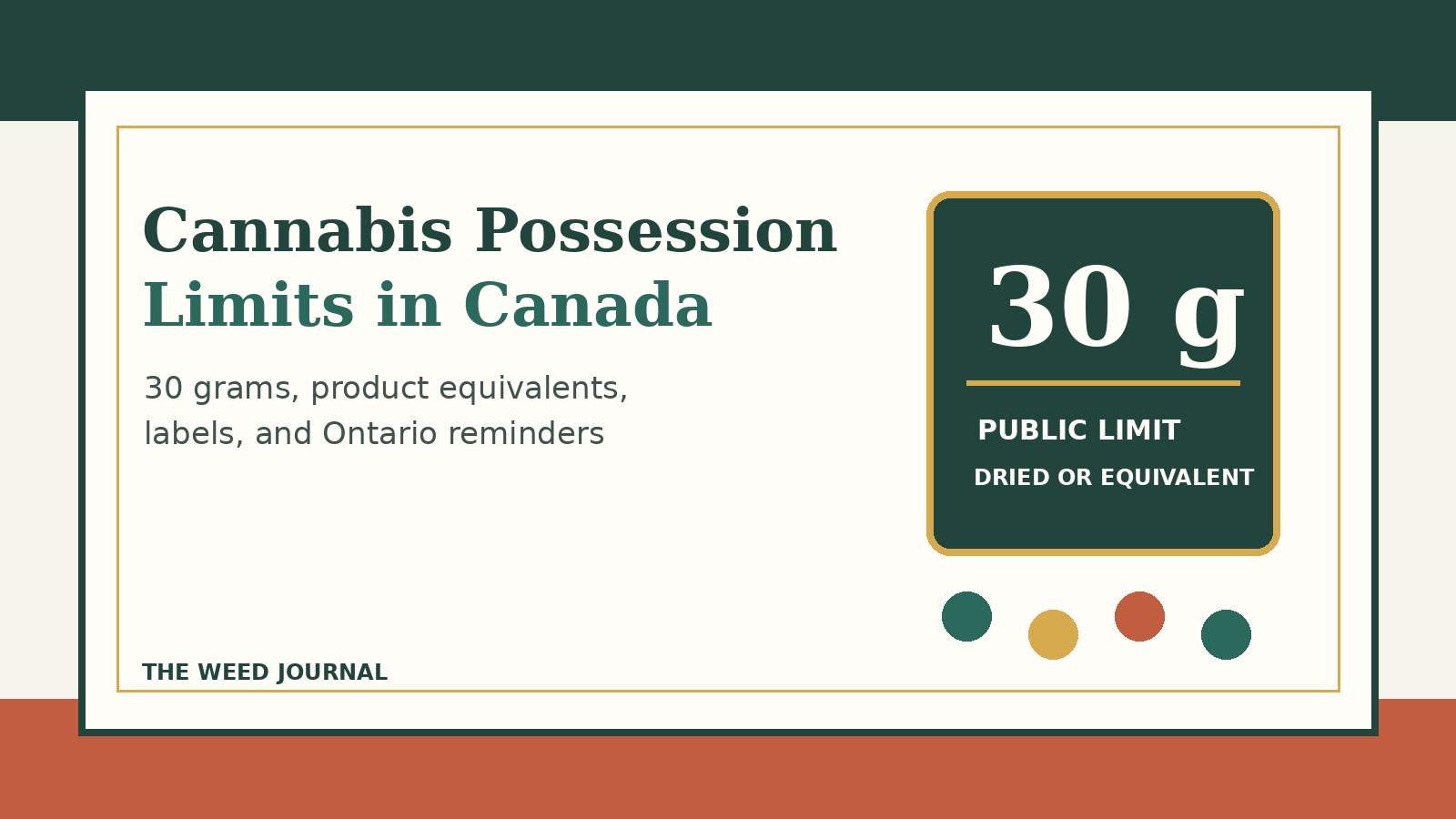
    Canada’s public possession limit for non-medical cannabis sounds simple: adults can generally carry up to 30 grams of dried legal cannabis, or the equivalent amount in other product forms. The confusing part is the word equivalent. A 30 gram flower pouch, a few cannabis drinks, a pack of edibles, seeds, and a small amount of concentrate are not counted the same way.

    This guide explains the federal 30 gram rule in plain language, how product equivalents work, what Ontario adults should remember, and what the limit does not cover. It is an educational overview, not legal advice. Provincial, territorial, municipal, medical-cannabis, workplace, housing, and travel rules can add extra limits.

    The Short Version

    • For non-medical cannabis, the federal public possession limit is 30 grams of dried cannabis or an equivalent amount in other cannabis classes.
    • The rule is about public possession. It is not a personal safety recommendation, a dosing guide, or permission to use cannabis anywhere.
    • Ontario sets the legal age at 19 for buying, using, possessing, and growing recreational cannabis.
    • Legal products should come from authorized retailers and have required packaging details such as an excise stamp, health warning, THC/CBD information, lot number, and packaging date.
    • Driving, crossing borders, sharing with youth, workplace use, and consuming in restricted places are separate legal issues.

    Cannabis Possession Equivalents in Canada

    Health Canada’s public possession calculator says an adult may possess up to 30 grams of dried cannabis, or its equivalent, in public for non-medical purposes. The equivalency system converts other product classes back to a dried-cannabis amount. That matters when you have mixed products in one bag, such as flower, drinks, gummies, and a vape cartridge.

    Product classFederal equivalencyApproximate amount equal to 30 g dried cannabisPlain-language note
    Dried cannabis1 g dried cannabis30 gThe familiar flower limit.
    Fresh cannabis5 g fresh cannabis = 1 g dried150 g fresh cannabisFresh material contains more moisture, so the allowed weight is higher.
    Cannabis solids at room temperature up to 3% THC15 g solid product = 1 g dried450 g solid productHealth Canada gives baked goods and some topical soaps as examples.
    Cannabis non-solids at room temperature up to 3% THC, excluding beverages70 g non-solid product = 1 g dried2,100 g non-solid productHealth Canada gives topical spray lotions as an example.
    Cannabis concentrates over 3% THC0.25 g concentrate = 1 g dried7.5 g concentrateThis can include products such as hash or vaping liquids.
    Cannabis beverages up to 3% THC570 g beverage = 1 g dried17,100 g beverageEquivalent weight is not the same thing as a low-risk amount to consume.
    Cannabis plant seeds1 seed = 1 g dried30 seedsGrowing rules are separate from public possession rules.
    Source: Health Canada’s public possession calculator. Use the official calculator when you are carrying a mix of product classes.

    The table is useful for understanding the rule, but it is not a shortcut for every situation. Health Canada’s own calculator warns that people remain responsible for the laws of the province or territory they are in. The calculator also is not meant for medical cannabis authorizations, where different public possession limits can apply.

    Why “30 Grams” Does Not Mean 30 Grams of Every Product

    The Cannabis Act uses dried cannabis as the baseline. Other cannabis classes are converted into a dried-cannabis equivalent because they have different water content, formats, and product characteristics. That is why 150 grams of fresh cannabis and 7.5 grams of concentrate can both point back to the same 30 gram dried-cannabis public limit.

    This is also why a product’s package weight does not tell the whole story. A 3.5 gram container of dried flower is simple. A drink, edible, topical, or concentrate needs more context: product class, net weight or volume, THC amount, and sometimes whether it is a beverage or another non-solid product. If a package is legal, the label should help you identify the product class and the net amount.

    If you are comparing different products before buying, our legal cannabis buying checklist for Canada is a better starting point than simply chasing the biggest package or strongest THC number. Legal status, label clarity, freshness, and product fit matter more than carrying as much as the law allows.

    A Practical Example

    Imagine an adult in Ontario is carrying 14 grams of dried flower, one small concentrate product, and several cannabis beverages. The dried flower uses 14 grams of the 30 gram dried-equivalent limit. A concentrate over 3% THC counts quickly because 0.25 grams of concentrate equals 1 gram dried. Beverages count differently again. The right answer depends on the exact product weights and classes, so the official calculator is the safer tool than mental math.

    The more mixed your products are, the easier it is to misjudge the total. This is especially true after shopping, when several product formats are still in their retail packaging. Keep receipts and packaging until you are home, and do not repackage products into unlabelled containers if you may need to show what they are.

    Do THC Milligrams Change the Possession Limit?

    THC amount matters for legal product rules, product strength, and personal risk, but the public possession equivalency table is not simply a “total THC in your bag” calculation. Health Canada’s legal-product guidance notes, for example, that edible cannabis is limited to 10 mg THC per container, while some extract categories have higher container limits. Those product limits are different from the public possession equivalency math.

    For personal use, do not treat the possession limit as a consumption target. A person could be within the public possession limit and still have far more THC than they should use in one day, one night, or one sitting. If edibles are involved, our edibles dose chart for Canada and edibles onset guide are more relevant than the possession-limit table.

    What Counts as Legal Cannabis?

    Justice Canada describes the adult public possession rule as applying to legal cannabis. Health Canada says legal non-medical products are sold only by retailers authorized by a province or territory. It also lists packaging cues that help shoppers recognize legal products, including an excise stamp, a standardized THC symbol where required, a yellow health warning, child-resistant packaging for most product types, and required label details.

    A legal product label should also show the product class, net weight or volume, number of units where applicable, recommended storage conditions, lot number, packaging date, contact information for the manufacturer, intended use, and THC/CBD quantity or concentration. That information is useful for more than compliance. It helps you compare products and catch quality issues. For deeper shopping context, see our guide to why THC percentage is not everything.

    Ontario Adults: What to Remember

    Ontario’s cannabis laws page says adults must be 19 or older to buy, use, possess, and grow recreational cannabis. It also repeats the maximum public possession amount as 30 grams, about one ounce, of dried cannabis or equivalent. That means an 18-year-old rule in a federal overview is not enough for an Ontario reader. In Ontario, the practical legal-age number is 19.

    Ontario rules around where cannabis can be used are also separate from how much can be possessed. You may be under the possession limit and still be in a place where smoking, vaping, or use is not allowed. Condo rules, lease terms, workplace policies, event rules, parks, campuses, hotels, and municipalities can add more restrictions. When in doubt, check the local rule before lighting, vaping, or opening an edible.

    What the Public Possession Limit Does Not Cover

    • Driving: Being under the possession limit does not make it safe or legal to drive after cannabis use. Read our cannabis and driving in Canada guide before making a ride plan.
    • International travel: Cannabis cannot be taken across the Canadian border, even when travelling to a place where cannabis is legal. See our guide to travelling with cannabis in Canada for the domestic-versus-border distinction.
    • Medical authorizations: Medical cannabis possession limits can differ from non-medical public possession limits.
    • Sharing and selling: Sharing with adults of legal age is not the same as selling. Selling requires proper licensing.
    • Home growing: Plant limits, seed rules, landlord rules, and provincial restrictions are separate from what you can carry in public.

    A Simple Carrying Checklist

    1. Confirm the product came from an authorized legal retailer.
    2. Keep products in original packaging while travelling home or carrying mixed formats.
    3. Check the product class, net weight or volume, and number of units.
    4. Use Health Canada’s calculator if you have more than one product class.
    5. Do not use the public possession limit as a dosing target.
    6. Keep cannabis away from children, pets, and anyone who should not access it.
    7. Plan transportation before consuming, especially with edibles, concentrates, or high-THC products.

    Bottom Line

    The 30 gram rule is a public possession limit, not a permission slip to ignore product labels, local rules, driving laws, or common sense. For most adults, the safest routine is simple: buy legal products, keep labels intact, carry less than you need to, use the official calculator for mixed formats, and separate possession from consumption. The law may let an adult carry a certain amount in public, but a good plan usually involves carrying less, storing it clearly, and using it cautiously.

    Sources

  • Cannabis and Driving in Canada: What Adults Should Know

    Cannabis and Driving in Canada: What Adults Should Know

    Legal cannabis does not make driving after cannabis legal. That is the simplest rule for adults in Canada, and it is the one worth remembering before any timing chart, THC percentage, or “I feel fine” guesswork. Cannabis can affect attention, reaction time, coordination, and judgment, and the safest driving plan is to separate cannabis use from driving entirely.

    This guide explains cannabis and driving in Canada in practical terms: what impairment means, why timing is hard to predict, how edibles and inhaled products differ, what Ontario drivers should know, and how to plan a lower-risk ride home. It is not legal advice, and it does not replace provincial or territorial rules.

    Quick answer

    Do not drive after using cannabis. In Canada, police can investigate drug-impaired driving, and drivers can face consequences including fines, criminal charges, licence suspensions, vehicle impoundment, or jail depending on the situation and jurisdiction. Cannabis effects vary by person, dose, format, tolerance, food, sleep, alcohol, and other drugs, so there is no reliable universal wait time that makes driving safe for everyone.

    If you have used cannabis and need to go somewhere, use a sober driver, transit, rideshare, taxi, walking plan, or overnight plan. If you are unsure whether you are impaired, treat that uncertainty as the answer: do not drive.

    Cannabis and driving at a glance

    Situation Why it matters Lower-risk choice
    Smoked or vaped cannabis Effects can be felt quickly, but impairment can outlast the first noticeable peak. Do not drive. Plan transport before using.
    Edibles, capsules, oils, or drinks Onset can be delayed and effects can last longer than expected. Do not drive the same outing; avoid redosing because “nothing happened yet.”
    High-THC product or concentrate Higher THC can increase impairment and unwanted effects. Choose lower THC when possible and keep driving off the schedule.
    Cannabis plus alcohol Combining substances can worsen impairment and judgment. Do not drive; arrange a sober ride.
    Young, novice, or commercial driver in Ontario Ontario applies zero-tolerance rules for cannabis detected in these driver groups. Do not use cannabis before driving; check current provincial rules.

    Legal does not mean drive-ready

    Canada legalized and regulates adult-use cannabis, but impaired driving remains illegal. Canada.ca warns that driving impaired by cannabis or other drugs can lead to serious consequences, including fines, criminal charges, or jail. The fact that a product was purchased legally does not protect a driver who is impaired behind the wheel.

    This distinction matters because cannabis marketing can make products feel ordinary. A legal edible, vape cartridge, dried flower product, oil, or beverage may be sold through a regulated retailer, labelled correctly, and still be completely incompatible with driving. Legal source helps with product safety and labelling; it does not make impairment safe.

    For source checks, use our legal cannabis buying checklist for Canada. For driving, use a stricter rule: if cannabis is part of the plan, driving should not be.

    How cannabis can affect driving

    Health Canada says cannabis can affect concentration, attention, coordination, and reaction time. Those are not abstract risks. They are exactly the skills drivers rely on when a pedestrian steps off a curb, traffic stops suddenly, weather changes, or another driver makes a mistake.

    Cannabis impairment is also easy to misread. Someone may feel relaxed, familiar with the route, or less “high” than they did earlier, but still be slower to respond. Confidence is not a driving test. Familiarity with cannabis is not the same as being safe to operate a vehicle.

    The risk is not limited to heavy use. A small amount can affect a new or occasional user more than expected. A higher-THC product can be too much for someone who normally uses lower-strength cannabis. A tolerance break can make a familiar dose feel stronger than it used to.

    Why wait-time rules are unreliable

    Readers often want a neat answer: “How many hours after cannabis can I drive?” The problem is that cannabis does not work on a universal clock. Inhaled products can be felt within minutes, while edibles and drinks may take much longer to show full effects. Body size, tolerance, THC amount, CBD amount, food, sleep, stress, and product type all change the experience.

    Health Canada’s lower-risk material notes that edible effects may be felt within 30 minutes to 2 hours and can take up to 4 hours to feel fully. Inhaled products can be felt in seconds to minutes and may take up to 30 minutes to feel the full effects. That timing difference is one reason edible redosing is risky, and it is also why driving plans should be made before using.

    For timing basics, see our guides on how long THC lasts in Canada and how long edibles take to kick in. For driving, the practical answer remains conservative: do not use cannabis when driving may be needed.

    Edibles and drinks deserve extra caution

    Edibles, capsules, oils, and cannabis drinks can be especially tricky because the delay can make people think they are not impaired yet, or not impaired anymore. A person may eat an edible at dinner, feel little at first, take more, then be much more impaired later when they expected to be going home.

    The risk is not only the first hour. Ingested cannabis can last long enough to affect the rest of the evening, and sometimes the next morning if the dose was high, the person slept poorly, or they are still feeling groggy. That does not mean every person is impaired the same way for the same length of time. It means a driving plan based on hope is weak planning.

    If you choose edibles or drinks, decide on transportation first. Keep the package so you can read the THC amount, avoid taking more too soon, and do not combine cannabis with alcohol because it can make impairment harder to judge.

    High THC and concentrates raise the stakes

    THC is the main intoxicating cannabinoid in cannabis. Higher THC does not automatically mean a better product, but it can mean stronger impairment. Health Canada’s lower-risk advice encourages lower-THC choices when possible and warns that certain extracts such as hash, kief, wax, or shatter can contain high THC concentrations.

    This matters for drivers because a small-looking amount can still be strong. A concentrate, high-THC vape, potent dried flower product, or large edible dose can be more than the person expected, especially if they are new, tired, stressed, or returning after a break. A product that feels efficient at home can be a poor choice before errands, work, school pickup, or any trip that might involve driving.

    If you want to understand potency without treating it as a quality score, read why THC percentage is not everything in Canada.

    Ontario: zero tolerance for some drivers

    Rules differ by province and territory, so drivers should check the rules where they live and travel. In Ontario, the provincial cannabis-and-driving page says there is zero tolerance for young, novice, and commercial drivers. Ontario explains this as cannabis detected in the system for those driver groups, similar in practical seriousness to alcohol rules for restricted drivers.

    That is important for G1, G2, M1, M2, young drivers, and commercial drivers. “I do not feel high” is not a reliable defence strategy, and it is not a safety strategy. If your licence class or job puts you under a stricter standard, keep cannabis and driving completely separate.

    Other provinces and territories may set different administrative rules, roadside processes, or sanctions. When in doubt, check the current official provincial or territorial page before relying on something a friend, forum, or seller told you.

    What about medical cannabis?

    Medical authorization does not create permission to drive impaired. A person using cannabis for medical reasons still has to consider impairment, product type, dose, timing, workplace rules, licence class, and safety-sensitive duties. If a health professional is involved in your cannabis use, ask direct questions about driving, work, medication interactions, and next-day impairment.

    Do not assume CBD-heavy products are automatically drive-safe either. CBD does not produce the same intoxication as THC, but products can still contain THC, affect people differently, or interact with other substances. Read the label, understand the product, and avoid driving if you feel altered, sleepy, slowed, dizzy, anxious, or unsure.

    A practical no-driving plan

    • Decide before using. If cannabis is part of the plan, choose a sober ride before the package is opened.
    • Keep your keys out of the decision. Leave the vehicle at home when possible.
    • Use one transport backup. Taxi, rideshare, transit, walking route, sober friend, or overnight stay.
    • Avoid alcohol mixing. Combining alcohol and cannabis can make impairment harder to judge.
    • Read the THC amount. Know the dose or concentration before you use anything.
    • Do not chase edibles. Wait long enough; do not take more because effects are delayed.
    • Watch the next morning. Grogginess, poor sleep, or lingering effects mean no driving.
    • Protect other people. Do not let an impaired friend talk themselves into driving.

    If someone is too high and planned to drive

    Do not debate whether they are “fine.” Move the conversation to options: take their keys if you can do so safely, call a sober ride, stay with them, get food and water nearby, or help them wait somewhere calm. If they are panicking, vomiting repeatedly, having chest pain, losing consciousness, behaving dangerously, or you are worried about their safety, seek urgent medical help.

    For non-emergency overconsumption support, our guide on what to do when you are too high gives practical steps. The driving rule is simpler: the person does not drive today.

    How common is driving after cannabis use?

    Health Canada’s 2024 cannabis survey key findings reported that 18% of people in Canada who consumed cannabis in the past year said they drove after cannabis use. That was lower than 2018 but higher than 2023. The same report said 16% reported driving within 2 hours of smoking or vaporizing cannabis, and 10% reported driving within 4 hours of ingesting cannabis.

    Those numbers are a useful reminder that this is not a niche issue. Plenty of adults understand cannabis can impair driving in theory, yet still make risky choices when timing, convenience, confidence, or social pressure gets involved. The fix is not a better self-test. The fix is a better plan before using.

    Bottom line

    Cannabis and driving should be kept separate. Legal cannabis can still impair attention, coordination, reaction time, and judgment. Effects vary too much for a universal wait-time promise, and edibles, drinks, high-THC products, concentrates, alcohol mixing, and fatigue can make the situation harder to judge.

    If you use cannabis, make transportation part of the purchase and consumption plan. Read the label, choose lower-risk products when possible, avoid mixing substances, and do not drive when you have used cannabis or when you are unsure. The safest driving decision is the one made before impairment has a vote.

    Sources

  • Budget vs Premium Cannabis in Canada: What Matters

    Budget vs Premium Cannabis in Canada: What Matters

    Budget cannabis can be a smart buy in Canada. Premium cannabis can also be worth paying for. The problem is that neither word tells you much by itself. A low price can hide old flower, weak packaging, or a format that does not fit your use. A high price can hide ordinary cannabis behind nicer branding.

    This guide gives adult shoppers a practical way to compare budget and premium cannabis without treating THC percentage as the whole decision. It is Canada-aware, label-first, and intentionally cautious: no product type is automatically safer or better for everyone, and this is not medical advice.

    Quick answer

    The best value is the product that fits your tolerance, format preference, freshness expectations, label needs, and budget. Budget cannabis is often a better choice for experienced shoppers who know what they like and can read labels closely. Premium cannabis may be worth it when freshness, aroma, terpene information, small-batch handling, or product consistency clearly improve the experience. In both cases, buy legal, check the label, and avoid shopping by THC percentage alone.

    Budget vs premium cannabis at a glance

    Comparison point Budget cannabis Premium cannabis What to check
    Price Lower cost per gram, unit, or package. Higher price because of brand, format, batch size, handling, or perceived quality. Compare value by usable fit, not just sticker price.
    THC percentage May still be high, especially in dried flower or concentrates. May be high, moderate, or balanced. Total THC matters, but higher is not automatically better.
    Freshness Can be fresh, but older packages may be more common in clearance or value bins. Often marketed around freshness, aroma, and craft handling. Look for packaging date, lot details, seal quality, smell after opening, and texture.
    Label detail Sometimes simple, sometimes very complete. Often more detailed, but not always. Read Total THC, Total CBD, ingredients, allergens, warnings, and directions.
    Best use case Everyday shoppers who already understand their tolerance and product preferences. Shoppers who care about aroma, flavour, terpene profile, specific format, or consistency. Choose by purpose: occasional, social, low-dose, format-specific, or aroma-focused.

    Start with legal source, not price tier

    Before comparing budget and premium, confirm the product comes through a legal Canadian source. Health Canada continues to warn that illegal cannabis products are still sold and consumed in Canada. Legal products have required packaging, labelling, child-resistant features, warning information, and a regulated supply chain that illegal sellers may not provide.

    That does not mean every legal product is perfect. It means the baseline comparison is fairer. If one seller cannot show a legal retailer trail, a proper package, clear THC/CBD information, and ordinary consumer protections, the price tier is a distraction. Our legal cannabis buying checklist for Canada is the first page to use when the source itself is uncertain.

    Do not treat THC as the value score

    One of the most common buying mistakes is comparing products by the biggest THC number per dollar. Health Canada explains that THC is responsible for intoxication, and that harmful effects may be greater when THC strength is higher. Higher potency can also make a product less useful if it pushes you past the experience you actually wanted.

    This is especially important when comparing a budget eighth against a premium eighth. A cheaper high-THC flower is not necessarily a better deal if it feels harsh, stale, too strong, or hard to dose. A premium flower is not necessarily better just because it also has a high number. THC percentage is one useful label fact, not the verdict.

    If you want a deeper explanation, read our guide on why THC percentage is not everything in Canada. For today’s shopping decision, the shortcut is simple: match potency to your tolerance and setting before you compare price.

    Read the label like a buyer, not a collector

    Health Canada’s cannabis label guidance says legal labels provide health and safety information that can help reduce harm. For shoppers, that turns the label into the most practical comparison tool. You do not need to know every technical term. You do need to slow down long enough to check the basics.

    Look for Total THC, Total CBD, package date, lot number, net weight or volume, directions for use, warnings, ingredients, and allergens where relevant. For inhaled products, check the format and any hardware requirements. For edibles and oils, check the amount per unit, not just the amount in the whole package.

    A premium-looking label that hides basic information is not shopper-friendly. A budget label that is clear, current, and easy to understand may be a better practical buy. Our Canadian cannabis label guide explains those fields in more detail.

    When budget cannabis can make sense

    Budget cannabis can be a good fit when the product is legal, clearly labelled, reasonably fresh, and aligned with your tolerance. Some value products are simply larger batches, simpler packaging, older brand lines, or lower-margin offerings. A lower price does not automatically mean poor quality.

    Budget flower may make sense for shoppers who use a dry herb vaporizer, roll regularly, cook with legal dried cannabis where permitted, or already know they prefer a certain THC/CBD range. Budget edibles or beverages may make sense when the serving size is clear and the product fits your routine. Budget CBD products may be reasonable when the label is clear and the cannabinoid amount is easy to compare.

    The warning is that budget buying punishes guesswork. If you are new, sensitive to THC, returning after a tolerance break, or shopping for a format you have never used, the cheapest option is not always the lower-risk option. Paying less for a product that is too strong, confusing, or stale is not value.

    When premium cannabis may be worth it

    Premium cannabis may be worth paying for when the extra cost buys something you can actually evaluate: fresher flower, better trim, stronger aroma, more complete terpene information, cleaner handling, format reliability, or a more consistent experience across purchases. The word “premium” should point to evidence, not just packaging.

    For dried flower, useful evidence can include a recent packaging date, good texture, intact aroma after opening, visible care in trim and cure, and label details that match the product story. For vape cartridges, premium should mean clear ingredients, reliable hardware compatibility, appropriate warnings, and no mystery additives. For oils, capsules, or edibles, premium should mean precise serving information, consistency, and clear ingredients.

    Premium is less persuasive when it leans on vague language. “Craft,” “top shelf,” “exclusive,” “reserve,” and “small batch” may describe real differences, but they do not replace label facts. If the product cannot tell you what is in it, how strong it is, how to use it, and when it was packaged, the brand language is doing too much work.

    Freshness is where price tiers often separate

    Freshness is not just a luxury concern. Dry, old, or poorly stored cannabis can smell flat, feel brittle, burn or vape harshly, and make the purchase feel disappointing even if the THC number looked attractive. Yesterday’s storage guide covered why light, heat, air, and moisture matter after purchase; the same logic matters before purchase too.

    When comparing two flower products, check the package date and ask whether the retailer can explain storage basics. Once opened, look for aroma, texture, and obvious signs of age or damage. Cannabis should not be wet, moldy, dusty, or suspiciously perfumed. If flower seems wrong, do not try to rescue it by using more.

    For a buyer-friendly freshness pass, use our fresh cannabis flower checklist. For after-purchase handling, see how to store cannabis in Canada.

    Format changes the value calculation

    Budget vs premium looks different across flower, vapes, edibles, oils, beverages, and concentrates. A cheap flower product may be easy to portion if you know your tolerance. A cheap vape cartridge with unclear ingredients or poor hardware fit can be a bad risk. A premium edible with the same THC per unit as a budget edible may not be meaningfully different if ingredients and serving size are similar.

    Compare products inside the same format first. Dried flower competes with dried flower. A vape cartridge should be compared with other cartridges that use compatible hardware and clear ingredients. Edibles should be compared by THC per unit, CBD amount, ingredients, onset expectations, and serving control. Concentrates should be compared even more carefully because small amounts can carry high THC exposure.

    If you are choosing between formats, step back to the larger product-type decision. Our Cannabis 101 product type guide is a better starting point than a price comparison when the format itself is undecided.

    A practical value checklist

    • Confirm the source. Legal Canadian retailer or proper medical channel first.
    • Match the format to your use. Do not buy a product type you do not understand just because it is discounted.
    • Check Total THC and Total CBD. Choose a strength that fits your tolerance and setting.
    • Read the package date. Especially for dried flower and products where freshness affects aroma or texture.
    • Inspect ingredients. Important for edibles, oils, vapes, beverages, capsules, and allergies.
    • Compare serving control. Products that are easy to portion are often better value for cautious users.
    • Ignore vague prestige words. Premium should mean clear evidence, not just nicer branding.
    • Plan storage. A good purchase can become a poor one if it is left in heat, light, or open air.

    Red flags in both budget and premium products

    Some warning signs apply at every price. Be cautious with missing or unclear label details, unrealistic health claims, cartoonish illegal-style branding, damaged packaging, no legal source trail, vague ingredients, pressure to buy quickly, or claims that a product is “safe” because it is natural. Cannabis is a psychoactive product; natural does not mean risk-free.

    Also be careful with products that make the experience sound guaranteed. Cannabis effects vary by person, tolerance, setting, product format, and other substances. A product cannot promise relaxation, sleep, creativity, pain relief, or anxiety relief for everyone. Those claims are especially risky when they encourage a shopper to ignore dose, potency, or personal health context.

    How to compare two products in the store

    Use a simple four-step scan. First, confirm both products are legal and in the same category. Second, compare Total THC, Total CBD, package size, and serving size. Third, compare freshness and label clarity. Fourth, ask what the higher price or lower price actually changes for you.

    Here is an example: Product A is cheaper flower with high THC, an older package date, and little terpene detail. Product B costs more, has moderate THC, a recent package date, and clearer aroma information. The right answer depends on the buyer. Someone seeking low-cost, familiar flower may choose Product A. Someone who values freshness and a less intense session may choose Product B. Neither decision should be based on the price tag alone.

    Keep notes after purchase if you use cannabis more than occasionally. Product name, format, THC/CBD, amount used, time, food or alcohol context, setting, and how it felt can teach you more than brand language. Over time, those notes make both budget and premium shopping easier.

    Bottom line

    Budget cannabis is not automatically low quality, and premium cannabis is not automatically better. In Canada, the stronger shopping habit is to buy legal, read the label, match potency to your tolerance, check freshness, and compare products by use case.

    If a cheaper product is clear, fresh enough, legal, and easy for you to use responsibly, it may be good value. If a premium product gives you better freshness, clearer information, better format reliability, or a more suitable potency, it may be worth the extra cost. The best buy is the one you can understand before you open it.

    Sources